.png?width=375&height=100&name=WebPage%20logo%20with%20curves%202026%20(8).png)
Categorizing Galaxies
"Categorize galaxies as spiral, elliptical, and irregular and locate Earth’s solar system within the Milky Way galaxy."
💡 What This Standard Actually Means
"Categorize" and "locate". This standard has two parts. First, students categorize galaxies as spiral, elliptical, and irregular based on their shape and structure. Second, students locate Earth's solar system within the Milky Way galaxy. There is no calculating distances or deriving formulas. Students should be able to look at an image of a galaxy, name its category, and explain the features that put it there. Then they can point to where our solar system sits within the Milky Way, out on one of the spiral arms rather than at the center. Instruction can take many forms, such as galaxy image sorts, labeled diagrams, and Milky Way maps that mark our solar system's position.
A galaxy is a massive system held together by gravity. It contains billions of stars along with gas, dust, and dark matter. When astronomers started photographing galaxies in detail, they noticed that most of them fall into three main shapes.
Spiral galaxies have a central bulge with flat arms that curve outward, like a pinwheel. The arms contain bands of bright, young stars along with gas and dust, which is why spirals still actively form new stars. The Milky Way is a spiral, and more specifically a barred spiral, with a straight bar of stars running through its center. Our neighbor Andromeda (M31) is also a barred spiral galaxy, the same Hubble type as the Milky Way, and it's about 2.5 million light-years away. Elliptical galaxies look like smooth, fuzzy ovals or spheres. They tend to hold older stars and less gas and dust, so new star formation is limited compared to spirals. Irregular galaxies don't fit either pattern. They can look chaotic or lopsided, often because of gravitational interactions with nearby galaxies.
Edwin Hubble organized these shapes into what astronomers call the tuning fork diagram, with ellipticals on the handle and spirals (regular and barred) on the two prongs. Galaxies also cluster together. The Milky Way, Andromeda, and dozens of smaller galaxies make up the Local Group, which is part of a larger structure of clusters and superclusters. The Milky Way and Andromeda are on a collision course and are long predicted to merge in roughly 4 to 5 billion years, though recent measurements from the Hubble Space Telescope and the Gaia satellite suggest the timing is less certain than once thought.
The trick I leaned on for this one was image-first, vocabulary-second. I'd put ten actual Hubble or James Webb photos up on the board with no labels and have kids sort them into piles. They'd usually land on three groups naturally: pinwheels, blobs, and "weird ones." Then I'd drop in the real terminology: spiral, elliptical, irregular. Because they'd already noticed the patterns, the names stuck. We'd finish by pinning up a photo of the Milky Way (artist rendering, since we can't photograph ourselves) and identifying which pile we live in.
⚠️ Misconceptions Your Students May Have
These are some of the most common misconceptions. Knowing what to look for can help you get ahead of them.
"The Milky Way and the solar system are the same thing"
The solar system is the Sun and everything that orbits it, which is a tiny neighborhood compared to our galaxy. The Milky Way is the whole galaxy: hundreds of billions of stars, including the Sun, all held together by gravity. Our entire solar system is just one dot on one arm of the Milky Way spiral.
"All galaxies look like spirals"
Spirals get most of the attention in textbooks because they photograph well, but they're only one of three main types. Elliptical galaxies are smooth and oval-shaped and hold a large share of the universe's stars. Irregular galaxies have no clear shape, often because of past interactions with other galaxies. Showing students real images of each helps break the "all galaxies are pinwheels" assumption.
"A galaxy is the same thing as a star cluster"
A star cluster is a group of thousands (sometimes hundreds of thousands) of stars bound together. A galaxy is vastly larger, containing hundreds of billions of stars along with gas, dust, and dark matter. Star clusters are structures found inside galaxies, not replacements for them.
"Galaxies are just randomly scattered through space"
Galaxies tend to gather in groups and clusters due to gravity. The Milky Way belongs to the Local Group, which includes Andromeda and many smaller galaxies. The Local Group is part of the larger Virgo Supercluster. On the largest scales, galaxies are organized in a web-like structure with vast empty regions between filaments.
📓 Teaching Resources for 8.9B
These resources are aligned to this standard.


100% Aligned Lessons for Every TEKS You Teach
Kesler Science Plus puts thousands of ready-to-teach lessons and activities in your hands, so you can boost engagement and get your planning time back. Trusted by schools and districts all over the great state of Texas.
🌎 Phenomenon Ideas for 8.9B
Use these real-world phenomena to anchor your lesson. Show students the phenomenon first, let them wonder, then build toward Categorizing Galaxies as the explanation.
The Band of Light Across the Night Sky
From a dark-sky location, a hazy band of light stretches across the sky. People have seen it for thousands of years and called it everything from a river to a spill of milk. When Galileo pointed the first telescope at it, he saw the "haze" was actually made up of countless stars. That band is what we see when we look across our own galaxy, edge-on, from inside.
"If we live inside the Milky Way, how can we tell what shape it is? What would it look like from the side? What would it look like from above?"
Andromeda Is Coming Toward Us
Andromeda (M31) is about 2.5 million light-years from Earth, and it's currently heading in our direction at roughly 110 kilometers per second. Astronomers predict it will collide and eventually merge with the Milky Way in about 4.5 billion years. Both are spiral galaxies, but the result of their merger is expected to be a much different shape.
"If two spiral galaxies merge, what category do you think the new galaxy might end up in? What could we look at to make that prediction?"
Hubble and Webb Deep Field Images
In 1995, Hubble pointed at a tiny dark patch of sky about the size of a grain of sand held at arm's length. After days of exposure, the resulting image revealed thousands of galaxies in that single spot. The James Webb Space Telescope has taken similar images at even higher detail. Every pinpoint of light in those deep field photos is a galaxy, and they come in a huge range of shapes.
"Look at a Hubble Deep Field image. How many different galaxy shapes can you identify? Which ones look like our Milky Way, and which look different?"
💡 Free Engagement Ideas for 8.9B
Ready-to-run activities you can drop straight into a lesson. Where one of these looks like a phenomenon from the section above, that is on purpose: show it first as the hook, then let students run it themselves.
Galaxy Photo Sort
Print 12 to 15 real galaxy images from NASA (free, high resolution). Don't label them. Hand a set to each group and have them sort the photos into three piles using only what they see. After sorting, reveal the names (spiral, elliptical, irregular) and have groups justify their placements. This surfaces the patterns before front-loading the vocabulary.
Pipe Cleaner Tuning Fork
Build one large tuning-fork diagram on the board or chart paper (handle for elliptical, one arm for spiral, the other arm for barred spiral, with irregulars off to the side). Give each student a pipe cleaner to bend into one galaxy shape, then have them tape it onto the correct branch of the class diagram. Quick, cheap, and the physical model sticks.
Coffee and Cream Spiral Demo
Fill a clear cup with coffee or dark water. Slowly pour in a bit of cream or milk while gently stirring in one direction. As the cream swirls, point out the spiral-like arms that briefly form. Use this as a low-stakes visual for how rotation and gravity can produce spiral structure in galaxies (with the clear note that it's an analogy, not a physical match).
Build a Map of the Local Group
Tape a large sheet of butcher paper to the floor. Place a labeled dot for the Milky Way in the center. Add labeled dots for Andromeda (M31), the Triangulum Galaxy (M33), and a handful of satellite galaxies (Large and Small Magellanic Clouds). Use simple distance scaling (1 cm equals 100,000 light-years) so the layout is roughly accurate. Students walk around the map and see that galaxies cluster, not scatter.
🎯 What Approaches, Meets, and Masters Thinking Look Like
Here is what student thinking at each level looks like on this one task, so you know what to look for and how to move a student up.
A student is shown three real galaxy photos: a pinwheel-shaped galaxy with curving arms, a smooth fuzzy oval, and a lopsided, no-clear-shape galaxy. Categorize each one as spiral, elliptical, or irregular, and explain the features that put it in that category. Then draw a simple map of the Milky Way and mark where Earth's solar system is located within it.
- The pinwheel galaxy categorized as spiral, with a reason tied to its features (a central bulge and arms that curve outward).
- The smooth oval categorized as elliptical, described as a smooth, fuzzy ball or oval with no arms.
- The lopsided one categorized as irregular, described as having no clear shape.
- Reasons that come from what the galaxy looks like (shape and structure), not just the category name repeated back.
- A Milky Way drawn as a spiral with the solar system marked out on one of the arms, not at the center (putting Earth at the middle of the galaxy is the easiest place to slip).
- A clear sense that the solar system is one tiny dot inside the much larger Milky Way, not the same thing as the galaxy.
The first one is a spiral because it has arms like a pinwheel. The second one is elliptical because it's a smooth oval. The third one is irregular because it has no shape. For the Milky Way, our solar system is in the middle of the galaxy because that's where Earth is.
The first galaxy is spiral because it has a bright center and arms that curve out from it like a pinwheel. The second is elliptical because it's a smooth, fuzzy oval with no arms. The third is irregular because it has no clear shape, it just looks lopsided. The Milky Way is a spiral galaxy, and our solar system is out on one of the spiral arms, not in the center. The solar system is just a tiny part of the whole galaxy.
The categories come from shape and structure. Spirals have a bright bulge with arms curving out, and they still make new stars in those dusty arms. Ellipticals are smooth ovals with older stars and little gas, so they form fewer new ones. Irregulars have no set shape. The Milky Way is a spiral, and our solar system sits out on one of the arms, a tiny dot in a galaxy of hundreds of billions of stars, nowhere near the center.
So if I'm handed a new photo of a galaxy that looks stretched and lopsided with a stream of stars reaching toward a neighbor, I'd call it irregular. It doesn't have the smooth oval of an elliptical or the neat arms of a spiral. The lopsided look usually means another galaxy's gravity has been tugging on it and pulled it out of shape.
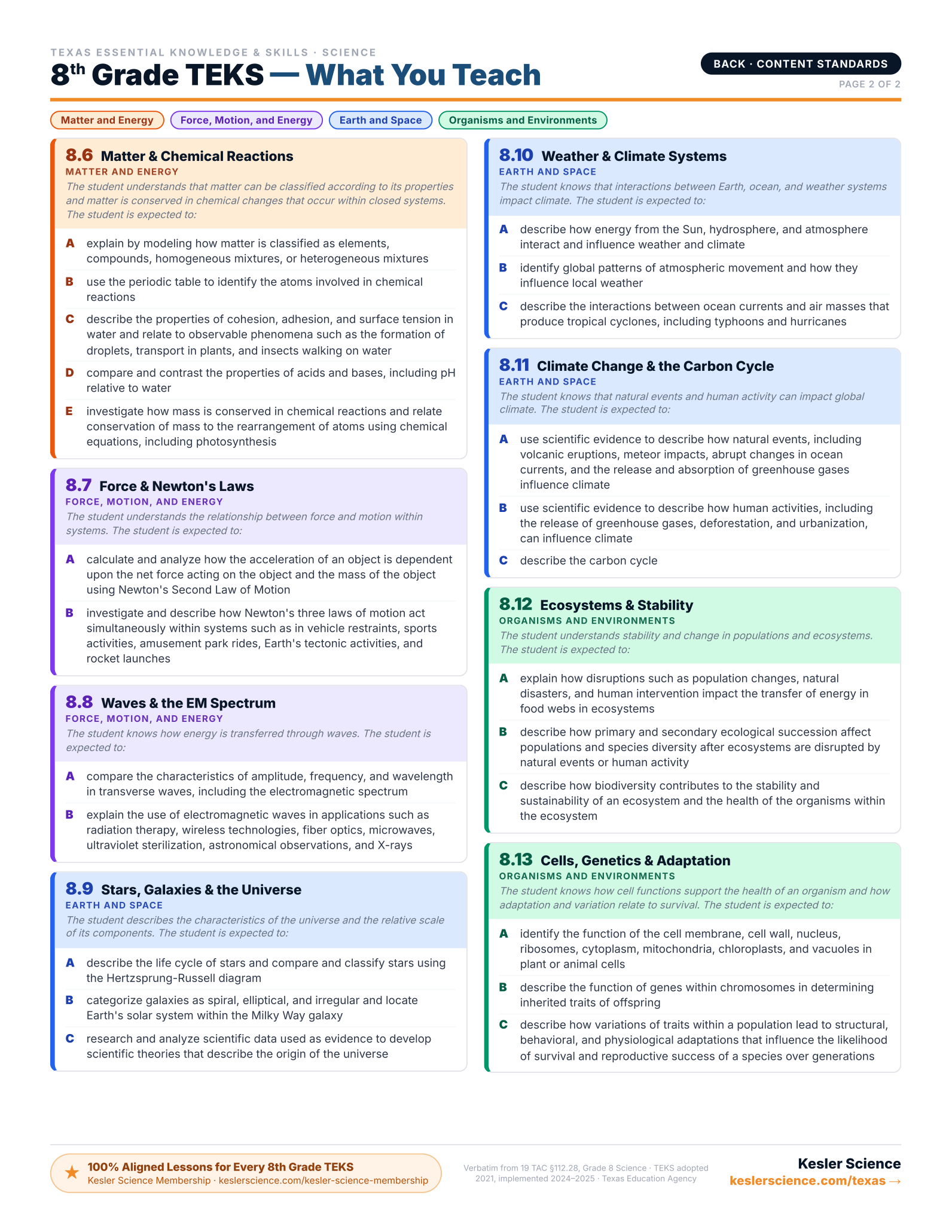
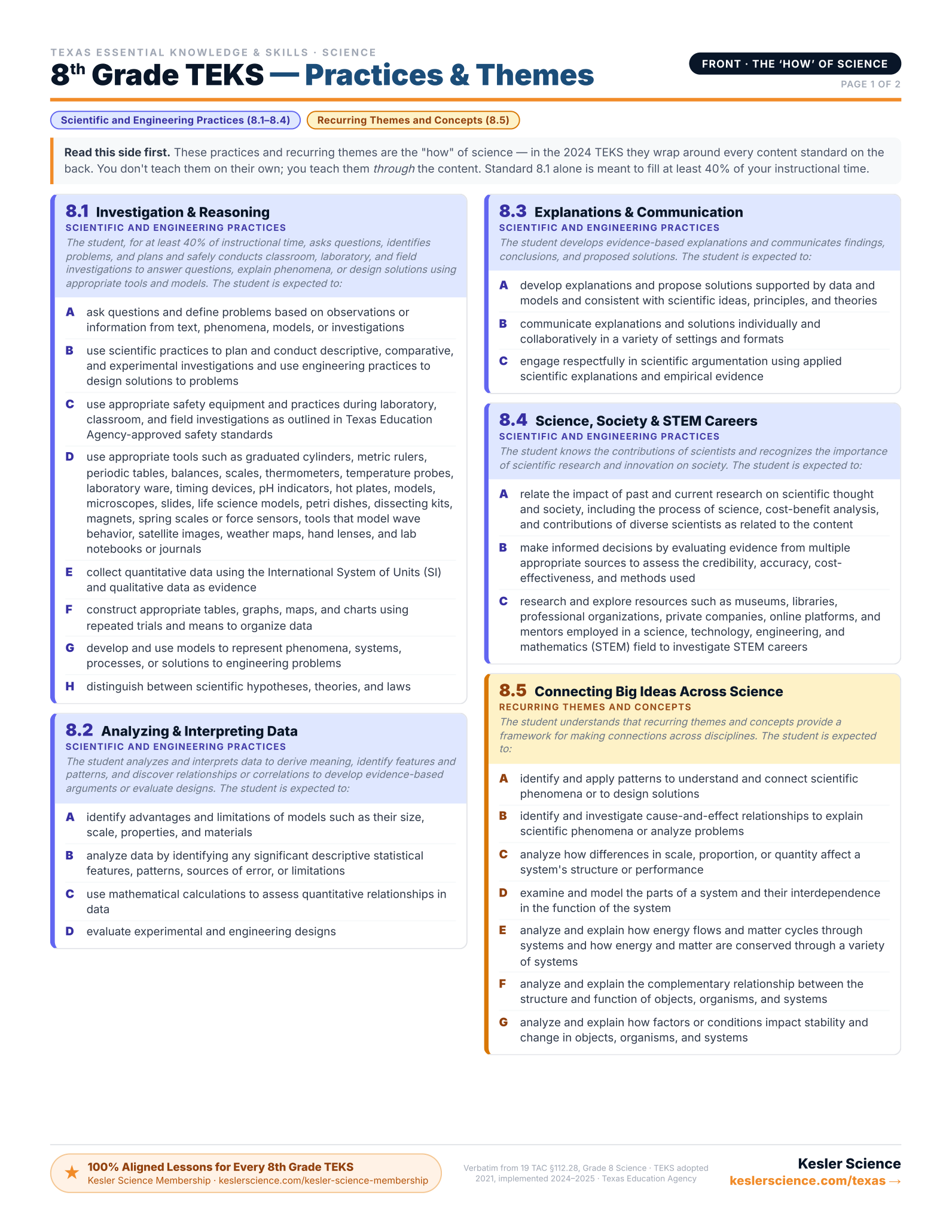
Every 8th-Grade Science TEKS on One Page
The color-coded, front-and-back cheat sheet I wish I'd had — every standard, organized by reporting category. Print it and reference it all year long. This will be your new favorite document!
Trusted Across Texas
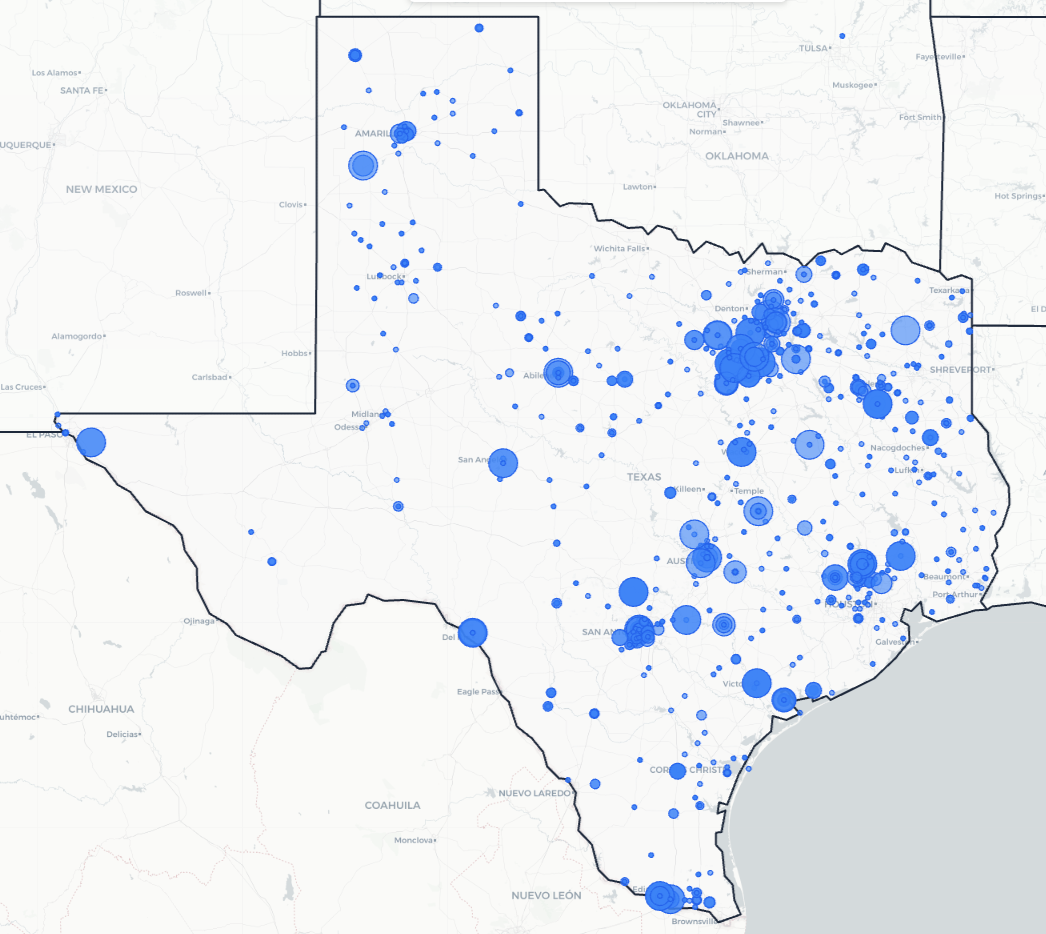
From the Rio Grande Valley to the Panhandle, Texas science teachers are using Kesler Science to save time and engage students.
Texas Schools and Districts
Love Kesler Science
What Teachers Are Saying
Give Your Science Teachers Everything They Need
School and district licenses give your teachers access to every resource they need, including station labs, inquiry labs, anchoring phenomena, presentations, escape rooms, and much more. One purchase covers the grade levels you need.
- PO-friendly. We accept purchase orders
- Volume discounts for 11+ teachers
- Complimentary Kesler Science Plus orientation for 4+ teachers
- Three free implementation PD sessions for departments of 11+
- Aligned to the 2024 TEKS standards


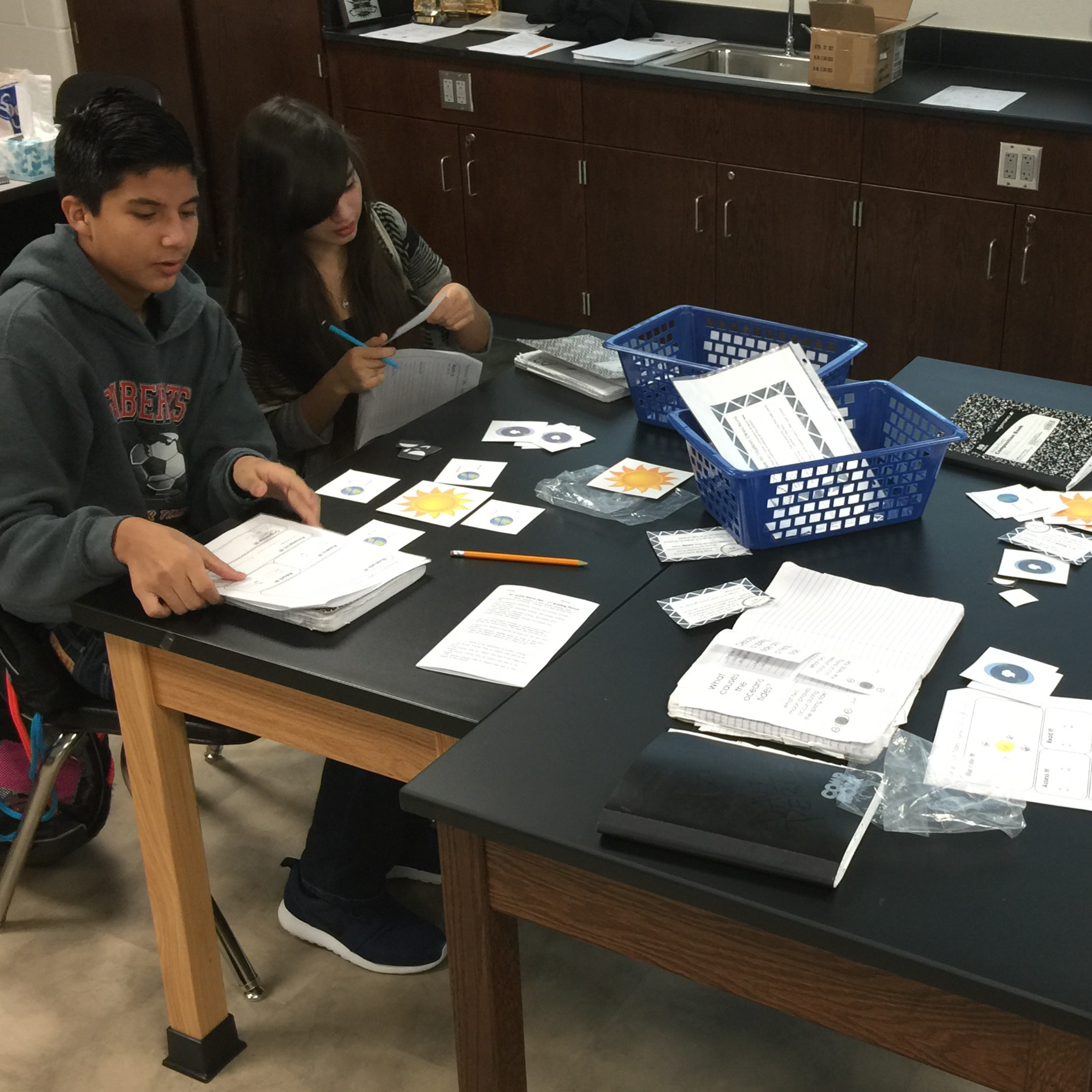
See It in Action
Book a walkthrough and we'll show you how Kesler Science fits your campus.
Book Demo CallNo pressure, no hard sell