.png?width=375&height=100&name=WebPage%20logo%20with%20curves%202026%20(8).png)
Periodic Table & Reactions
"Use the periodic table to identify the atoms involved in chemical reactions."
💡 What This Standard Actually Means
"Use the periodic table to identify". Students look at a chemical formula or equation, pick out the element symbols, and use the periodic table to identify which atoms are participating in the reaction. The elements they work with are the ones already on the table itself, identified by their symbols (H, O, Na, Cl, Fe, C, and so on). Students should be able to read a formula like H2O and say, "That's two hydrogen atoms and one oxygen atom," then point to each one on the table. Instruction can take many forms, such as atom-hunt activities, formula decoding, equation labeling, and giant wall periodic tables that students physically reference during reactions.
This standard is about fluency. When a chemical reaction shows up in print or on a board, students need to be able to read it. The periodic table is the tool that turns those letters and numbers into actual atoms students can name and locate. Every element symbol on a chemical equation comes directly from the table, and the table tells you the element's name, its atomic number, and its atomic mass.
To do this well, students need to read both chemical formulas (like H2O or CO2) and chemical equations (like 2H2 + O2 → 2H2O). They count atoms using subscripts (the small numbers inside a formula that tell you how many of that element are in one molecule) and coefficients (the big numbers in front that multiply the whole formula). They locate each symbol on the periodic table and identify the actual element. Some symbols are easy (H is hydrogen, O is oxygen) and some come from Latin names (Na is sodium from natrium, Fe is iron from ferrum, Au is gold from aurum). The table is the key.
The core understanding students should walk away with is that a chemical equation is not a string of letters to memorize. Each symbol points to a real atom on the periodic table, and the formula tells you exactly how many of each are involved. Once students can read an equation that way, the rest of chemistry opens up.
I learned the hard way that students will memorize "H2O is water" without ever connecting the H to hydrogen on the periodic table. So I started doing what I called the atom hunt. I'd write a reaction on the board (something simple, like iron rusting: Fe + O2 → Fe2O3) and pass out paper periodic tables. Before we talked about the reaction at all, every student had to circle every atom symbol from that equation on their own table and write the full element name next to it. Sounds basic. But the first time I did it, kids were genuinely surprised that Fe meant iron. After a few weeks of starting every reaction that way, they stopped seeing chemistry as a foreign language and started seeing the periodic table as the dictionary it actually is.
⚠️ Misconceptions Your Students May Have
These are some of the most common misconceptions. Knowing what to look for can help you get ahead of them.
"The big number in front and the little number inside mean the same thing"
They count atoms in different ways. The subscript (the small number inside a formula) tells you how many atoms of that one element are in a single molecule. So H2O has two hydrogens and one oxygen. The coefficient (the big number in front) multiplies the whole formula. So 3H2O means three water molecules total, which is six hydrogens and three oxygens. Mixing them up is one of the most common counting errors students make.
"Element symbols are just letter abbreviations of the English name"
Some are. H is hydrogen, O is oxygen, Ca is calcium. But several common ones come from Latin or Greek names and don't match the English word at all. Na is sodium (from natrium). Fe is iron (from ferrum). Au is gold (from aurum). K is potassium (from kalium). Pb is lead (from plumbum). The periodic table is the only reliable way to look up what a symbol actually represents.
"Any equation written on the board is automatically balanced"
An equation isn't balanced just because it's written down. To be balanced, every element on the left side has to have the same total number of atoms as it does on the right side. Students need to count atoms using the periodic table to verify it. Identifying the atoms is the first step. Counting them on each side is the next step that confirms whether the equation is balanced or still needs work.
"You can read a chemical formula however you want"
Chemical formulas follow specific rules. Capital letters start a new element symbol. A lowercase letter is part of the symbol right before it. CO is carbon and oxygen (carbon monoxide), but Co is the single element cobalt. A capital letter followed by a number means that count of one element. Students who guess at how to read symbols will routinely confuse two completely different substances. The periodic table sets the rules, not the reader.
📓 Teaching Resources for 8.6B
These resources are aligned to this standard.


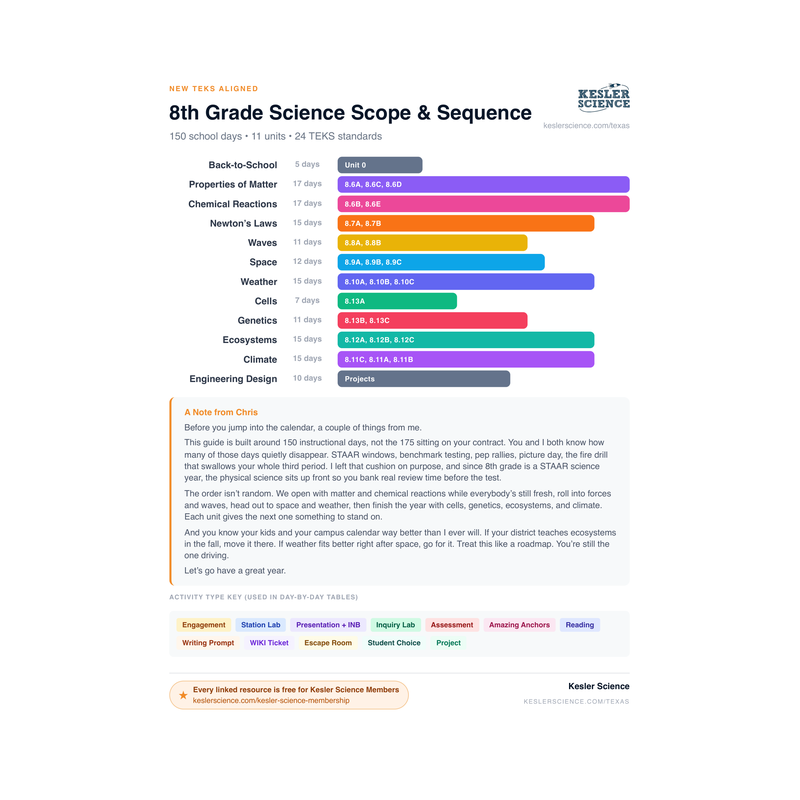
100% Aligned Lessons for Every TEKS You Teach
Kesler Science Plus puts thousands of ready-to-teach lessons and activities in your hands, so you can boost engagement and get your planning time back. Trusted by schools and districts all over the great state of Texas.
🌎 Phenomenon Ideas for 8.6B
Use these real-world phenomena to anchor your lesson. Show students the phenomenon first, let them wonder, then build toward Periodic Table & Reactions as the explanation.
Rust on a Bike Frame
A bike left out in the rain over a few weeks ends up coated in flaky red-brown rust. The balanced chemical equation for that reaction is 4Fe + 3O2 → 2Fe2O3. The Fe is iron from the bike frame. The O2 is oxygen from the air. The product, Fe2O3, is iron oxide, the rust itself. Two simple symbols on the periodic table, one familiar everyday reaction.
"Find Fe and O on the periodic table. What are the full element names, and where do they sit? How many atoms of each are in the reactants of this equation?"
Burning a Candle
A lit candle goes through a chemical reaction every second it burns. The wax (mostly long carbon-and-hydrogen chains) reacts with oxygen from the air to make carbon dioxide and water vapor. A simplified version uses methane (natural gas) as a stand-in for the longer wax molecules: CH4 + 2O2 → CO2 + 2H2O. Three different elements show up in this reaction, all of them sitting close together on the right side of the periodic table.
"Use the periodic table to identify every atom in this reaction. How many carbon atoms, hydrogen atoms, and oxygen atoms are in the reactants? How many are in the products?"
Baking Soda and Vinegar Volcano
Pour vinegar onto baking soda and the mixture foams up immediately. This equation has more symbols than the earlier ones, but every one still comes from the periodic table. Baking soda is NaHCO3. Vinegar contains acetic acid (CH3COOH, sometimes written HC2H3O2). Together they release carbon dioxide gas, which is what makes the foam.
"Pick out every element symbol in NaHCO3 and HC2H3O2. Use the periodic table to name each element. Which atoms appear in both reactants?"
💡 Free Engagement Ideas for 8.6B
Ready-to-run activities you can drop straight into a lesson. Where one of these looks like a phenomenon from the section above, that is on purpose: show it first as the hook, then let students run it themselves.
Atom Hunt Wall Walk
Hang a giant printed periodic table on the wall. Hand each pair of students a card with a chemical formula or equation on it (H2O, CO2, NaCl, Fe2O3, CH4 + O2 → CO2 + H2O). They take their card to the wall, locate each atom, and write the full name and atomic number in the margin of their card. Rotate cards through the class so every pair sees several reactions.
LEGO Molecule Build
Assign a brick color to each common element (red for hydrogen, white for oxygen, black for carbon, etc.). Students build the reactants of a simple equation, then physically rearrange the bricks to build the products. They write down the formula and label each atom with the periodic table symbol. The kinesthetic move from reactants to products makes formula-reading concrete.
Equation Cut and Reassemble
Print balanced equations on cardstock and cut them apart at every symbol, number, and arrow. Hand each group an envelope with the pieces of one equation. They reassemble it on their desk, then identify each atom by name and atomic number using the periodic table. Mix up the envelopes for a faster second round.
Color-Code the Reaction
Give each student a printed periodic table and a chemical equation written across the top of the page. They use a different colored pencil for each element in the equation, then shade the corresponding box on the periodic table the same color. The page becomes a visual record of which atoms appeared in the reaction. Quick to grade, fast formative check.
🎯 What Approaches, Meets, and Masters Thinking Look Like
Here is what student thinking at each level looks like on this one task, so you know what to look for and how to move a student up.
Look at this chemical equation: 2Na + 2H2O → 2NaOH + H2. Use the periodic table to identify every atom involved in this reaction. Name each element from its symbol, and count exactly how many atoms of each element are on the reactant side and on the product side. Then explain how you used the subscripts and coefficients to get your counts.
- Every symbol named correctly from the periodic table: Na is sodium, H is hydrogen, O is oxygen.
- Recognition that Na is a Latin-based symbol (from natrium) and cannot be guessed from the English name "sodium."
- Subscripts used correctly to count atoms inside one molecule (H2O has two hydrogen and one oxygen).
- Coefficients used correctly to multiply the whole formula (2H2O means two water molecules, so four hydrogen and two oxygen).
- Atom counts given for both the reactant side and the product side, not just one side.
- An explanation that clearly separates what the small inside number does from what the big front number does.
- The coefficient-times-subscript step handled correctly (2NaOH means two sodium, two oxygen, and two hydrogen, not one of each). That is the easiest place to slip.
The atoms are sodium (Na), hydrogen (H), and oxygen (O). On the left there is sodium, hydrogen, and oxygen. The big 2 in front of NaOH and the little 2 in H2O both mean the same thing, two atoms. So NaOH has 2 of each atom and H2O has 2 of each atom. The numbers all just tell you there are two.
From the periodic table, the symbols are Na (sodium), H (hydrogen), and O (oxygen). I had to look Na up because it comes from a Latin name, not the English word sodium.
Reactant side: 2Na is two sodium atoms. 2H2O is two water molecules, and each one has two hydrogen and one oxygen, so that is four hydrogen and two oxygen. Left side total: two sodium, four hydrogen, two oxygen.
Product side: 2NaOH is two of that molecule, and each NaOH has one sodium, one oxygen, and one hydrogen, so that is two sodium, two oxygen, two hydrogen. Then H2 adds two more hydrogen. Right side total: two sodium, four hydrogen, two oxygen. The little subscript counts atoms inside the molecule and the big coefficient multiplies the whole formula.
Using the periodic table: Na is sodium, H is hydrogen, O is oxygen. Reactant side has two sodium, four hydrogen, two oxygen (the 2 in front of H2O multiplies the two hydrogen and one oxygen inside it). Product side has two sodium, four hydrogen, two oxygen as well. Both sides match because the coefficient multiplies the whole formula and the subscript only counts one element inside it.
The real skill is reading the symbol itself the way the table sets it up, not the way it looks. A capital letter starts a new element, and a lowercase letter belongs to the element above it. So if an equation showed Co, that is the single element cobalt, but CO would be carbon and oxygen, two different atoms. You cannot tell which atoms are in a reaction by guessing. You have to let the periodic table and the capital and lowercase letters decide.
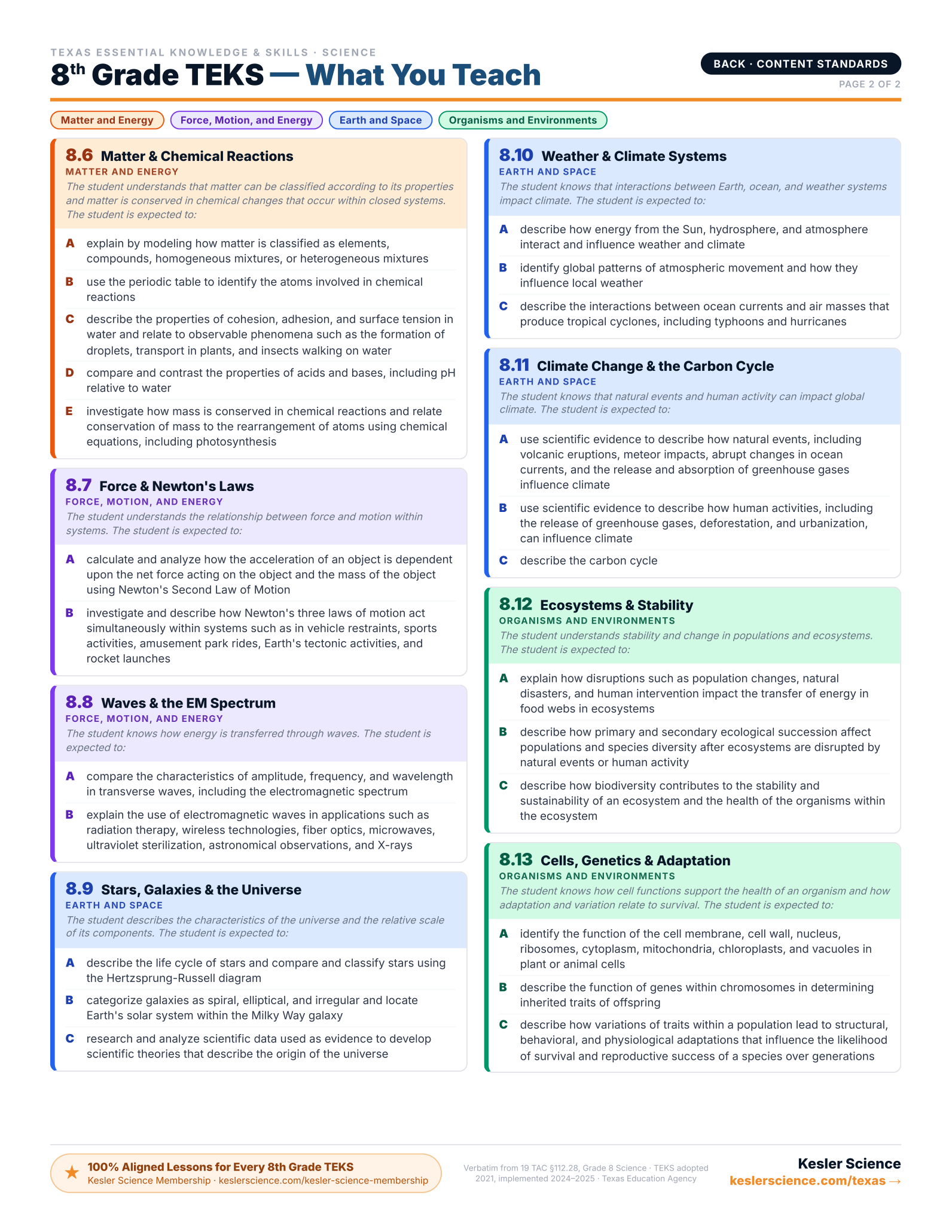
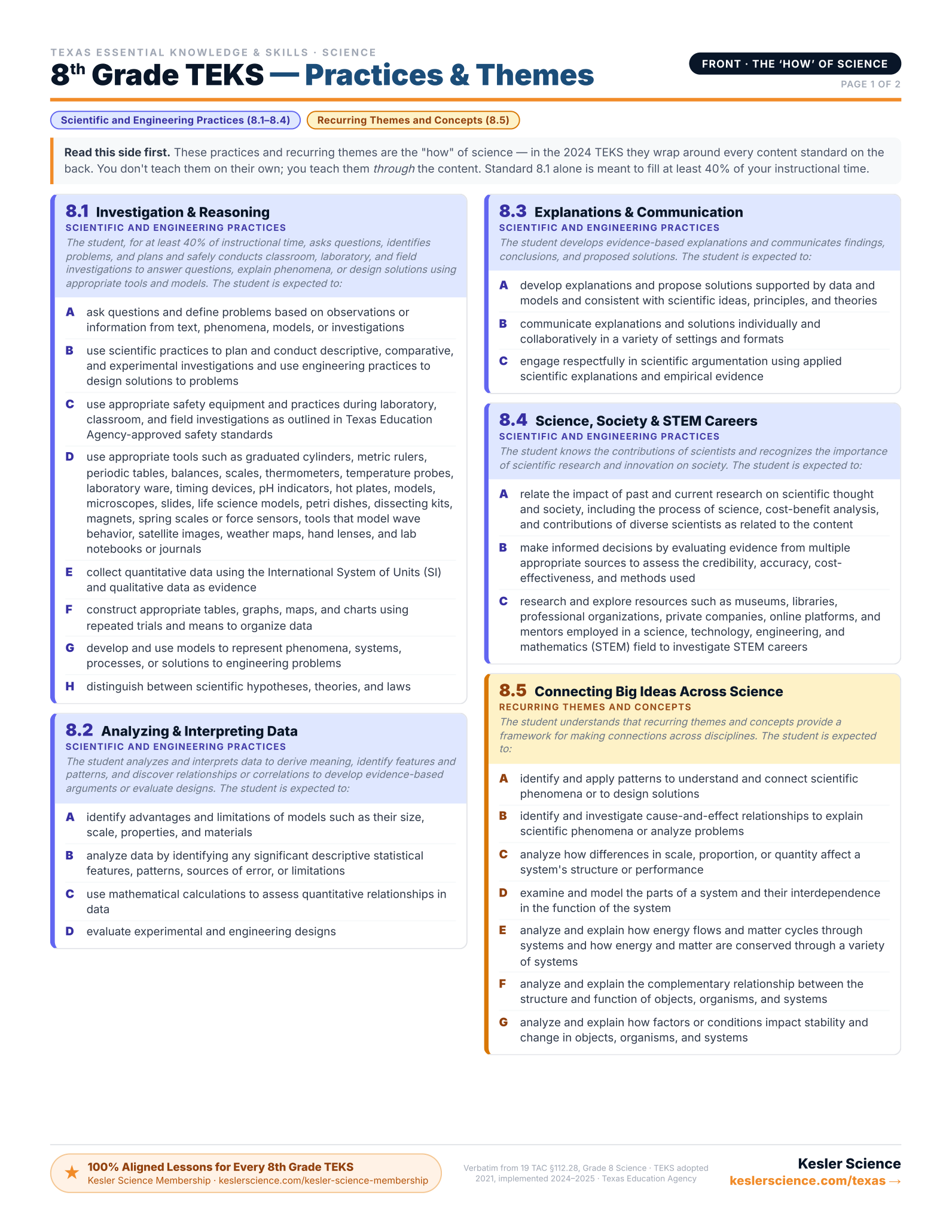
Every 8th-Grade Science TEKS on One Page
The color-coded, front-and-back cheat sheet I wish I'd had — every standard, organized by reporting category. Print it and reference it all year long. This will be your new favorite document!
Trusted Across Texas
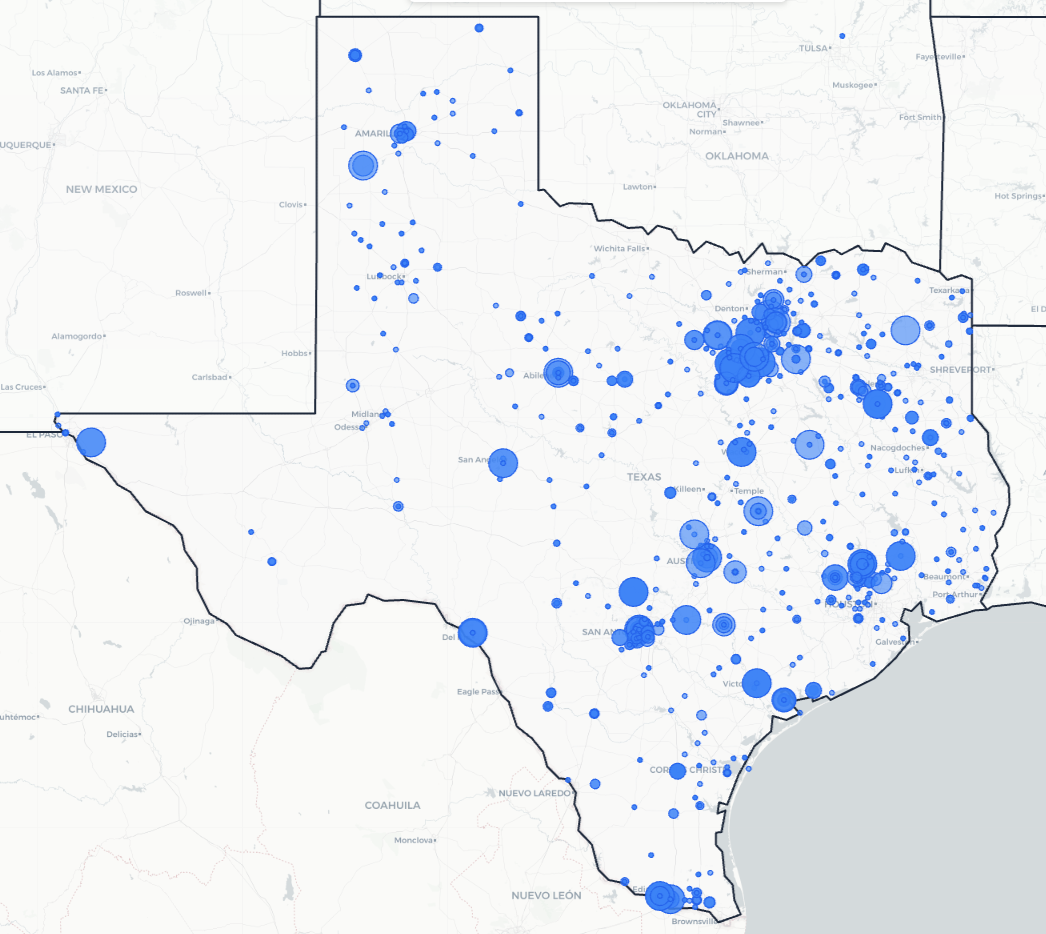
From the Rio Grande Valley to the Panhandle, Texas science teachers are using Kesler Science to save time and engage students.
Texas Schools and Districts
Love Kesler Science
What Teachers Are Saying
Give Your Science Teachers Everything They Need
School and district licenses give your teachers access to every resource they need, including station labs, inquiry labs, anchoring phenomena, presentations, escape rooms, and much more. One purchase covers the grade levels you need.
- PO-friendly. We accept purchase orders
- Volume discounts for 11+ teachers
- Complimentary Kesler Science Plus orientation for 4+ teachers
- Three free implementation PD sessions for departments of 11+
- Aligned to the 2024 TEKS standards

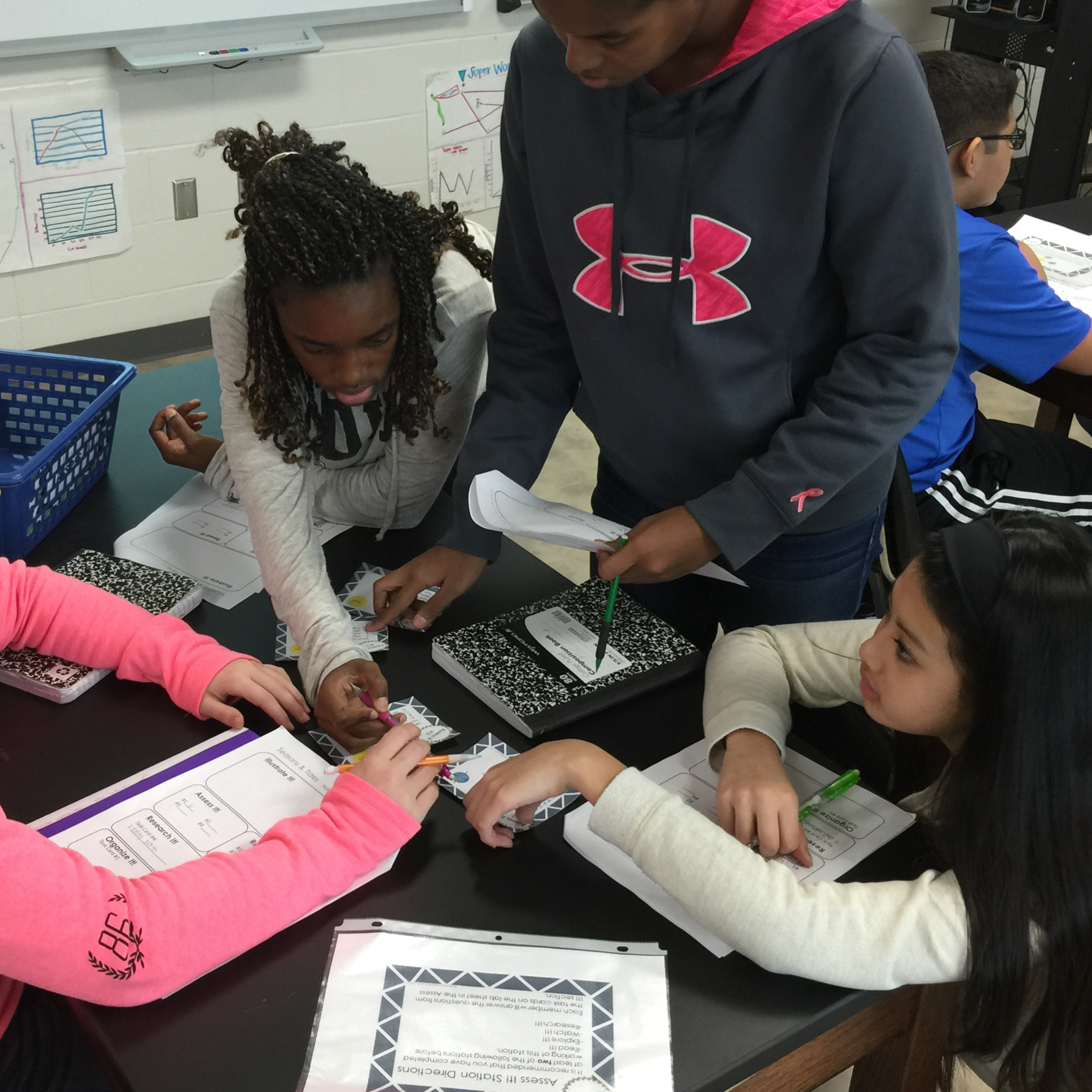
See It in Action
Book a walkthrough and we'll show you how Kesler Science fits your campus.
Book Demo CallNo pressure, no hard sell