.png?width=375&height=100&name=WebPage%20logo%20with%20curves%202026%20(8).png)
Natural Events & Climate
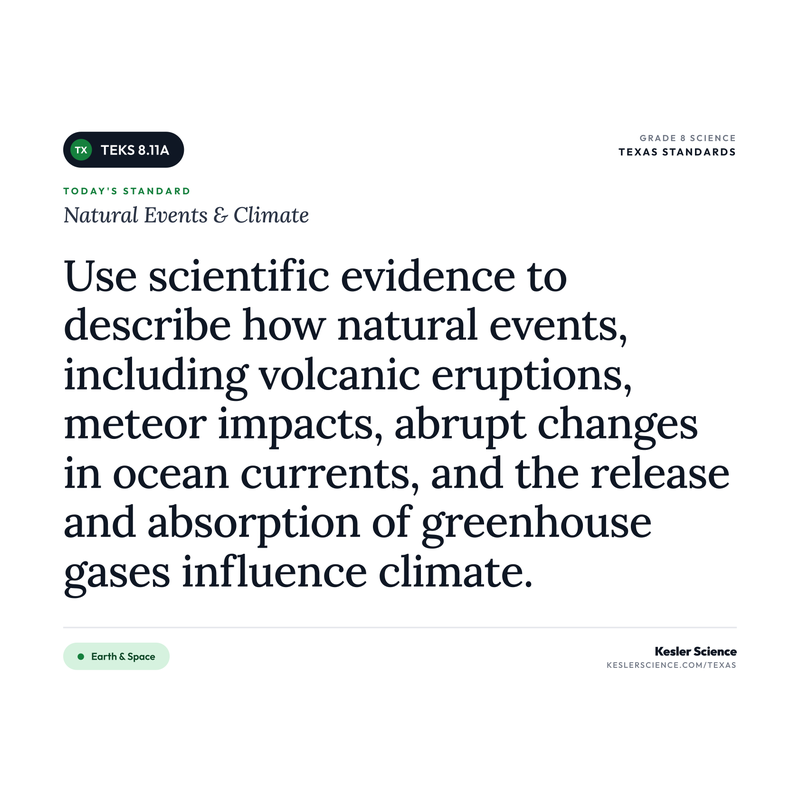
"Use scientific evidence to describe how natural events, including volcanic eruptions, meteor impacts, abrupt changes in ocean currents, and the release and absorption of greenhouse gases influence climate."
💡 What This Standard Actually Means
"Use scientific evidence to describe". Students aren't just listing causes from memory. They're reading data, looking at evidence (temperature records, ice cores, ash layers, ocean current maps, atmospheric CO2 readings), and explaining how natural events change climate. The standard uses "including", which signals where to focus your students: volcanic eruptions, meteor impacts, abrupt changes in ocean currents, and the release and absorption of greenhouse gases. Students should be able to identify each of these natural events, point to a piece of evidence that connects it to a climate effect, and explain whether the effect is short-term or long-term. Instruction can take many forms, such as timelines, case studies, data-graph reading, and cause-effect diagrams.
Volcanic eruptions can cool the climate for months or years. A large eruption blasts sulfur dioxide and ash high into the stratosphere, where the sulfur becomes tiny droplets called aerosols. These aerosols reflect some incoming sunlight back into space, which lowers global temperatures temporarily. The 1991 eruption of Mount Pinatubo in the Philippines cooled global temperatures by about half a degree Celsius for roughly two years before the aerosols settled out. Volcanic eruptions also release CO2 into the atmosphere, but the cooling from aerosols is the bigger short-term climate effect.
Meteor impacts are rare but can change climate drastically. A quick note on terms: an asteroid is the object in space, a meteor is the streak of light when it burns through the atmosphere, and a meteorite is what is left on the ground. About 66 million years ago, an asteroid roughly 10 kilometers across slammed into what is now Mexico's Yucatan Peninsula. The impact threw enormous amounts of dust and sulfur into the atmosphere, blocking sunlight for years, cooling the planet, and contributing to the extinction of the non-avian dinosaurs. Scientists know this from a worldwide layer of iridium-rich clay in rocks dated to that time. Smaller asteroid impacts happen regularly, but only the very largest ones leave a mark on global climate.
Abrupt changes in ocean currents can shift regional climates quickly. Ocean currents move enormous amounts of heat around the planet. The Gulf Stream, for example, carries warm water from the tropics up toward Europe, which is why London is much milder than Canadian cities at the same latitude. When currents like this slow down, speed up, or shift (because of changes in salinity, temperature, or wind), the climate of regions downstream can change within years rather than centuries. El Niño and La Niña are smaller-scale examples that shift weather patterns across the Pacific every few years.
The natural release and absorption of greenhouse gases also influences climate. Volcanoes release CO2. Decomposing plants and animals release CO2 and methane. Oceans absorb large amounts of CO2 and pull it out of the atmosphere. Forests, plankton, and other living things take in CO2 during photosynthesis. Over long timescales, the natural balance between release and absorption of these gases is one of the biggest controls on Earth's climate.
The thing that works here is building a timeline of evidence. I'd tape a long roll of paper across the wall and have students place real events on it with the data that supports them: the K-Pg meteor impact 66 million years ago (with the iridium clay layer as evidence), Pinatubo in 1991 (with the global temperature dip in the data), an El Niño shift in the Pacific (with the sea-surface temperature map), and a volcanic CO2 spike (with ice core data). When students see events of such wildly different timescales side by side, two things click. First, climate changes for different reasons at different speeds. Second, every natural cause of climate change leaves evidence behind that scientists can read. That keeps the standard about evidence, not memorization.
⚠️ Misconceptions Your Students May Have
These are some of the most common misconceptions. Knowing what to look for can help you get ahead of them.
"Volcanoes warm up the climate because they're hot and release CO2"
Large volcanic eruptions actually cool the climate in the short term, not warm it. The heat from a single eruption is tiny compared to Earth's climate system, and the sulfur aerosols and ash injected into the stratosphere reflect sunlight away from Earth, lowering temperatures for months or years. Volcanoes do release CO2, but the annual amount is small compared to human emissions.
"Ocean currents are too slow to affect climate"
Ocean currents move massive amounts of heat around the planet, and abrupt changes in those currents can shift regional climates noticeably within years. The Gulf Stream is the reason Western Europe is much milder than Canadian cities at the same latitude. El Niño and La Niña are short-term shifts in Pacific currents that change rainfall and temperature across continents. When evidence like sea-surface temperature maps shows a current speeding up, slowing, or moving, scientists can predict climate effects downstream.
"Greenhouse gases only come from cars and factories"
Greenhouse gases are released and absorbed by natural processes too. Volcanoes release CO2. Decomposing plants and animals release CO2 and methane. Wildfires release CO2. On the absorption side, oceans dissolve enormous amounts of CO2, and forests and plankton pull CO2 out of the atmosphere through photosynthesis. The natural release and absorption of greenhouse gases is one of the biggest long-term controls on Earth's climate, and it's part of what 8.11A asks students to describe.
"Meteor impacts are ancient history and don't matter anymore"
Large impacts are rare, but they remain a real factor in Earth's climate history. The K-Pg impact 66 million years ago caused a major extinction event, and the iridium clay layer in rocks worldwide is the evidence. Smaller meteor impacts happen much more often, including one in 2013 over Chelyabinsk, Russia, that shattered windows across the region. Scientists actively track near-Earth objects and model the potential climate effects of impacts of various sizes.
📓 Teaching Resources for 8.11A
These resources are aligned to this standard.


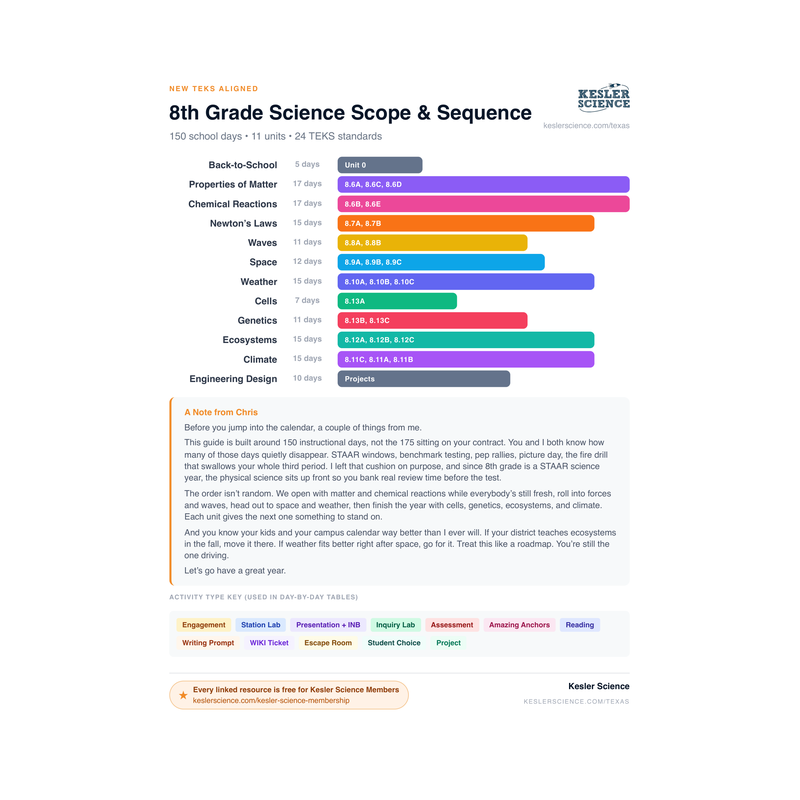
100% Aligned Lessons for Every TEKS You Teach
Kesler Science Plus puts thousands of ready-to-teach lessons and activities in your hands, so you can boost engagement and get your planning time back. Trusted by schools and districts all over the great state of Texas.
🌎 Phenomenon Ideas for 8.11A
Use these real-world phenomena to anchor your lesson. Show students the phenomenon first, let them wonder, then build toward Natural Events & Climate as the explanation.
The Year Without a Summer (1816)
In June of 1816, snow fell in New England. Frost destroyed crops in Pennsylvania. Europe had failed harvests and food shortages. People at the time had no idea why. Much later, scientists traced the cause back to a massive volcanic eruption of Mount Tambora in Indonesia, about a year earlier.
"How could a volcano erupting on the other side of the world cool summers in New England a year later? What would the eruption have to put into the atmosphere for that to happen?"
The Thin Dark Layer in Rocks From 66 Million Years Ago
In rock layers around the world, geologists find a thin band of dark clay that dates to about 66 million years ago. That layer contains unusually high amounts of iridium, an element rare on Earth but common in meteors. Fossils of non-avian dinosaurs appear in the rock below the layer, but never in the rock above it.
"What could put a layer of meteor material onto the whole surface of Earth at the same time? How might the climate have changed right after that event, and how could that explain the disappearance of certain fossils above the line?"
Why Europe Is Warmer Than Its Latitude Should Allow
London, England sits at about 51 degrees North, the same latitude as Calgary, Canada. Yet London's average winter low is around 41 degrees Fahrenheit, while Calgary's is around 16 degrees Fahrenheit. The Gulf Stream, a giant ocean current, carries warm water from the tropics across the Atlantic and keeps Western Europe much milder than its latitude would suggest. If that current were ever to slow down or shift, the climate of Europe could change quickly.
"How could a current of moving water change the climate of an entire continent? What kinds of evidence would scientists need to track to know if an ocean current was changing?"
💡 Free Engagement Ideas for 8.11A
Ready-to-run activities you can drop straight into a lesson. Where one of these looks like a phenomenon from the section above, that is on purpose: show it first as the hook, then let students run it themselves.
Sunlight vs. Aerosol Model
Shine a lamp through a clear glass of water onto a paper surface and measure the brightness using a light meter app on a phone. Then stir in a teaspoon of flour or powdered milk to represent volcanic aerosols. Measure the brightness again. Students see how a thin layer of particles can cut incoming energy significantly.
Climate Event Timeline Walk
Tape a long roll of paper along a hallway or wall. Assign groups to research and place cards for: the K-Pg meteor impact (66 million years ago), Tambora (1815), Pinatubo (1991), a recent strong El Niño, and a major Atlantic ocean-current shift in past climate records. Once placed, have students describe how far apart these events are in time and what kind of climate effect each one had based on the evidence (temperature drop, regional rainfall change, etc.).
Ocean Current Conveyor Belt Demo
Fill a large clear bin with room-temperature water. Use food coloring to mark a small region of the water as "the tropics" (red) and another region as "the poles" (blue). Add ice cubes to the polar end and a heat lamp or warm water bottle to the tropical end. As temperatures change, the dyed water moves, mimicking how cold and warm currents drive global ocean circulation. Discuss what happens to a coastline if its incoming current changes.
Natural Greenhouse Gas Sources Card Sort
Create a deck of cards with sources and sinks of greenhouse gases: erupting volcano, forest absorbing CO2, ocean absorbing CO2, decomposing leaves, wildfire, plankton bloom, melting permafrost releasing methane, swamp releasing methane. Students sort each card into "Releases greenhouse gases" and "Absorbs greenhouse gases" piles. Then they arrange the cards on a balance scale drawn on the whiteboard to show how natural release and absorption together influence climate.
🎯 What Approaches, Meets, and Masters Thinking Look Like
Here is what student thinking at each level looks like on this one task, so you know what to look for and how to move a student up.
A large volcanic eruption sends ash and gases high into the atmosphere. Explain how this natural event changes Earth's climate, and describe the scientific evidence scientists use to know it happened and how long the effect lasts.
- A clear statement of the direction of the effect: a large eruption cools the climate.
- A mechanism, not just a claim: sulfur and ash reach the upper atmosphere and reflect incoming sunlight back into space.
- A piece of real evidence named (a temperature record after an eruption, such as Mount Pinatubo in 1991).
- The effect labeled as short-term (months to a couple of years) because the particles settle out.
- An explanation that connects the evidence to the claim, not just facts listed side by side.
- The reasoning that the eruption's heat and its CO₂ are not what drive the short-term change. The cooling from reflected sunlight is. That is the easiest place to slip.
A volcanic eruption warms the climate. Lava and ash are really hot, and volcanoes also pump out a lot of CO₂, which is a greenhouse gas that traps heat. So a big eruption heats the planet up. Scientists know an eruption happened because of the ash and lava it leaves behind.
If eruptions only warm things, why does the line dip for about two years afterward?That points them toward the sulfur and ash reflecting sunlight away.
A large volcanic eruption actually cools the climate for a year or two. It blasts sulfur and ash high into the upper atmosphere, where the sulfur turns into tiny droplets called aerosols. Those aerosols and ash reflect some incoming sunlight back into space, so less sunlight reaches the surface and global temperatures drop. The evidence is the temperature record after the 1991 Mount Pinatubo eruption, which shows global temperatures fell about half a degree Celsius. This is a short-term effect, because the particles slowly settle out of the atmosphere and temperatures go back to normal after a couple of years.
A large eruption has two effects that pull in opposite directions, and the timescale is what tells them apart. In the short term (months to about two years), the sulfur and ash high in the atmosphere reflect sunlight back into space, so the planet cools. The Pinatubo temperature record showing a dip of about half a degree is the evidence for that. But the eruption also releases CO₂, a greenhouse gas that traps heat and stays in the air far longer than the ash. So the reflecting effect is short-term cooling, while the CO₂ adds a tiny, much longer-term warming push. For one eruption the cooling clearly wins because the CO₂ amount is small.
Using that same idea, I can predict a new event. A giant meteor impact is not a volcano, but it should work the same way as the cooling part: it throws huge amounts of dust and sulfur into the atmosphere, which blocks and reflects sunlight, so the planet cools. The worldwide layer of iridium-rich clay from the dinosaur impact is the evidence, just like the temperature record is for the volcano. So I'd expect a big impact to cause short-term cooling for the same reason an eruption does, blocking sunlight, only stronger.
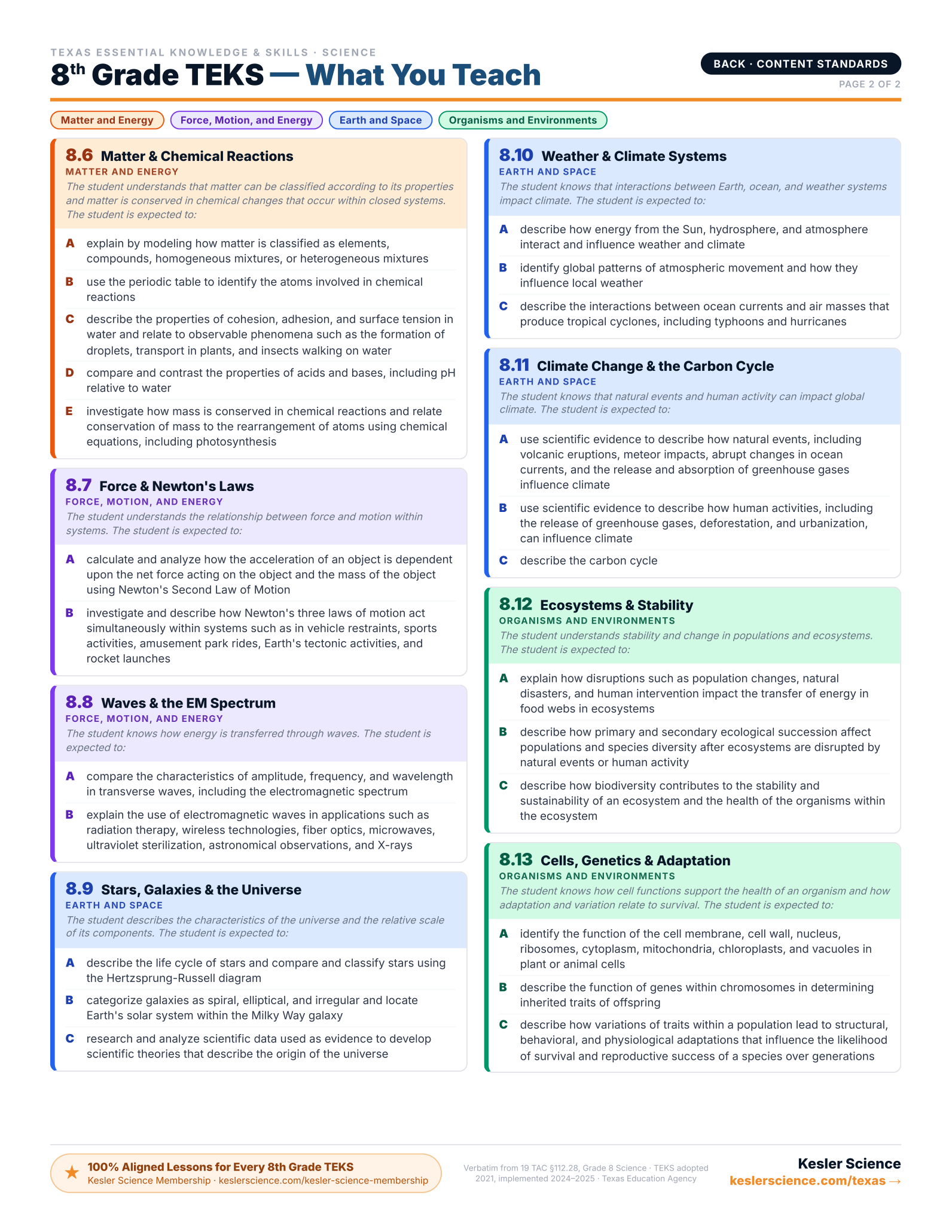
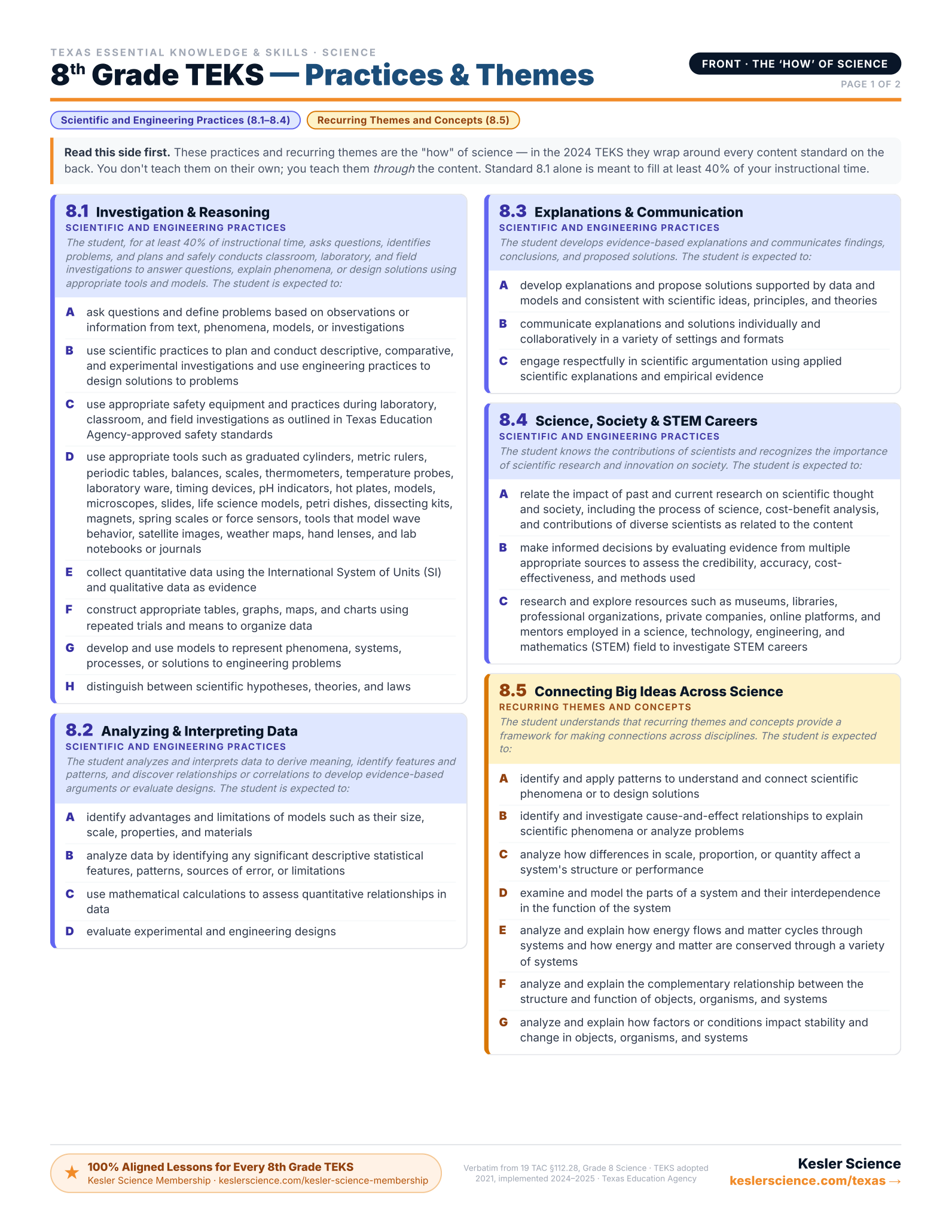
Every 8th-Grade Science TEKS on One Page
The color-coded, front-and-back cheat sheet I wish I'd had — every standard, organized by reporting category. Print it and reference it all year long. This will be your new favorite document!
Trusted Across Texas
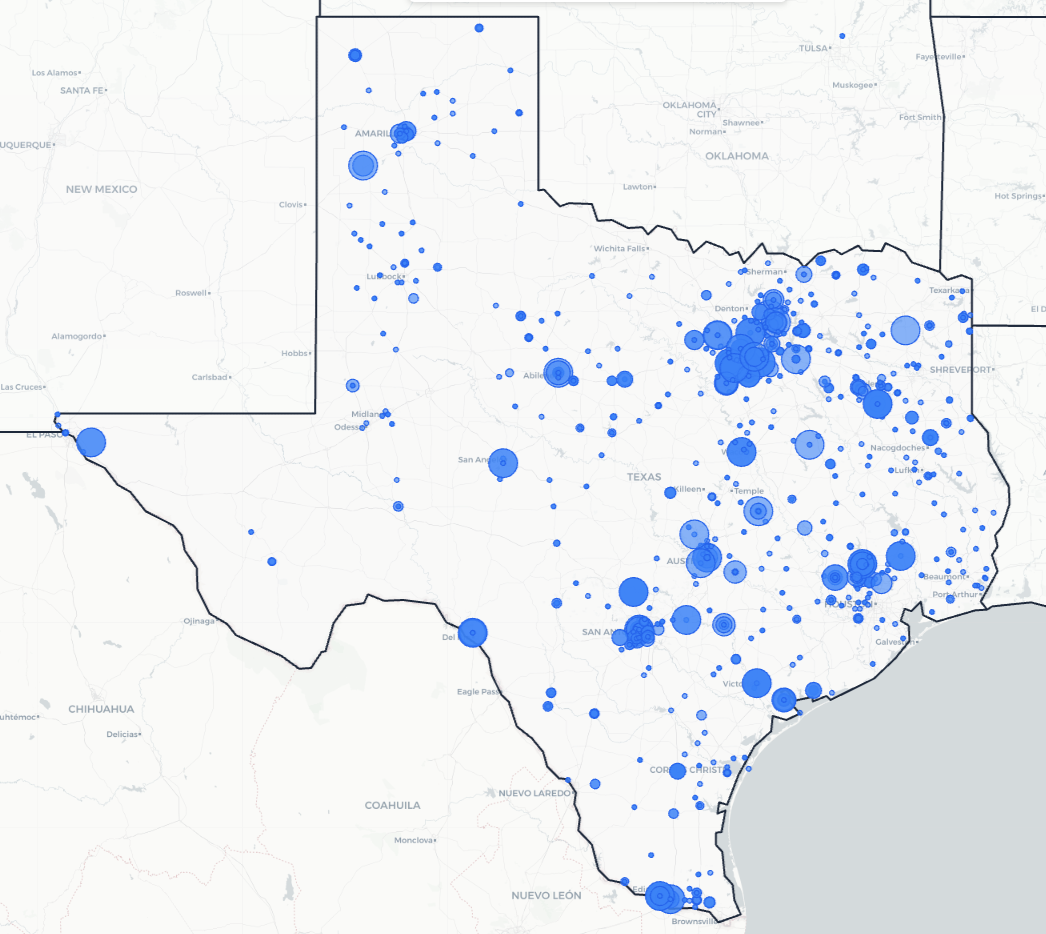
From the Rio Grande Valley to the Panhandle, Texas science teachers are using Kesler Science to save time and engage students.
Texas Schools and Districts
Love Kesler Science
What Teachers Are Saying
Give Your Science Teachers Everything They Need
School and district licenses give your teachers access to every resource they need, including station labs, inquiry labs, anchoring phenomena, presentations, escape rooms, and much more. One purchase covers the grade levels you need.
- PO-friendly. We accept purchase orders
- Volume discounts for 11+ teachers
- Complimentary Kesler Science Plus orientation for 4+ teachers
- Three free implementation PD sessions for departments of 11+
- Aligned to the 2024 TEKS standards
See It in Action
Book a walkthrough and we'll show you how Kesler Science fits your campus.
Book Demo CallNo pressure, no hard sell