.png?width=375&height=100&name=WebPage%20logo%20with%20curves%202026%20(8).png)
Origins of the Universe
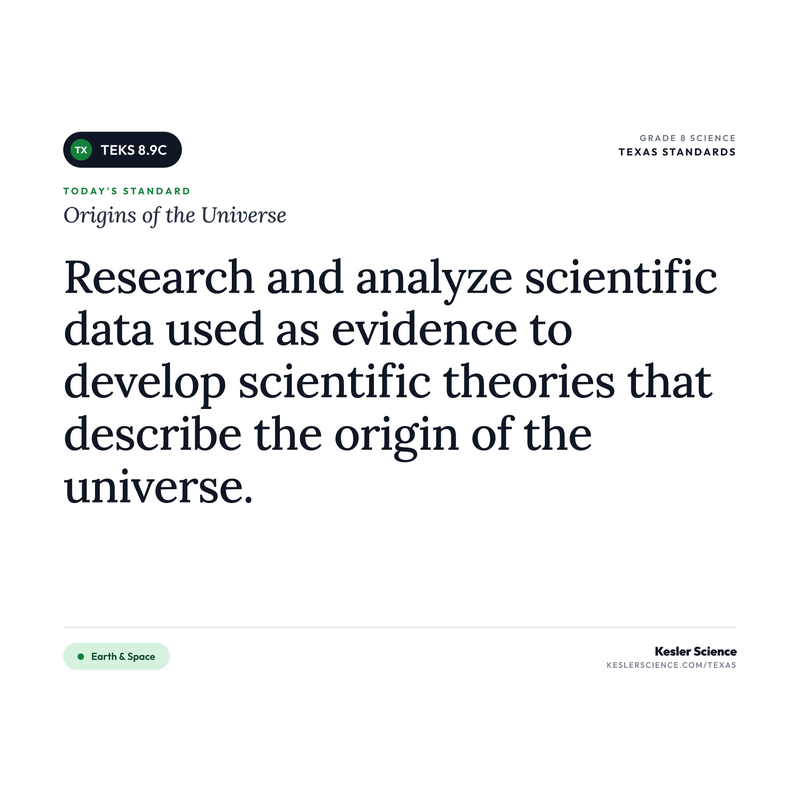
"Research and analyze scientific data used as evidence to develop scientific theories that describe the origin of the universe."
💡 What This Standard Actually Means
"Research and analyze". Students are investigators looking at the actual scientific data that astronomers have collected, then connecting that data to the scientific theories that have been proposed to explain how the universe began. No deriving equations. No advanced cosmology math. The TEKS deliberately uses the plural "theories" and emphasizes scientific data used as evidence. Students should be able to identify the kinds of evidence (such as the redshift of distant galaxies, the cosmic microwave background, and the abundance of light elements), explain what each one shows, and describe how scientists use that evidence to develop and refine their explanations of the universe's origin. Instruction can take many forms, such as evidence charts, data analysis tasks, timelines, and short research summaries.
The TEKS for this standard is built around two big ideas. The first is that scientists have proposed several scientific theories over time to describe the origin of the universe. The second is that those theories are not just opinions or guesses. They are built on, tested by, and revised because of scientific data. The whole standard is really about how science works: scientists observe, gather evidence, propose explanations, and update those explanations when new data comes in.
The current leading scientific theory describes the universe beginning about 13.8 billion years ago from an extremely hot, dense state and expanding ever since. The key point for students is the kind of evidence that led scientists to that conclusion. Galaxy redshift: in 1929, Edwin Hubble showed that distant galaxies have light shifted toward the red end of the spectrum, and the farther the galaxy, the bigger the shift. That tells us the space between galaxies is stretching. Cosmic microwave background: in 1964, Arno Penzias and Robert Wilson detected a faint microwave glow coming from every direction in space. It is leftover heat from when the universe was much hotter and denser, now cooled to about 2.7 K. Abundance of light elements: roughly 75% of the ordinary matter in the universe by mass is hydrogen and 24% is helium, which lines up with what scientists calculated should have been produced in the first few minutes of the early universe.
The core understanding students should walk away with is not a memorized name or definition. It is the idea that scientists analyze data over many decades, build theories that fit the evidence, and stay open to updating those theories as new evidence arrives. That is exactly the process this standard is asking students to research and describe.
I used to teach this standard like a vocabulary unit. Define the theory, list three pieces of evidence, move on. It fell flat every time. The shift that worked was reframing the lesson around how scientists actually figured this out. I would put three pieces of real data on the board, the redshift graph, a CMB sky map, and the hydrogen-to-helium ratio, and ask students what they noticed before I told them what they were looking at. Once they had wrestled with the data themselves, the theory landed naturally as the explanation that fit. That framing turned the lesson into a detective case. Students stop asking "is this true?" and start asking "what does the evidence show, and what would change our minds?" That is the question this TEKS is really after.
⚠️ Misconceptions Your Students May Have
These are some of the most common misconceptions. Knowing what to look for can help you get ahead of them.
"A scientific theory is just a guess"
In everyday talk, "theory" can mean a hunch. In science, a theory is a well-tested explanation built on a large body of evidence. Scientific theories about the origin of the universe are supported by multiple independent lines of data, including galaxy redshift, the cosmic microwave background, and the measured abundance of hydrogen and helium. A theory becomes accepted because the evidence keeps lining up with it, and it can still be revised when new evidence comes in.
"Scientists know exactly how the universe began and the question is closed"
Scientists have a leading theory that describes the universe expanding from a hot, dense early state about 13.8 billion years ago, and the data strongly supports it. But what caused that early state, what (if anything) came before it, and the exact details of the very first moments are still active questions in physics. Theories about the origin of the universe have been refined many times as new data has come in, and they will keep being refined. That's how science works.
"The expansion of the universe means galaxies are flying out into empty space"
The data suggests something stranger. Distant galaxies in every direction show light shifted toward the red end of the spectrum, which means the space between us and them is stretching. Galaxies aren't moving through space like debris from a bomb. The space itself is getting larger between them. The balloon analogy helps here: dots drawn on an inflating balloon move apart because the surface stretches, not because the dots are flying through the balloon.
"All of the data was found at the same time and proved the theory at once"
The evidence was collected piece by piece over almost a century. Hubble showed the redshift of distant galaxies in 1929. Penzias and Wilson detected the cosmic microwave background in 1964. Measurements of hydrogen and helium ratios were refined over decades. Each new piece of data either matched what existing theories predicted or pushed scientists to revise them. Students should see this as a long process of analyzing data, not a single "aha" moment.
📓 Teaching Resources for 8.9C
These resources are aligned to this standard.


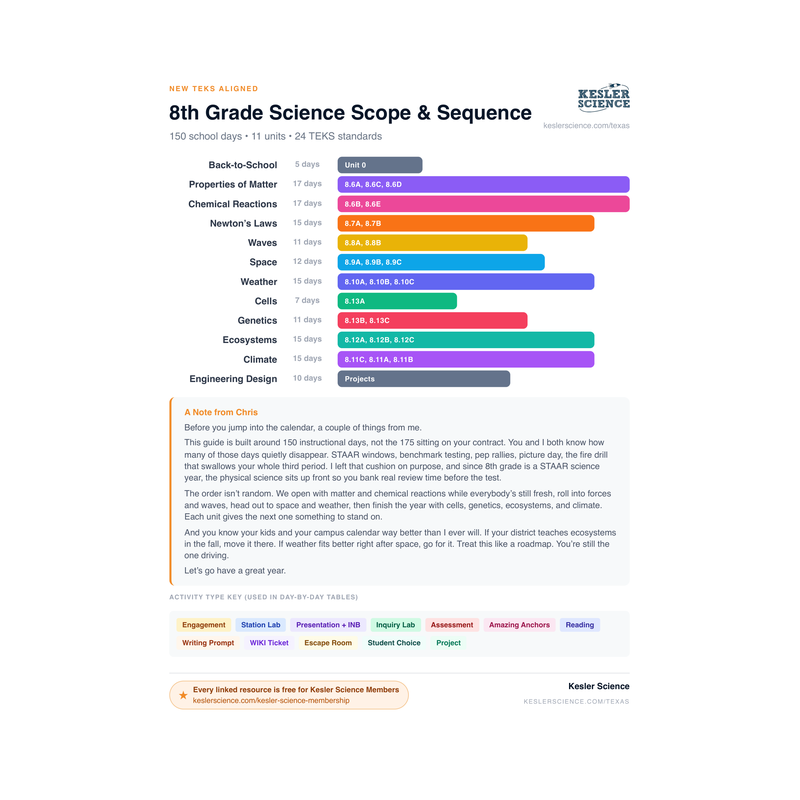
100% Aligned Lessons for Every TEKS You Teach
Kesler Science Plus puts thousands of ready-to-teach lessons and activities in your hands, so you can boost engagement and get your planning time back. Trusted by schools and districts all over the great state of Texas.
🌎 Phenomenon Ideas for 8.9C
Use these real-world phenomena to anchor your lesson. Show students the phenomenon first, let them wonder, then build toward Origins of the Universe as the explanation.
Distant Galaxies Look Redder Than They Should
When astronomers split the light from galaxies with a spectrograph, they expect to see specific patterns from hydrogen, helium, and other elements. The pattern is always there, but for galaxies farther away, the whole pattern is shifted toward the red end of the spectrum. The farther the galaxy, the bigger the shift. Edwin Hubble noticed this in 1929, and it's still observed in every direction we look.
"If distant galaxies in every direction look redshifted, what could that tell us about how space between galaxies is changing over time?"
A Quiet Hum From Every Direction in Space
In 1964, two radio astronomers named Arno Penzias and Robert Wilson were testing a radio antenna in New Jersey. They kept picking up a faint hiss of microwave radiation no matter where they pointed the dish. They scrubbed the antenna, cleaned out pigeon droppings, checked their equipment, but the signal wouldn't go away. It turned out to be the cosmic microwave background, the leftover heat from the early universe, now cooled to about 2.7 K.
"Why would a faint microwave glow coming from every direction in space be strong evidence that the universe used to be much hotter and denser than it is now?"
The Universe Is Almost All Hydrogen and Helium
When astronomers measure what the visible universe is made of, about 75% of its ordinary matter by mass is hydrogen and around 24% is helium, with only a tiny fraction made up of everything else combined. Scientists had calculated those proportions from theory before they had the technology to measure them accurately. The match between prediction and observation is one of the strongest pieces of evidence that the leading theory of the universe's origin is on the right track.
"If a scientific theory predicts the exact ratio of hydrogen to helium that we end up measuring, what does that tell us about how reliable the theory is? What might happen to the theory if future measurements showed a very different ratio?"
💡 Free Engagement Ideas for 8.9C
Ready-to-run activities you can drop straight into a lesson. Where one of these looks like a phenomenon from the section above, that is on purpose: show it first as the hook, then let students run it themselves.
The Balloon Universe
Give each student a deflated balloon and a marker. Have them draw 6 to 8 "galaxies" on the balloon while it's still flat. Then slowly inflate it. At each stage, they measure the distance between two galaxies using a piece of string. As the balloon grows, all the galaxies move apart from each other, and the farther apart they were, the faster they separate. Ties directly to Hubble's redshift observation.
Evidence Card Sort
Print 12 cards. Three of them are the main evidence lines (redshift, CMB, light-element abundance). The other nine are short descriptions of observations or statements. Students sort each description under the evidence category it supports. Forces them to connect specific observations back to the broader evidence, rather than memorizing labels.
Rubber Band Redshift Demo
Draw a sine wave on a wide rubber band with a fine marker. Stretch the rubber band, and the wavelengths of the drawn wave stretch out too. Explain that this is what happens to light as space expands between a distant galaxy and us. Longer wavelengths mean redder light. Cheap, fast, and the visual sticks.
Cosmic Timeline Adding-Machine Tape
Roll out a strip of adding-machine tape along the floor. If 13.8 billion years equals 10 meters, have students mark when major events happened: Big Bang (start), first atoms forming (about 380,000 years in, basically right at the start on this scale), first stars (a few hundred million years later), Earth forming (roughly two-thirds of the way along), and humans (the last fraction of a millimeter). Puts scale in their hands.
🎯 What Approaches, Meets, and Masters Thinking Look Like
Here is what student thinking at each level looks like on this one task, so you know what to look for and how to move a student up.
Scientists describe the origin of the universe with a theory built from many years of collected data. Three major lines of evidence are the redshift of distant galaxies, the cosmic microwave background, and the measured abundance of light elements (about 75% hydrogen and 24% helium). For each piece of evidence, explain what scientists observed and what it tells us about the origin of the universe. Then describe how scientists used this data to develop and refine a scientific theory.
- All three lines of evidence addressed, not just one: galaxy redshift, the cosmic microwave background, and the abundance of light elements.
- Galaxy redshift explained as distant galaxy light shifting toward the red end of the spectrum, showing the space between galaxies is stretching.
- The cosmic microwave background explained as a faint glow coming from every direction, leftover from a much hotter, denser early universe.
- The hydrogen and helium ratio described as matching what scientists calculated should have formed in the early universe.
- An explanation that the theory was built from and tested against this data, not just invented.
- Some sense that science updates a theory when new evidence arrives, rather than treating it as finished and unquestionable.
- The word "theory" used in its scientific sense (a well-tested explanation), not as a casual guess. That is the easiest place to slip.
Galaxies are redshifted, which means they are moving away and the universe is getting bigger. There is also background radiation in space left over from when everything was hot. Scientists made a theory about how the universe started, but it's still just a theory, so it's really their best guess. Nobody was there to see it happen, so we can't know for sure. They might find out something totally different later.
Redshift: light from distant galaxies is shifted toward red, and the farther away a galaxy is, the bigger the shift. This tells scientists the space between galaxies is stretching, so the universe is expanding. Cosmic microwave background: there is a faint microwave glow coming from every direction in space. It's leftover heat from when the universe was much hotter and denser, now cooled way down. Light elements: about 75% of ordinary matter is hydrogen and 24% is helium, which matches what scientists calculated should have formed in the early universe.
Scientists didn't just make up the theory. They collected this data, and the theory had to fit all of it. Because all three lines of evidence agree, the theory that the universe began about 13.8 billion years ago from a hot, dense state is well supported.
All three lines of evidence point to the same story. Redshift shows the space between galaxies is stretching now, so running it backward means everything was once packed together. The cosmic microwave background is the leftover heat from that hot, dense early state, and the hydrogen and helium ratio matches what should have formed in the first few minutes. The strongest part isn't any one piece. It's that three independent measurements, found at different times, all agree. That's what makes it a tested theory and not a guess.
This also shows how science keeps working. The evidence came in piece by piece over almost a hundred years, from Hubble's redshift in 1929 to the background radiation in 1964, and each new measurement either fit the theory or forced scientists to adjust it. So if astronomers found a new measurement tomorrow that didn't fit, like the expansion speeding up in a way the theory didn't predict, they wouldn't throw out all the evidence. They would revise the theory to account for it. The theory is the best current explanation, and it stays open to new data.
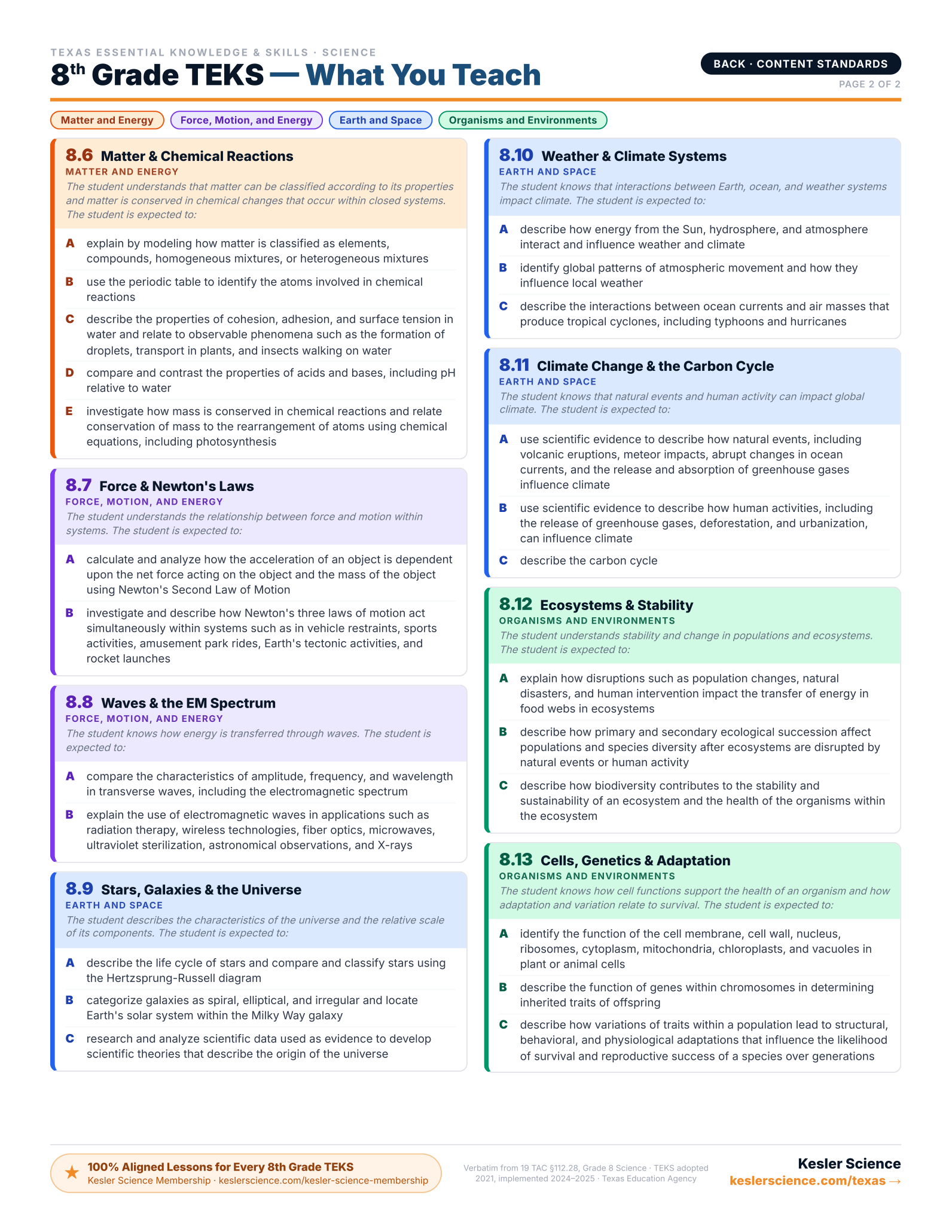
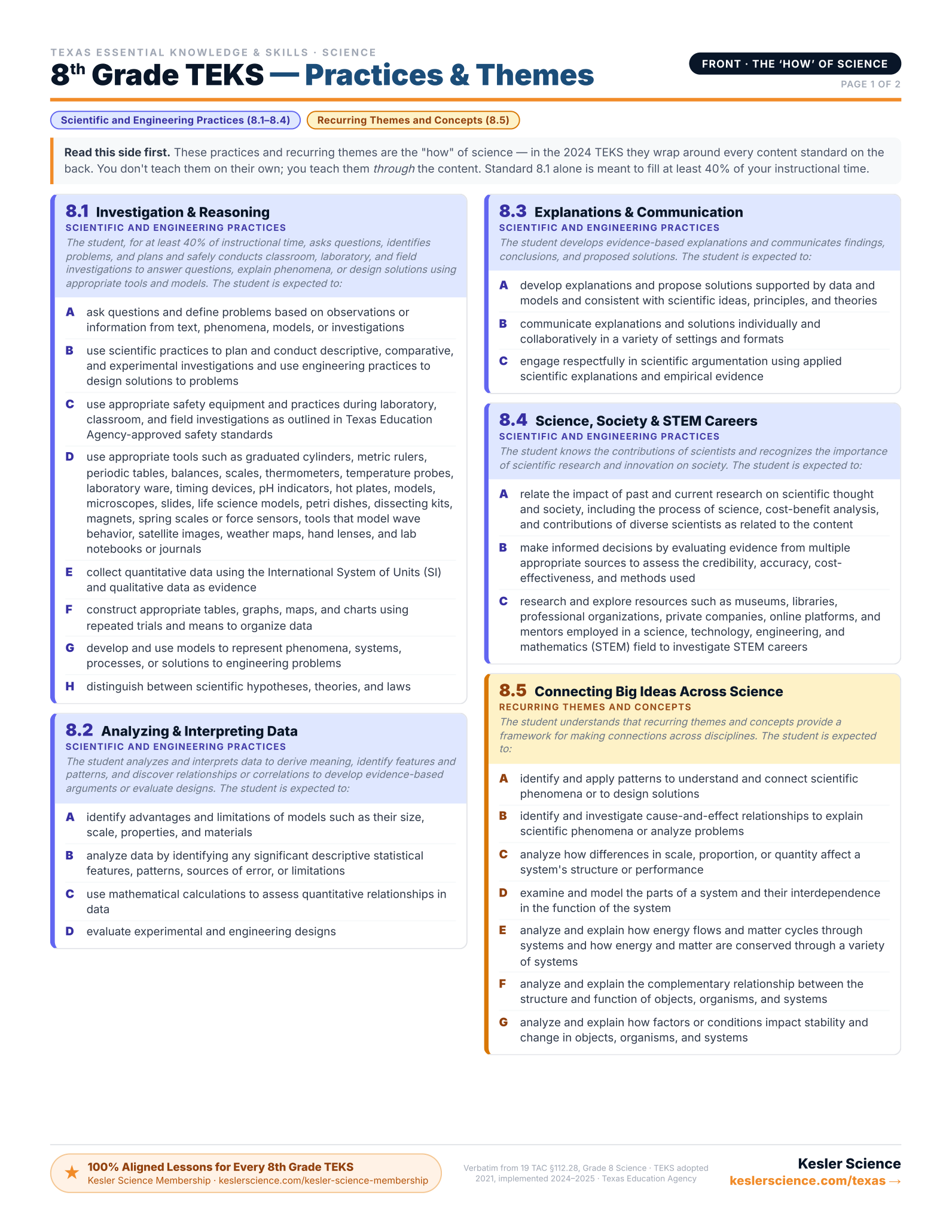
Every 8th-Grade Science TEKS on One Page
The color-coded, front-and-back cheat sheet I wish I'd had — every standard, organized by reporting category. Print it and reference it all year long. This will be your new favorite document!
Trusted Across Texas
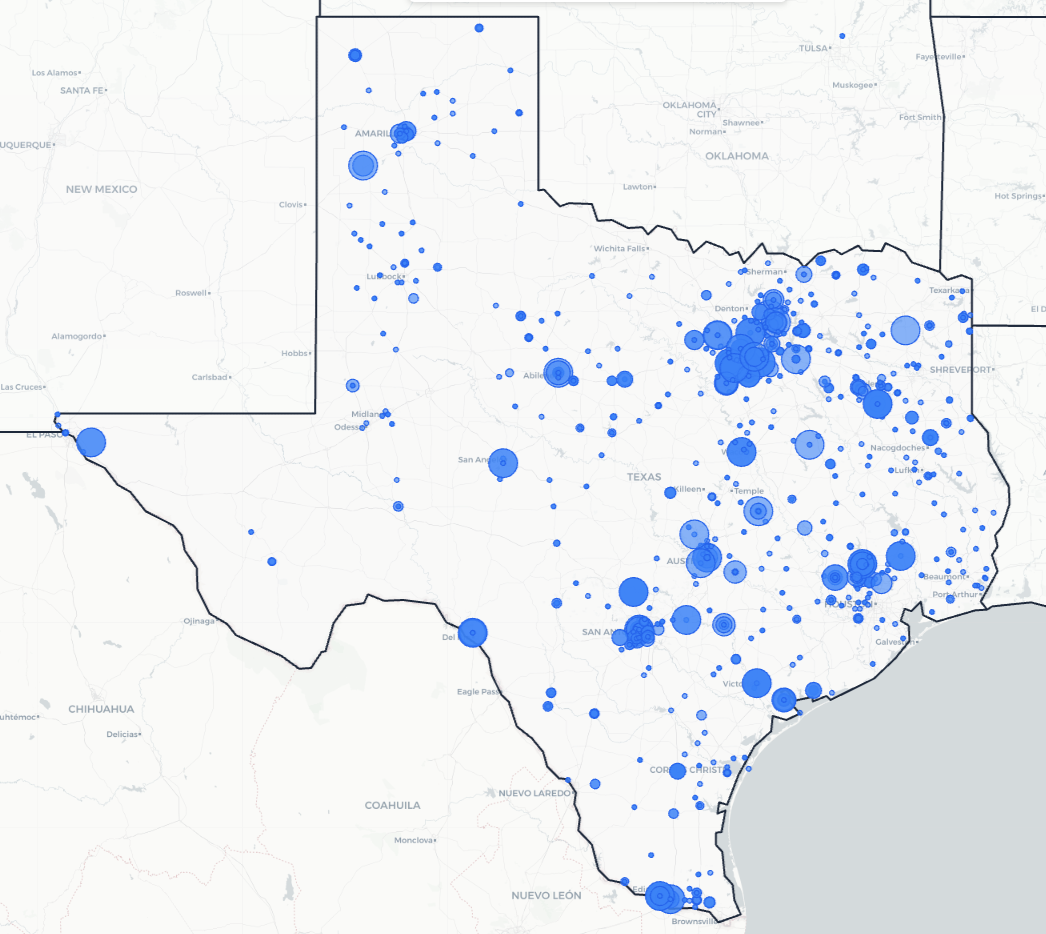
From the Rio Grande Valley to the Panhandle, Texas science teachers are using Kesler Science to save time and engage students.
Texas Schools and Districts
Love Kesler Science
What Teachers Are Saying
Give Your Science Teachers Everything They Need
School and district licenses give your teachers access to every resource they need, including station labs, inquiry labs, anchoring phenomena, presentations, escape rooms, and much more. One purchase covers the grade levels you need.
- PO-friendly. We accept purchase orders
- Volume discounts for 11+ teachers
- Complimentary Kesler Science Plus orientation for 4+ teachers
- Three free implementation PD sessions for departments of 11+
- Aligned to the 2024 TEKS standards
See It in Action
Book a walkthrough and we'll show you how Kesler Science fits your campus.
Book Demo CallNo pressure, no hard sell