.png?width=375&height=100&name=WebPage%20logo%20with%20curves%202026%20(8).png)
Succession & Species Diversity
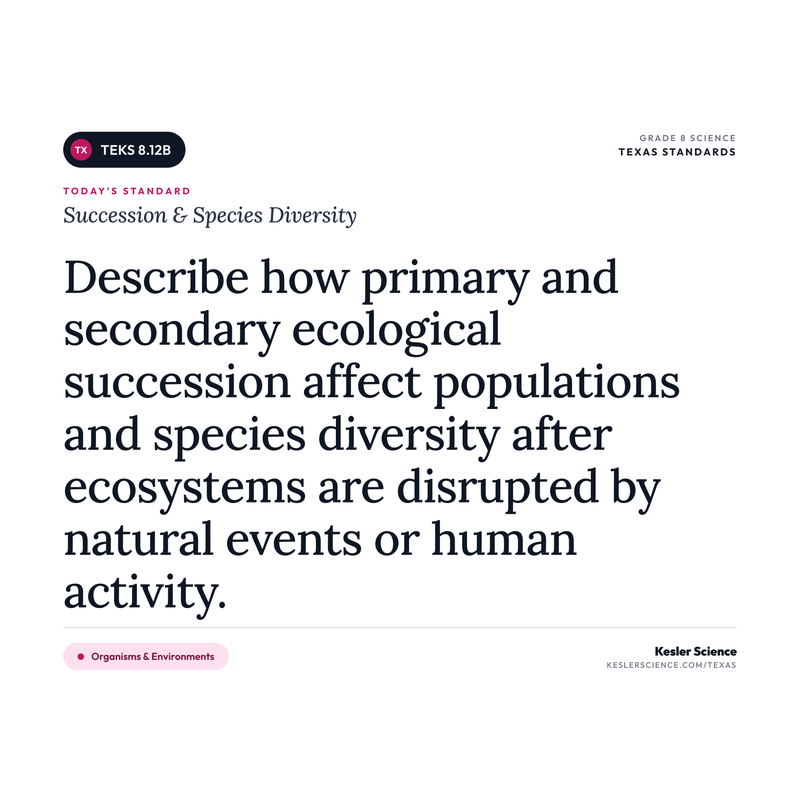
"Describe how primary and secondary ecological succession affect populations and species diversity after ecosystems are disrupted by natural events or human activity."
💡 What This Standard Actually Means
"Describe". Students explain how primary and secondary ecological succession change populations and species diversity after an ecosystem is disrupted. Two types to focus on: primary succession (bare rock or new land with no soil) and secondary succession (existing community with soil intact after a disturbance like fire or flood). Students should be able to describe the order of communities involved, distinguish the two types, and connect succession to changes in species diversity over time. Instruction can take many forms, such as sequencing cards, side-by-side comparison diagrams, and modeled timelines after specific events (wildfire, glacier retreat, abandoned field).
Ecological succession is the series of changes an ecosystem goes through over time after a disturbance or in a brand-new area. Primary succession begins where no soil exists yet, such as on bare rock left behind by a retreating glacier or on fresh volcanic lava. Pioneer species like lichens and mosses break down rock and build up a thin layer of soil. Over hundreds to thousands of years, grasses, shrubs, and eventually trees can establish as conditions allow.
Secondary succession happens where soil is already in place but the existing community has been disturbed, such as after a forest fire, a flood, or an abandoned field. Because soil and seed banks remain, recovery can occur much faster, often within decades. Fast-growing grasses and weeds come in first, followed by shrubs, then trees. The endpoint of succession is often called a climax community, though modern ecology treats it as a working model rather than a truly fixed state.
Species diversity refers to how many different species live in an ecosystem and how evenly their populations are distributed. Ecosystems with higher species diversity tend to be more stable in the face of disturbance, because when one species is lost or reduced, others can fill similar roles. Lower-diversity systems, such as monoculture farm fields, are more vulnerable when a single pest or disease appears.
The sequence is where students get tangled. I used to put five cards on the board (bare rock, lichens, grasses, shrubs, trees) and ask groups to order them. Easy win. Then I'd flip the scenario: "Now the forest burned. What comes first this time?" Watching students work out that the order shifts when soil is already there is the moment the difference between primary and secondary clicks. After that, I'd pivot to diversity with a simple thought experiment. Show two ecosystems, one with 3 species and one with 30. Ask which one recovers faster if a disease takes out 2 species. The answer becomes obvious and gives you a bridge to why diversity matters.
⚠️ Misconceptions Your Students May Have
These are some of the most common misconceptions. Knowing what to look for can help you get ahead of them.
"Primary and secondary succession take about the same amount of time"
Primary succession starts from bare rock with no soil and can take hundreds to thousands of years to reach a mature forest community. Secondary succession starts with soil already in place and can reach a similar state within decades. Soil is the shortcut. Make the difference in time a headline point when introducing the two types.
"Succession only happens after big disasters like volcanoes"
Succession happens any time the conditions of an ecosystem change enough that the community shifts. An abandoned parking lot, a farm field left alone for a year, a pond slowly filling in with sediment. These are all real examples of succession students can picture close to home.
"A climax community stays the same forever once it's reached"
The climax community is a model that describes a relatively stable endpoint, not a frozen one. Disturbances continue to occur, species come and go, and climate and soil conditions shift over long timescales. Teach it as a working stage, not a permanent destination.
"More species means more stable, no matter what"
Higher species diversity generally supports greater stability, but the relationship is nuanced. What those species do in the ecosystem matters as much as how many there are. A community with many species that all fill similar roles may be less resilient than a smaller community with a range of roles. Frame diversity as typically increasing stability, with real-world exceptions worth noticing.
📓 Teaching Resources for 8.12B
These resources are aligned to this standard.



100% Aligned Lessons for Every TEKS You Teach
Kesler Science Plus puts thousands of ready-to-teach lessons and activities in your hands, so you can boost engagement and get your planning time back. Trusted by schools and districts all over the great state of Texas.
🌎 Phenomenon Ideas for 8.12B
Use these real-world phenomena to anchor your lesson. Show students the phenomenon first, let them wonder, then build toward Succession & Species Diversity as the explanation.
Life Returning to a Volcanic Lava Field
When Mount St. Helens erupted in 1980, it left behind hundreds of square miles of bare rock and ash. In the most heavily-impacted zones, where soil and seeds were stripped away, lichens and mosses had to start the process of building new soil from scratch. That is classic primary succession. (In other areas where some plants and soil survived under snowpack, secondary succession kicked in.) Within a few years, those pioneer species began to appear on surfaces where no soil existed. Today, decades later, young forests have returned to parts of the blast zone. The process is still ongoing.
"What had to happen before trees could grow on the bare rock? Why has this process taken so many decades when a forest recovering from a fire can return much faster?"
An Abandoned Texas Farm Field
A farm field left unplanted for one year fills with weeds and wild grasses. After five years, shrubs and small trees push through. After thirty or forty years, the field may look like a young oak or pine woodland depending on the region. No one planted it. The ecosystem rebuilt itself.
"How is the recovery of this farm field different from the recovery of a lava field? What head start does the farm field have?"
A Monoculture Field and a Prairie Next Door
A field of one crop stretches to the horizon. Across the fence, a patch of restored prairie holds dozens of plant species along with insects, birds, and small mammals. When a fungal disease hits, the monoculture field can be devastated in a single season. The prairie next door shows far less impact.
"Why does species diversity often make an ecosystem more stable in the face of disease or disturbance? What does 'stability' look like in each of these systems?"
💡 Free Engagement Ideas for 8.12B
Ready-to-run activities you can drop straight into a lesson. Where one of these looks like a phenomenon from the section above, that is on purpose: show it first as the hook, then let students run it themselves.
Succession Sequencing Strips
Print out two sets of strips, one for primary and one for secondary succession. Each strip lists a stage (bare rock, lichens, mosses, grasses, shrubs, trees for primary; grasses, shrubs, young trees, mature forest for secondary). Have groups assemble both sequences in the correct order and explain the difference in starting conditions and timescale.
Rock to Forest Poster
Groups create a 6-panel timeline poster showing primary succession from bare rock to mature forest. Each panel must label the dominant community and estimate the time. Students realize how long primary succession actually takes when they have to fill in the numbers.
Species Diversity Bean Jars
Give two groups sealed jars. Jar A has 100 beans of one color. Jar B has 10 colors with 10 beans each. Remove a random 20% of beans from each jar (simulating a disease). Have students compare what survives in each and describe why higher diversity typically supports stability.
Schoolyard Succession Survey
Walk students around the schoolyard or a nearby natural area. Have them identify and count the plant species they see in a mowed area versus an unmowed corner. Back in class, groups discuss which looks more like an early succession stage and why.
🎯 What Approaches, Meets, and Masters Thinking Look Like
Here is what student thinking at each level looks like on this one task, so you know what to look for and how to move a student up.
Two ecosystems are disrupted. Site A is bare rock left behind when a glacier melts away, with no soil at all. Site B is a forest that just burned in a wildfire but still has its soil. For each site, describe the type of ecological succession that follows, sketch a timeline of the communities that move in and in what order, and describe how the populations and species diversity change over time at each site.
- Site A correctly named as primary succession (starts from bare rock, no soil) and Site B as secondary succession (soil and seeds already there after the fire).
- A timeline for each site that puts the communities in the right order, not just a list of plants.
- Pioneer species (lichens, mosses) shown building soil first at Site A, before grasses, shrubs, and trees can move in.
- Site B starting with fast-growing grasses and weeds, then shrubs, then trees, because the soil is already there.
- A clear statement that species diversity starts low and increases as more populations establish over time.
- An explanation that connects the two timelines to time: Site A takes hundreds to thousands of years, Site B recovers in decades.
- The reason the two sites differ in speed handled correctly: it is the soil, not the size of the disturbance, that sets the pace. That is the easiest place to slip.
Site A is primary succession because it starts on bare rock. Site B is secondary succession because the forest already grew there once. Both sites end up as a forest again. They take about the same amount of time to grow back into trees because they both turn into the same kind of forest in the end.
Site A is primary succession because it starts on bare rock with no soil. Lichens and mosses are pioneer species, and they break down the rock to build a thin layer of soil. After that, grasses, then shrubs, then trees can grow. This takes hundreds to thousands of years. Site B is secondary succession because the soil is still there after the fire, so grasses and weeds come back first, then shrubs, then trees, and it only takes decades. At both sites the species diversity starts low, with just a few populations, and increases over time as more kinds of plants and animals move in.
Site A is primary succession, starting from bare rock with no soil, so pioneer species like lichens and moss have to build soil first. That is why it takes hundreds to thousands of years. Site B is secondary succession, because the fire left the soil and seed bank in place, so it recovers in decades. At both sites species diversity starts low and climbs as more populations move in and fill different roles, which usually makes the ecosystem more stable.
The real reason the two sites move at different speeds is not how big the disturbance was, it is whether soil is already there. That is how I know an abandoned parking lot is secondary succession, not primary: weeds and bushes come up through the cracks in just a few years because there is enough soil and seed underneath. If it were truly bare rock with no soil, it would crawl along like Site A instead.
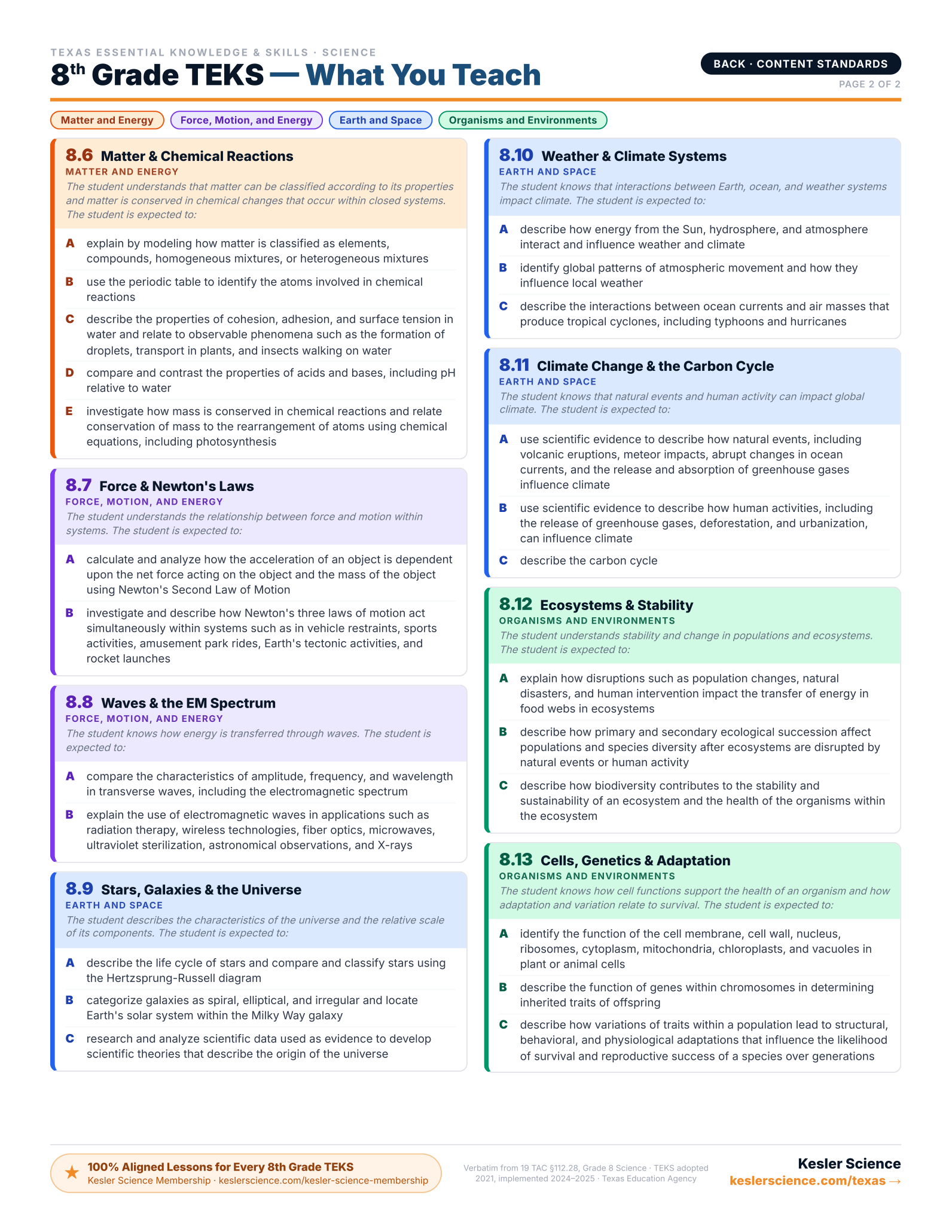
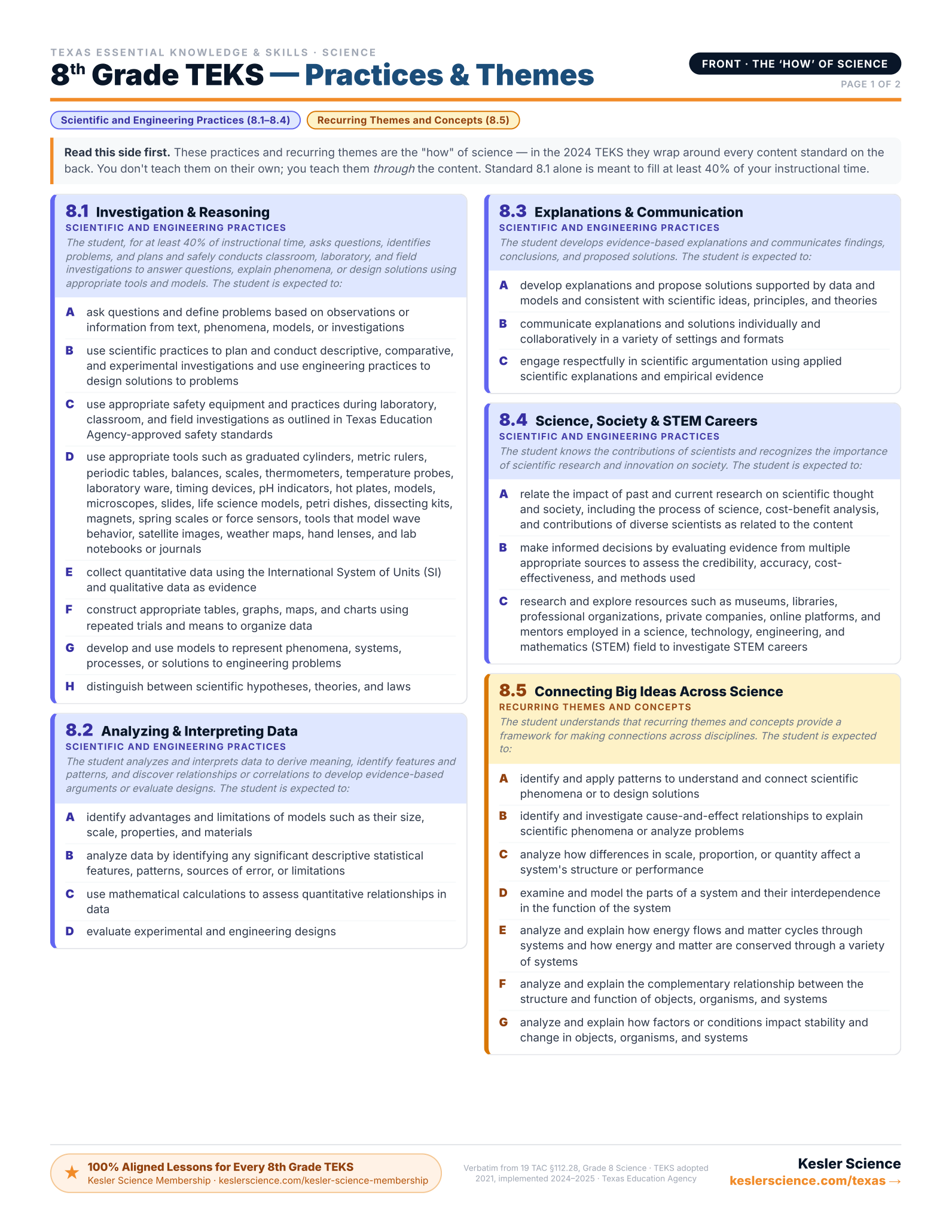
Every 8th-Grade Science TEKS on One Page
The color-coded, front-and-back cheat sheet I wish I'd had — every standard, organized by reporting category. Print it and reference it all year long. This will be your new favorite document!
Trusted Across Texas
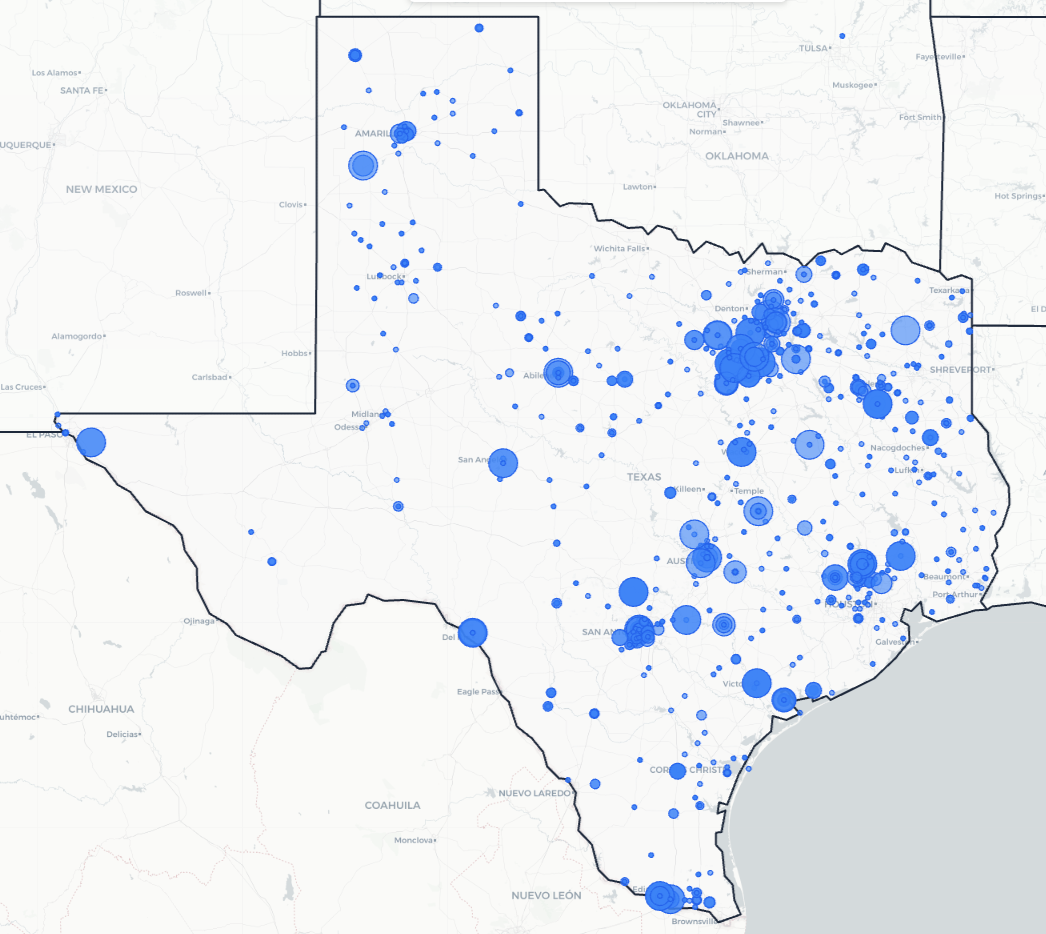
From the Rio Grande Valley to the Panhandle, Texas science teachers are using Kesler Science to save time and engage students.
Texas Schools and Districts
Love Kesler Science
What Teachers Are Saying
Give Your Science Teachers Everything They Need
School and district licenses give your teachers access to every resource they need, including station labs, inquiry labs, anchoring phenomena, presentations, escape rooms, and much more. One purchase covers the grade levels you need.
- PO-friendly. We accept purchase orders
- Volume discounts for 11+ teachers
- Complimentary Kesler Science Plus orientation for 4+ teachers
- Three free implementation PD sessions for departments of 11+
- Aligned to the 2024 TEKS standards
See It in Action
Book a walkthrough and we'll show you how Kesler Science fits your campus.
Book Demo CallNo pressure, no hard sell