.png?width=375&height=100&name=WebPage%20logo%20with%20curves%202026%20(8).png)
Transverse Waves
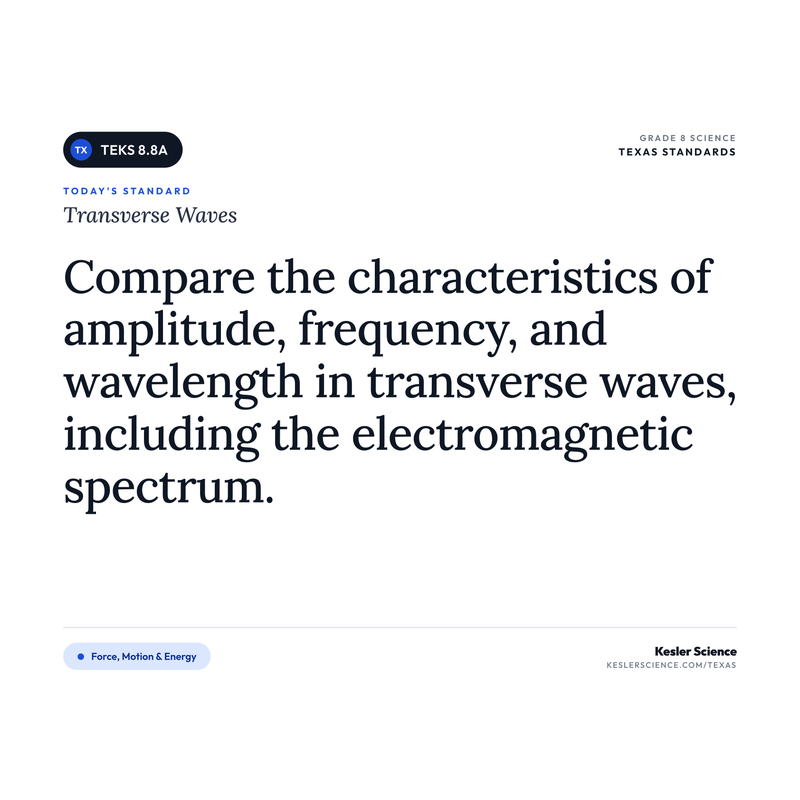
"Compare the characteristics of amplitude, frequency, and wavelength in transverse waves, including the electromagnetic spectrum."
💡 What This Standard Actually Means
"Compare". Students compare three characteristics of transverse waves: amplitude, frequency, and wavelength. The standard uses the word "including", which signals a required focus: the electromagnetic spectrum. So students compare how amplitude, frequency, and wavelength differ from one wave to another, and apply that comparison across the electromagnetic spectrum, from long-wavelength, low-frequency radio waves up to short-wavelength, high-frequency gamma rays. Students should be able to look at two transverse waves and compare their amplitude, frequency, and wavelength, then place different types of electromagnetic waves in order by those characteristics. Instruction can take many forms, such as labeled diagrams, wave comparisons, electromagnetic spectrum lineups, and short-answer explanations.
A transverse wave is one where the particles of the medium move perpendicular (at a right angle) to the direction the wave is traveling. Picture shaking a rope up and down. The wave moves along the rope, but the rope itself is moving up and down, not in the direction the wave travels. That perpendicular motion is what makes a wave transverse.
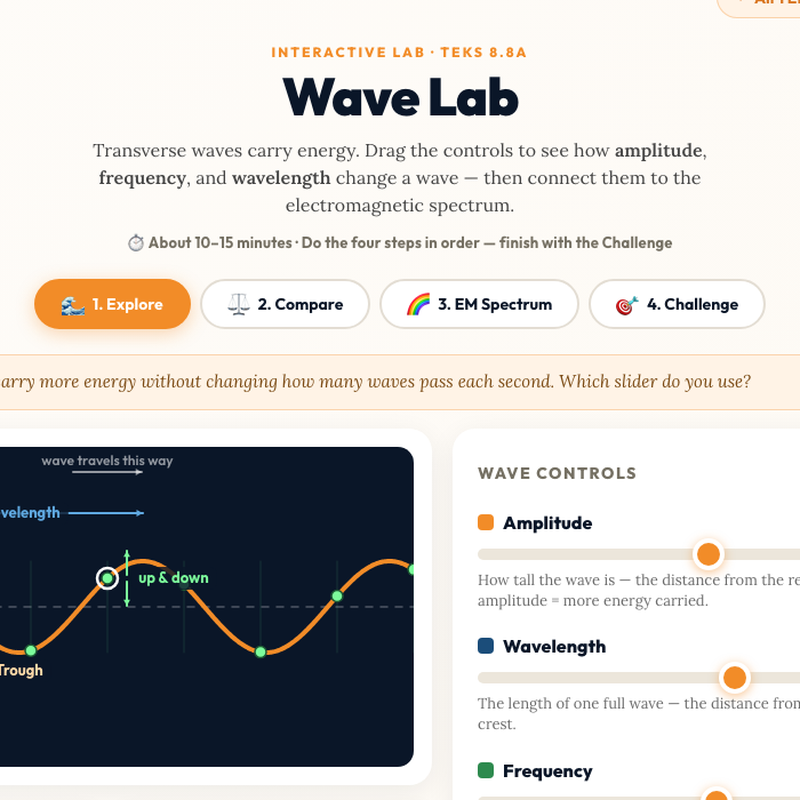
The crest is the highest point of the wave. The trough is the lowest point. Amplitude is the distance from the resting position up to a crest (or down to a trough) and relates to the energy the wave is carrying. Wavelength is the distance from one crest to the next crest (or from one trough to the next trough). Frequency is how many full waves pass a point in one second, measured in hertz (Hz).
Wave speed, wavelength, and frequency are tied together by the equation v = f × λ. A wave's speed is set by the medium it travels through, not by how hard you shake the rope. If the medium stays the same, a shorter wavelength goes with a higher frequency, and a longer wavelength goes with a lower frequency. Amplitude is a separate property that tells you about energy, not about speed.
The move that unlocked this standard for my students was a long piece of rope and a clear space on the floor. I'd hand one end to a student and hold the other. Shake slowly, and you get big, lazy waves with long wavelengths. Shake faster, and you get short, tight waves. Shake harder, and the amplitude goes up. We'd label a photo of the rope on the whiteboard and practice putting the vocabulary on the real thing before we ever drew a textbook wave. Once they had handled a transverse wave, the labeled diagrams made sense almost immediately. Textbook first doesn't work here. Rope first does.
⚠️ Misconceptions Your Students May Have
These are some of the most common misconceptions. Knowing what to look for can help you get ahead of them.
"The matter travels along with the wave"
This one is a big deal. The wave moves, but the medium doesn't travel with it. A seagull bobbing on the ocean goes up and down as each wave passes, but the bird doesn't get dragged to shore by the wave. The water particles move up and down while the wave itself moves forward. The energy travels. The matter mostly stays put.
"Bigger waves move faster than smaller waves"
Amplitude (the size of the wave) tells you about energy, not speed. In the same medium, a big wave and a small wave travel at the same speed. A louder sound wave doesn't move faster than a quieter one. A brighter light doesn't travel faster than a dimmer one. Wave speed depends on the medium. Amplitude depends on how much energy you gave the wave to start with.
"Wavelength and amplitude are the same thing"
These two get mixed up constantly. Wavelength is measured horizontally along the direction of travel, from one crest to the next crest (or one trough to the next trough). Amplitude is measured vertically, from the resting line up to a crest (or down to a trough). One describes the distance between repeating parts of the wave. The other describes how tall or deep the wave is.
"Higher frequency means the wave is taller"
Frequency and amplitude are independent. Higher frequency means more waves pass a point each second, which usually shows up as tighter wavelengths. It does not tell you anything about how tall those waves are. A tall wave can have low frequency, and a short wave can have high frequency. Students often conflate the two because both "get bigger" in casual language.
📓 Teaching Resources for 8.8A
These resources are aligned to this standard.



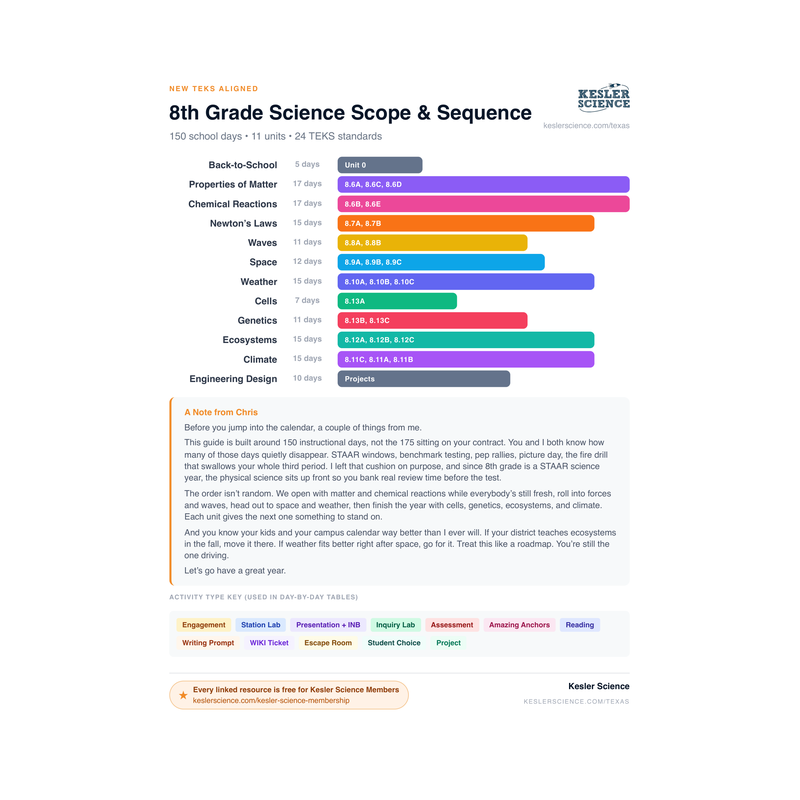
100% Aligned Lessons for Every TEKS You Teach
Kesler Science Plus puts thousands of ready-to-teach lessons and activities in your hands, so you can boost engagement and get your planning time back. Trusted by schools and districts all over the great state of Texas.
🌎 Phenomenon Ideas for 8.8A
Use these real-world phenomena to anchor your lesson. Show students the phenomenon first, let them wonder, then build toward Transverse Waves as the explanation.
A Surfer Waiting in the Lineup
A surfer sitting on their board rises up over each wave and then drops back down into the trough. They stay in roughly the same spot in the water, even though the waves keep rolling past them toward shore. Every so often a bigger wave lifts them higher than the others. What is actually moving here, the water or just the energy?
"If the waves are moving toward the beach, why doesn't the surfer end up on the beach without paddling? What does that tell you about how transverse waves carry energy through water?"
Dropping a Pebble Into a Still Pond
Toss a small pebble into a calm pond and circular ripples spread outward from the splash. If a leaf is floating nearby, it bobs up and down as the ripples pass but stays roughly in the same spot. Drop a bigger rock from higher up and the ripples are taller and reach farther.
"What changes about the ripples when you drop a bigger rock? What stays the same? Use the words amplitude, wavelength, and frequency in your answer."
A Guitar String Being Plucked
Pluck a guitar string hard and it vibrates in a big, visible wave. Pluck it gently and it still vibrates, but the motion is small. Press your finger on a fret and pluck the same string. It vibrates faster and produces a higher note. The string is making a transverse wave you can see with your eyes.
"A hard pluck and a soft pluck both make the same note on the same string. What is different about those two waves? What is the same? Now what changes when you shorten the string with your finger on the fret?"
💡 Free Engagement Ideas for 8.8A
Ready-to-run activities you can drop straight into a lesson. Where one of these looks like a phenomenon from the section above, that is on purpose: show it first as the hook, then let students run it themselves.
Rope Wave Lab
Stretch a long jump rope across the floor with two students holding the ends. One student creates transverse waves by moving their hand up and down. Groups record what happens when they move slowly (low frequency, long wavelength), quickly (high frequency, short wavelength), gently (low amplitude), and hard (high amplitude). They label a photo of each wave with the correct vocabulary.
Slinky Wave Demonstration
Stretch a Slinky across a smooth floor. Have one student flick their end side-to-side to create a transverse wave. Students observe that each coil moves back and forth, perpendicular to the direction the wave is traveling. They measure the wavelength using the floor tiles as a ruler and count how many times a single coil moves back and forth in 10 seconds, then divide by 10 to get the frequency in waves per second (Hz). Ten seconds is easier to count accurately than one.
Water Ripple Tank
Fill a clear baking pan with a shallow layer of water on top of a white sheet of paper. Dip the tip of a pencil gently into the water at one end and rock it rhythmically. Students watch the ripples travel across the pan. They change the speed (frequency) of the rocking and the size of the dip (amplitude) and sketch what they see each time.
Wave in a Bottle
Fill a clear plastic bottle about two-thirds with water and a few drops of food coloring, then fill the rest with baby oil. Cap it tightly and tape the cap. Tip the bottle gently side to side and students watch the traveling wave at the boundary between the two liquids. Groups label the crests, troughs, and amplitude of the visible wave on a sketch.
🎯 What Approaches, Meets, and Masters Thinking Look Like
Here is what student thinking at each level looks like on this one task, so you know what to look for and how to move a student up.
Two transverse waves, Wave A and Wave B, are drawn on the same axis. Wave A is tall with crests spread far apart. Wave B is short with crests packed close together. Draw and label the amplitude, wavelength, frequency, crest, and trough on each wave, then compare the two waves on all three characteristics. Finally, use those same three characteristics to place radio waves, visible light, and gamma rays in order on the electromagnetic spectrum, and explain how you ordered them.
- Amplitude labeled vertically, from the resting line up to a crest (or down to a trough), on each wave.
- Wavelength labeled horizontally, from one crest to the next crest (or trough to trough), on each wave.
- Crest and trough labeled correctly as the highest and lowest points.
- A comparison that keeps the three characteristics separate: Wave A has greater amplitude, longer wavelength, and lower frequency than Wave B.
- Frequency tied to wavelength in the same medium (closer crests means more waves pass per second, so higher frequency), not tied to how tall the wave is.
- The electromagnetic spectrum ordered by wavelength and frequency: radio (long wavelength, low frequency), then visible light, then gamma rays (short wavelength, high frequency).
- Amplitude kept out of the frequency comparison. Treating a taller wave as automatically higher frequency is the easiest place to slip.
Wave A is the tall one and Wave B is the short one. Wave A has a bigger amplitude and a bigger wavelength because it's taller. Wave B is shorter so it has less of everything. Wave A has a higher frequency too, because the bigger wave carries more, so radio waves must be the biggest and gamma rays the smallest.
Wave A has a bigger amplitude because it goes higher above the resting line. Wave A also has a longer wavelength because its crests are farther apart. Wave B has a shorter wavelength because its crests are close together, so more of Wave B's waves pass a point each second, which means Wave B has the higher frequency. Amplitude is up and down, wavelength is across, so they're not the same.
For the electromagnetic spectrum, radio waves have the longest wavelength and lowest frequency, gamma rays have the shortest wavelength and highest frequency, and visible light is in between.
Wave A has the greater amplitude and the longer wavelength, and Wave B has the higher frequency because its crests are packed closer together. Amplitude is separate from the other two. It tells you how much energy went into the wave, not how fast or how often the waves come. That's why Wave A being taller doesn't make it higher frequency.
On the electromagnetic spectrum, all the waves travel at the same speed, so wavelength and frequency trade off: a shorter wavelength always goes with a higher frequency. Radio waves are long and low frequency, gamma rays are short and high frequency. Using that same rule, a microwave belongs near the radio end because it has a long wavelength, and an X-ray belongs near the gamma end because it has a short wavelength and high frequency, even though neither one was in the original list.
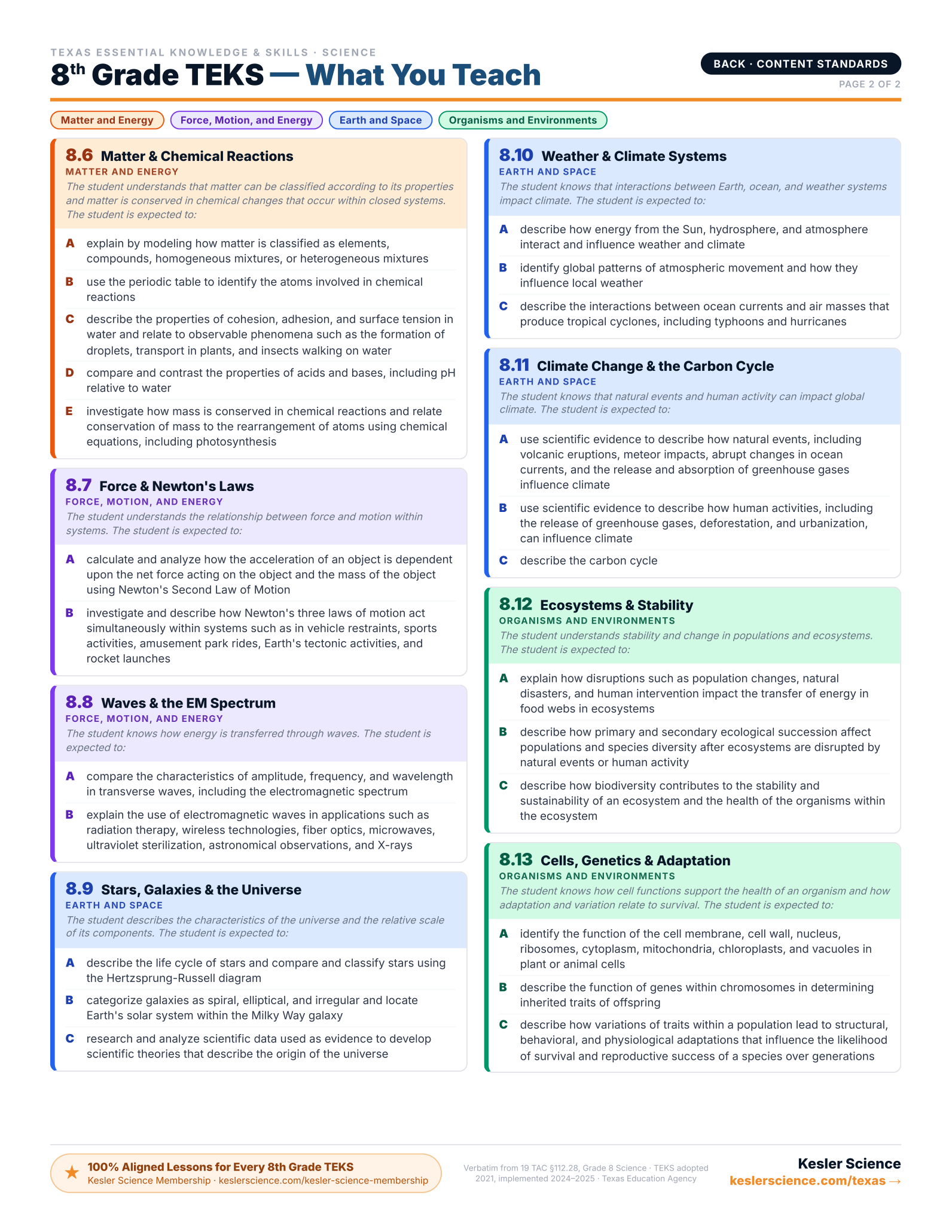
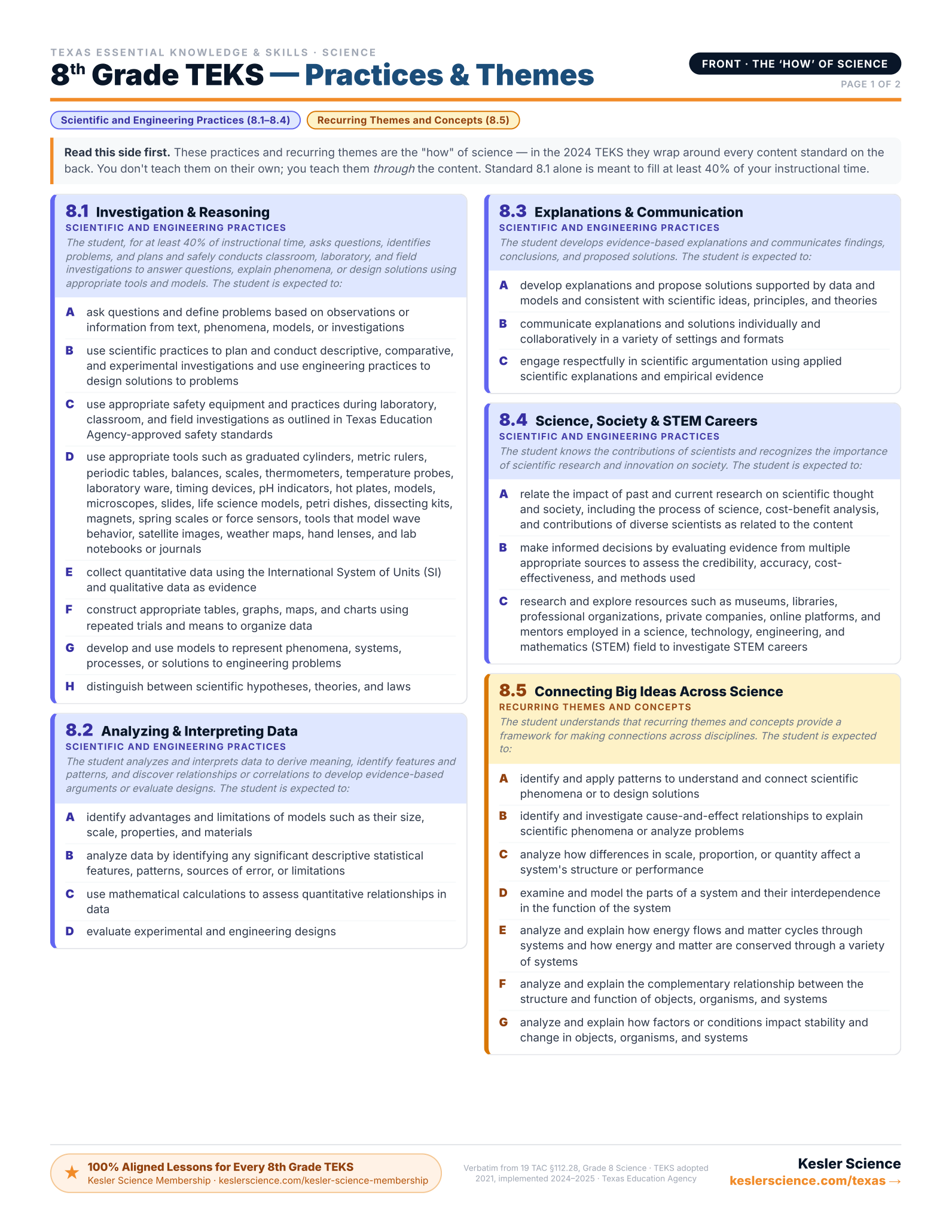
Every 8th-Grade Science TEKS on One Page
The color-coded, front-and-back cheat sheet I wish I'd had — every standard, organized by reporting category. Print it and reference it all year long. This will be your new favorite document!
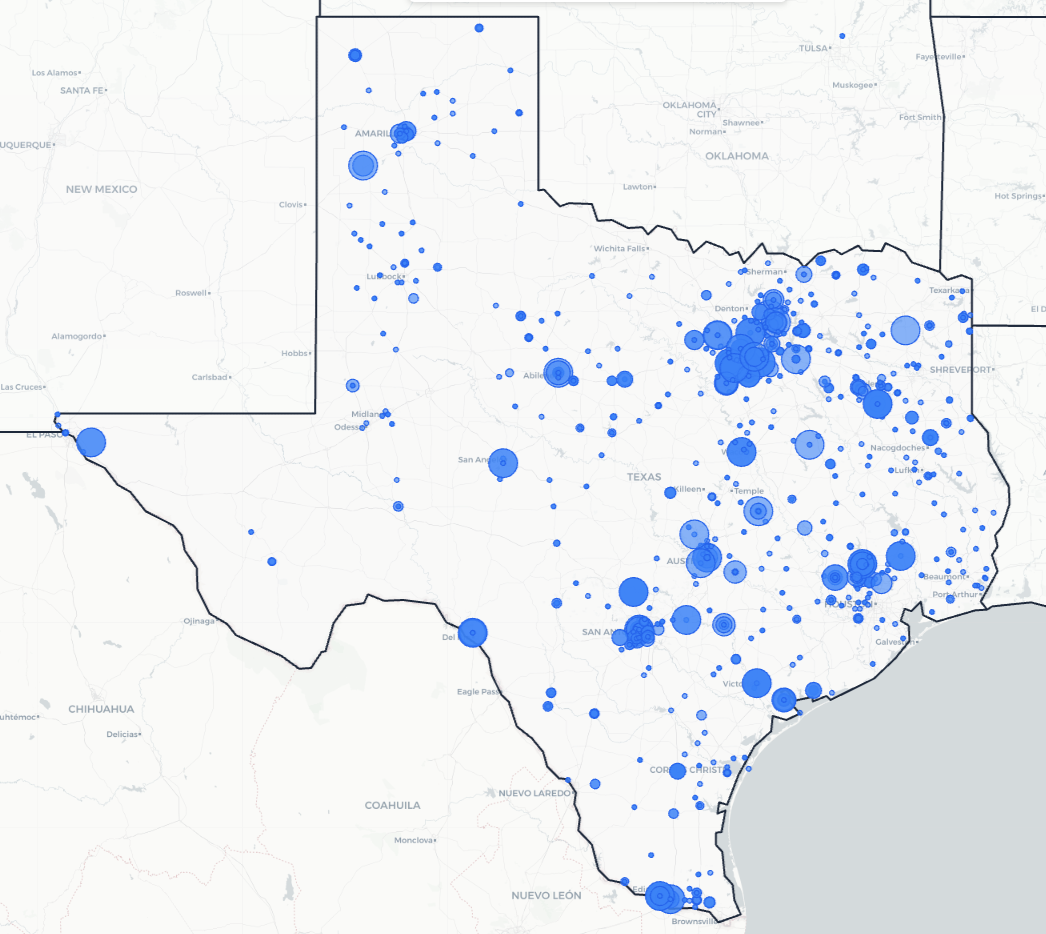
Trusted Across Texas
From the Rio Grande Valley to the Panhandle, Texas science teachers are using Kesler Science to save time and engage students.
Texas Schools and Districts
Love Kesler Science
What Teachers Are Saying
Give Your Science Teachers Everything They Need
School and district licenses give your teachers access to every resource they need, including station labs, inquiry labs, anchoring phenomena, presentations, escape rooms, and much more. One purchase covers the grade levels you need.
- PO-friendly. We accept purchase orders
- Volume discounts for 11+ teachers
- Complimentary Kesler Science Plus orientation for 4+ teachers
- Three free implementation PD sessions for departments of 11+
- Aligned to the 2024 TEKS standards
See It in Action
Book a walkthrough and we'll show you how Kesler Science fits your campus.
Book Demo CallNo pressure, no hard sell