.png?width=375&height=100&name=WebPage%20logo%20with%20curves%202026%20(8).png)
Laws of Motion in Systems
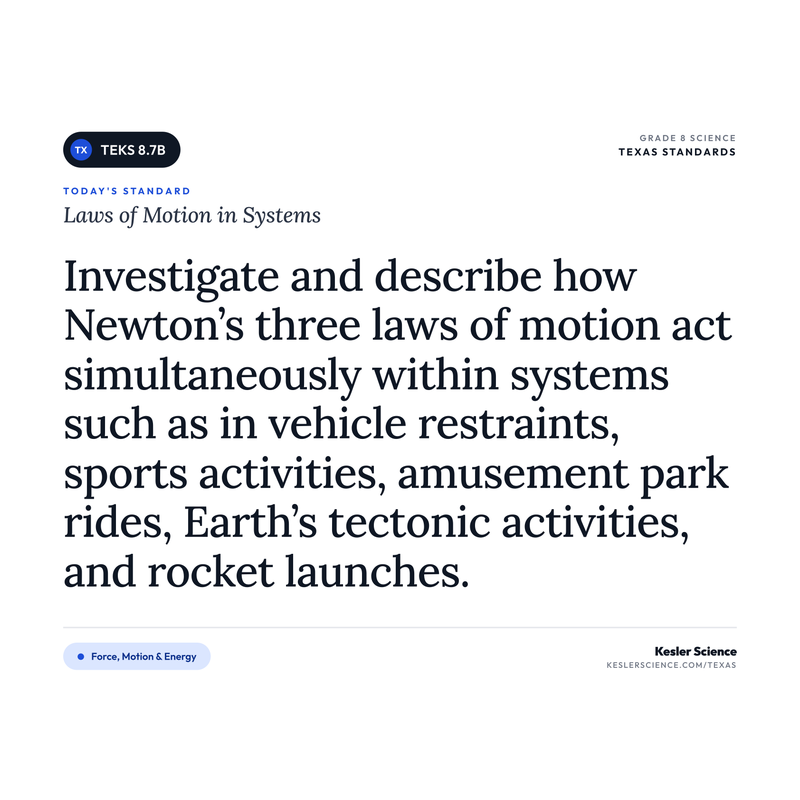
"Investigate and describe how Newton’s three laws of motion act simultaneously within systems such as in vehicle restraints, sports activities, amusement park rides, Earth’s tectonic activities, and rocket launches."
💡 What This Standard Actually Means
"Investigate and describe". Students investigate real systems and describe how all three of Newton's laws of motion act at the same time within them. The standard uses the words "such as", which means these are example contexts to choose from, not a required checklist: vehicle restraints, sports activities, amusement park rides, Earth's tectonic activities, and rocket launches. Students should be able to point to a single event and explain how inertia (first law), force and acceleration (second law), and action-reaction pairs (third law) are all happening together. Instruction can take many forms, such as case studies, labeled diagrams, system walk-throughs, and short-answer explanations tied to a specific scenario.
Newton's First Law says objects keep doing what they're doing unless a net force acts on them. An object at rest stays at rest. An object in motion keeps moving at the same speed and direction. This is inertia.
Newton's Second Law says the net force on an object equals its mass times its acceleration (F = ma). Bigger force, bigger acceleration. Bigger mass, smaller acceleration for the same force.
Newton's Third Law says for every action, there's an equal and opposite reaction. When object A pushes on object B, object B pushes back on object A with the same size of force in the opposite direction.
The real shift in 8.7B is that students stop looking at the laws one at a time and start analyzing systems where all three apply at once. A rocket launch involves all three. A football tackle involves all three. A car braking at a stoplight involves all three. Students should be able to pick a real-world system and walk through which law explains which part of what they're seeing.
The strategy that worked best for me was what I called "law hunting." I'd pull up a 30-second video clip, anything from a skateboarder landing a trick to a dog jumping off a couch, and the job was to spot all three laws in the same clip. Students would pause the video, point at what the skateboard was doing on the rail (first law), what happened when the skater pushed off the ramp (second law), and what the ground did back to the skateboard on landing (third law). Once they could find all three in one short clip, they stopped seeing the laws as a list to memorize and started seeing them as the script behind every motion they watched. That's what 8.7B is really asking them to do.
⚠️ Misconceptions Your Students May Have
These are some of the most common misconceptions. Knowing what to look for can help you get ahead of them.
"A rocket pushes off the ground to launch"
A rocket does not need the ground to push against. It works the same way in outer space, where there is nothing to push off of. The engine fires hot gas downward at high speed, and by Newton's Third Law, the gas pushes the rocket upward with an equal and opposite force. The rocket pushes the gas, and the gas pushes the rocket. That's the real action-reaction pair.
"When two objects collide, the heavier one hits the lighter one with more force"
This trips up a lot of students. By Newton's Third Law, the forces in a collision are equal in size. If a truck hits a bike, the truck pushes on the bike with the same size force that the bike pushes on the truck. The reason the bike gets wrecked and the truck doesn't isn't the force. It's the mass. The same force produces a huge acceleration on the small mass (the bike) and a tiny acceleration on the large mass (the truck). That's Newton's Second Law working on top of the Third Law.
"In sports, a ball stops moving because it runs out of force"
A ball doesn't carry a supply of force inside it. Once it leaves the player's hand, foot, or bat, the only forces acting on it are gravity, air resistance, and whatever it hits. The push from the hand or bat is already gone. It set the ball moving, but it does not travel with the ball. The ball slows down because friction and air resistance are pushing back on it. Newton's First Law says the ball would keep moving forever if nothing slowed it down, but in the real world, something almost always does.
"Seatbelts protect you because they hold you to the car"
Seatbelts are a Newton's First Law story. When a car stops suddenly, the car gets pushed backward by the crash, but your body keeps moving forward at the same speed because of inertia. A seatbelt applies a backward force on your body, slowing you down with the car so you don't keep moving into the windshield. The belt isn't holding you to the car. It's supplying the force that overcomes your inertia.
📓 Teaching Resources for 8.7B
These resources are aligned to this standard.


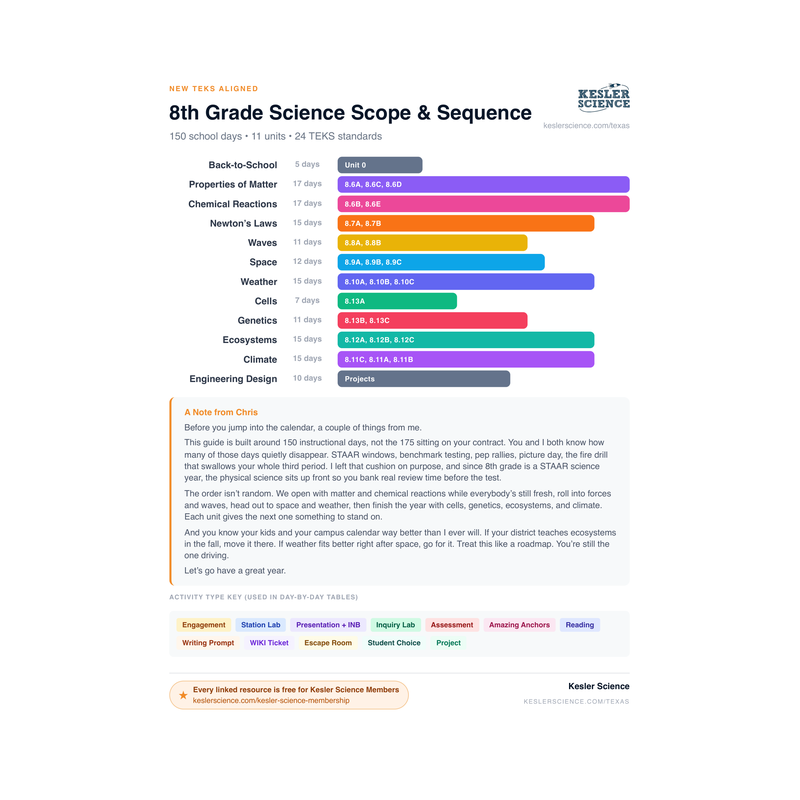
100% Aligned Lessons for Every TEKS You Teach
Kesler Science Plus puts thousands of ready-to-teach lessons and activities in your hands, so you can boost engagement and get your planning time back. Trusted by schools and districts all over the great state of Texas.
🌎 Phenomenon Ideas for 8.7B
Use these real-world phenomena to anchor your lesson. Show students the phenomenon first, let them wonder, then build toward Laws of Motion in Systems as the explanation.
A Rocket Launch
At liftoff, the rocket sits still on the pad. Engines ignite, hot gas shoots downward, and the rocket slowly starts to rise. Within seconds it's accelerating upward faster and faster. As fuel burns off, the rocket gets lighter, and the same engine thrust makes it accelerate even harder. Once it reaches space, it keeps moving with almost no engine on.
"Which of Newton's laws explains why the rocket accelerates faster as fuel burns off? Which one explains why hot gas shooting downward pushes the rocket upward? And once the engine is off in space, which law explains how the rocket keeps moving?"
A Sudden Stop at a Red Light
A driver is cruising along when a car pulls out in front of them. They slam on the brakes. The tires lock up, the car screeches to a stop, and everyone inside gets thrown forward into their seatbelts. A coffee cup on the dashboard flies across the car. The car is done moving. The stuff inside it doesn't get that memo.
"Use Newton's laws to explain three things at once: why the car stops when the brakes are applied, why the passengers keep moving forward after the car stops, and why a bigger car would have needed more force to stop in the same distance."
A Basketball Player Driving to the Hoop
A point guard dribbles up the court, then plants their foot and pushes hard off the floor to accelerate toward the basket. A defender steps in to block the path. The two players collide, and both end up stopped or pushed backward. Then the shooter launches the ball. The ball leaves their hand and arcs toward the hoop.
"Walk through this play and label where each of Newton's three laws shows up. Where do you see inertia? Where do you see force and mass driving acceleration? Where do you see equal and opposite forces?"
💡 Free Engagement Ideas for 8.7B
Ready-to-run activities you can drop straight into a lesson. Where one of these looks like a phenomenon from the section above, that is on purpose: show it first as the hook, then let students run it themselves.
Balloon Rocket Race
Thread a straw onto a long piece of fishing line stretched across the room. Tape a blown-up balloon (pinched shut) to the straw. Let it go. The balloon shoots along the line as air escapes out the back. Students explain the launch using all three laws: inertia before release, F = ma changing with different balloon sizes, and the action-reaction pair between escaping air and the balloon.
Toy Car Crash Test
Build a small ramp with books or a board. Roll two different toy cars down the ramp, one heavier and one lighter, and crash them into a tower of stacked cups or blocks. Students record which setup knocks down the most. They then explain each trial using Newton's laws (same starting speed, different masses, different crash outcomes).
Rolling Skateboard Pass
Have two students sit facing each other on identical office chairs with wheels, or on skateboards. They toss a medicine ball or heavy backpack back and forth. Each throw pushes the thrower backward. Students diagram the forces on both people and identify which law explains the backward motion. (Start slow, supervise, clear the space.)
Egg and Tablecloth
Set a plastic cup upside down on a piece of cloth on a smooth table. Place a cardboard circle on top of the cup and a plastic egg (or small weight) on the cardboard. Pull the cloth quickly straight out. The cup stays in place, and when you do it right, so does the egg (if balanced carefully). Students explain the outcome using Newton's First Law and relate it to seatbelt design and airbag timing.
🎯 What Approaches, Meets, and Masters Thinking Look Like
Here is what student thinking at each level looks like on this one task, so you know what to look for and how to move a student up.
A car traveling down the road runs a red light and crashes head-on into a parked delivery truck. A passenger in the car was wearing a seatbelt. Draw a labeled diagram of this system, then describe how all three of Newton's laws of motion are acting at the same time during the crash: the inertia of the passenger (first law), the force and acceleration on each vehicle (second law), and the action-reaction forces between the car and the truck (third law).
- A labeled diagram of the system, not just the two vehicles, with the passenger, the seatbelt, and force arrows shown.
- First law (inertia) used to explain why the passenger keeps moving forward when the car stops, and why the seatbelt is what slows them down.
- Second law (F = ma) used to explain why the same crash does very different damage to the car and the truck.
- Third law used to identify the action-reaction pair: the car pushes on the truck, and the truck pushes back on the car.
- An explanation that ties all three laws to the same event happening at once, not three separate stories.
- Force arrows that are correct in direction (the seatbelt pulls the passenger backward; the truck and car push on each other in opposite directions).
- The collision forces named as equal in size on both vehicles, with mass (not force) used to explain the different damage. That is the easiest place to slip.
When the car stops, the passenger keeps going forward because of inertia, so the seatbelt holds them back. That's the first law. The car was moving and the truck was parked. The car is heavier and faster, so it hits the truck with more force than the truck hits the car back. That's why the car wins the crash and the truck gets pushed.
First law: when the car suddenly stops, the passenger keeps moving forward at the same speed because of inertia, and the seatbelt puts a backward force on them to slow them down with the car. Second law: the same crash force gives the lighter car a big acceleration (a lot of damage) and the heavier truck a small acceleration (less damage), because F = ma. Third law: the car pushes on the truck, and the truck pushes back on the car with an equal and opposite force. All three are happening in the same instant of the crash.
All three laws are really describing the same instant from different angles. Inertia (first law) explains why the passenger keeps moving when the car stops, so the seatbelt has to supply the force that overcomes that inertia. The third law says the car and truck push on each other with equal and opposite forces. The second law then explains the outcome: that same size force divided by a small mass gives a big acceleration, and divided by a big mass gives a small acceleration, which is why the lighter car takes the worse hit even though the forces were equal.
The same three-law combination shows up in a rocket launch. The engine pushes hot gas downward, and by the third law the gas pushes the rocket upward with an equal force (it doesn't push off the ground, which is why it still works in space). That upward force divided by the rocket's mass gives its acceleration (second law), and as fuel burns the mass drops, so the same thrust produces more acceleration. The rocket would just sit there by inertia (first law) until that unbalanced thrust force gets it moving.
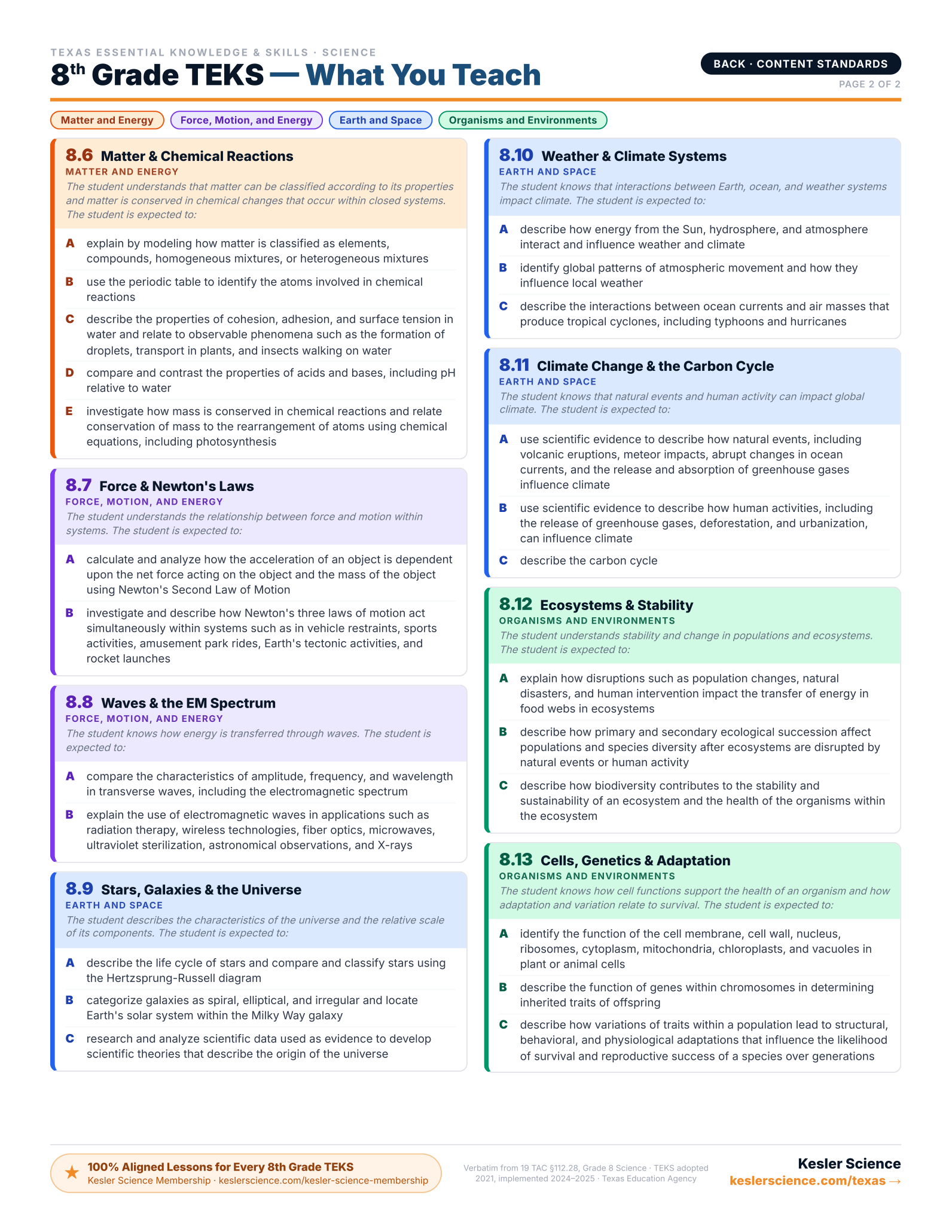
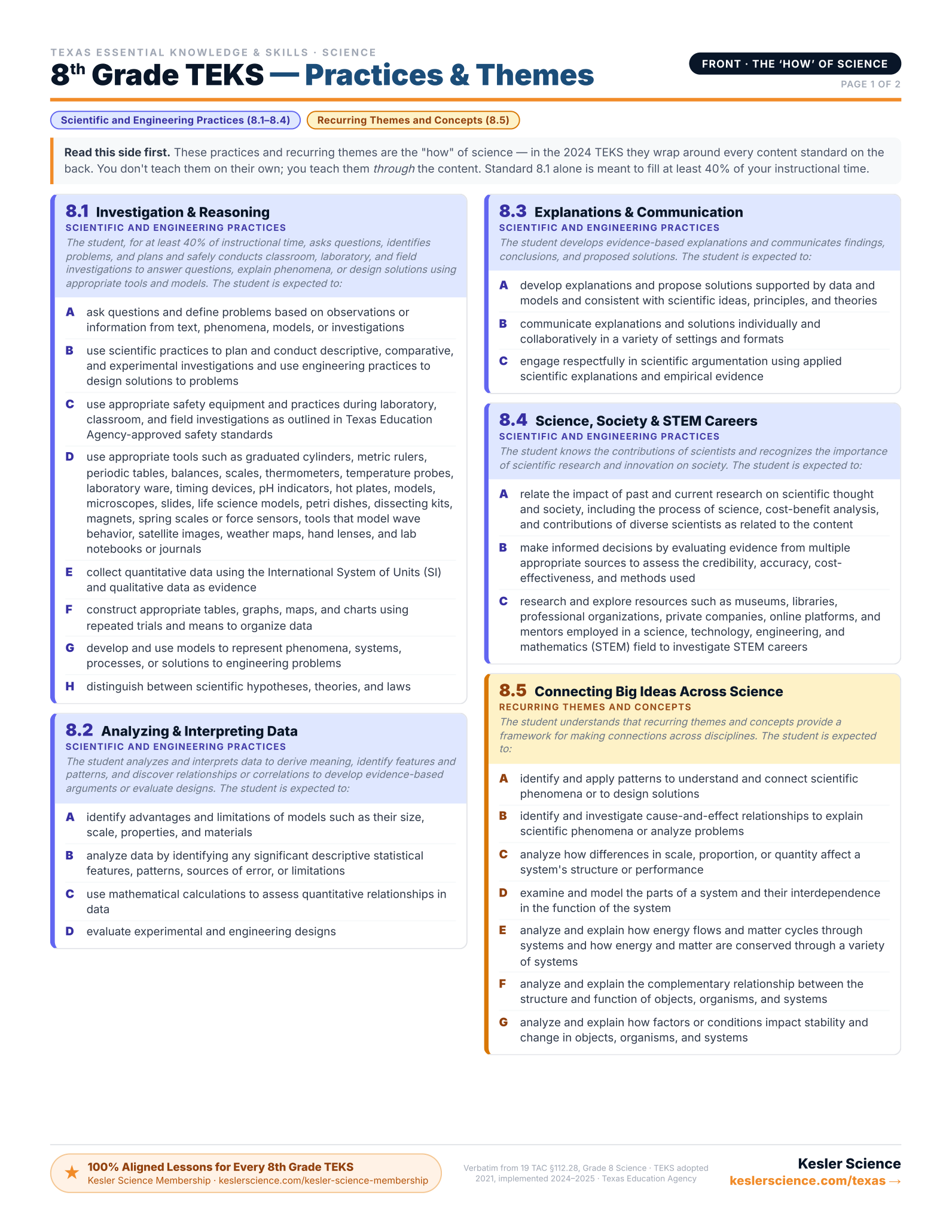
Every 8th-Grade Science TEKS on One Page
The color-coded, front-and-back cheat sheet I wish I'd had — every standard, organized by reporting category. Print it and reference it all year long. This will be your new favorite document!
Trusted Across Texas
From the Rio Grande Valley to the Panhandle, Texas science teachers are using Kesler Science to save time and engage students.
Texas Schools and Districts
Love Kesler Science
What Teachers Are Saying
Give Your Science Teachers Everything They Need
School and district licenses give your teachers access to every resource they need, including station labs, inquiry labs, anchoring phenomena, presentations, escape rooms, and much more. One purchase covers the grade levels you need.
- PO-friendly. We accept purchase orders
- Volume discounts for 11+ teachers
- Complimentary Kesler Science Plus orientation for 4+ teachers
- Three free implementation PD sessions for departments of 11+
- Aligned to the 2024 TEKS standards

See It in Action
Book a walkthrough and we'll show you how Kesler Science fits your campus.
Book Demo CallNo pressure, no hard sell