.png?width=375&height=100&name=WebPage%20logo%20with%20curves%202026%20(8).png)
Matter & Kinetic Energy
"Compare solids, liquids, and gases in terms of their structure, shape, volume, and kinetic energy of atoms and molecules."
💡 What This Standard Actually Means
"Compare". Students are looking at solids, liquids, and gases side by side and explaining how they're alike and how they're different. The standard tells you exactly which features to focus on: structure (how the particles are arranged), shape (whether the substance holds its own shape or takes the shape of its container), volume (whether it has a fixed amount of space or fills whatever it's in), and kinetic energy of atoms and molecules (how much the particles are moving). Students should be able to take any everyday substance and place it in the right state with reasons. Instruction can take many forms, such as particle model drawings, sorting cards, T-charts, hands-on observation stations, and short writing prompts.
All matter is made of tiny particles, and those particles are always moving. The energy of that motion is called kinetic energy. The state a substance is in (solid, liquid, or gas) comes down to how its particles are arranged and how much they're moving.
In a solid, particles are packed close together in a fixed structure, vibrating in place. That's why a solid keeps its own shape and its own volume. A textbook on a desk doesn't change shape or get bigger just because you move it. In a liquid, particles still touch but they slide past each other freely. A liquid takes the shape of whatever container it's in, but the volume stays the same. Pour 250 mL of juice into a tall glass or a wide bowl and you still have 250 mL. In a gas, particles have so much kinetic energy that they break away from each other and zip around with lots of space in between. A gas spreads out to fill its whole container, so neither shape nor volume is fixed.
The pattern that ties it together is energy. Solids have the lowest particle kinetic energy. Liquids have more. Gases have the most. Add energy (heat) and particles speed up enough to push a substance from solid to liquid to gas. Take energy away and the particles slow back down. Students should walk away able to compare any two states using structure, shape, volume, and particle motion.
The demo that never missed for me was the food coloring race. I'd put two clear cups on the front table, one with ice water and one with hot tap water. Same dropper, one drop of food coloring in each, same time. The hot cup turned dark in seconds while the cold cup took forever. Kids would lean in, and that's when I'd drop the word particles. "What's going on in the hot cup that isn't happening in the cold one?" Then we'd sketch particle diagrams for each. That one demo did more work for me on this standard than any lecture slide ever did.
⚠️ Misconceptions Your Students May Have
These are some of the most common misconceptions. Knowing what to look for can help you get ahead of them.
"Particles in a solid aren't moving at all"
Students see a rock or an ice cube and assume the particles inside are frozen in place. Particles in a solid are still vibrating, just in a tight, fixed arrangement. They're not free to move around, but they're not sitting still either. Drawing a solid as dots with tiny jiggle marks helps this stick.
"Heat and temperature are the same thing"
This one trips up even older students. Temperature measures the average kinetic energy of particles. Heat is the transfer of energy from one substance to another because of a temperature difference. A lit match has a higher temperature than a bathtub of warm water, but the bathtub has way more total heat energy because it has far more particles.
"Gases don't have any mass"
Because gas particles spread out and can't usually be seen, students often decide a gas isn't really there. But gases are made of particles with mass, just spread far apart. A flat basketball and a fully inflated one have different masses because of the air inside. Weighing both on a sensitive scale makes the point fast.
"When a liquid boils, the particles change into something new"
Students sometimes think the steam rising off boiling water is a different substance. Liquid water and water vapor are both made of the same water particles. The particles didn't change, they just gained enough energy to separate and move as a gas. Same particles, different amount of kinetic energy.
📓 Teaching Resources for 6.6A
These resources are aligned to this standard.


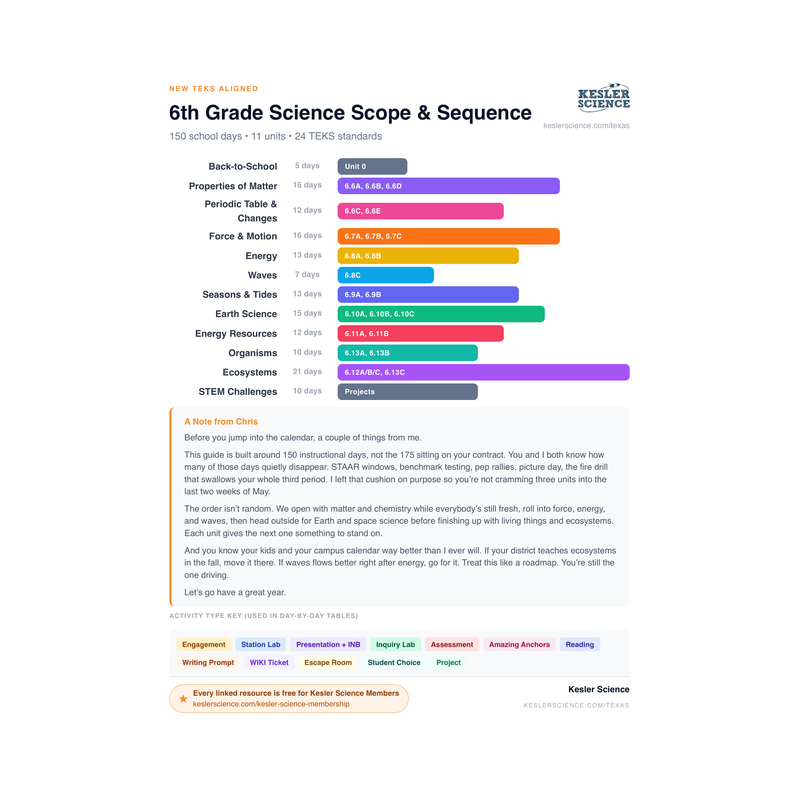
100% Aligned Lessons for Every TEKS You Teach
Kesler Science Plus puts thousands of ready-to-teach lessons and activities in your hands, so you can boost engagement and get your planning time back. Trusted by schools and districts all over the great state of Texas.
🌎 Phenomenon Ideas for 6.6A
Use these real-world phenomena to anchor your lesson. Show students the phenomenon first, let them wonder, then build toward Matter & Kinetic Energy as the explanation.
Steam Rising Off a Hot Cup of Coffee
Pour hot coffee into a mug and you can see wispy steam drifting upward. Let the cup sit for 20 minutes and the steam goes away, even though there's still liquid in the cup. A glass of ice water sitting right next to it doesn't make any steam at all. The same water particles can behave in wildly different ways depending on what's going on with their energy.
"The hot coffee and the ice water are both mostly water. Why does steam come off one and not the other? What's different about the particles in each cup?"
Popcorn in the Microwave
A hard kernel sits quiet on the counter. Drop it in the microwave for two minutes and it explodes open. Inside each kernel is a tiny bit of water. When the microwave heats the kernel, the water particles inside gain so much energy that they push the hard shell from the inside until it bursts.
"The kernel didn't move when it was on the counter. What changed about the water particles inside it when the microwave turned on? Why did that cause the shell to burst?"
A Deflated Ball Left in a Hot Car
You leave a slightly soft basketball in the backseat on a hot Texas afternoon. Come back a few hours later and the ball feels firmer. Nobody pumped any new air in. Same ball, same air inside, but the pressure pushing outward has changed. Something about the particles has to be different.
"No air was added to the ball. So how did it get firmer? What happened to the air particles inside when the car heated up?"
💡 Free Engagement Ideas for 6.6A
Ready-to-run activities you can drop straight into a lesson. Where one of these looks like a phenomenon from the section above, that is on purpose: show it first as the hook, then let students run it themselves.
Food Coloring Race
Set up two clear cups, one with ice water and one with hot tap water. At the same instant, drop one drop of food coloring in each. Students time how long it takes for the color to spread evenly. The hot cup wins every time because its particles are moving faster and bump into the dye particles more often.
Balloon on a Bottle
Stretch a deflated balloon over the mouth of a plastic bottle. Place the bottle in a bowl of hot tap water for a few minutes and watch the balloon inflate. Then move it to ice water and watch it collapse. The air didn't leave or enter. Particle motion just changed.
Particle Dance Simulation
Clear a space in the room. Students become particles. In "solid mode" they stand in a tight grid and jiggle in place. In "liquid mode" they stay close but slide past each other. In "gas mode" they spread out and move freely. Call out states and temperatures and have them adjust.
Bag Full of Smell
Place a strong-smelling item (orange peel, vanilla, coffee grounds) in a sealed plastic bag. Pass the bag around. Students can't smell it through the plastic. Then open the bag at one end of the room and time how long it takes students in the back to smell it. Discuss how gas particles have to travel through the air to reach their noses.
🎯 What Approaches, Meets, and Masters Thinking Look Like
Here is what student thinking at each level looks like on this one task, so you know what to look for and how to move a student up.
Look at an ice cube (a solid) and the liquid water it melts into. Draw a particle model for each one. Then use your models to compare the solid and the liquid. Tell how the particles are arranged, whether each one keeps its own shape, and how much the particles are moving (their kinetic energy).
- A particle model for both the ice and the water that shows individual particles, not just a labeled cube or cup.
- The ice modeled as particles packed close together in a neat, fixed arrangement.
- The liquid water modeled as particles that still touch but are spread a little looser and can slide past each other.
- A clear statement that the ice keeps its own shape but the water takes the shape of its container.
- A comparison of kinetic energy: the liquid particles are moving more than the solid particles.
- An explanation that ties it together: adding energy (heat) made the particles speed up, which is why the solid turned into a liquid.
- The solid particles shown as still moving (vibrating in place), not frozen still. That is the easiest place to slip.
The ice is a solid so it keeps its shape. The water is a liquid so it spreads out and takes the shape of the cup. In the ice the particles are packed together and they hold still. In the water the particles are moving and that is why it can pour.
In the ice the particles are packed close together in a fixed pattern. They are still moving, but they only vibrate in place, so the ice keeps its own shape. In the water the particles still touch but they slide past each other, so the water takes the shape of the cup. The water particles have more kinetic energy than the ice particles because they move around more.
In the ice the particles are packed close and only vibrate in place, so it keeps its shape. When you add heat, the particles gain kinetic energy and speed up. That is why the ice melts into water, where the particles slide past each other and the water takes the shape of the cup. The particles did not change, they just move more.
The real pattern is that more energy means more particle motion. So if you keep heating the water until it boils, the particles get so much kinetic energy that they break apart and spread out into a gas. That is what steam is. It is still the same water particles, just moving fast with lots of space between them, so a gas fills its whole container instead of keeping a shape.
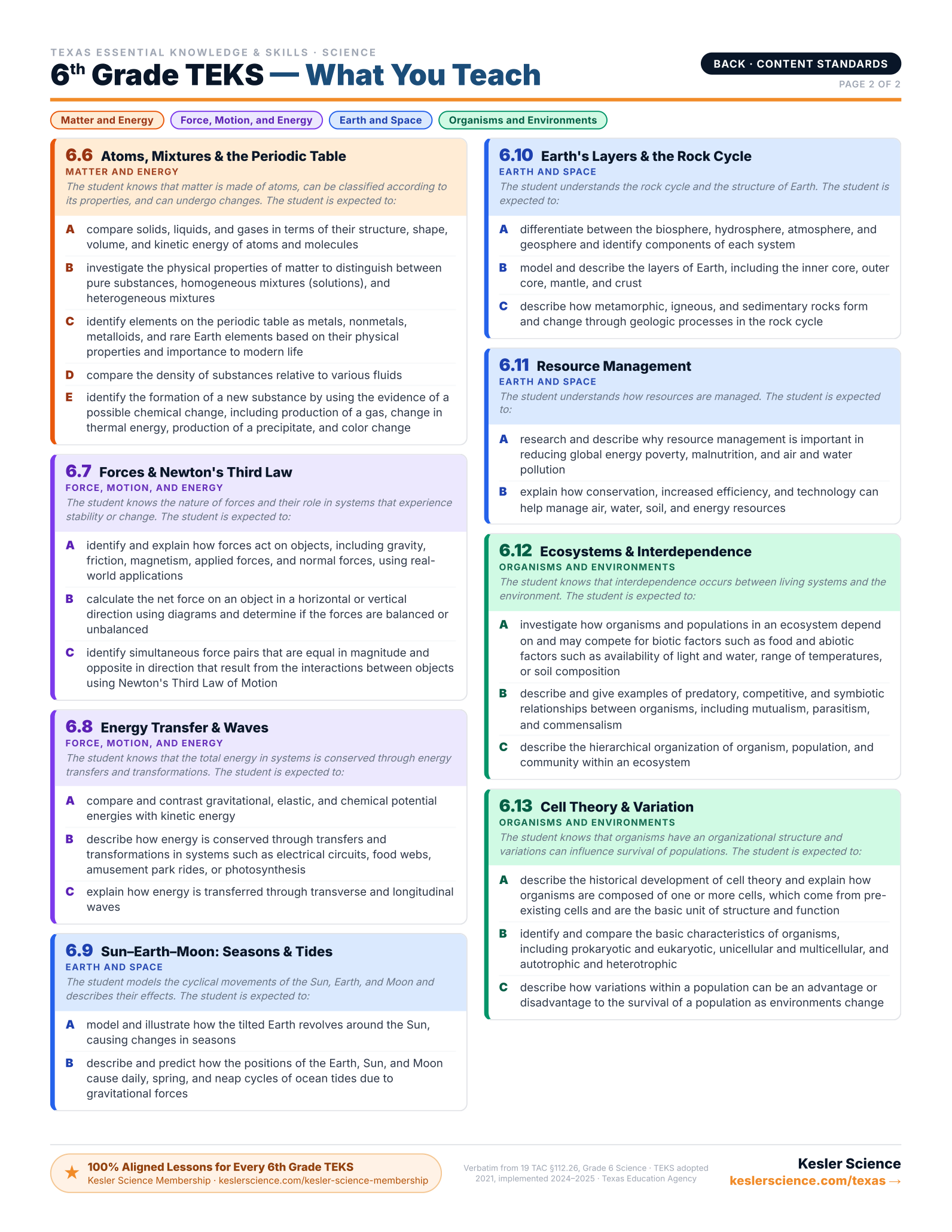
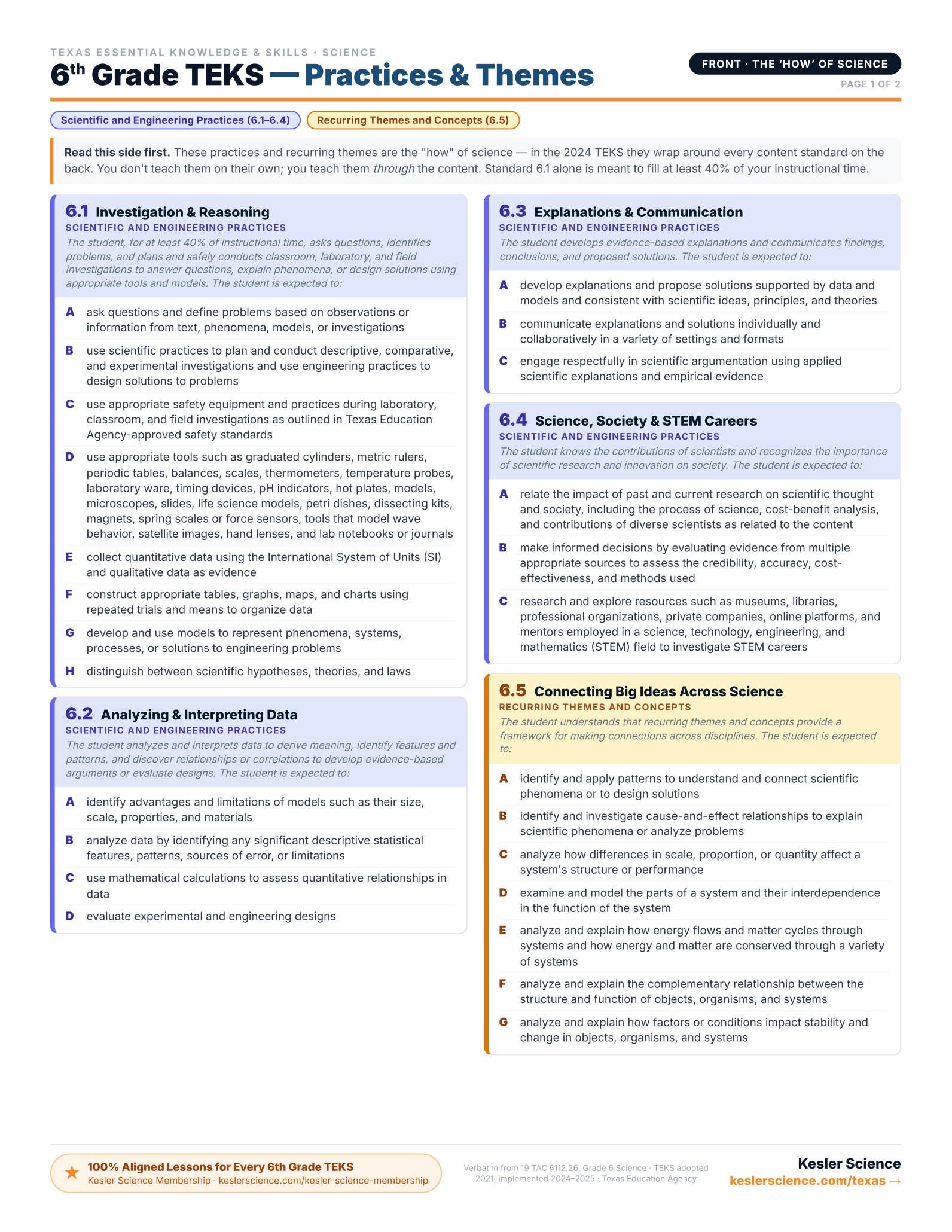
Every 6th-Grade Science TEKS on One Page
The color-coded, front-and-back cheat sheet I wish I'd had — every standard, organized by reporting category. Print it and reference it all year long. This will be your new favorite document!
Trusted Across Texas
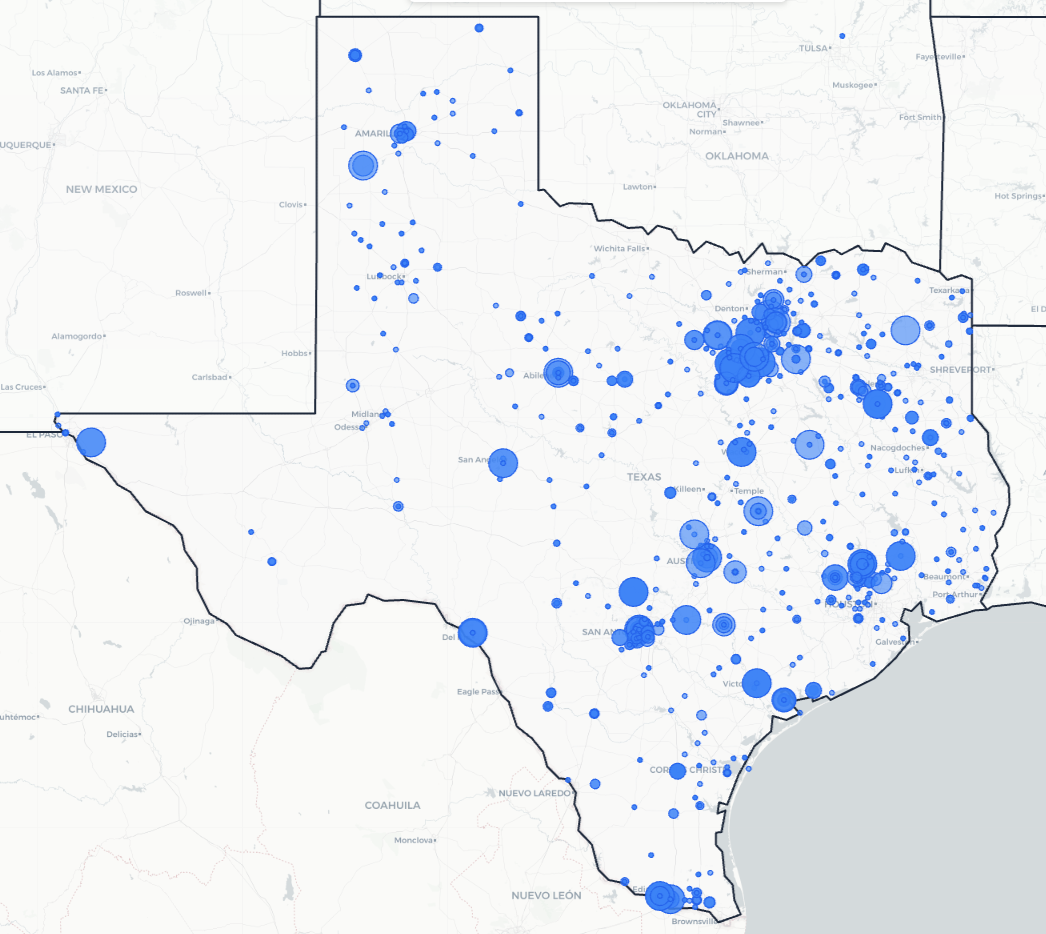
From the Rio Grande Valley to the Panhandle, Texas science teachers are using Kesler Science to save time and engage students.
Texas Schools and Districts
Love Kesler Science
What Teachers Are Saying
Give Your Science Teachers Everything They Need
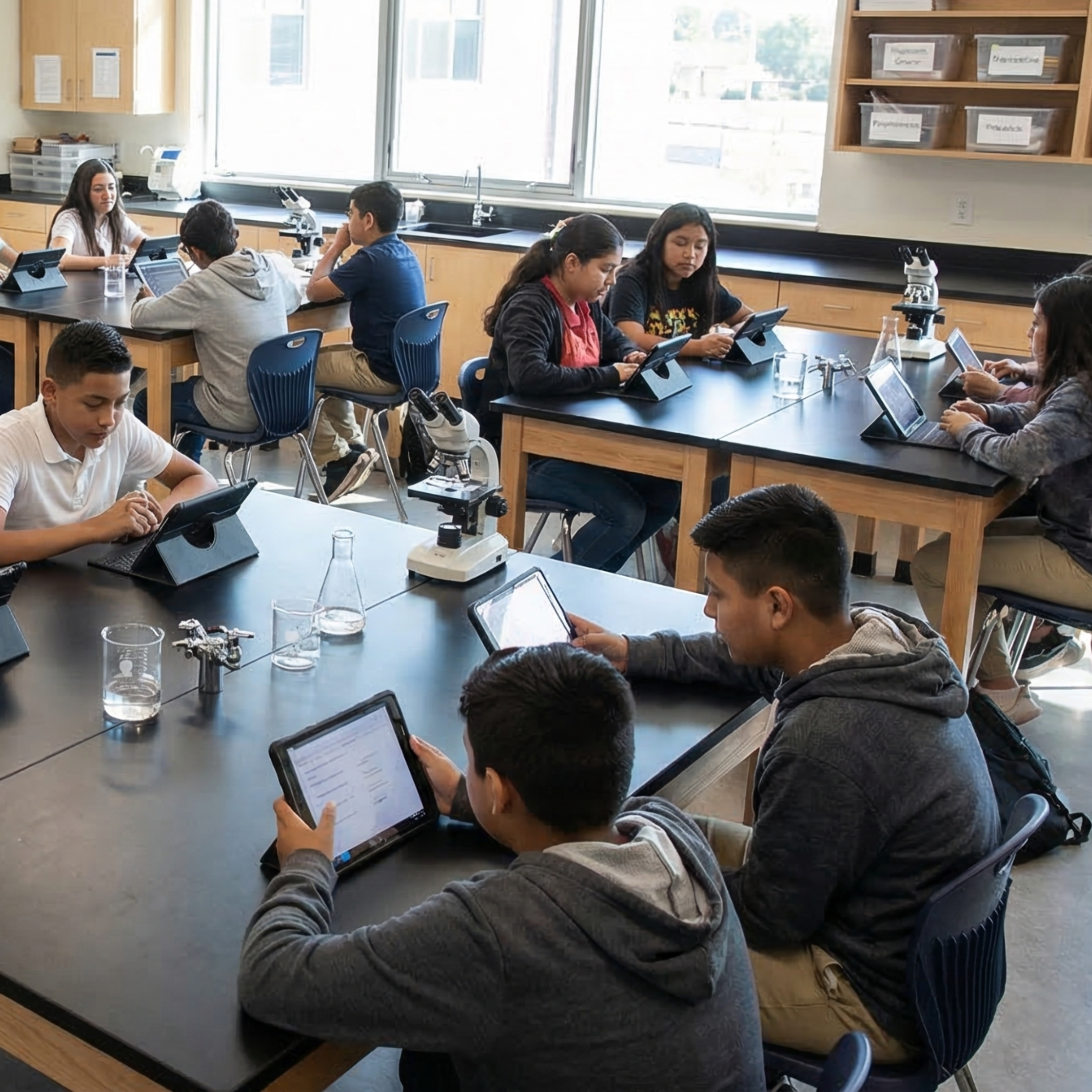
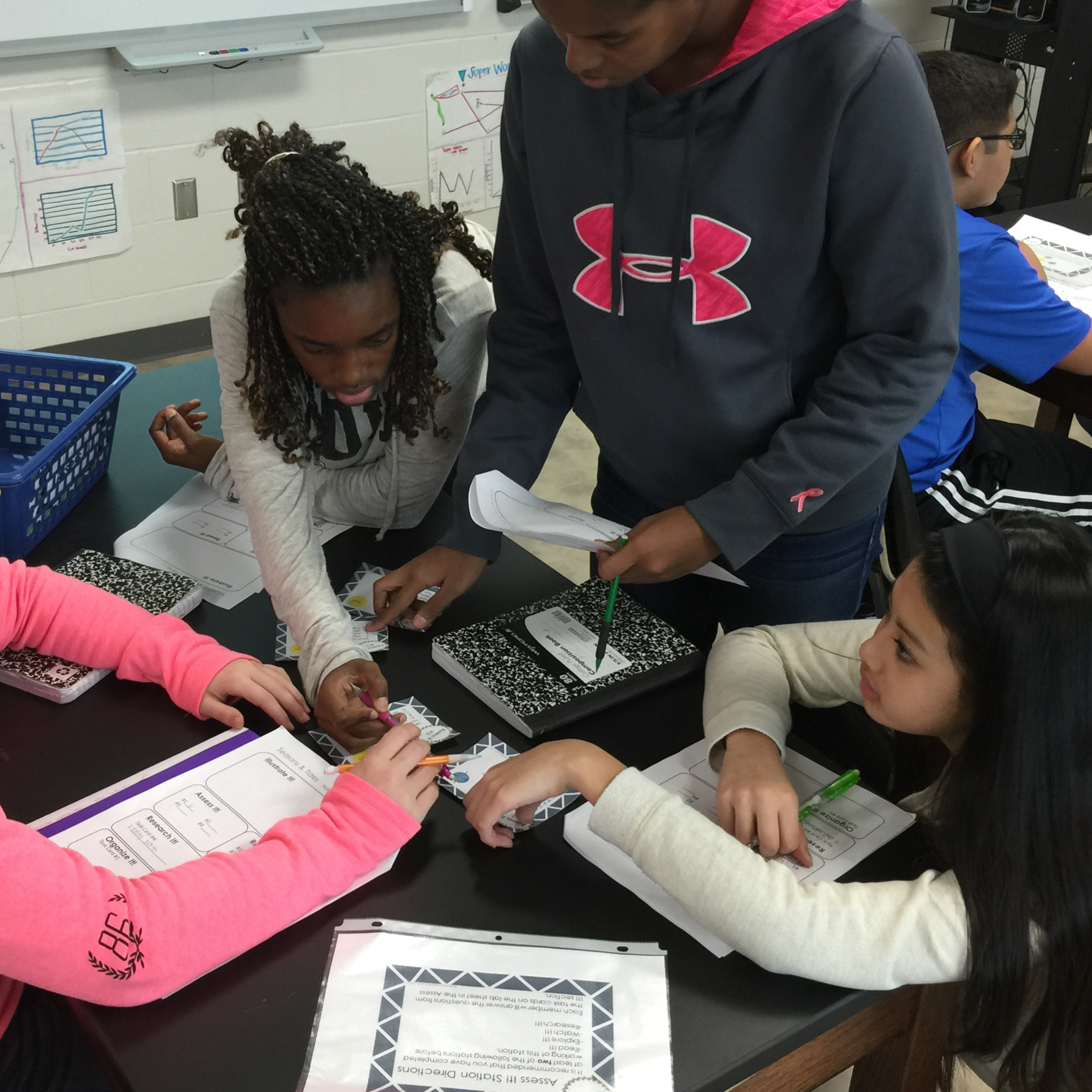
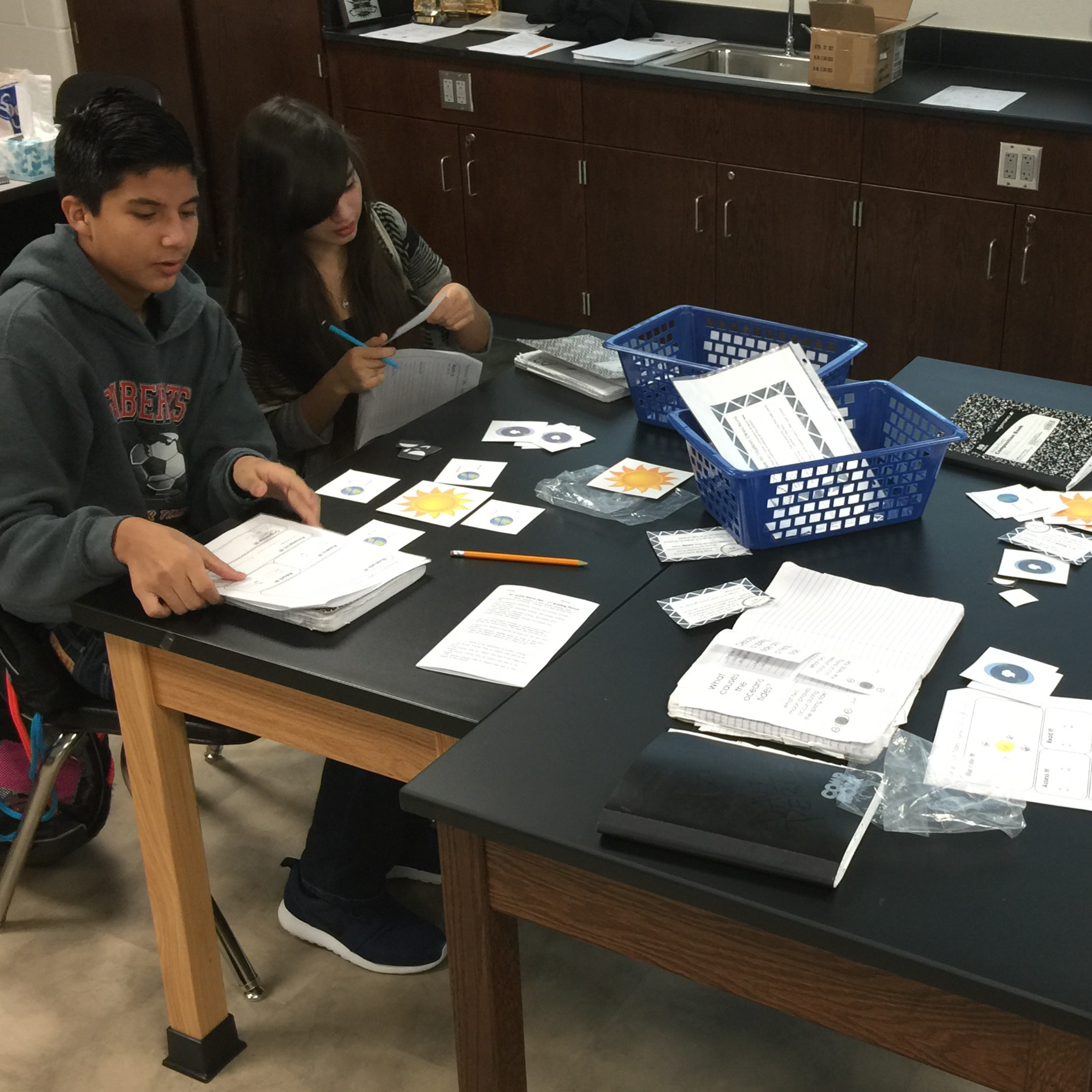
School and district licenses give your teachers access to every resource they need, including station labs, inquiry labs, anchoring phenomena, presentations, escape rooms, and much more. One purchase covers the grade levels you need.
- PO-friendly. We accept purchase orders
- Volume discounts for 11+ teachers
- Complimentary Kesler Science Plus orientation for 4+ teachers
- Three free implementation PD sessions for departments of 11+
- Aligned to the 2024 TEKS standards
See It in Action
Book a walkthrough and we'll show you how Kesler Science fits your campus.
Book Demo CallNo pressure, no hard sell