.png?width=375&height=100&name=WebPage%20logo%20with%20curves%202026%20(8).png)
Atmospheric Movement
"Identify global patterns of atmospheric movement and how they influence local weather."
💡 What This Standard Actually Means
"Identify". Students recognize global patterns of atmospheric movement, the major systems of moving air across Earth, and connect them to local weather. The focus is on patterns of movement and the local weather they drive. Students should be able to name and locate the major atmospheric patterns (trade winds, westerlies, polar easterlies, jet streams) and explain how those movements shape conditions on the ground. Instruction can take many forms, such as labeled global wind maps, convection demonstrations, flow-arrow diagrams, and weather-tie-in case studies.
Air moves because of pressure differences. Warm air is less dense than cool air, so warm air rises and leaves behind an area of lower pressure near the ground. Cool, denser air sinks and creates an area of higher pressure. Air flows from high pressure toward low pressure, and that flowing air is what we call wind. The bigger the pressure difference, the stronger the wind.
On a global scale, those pressure differences form huge loops called convection cells. Warm air rises near the equator, travels toward the poles, cools, sinks back down, and flows back toward the equator along the surface. The three main cells in each hemisphere are the Hadley, Ferrel, and Polar cells. These cells set up bands of prevailing winds: the trade winds in the tropics, the westerlies in the middle latitudes, and the polar easterlies near the poles.
The Coriolis effect adds a twist. Earth rotates from west to east, so any moving air or water gets deflected to the right in the Northern Hemisphere and to the left in the Southern Hemisphere. This deflection is why winds do not just flow in straight lines from high to low pressure. It curves hurricanes, steers the jet stream, and creates the swirling shape of weather systems on satellite images.
The part of this standard that always tripped my kids up was the Coriolis effect. They'd nod through the convection section, then glaze over the moment I said "Coriolis." What finally worked was skipping the vocabulary at first. I'd have two students stand across from each other, rolling a ball back and forth while a third student slowly spun a lazy-susan turntable between them. From the outside, the ball goes straight. From the turntable's view, it curves. That's Coriolis in 30 seconds. Once they'd seen it with their own eyes, I'd bring the vocabulary in and tie it to global wind maps. Do the demo first, label it second. And while we're here: no, Coriolis does not steer your bathtub drain. That myth comes up every year. The scale is way too small for the rotation of Earth to matter in a sink.
⚠️ Misconceptions Your Students May Have
These are some of the most common misconceptions. Knowing what to look for can help you get ahead of them.
"Warm air sinks because it's heavy and humid"
Warm air rises. Students often confuse "humid feels heavy" with "humid air is denser," but humid air is actually less dense than dry air at the same temperature because water vapor is lighter than the nitrogen and oxygen it displaces. What matters most for vertical movement is temperature: warm air expands, becomes less dense, and rises. Cool air contracts, becomes denser, and sinks.
"The Coriolis effect makes water swirl down the drain"
This is a famous myth. The Coriolis effect is real, but it only produces noticeable deflection over large distances and long travel times, like hurricanes and jet streams. A bathtub, sink, or toilet is far too small for Earth's rotation to make any measurable difference. The direction water swirls down your drain is controlled by the shape of the basin and small currents already in the water.
"Wind is just air blowing for no reason"
Wind always has a cause, and that cause is almost always a pressure difference. Air flows from areas of higher pressure toward areas of lower pressure. The bigger the difference between the two regions, the stronger the wind. Pressure differences, in turn, come from uneven heating of Earth's surface, which comes back to solar energy.
"High pressure means bad weather, low pressure means good weather"
Students often get this reversed from what meteorologists say. High pressure systems usually bring sinking air, clearing skies, and calm weather. Low pressure systems usually bring rising air, which cools and condenses, producing clouds and precipitation. A useful way to remember it: air sinks under a "high," and sinking air does not make clouds.
📓 Teaching Resources for 8.10B
These resources are aligned to this standard.


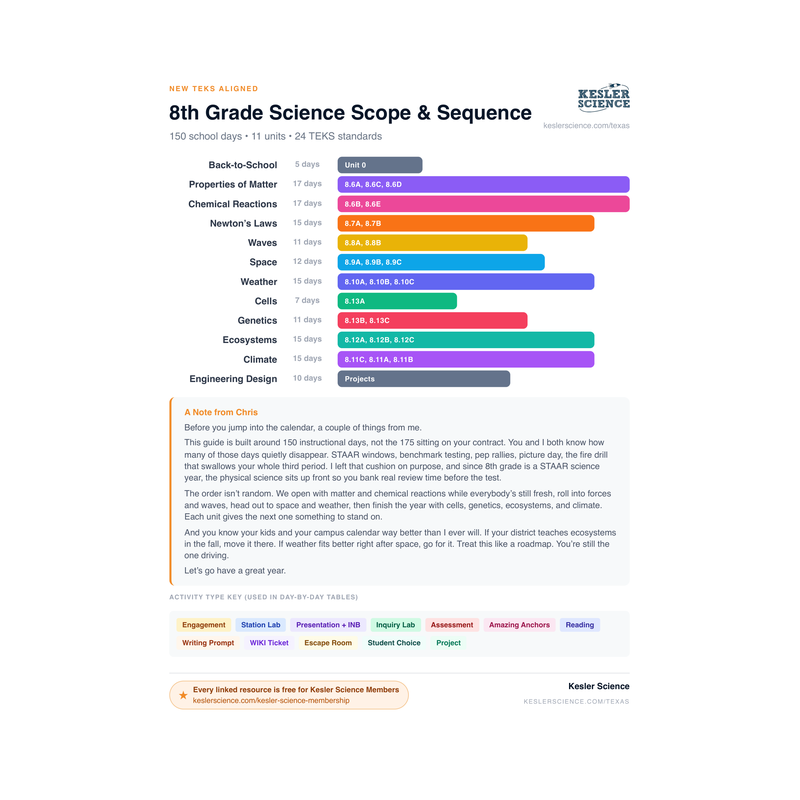
100% Aligned Lessons for Every TEKS You Teach
Kesler Science Plus puts thousands of ready-to-teach lessons and activities in your hands, so you can boost engagement and get your planning time back. Trusted by schools and districts all over the great state of Texas.
🌎 Phenomenon Ideas for 8.10B
Use these real-world phenomena to anchor your lesson. Show students the phenomenon first, let them wonder, then build toward Atmospheric Movement as the explanation.
Why Flights Are Faster Going East
A nonstop flight from Los Angeles to New York can take about 5 hours. The same flight going the other direction, New York to Los Angeles, often takes about 6 hours. The distance is the same. The airplane is the same. Something in the atmosphere is helping one flight and fighting the other.
"What's moving in the upper atmosphere that could push an airplane forward in one direction and slow it down in the other? Where does the energy for that moving air ultimately come from?"
Why the Beach Breeze Flips Direction
Stand on a Gulf Coast beach during the day and the wind blows off the water onto the shore. Stay there until after sunset and the breeze often reverses, blowing from the land out toward the water. Nothing about the beach changed. The wind just flipped directions.
"During the day, which surface heats up faster, the land or the ocean? What does that do to the air pressure over each one? How does that pressure difference steer the wind, and why would the whole pattern reverse once the Sun goes down?"
Hurricanes Always Spin Counterclockwise (In the North)
Pull up a satellite image of any hurricane that has ever hit Texas, Florida, or the Carolinas. Every one of them spins counterclockwise. Pull up a satellite image of a cyclone off the coast of Australia. Every one of those spins clockwise. The storms themselves are very similar. Something about where they form is making them rotate in opposite directions.
"What do Northern Hemisphere storms have in common that Southern Hemisphere storms do not? How could the rotation of Earth deflect moving air differently depending on which half of the globe the storm is in?"
💡 Free Engagement Ideas for 8.10B
Ready-to-run activities you can drop straight into a lesson. Where one of these looks like a phenomenon from the section above, that is on purpose: show it first as the hook, then let students run it themselves.
The Balloon Over a Bottle
Stretch a balloon over the mouth of an empty plastic bottle. Place the bottle in a bowl of hot tap water for two minutes and watch the balloon inflate. Move it to a bowl of ice water and watch the balloon deflate. Students see that warm air expands and pushes out while cool air contracts and pulls in. Pressure in action.
Lazy-Susan Coriolis
Tape a piece of paper to a lazy-susan turntable. Have one student slowly spin it while another student tries to draw a straight line across the paper with a marker, keeping their hand still. The line curves even though the hand moved straight. That's exactly what moving air does on a rotating Earth.
Convection in a Fish Tank
Fill a clear plastic bin with room-temperature water. At one end, gently pour in a cup of warm water dyed red. At the other end, a cup of cold water dyed blue. Drop the dyes in slowly near the edges so the water does not mix too fast. Watch red water rise on one side, blue water sink on the other, and a current form between them. Same structure as atmospheric convection cells.
Wind Map Detective
Print or project a blank world map. Give groups a simplified pressure map with "H" and "L" labels on different latitudes. Students draw arrows showing the direction wind should flow (high to low) and then add a second arrow showing the Coriolis deflection (right in the Northern Hemisphere, left in the Southern). Compare their maps to a real global wind pattern chart.
🎯 What Approaches, Meets, and Masters Thinking Look Like
Here is what student thinking at each level looks like on this one task, so you know what to look for and how to move a student up.
On a blank map of Earth, draw and label the major global patterns of atmospheric movement: the trade winds, the westerlies, the polar easterlies, and a jet stream. Show which way the air moves in each band. Then identify how these global wind patterns influence local weather, using a specific example such as why weather systems in Texas usually arrive from the west.
- The three main wind belts placed in roughly the correct latitudes: trade winds in the tropics, westerlies in the middle latitudes, polar easterlies near the poles.
- Arrows that show the actual direction each band blows, not just a label slapped on a region.
- A jet stream drawn as a fast, wavy band of wind in the upper middle latitudes.
- A clear statement that air moves because of pressure differences (high pressure toward low pressure), driving these patterns.
- At least one solid tie from a global pattern to local weather (for example, the westerlies pushing storm systems across Texas from west to east).
- Wind directions named correctly: a wind is named for where it comes from, so the westerlies blow from the west.
- The trade winds vs. westerlies direction handled correctly (trades blow toward the west, westerlies blow toward the east). That is the easiest place to slip.
These are the global wind belts. The trade winds, the westerlies, and the polar easterlies. The jet stream is up high and moves fast. The wind is just air blowing around the planet. It affects weather because if it's windy outside then a storm is coming.
Air moves because of pressure differences. It flows from high pressure to low pressure, and that flowing air is wind. The trade winds blow toward the west in the tropics, the westerlies blow toward the east in the middle latitudes, and the polar easterlies blow toward the west near the poles. The jet stream is a fast river of air high up in the westerlies. These patterns control local weather. Texas is in the westerlies, so our storm systems usually move in from the west and head east. That's why the forecast looks at what's happening to our west.
The whole system starts with uneven heating. The equator gets the most direct sunlight, so warm air rises there and leaves low pressure, while cooler air sinks at other latitudes and makes high pressure. Air flows from high to low, and as it travels it curves because of the Coriolis effect, which is why the trades and westerlies blow at an angle instead of straight north or south. That's what sets up the belts and steers the jet stream.
You can use the same idea to predict a less obvious case. When the jet stream dips way down south in winter, it drags cold polar air down with it, which is how Texas gets a sudden hard freeze even though we sit in the westerlies. The local cold snap isn't random. It's the global pattern bending and pulling air from a different latitude into our region.
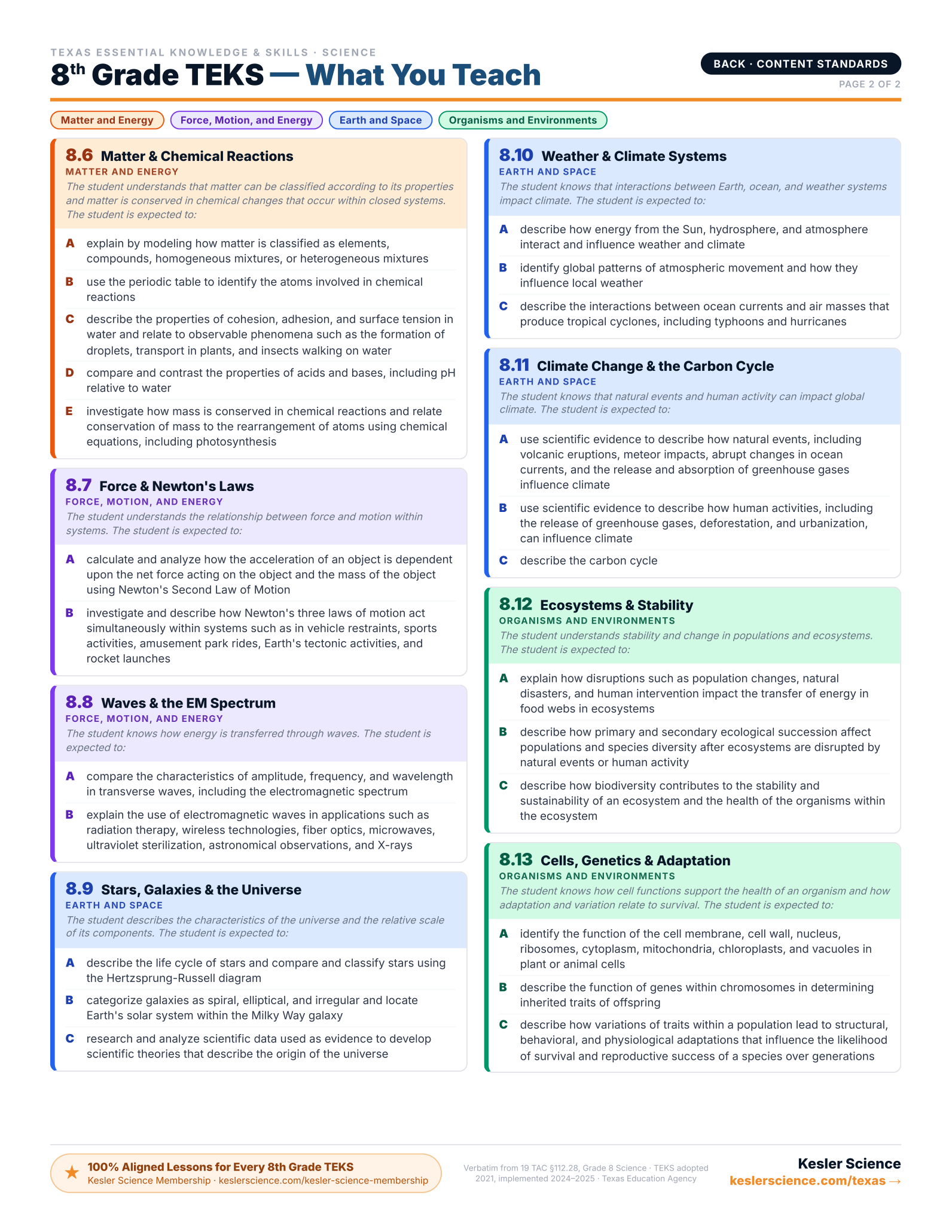
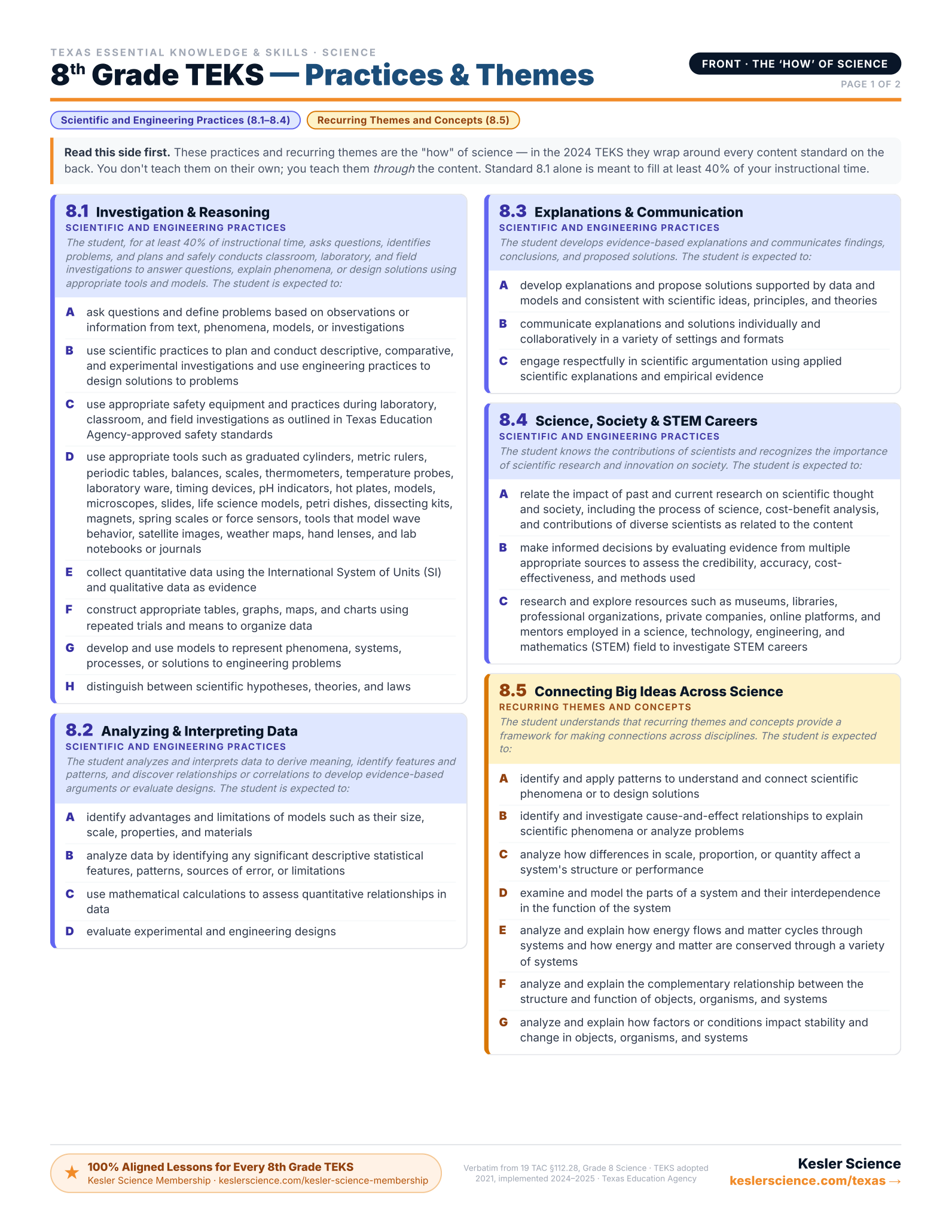
Every 8th-Grade Science TEKS on One Page
The color-coded, front-and-back cheat sheet I wish I'd had — every standard, organized by reporting category. Print it and reference it all year long. This will be your new favorite document!
Trusted Across Texas
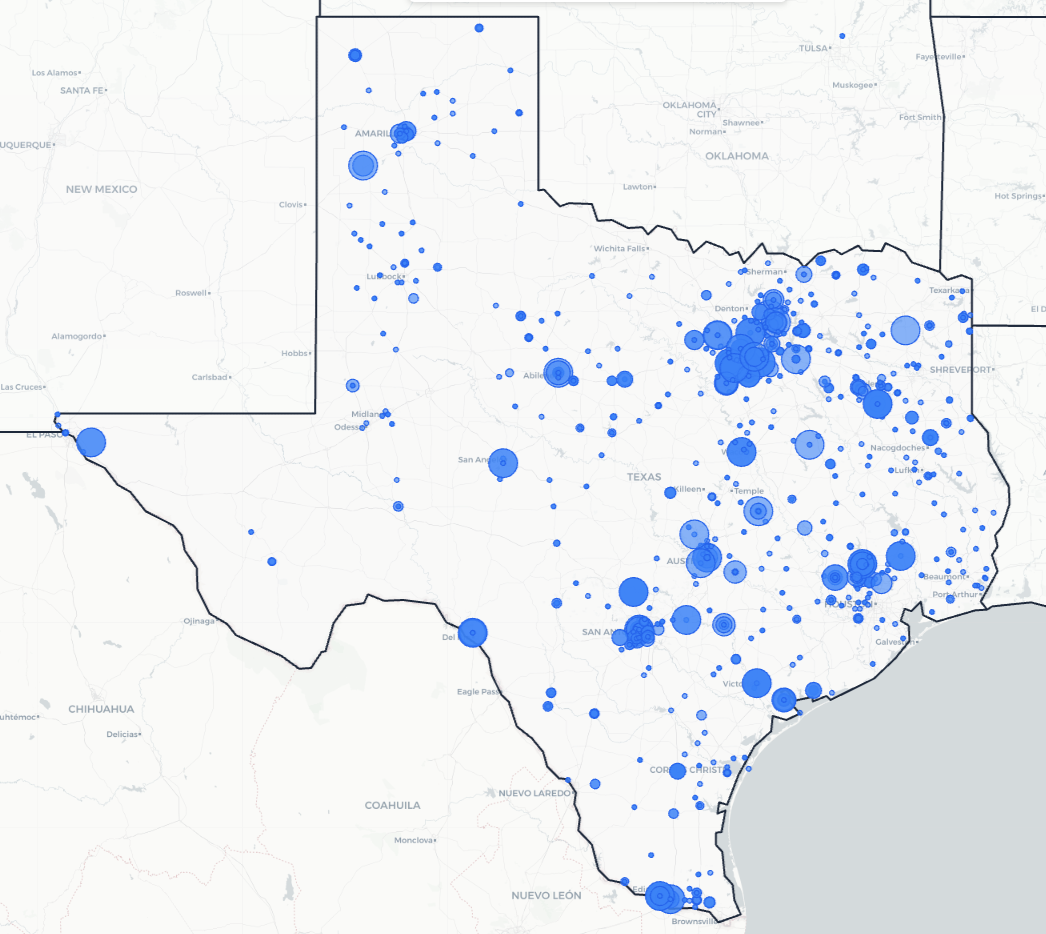
From the Rio Grande Valley to the Panhandle, Texas science teachers are using Kesler Science to save time and engage students.
Texas Schools and Districts
Love Kesler Science
What Teachers Are Saying
Give Your Science Teachers Everything They Need
School and district licenses give your teachers access to every resource they need, including station labs, inquiry labs, anchoring phenomena, presentations, escape rooms, and much more. One purchase covers the grade levels you need.
- PO-friendly. We accept purchase orders
- Volume discounts for 11+ teachers
- Complimentary Kesler Science Plus orientation for 4+ teachers
- Three free implementation PD sessions for departments of 11+
- Aligned to the 2024 TEKS standards
See It in Action
Book a walkthrough and we'll show you how Kesler Science fits your campus.
Book Demo CallNo pressure, no hard sell