
8 hands-on stations for teaching galaxy categories
A station lab is a student-led activity where small groups rotate through 8 stations (plus a 9th challenge station for early finishers) at their own pace during one to two class periods. You become a facilitator instead of a lecturer. You walk around, spot-check, and break misconceptions while kids work through the rotation.
The Categorizing Galaxies Station Lab has four input stations (where students take in new info on spiral, elliptical, and irregular galaxies and the Milky Way) and four output stations (where they show what they learned). Here's what's at each one.
4 input stations: how students learn galaxy categories
A short YouTube video covers the discovery of galaxies, the supermassive black holes at the centers of large galaxies, and the upcoming Milky Way–Andromeda collision. Students answer three questions about Edwin Hubble's discovery, the common feature at the centers of large galaxies, and what will happen when the Milky Way meets Andromeda. Visual learners come alive at this station.
A one-page passage called "Understanding our Galactic Neighbors" walks students through what a galaxy is, how the light year works, and the three main galaxy categories. Three multiple-choice questions follow. Comes in two reading levels (Dependent and Modified) plus a Spanish version.
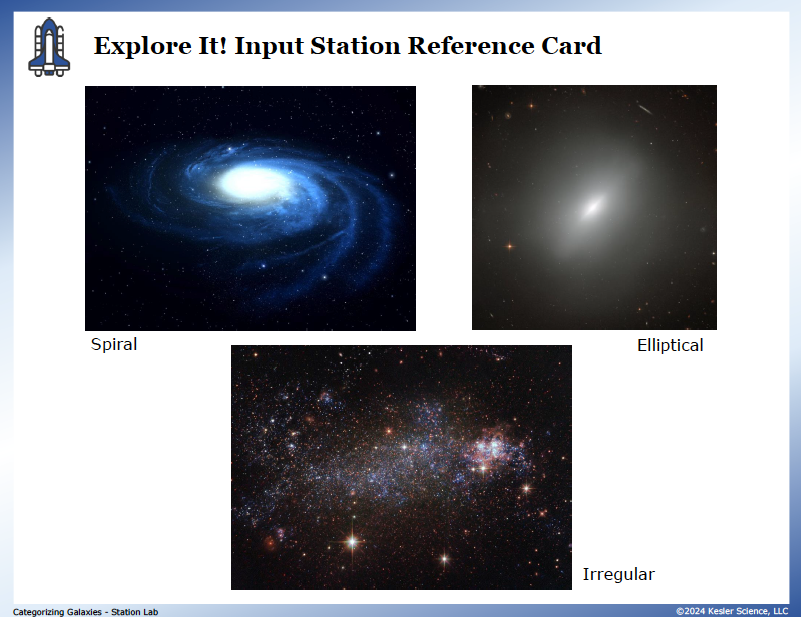
This is the heart of the lab. Students build paper-and-cotton models of all three galaxy types. Spiral: draw a center bulge, lay yarn in spiral arms, glue cotton along the arms, add stars in the star-forming regions. Elliptical: cluster cotton balls tightly in the center and thin out toward the edges, add stars evenly throughout for older, evenly distributed stars. Irregular: scatter cotton chaotically, add stars randomly with a few bright clumps for active star formation. Three reflection questions wrap it up. By the end, kids have built three galaxies with their hands.
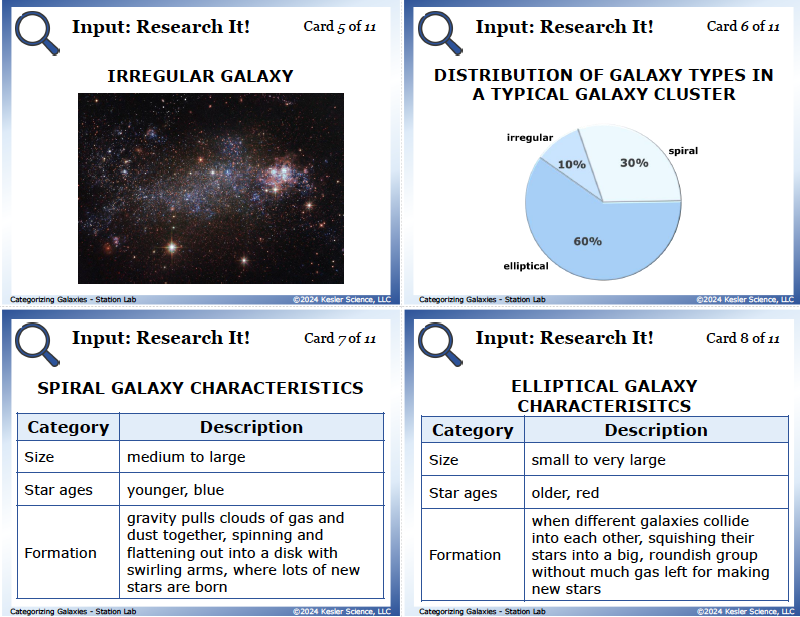
Students examine 11 reference cards covering the Milky Way (with our Sun's location marked), nearest galaxies in the Local Group, photos of spiral, elliptical, and irregular galaxies, characteristics tables for each type, and a pie chart showing the typical distribution (60% elliptical, 30% spiral, 10% irregular in a galaxy cluster). Four questions check whether they can describe the Sun's location, compare the Milky Way to Andromeda and Triangulum, distinguish galaxy types, and explain how distribution data tells us about formation.
4 output stations: how students show what they learned
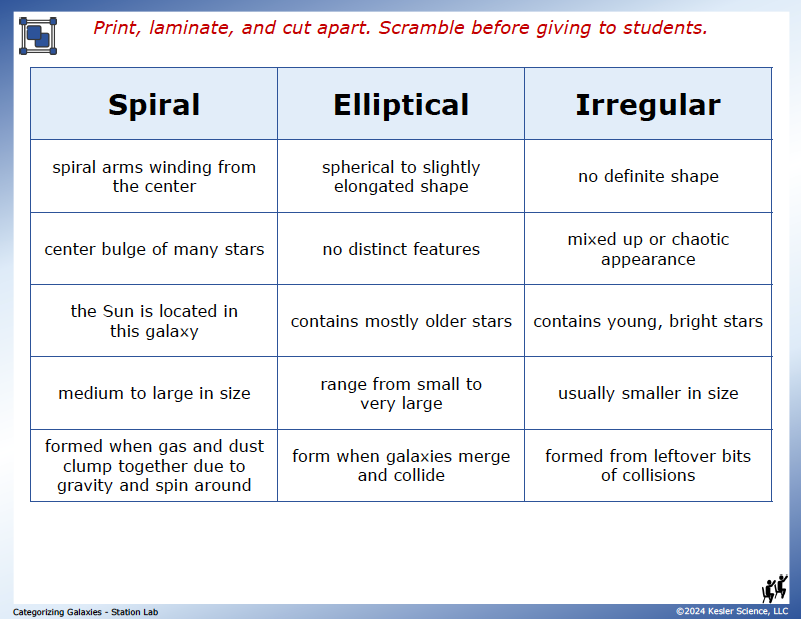
A card sort. Kids match characteristics with one of three galaxy types: "spiral arms winding from the center" → spiral, "spherical to slightly elongated shape" → elliptical, "no definite shape" → irregular. Cards include size, star ages, formation method, and the dead-giveaway "the Sun is located in this galaxy" (spiral). Easy to spot-check at a glance.
Students draw all three galaxy types side by side and label the key features for each: central bulge and spiral arms for spiral, dense core for elliptical, star-forming regions for irregular. Even kids who say "I can't draw" surprise themselves here. The drawings lock in the visual differences.
Three open-ended questions: how spiral and elliptical galaxies differ structurally (using the Milky Way as the example), what causes a galaxy to become irregular, and why new stars are more likely to form in spirals than ellipticals. This is the writing practice middle schoolers need and rarely get in science class.
Eight multiple-choice and fill-in-the-paragraph questions tied to TEKS 8.9B vocabulary (light year, galaxies, spiral galaxy, elliptical galaxy, irregular galaxy). Includes "which is NOT a feature of spiral galaxies," a Sun-location image-pick question, and a galaxy-collision-and-merger question. The fill-in paragraph weaves all five vocabulary words together. If you're grading the lab, this is the easiest station to grade.
Bonus Challenge It! station for early finishers
Four optional extensions: build a 10-word galaxy crossword puzzle (paper or digital), make a compare-and-contrast chart of the three galaxy types, write an acrostic poem for spiral/elliptical/irregular, or design a galaxy bookmark. Requires teacher approval before they start.
How this fits into a complete categorizing galaxies unit
This Station Lab is the Explore day of our full Categorizing Galaxies Complete 5E Lesson for TEKS 8.9B. The complete two-week unit follows the 5E method of instruction and includes an Engage hook, the Categorizing Galaxies Station Lab for Explore, PowerPoint slides and interactive notebook pages for Explain, student choice projects to Elaborate, and an Evaluate assessment.
Most teachers grab the full 5E because the Station Lab lands hardest with the days around it. But if you just need a strong hands-on day on galaxy categories and our place in the Milky Way, the Station Lab on its own does the job.

Get this categorizing galaxies activity

Or if you want the full two-week experience with the Engage hook, Explain day, Elaborate extension, and Evaluate assessment all included:
(Station Lab is included)
Frequently asked questions
What does TEKS 8.9B cover?
Texas TEKS 8.9B asks 8th grade students to categorize galaxies as spiral, elliptical, or irregular and locate Earth's solar system within the Milky Way galaxy. Students should be able to look at a galaxy image and name its type, and pinpoint the Sun's position in the Milky Way (about two-thirds of the way out from the center, in one of the spiral arms).
Where exactly is the Sun in the Milky Way?
The Sun sits in the Orion Arm (sometimes called the Orion Spur) of the Milky Way, roughly 26,000 light years from the galactic center. It's about two-thirds of the way out from the center toward the outer edge. The Research It! Milky Way reference card marks this spot directly.
How long does this categorizing galaxies activity take?
One to two class periods (45 to 110 minutes total). The Explore It! station's hands-on galaxy-building activity is the longest part, so plan for two periods the first time you run a station lab. Once your class has the routine down, most groups can finish all 8 stations in one period.
Do I need to provide my own materials?
Cotton balls, yarn, paper, glue or tape, and colored pencils. Total cost for a class of 30: under $10 if you don't already have these supplies. The Watch It! station also needs a device with internet.
Can I use this in a 1:1 digital classroom?
Yes. The full digital version (PowerPoint or Google Slides) works in 1:1 classrooms and Google Classroom. Students drag the digital reference cards instead of physically modeling. The galaxy-building hands-on demo can be replaced with side-by-side comparison images of real galaxies.