.png?width=375&height=100&name=WebPage%20logo%20with%20curves%202026%20(8).png)
Electromagnetic Waves
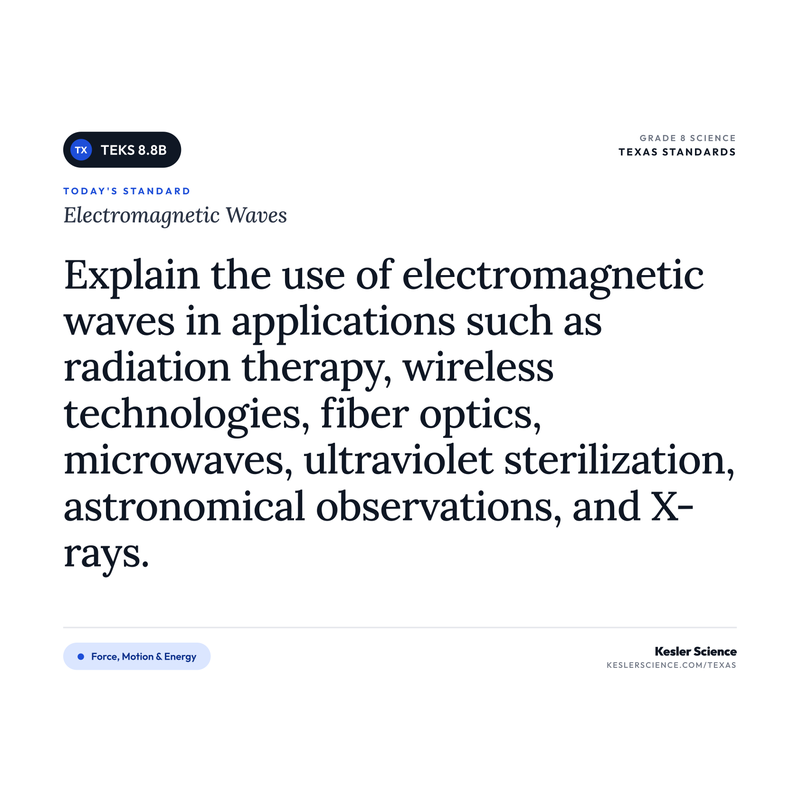
"Explain the use of electromagnetic waves in applications such as radiation therapy, wireless technologies, fiber optics, microwaves, ultraviolet sterilization, astronomical observations, and X-rays."
💡 What This Standard Actually Means
"Explain the use". Students aren't just listing the regions of the EM spectrum. They're explaining how each region gets used in real technology and why. The standard's "such as" list signals where to focus your students: radiation therapy, wireless technologies, fiber optics, microwaves, ultraviolet sterilization, astronomical observations, and X-rays. Students should be able to match each technology to the part of the spectrum it uses and describe what makes those waves the right tool for the job. Instruction can take many forms, such as application-to-wave matching, real-tech case studies, hospital and home device walk-throughs, and short-answer "why this wave" prompts.
The electromagnetic spectrum is the full range of EM waves, from radio on the low-energy end to gamma rays on the high-energy end. This standard isn't asking students to compare wavelengths or order them. It's asking them to explain real-world uses. Every part of the spectrum has technology built around it, and the technology only works because of the specific properties of those waves.
On the low-energy side, radio waves carry information for broadcasting, Wi-Fi, and cell phones because they pass easily through walls and air. Microwaves heat food by making water molecules rotate back and forth rapidly, and shorter microwaves carry signals to satellites and phones. Infrared shows up in TV remotes, thermal imaging cameras, and night vision goggles. Visible light runs cameras and fiber optic internet. Ultraviolet sterilizes hospital equipment and water supplies because its energy is high enough to damage germs. X-rays pass through soft tissue but get absorbed by bone, which is what makes medical imaging possible. Gamma rays are used in radiation therapy because their high energy can target and destroy cancer cells. Astronomers use waves from across the entire spectrum, from radio telescopes to X-ray observatories, to study things in space that visible light can't reveal.
The core understanding students should walk away with is that each technology was built around the natural properties of a specific kind of wave. Lower-energy waves move information through walls. Higher-energy waves penetrate matter and damage cells, which makes them dangerous in large doses but useful for therapy and imaging. Match the wave to the job and the technology makes sense.
I used to teach this standard like a vocabulary list. Radio, microwave, infrared, all the way up to gamma. Kids would memorize the order and bomb the application questions on the test. The fix was making it a tour of their own house. I'd ask them to walk around the room and point at every device that used an EM wave. Wi-Fi router. Cell phone. TV remote. Microwave oven. The lights overhead. The sun coming through the window. Then I'd ask, "Which wave is each one using, and why is that the right one?" The answers came slow at first, but once they had a real device in mind, the spectrum stopped being a chart on the wall. It became the reason their stuff works. Texas teacher tip: a quick poll of how many kids' parents work in oil and gas opens the door to talking about how seismic surveys, pipeline inspections, and medical imaging at the local hospital all use parts of the EM spectrum.
⚠️ Misconceptions Your Students May Have
These are some of the most common misconceptions. Knowing what to look for can help you get ahead of them.
"Microwaves cook food because they heat it like a stove burner"
A microwave oven doesn't rely on a hot surface like a burner. Instead, microwaves at a specific frequency penetrate about an inch into the food and directly heat the water molecules in that outer layer by making them rotate back and forth rapidly. The rest of the interior warms by conduction from that heated layer. The "cool surface, hot inside" experience you sometimes notice comes from surface evaporation and from microwaves concentrating at edges and corners, not from heating the food throughout all at once. The wave is doing work directly on water molecules. A stove burner uses conduction from a hot surface, which is a totally different mechanism.
"X-rays see through everything"
X-rays don't see through everything. They pass through soft tissue (skin, muscle, fat) but they get absorbed by dense material like bone. That's exactly what makes a medical X-ray image work. Where the X-rays pass through, the film or sensor turns dark. Where bone absorbs them, the film stays light. The contrast shows the bones. Lead aprons block almost all of the X-rays, which is why dentists drape one over patients during imaging.
"All electromagnetic waves are dangerous radiation"
The word "radiation" gets used for the whole spectrum, but only the high-energy waves are ionizing, meaning they can knock electrons off atoms and damage living cells. UV, X-rays, and gamma rays fall in this category, which is why too much sun causes skin damage and why X-rays require lead shielding. Radio waves, microwaves, infrared, and visible light are all non-ionizing and don't damage cells the same way. A Wi-Fi signal and a chest X-ray are not the same kind of threat.
"Fiber optic cables carry electricity through wires"
Fiber optic cables don't carry electricity. They carry pulses of light through tiny glass strands. The light bounces along the inside of the strand all the way to the destination, where it's converted back into a signal a device can use. That's why fiber internet is so fast and why a single fiber strand can carry far more data than a copper wire. The "wave" doing the work is infrared light (just past the red end of what your eye can see), used as a precise data carrier. Glass fiber is more transparent to certain infrared wavelengths than to visible light, which is why those are used for long-distance transmission.
📓 Teaching Resources for 8.8B
These resources are aligned to this standard.


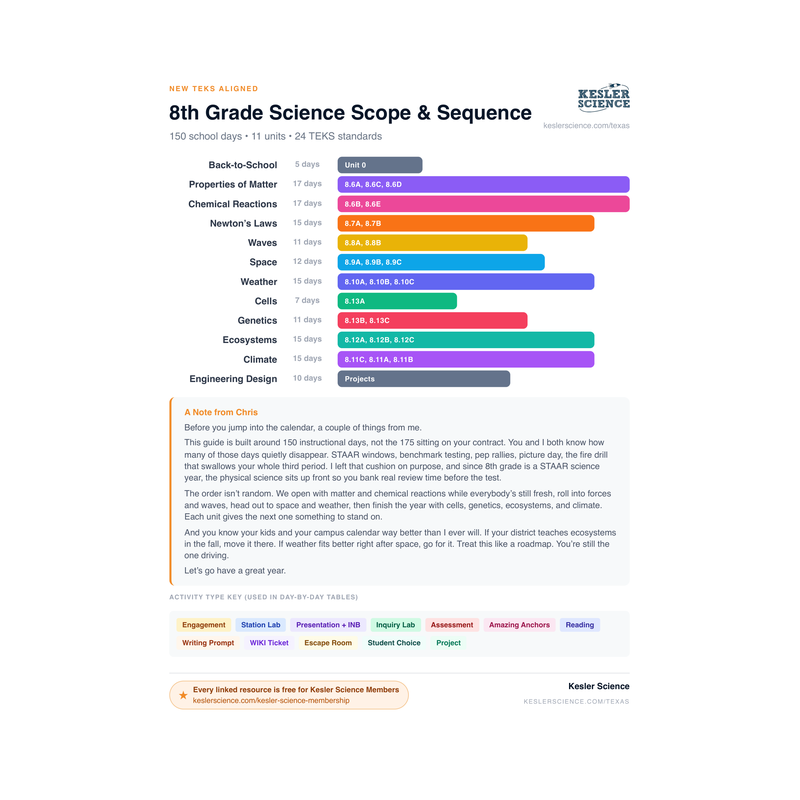
100% Aligned Lessons for Every TEKS You Teach
Kesler Science Plus puts thousands of ready-to-teach lessons and activities in your hands, so you can boost engagement and get your planning time back. Trusted by schools and districts all over the great state of Texas.
🌎 Phenomenon Ideas for 8.8B
Use these real-world phenomena to anchor your lesson. Show students the phenomenon first, let them wonder, then build toward Electromagnetic Waves as the explanation.
A TV Remote That Only Works Pointed at the TV
Press a button on a TV remote across the room and the channel changes. Press the same button while pointing the remote at the floor or behind your back and nothing happens. Most remotes use an infrared LED that flashes a coded pattern of light invisible to the human eye. The TV has a small infrared sensor on the front. Point a phone camera at the remote while pressing a button and you can actually see the IR flashing.
"Why does the remote only work when pointed at the TV? What property of infrared light explains why the remote stops working when the path is blocked, and why is infrared a good choice for short-range device control?"
UV Sterilization in Hospitals
Some hospitals roll a wheeled UV light tower into an empty patient room between visits. The lamp glows pale violet for several minutes while no people are in the room. After the light cycle, the surfaces are considered sterilized. Ultraviolet light at the right wavelength damages the DNA of bacteria and viruses, killing them on contact. Some city water treatment plants use the same principle to disinfect drinking water.
"Why can ultraviolet light kill bacteria when visible light cannot? What does that tell you about the energy of UV waves compared to the rest of the spectrum, and why must people leave the room when the lamp is on?"
Photos From Space at Wavelengths You Can't See
NASA releases stunning images of the same galaxy taken in visible light, infrared, X-ray, and radio. Each version looks completely different. The infrared image shows clouds of warm dust the eye couldn't see. The X-ray image highlights super-hot gas around a black hole. Radio telescopes pick up cool gas no other instrument can detect. Astronomers use the entire EM spectrum because each region reveals a different piece of what's happening in space.
"Why would scientists need different telescopes for different parts of the spectrum? What can a radio telescope or X-ray telescope show us that a regular optical telescope cannot?"
💡 Free Engagement Ideas for 8.8B
Ready-to-run activities you can drop straight into a lesson. Where one of these looks like a phenomenon from the section above, that is on purpose: show it first as the hook, then let students run it themselves.
Map the Tech in the Room
Hand each group a printed EM spectrum chart. Together, students walk around the room (or their school) and identify every device using EM waves: Wi-Fi router (radio), microwave oven (microwave), TV remote (infrared), the lights overhead (visible), the sun through the window (visible plus UV plus IR), the school nurse's first-aid X-ray poster, etc. They label the spectrum chart with each device and write one sentence explaining why that part of the spectrum is the right tool.
Remote-and-Camera Infrared Demo
Hand out TV remotes and let students view them through a phone or webcam (most digital cameras can see infrared even though the eye can't). Students watch the IR LED flash when buttons are pressed. Then they test what blocks the signal: a piece of paper, glass, water, plastic wrap, aluminum foil. They record results and explain which materials let infrared through and why.
UV-Sensitive Bead Sunscreen Lab
Give each group a pipe cleaner of UV-sensitive beads (clear or pale white indoors, color-changing in sunlight). One pipe cleaner gets coated in sunscreen, one stays uncovered, and one is wrapped in plastic wrap. Take all three outside on a sunny day and watch the differences. Students connect the results to UV sterilization and to why sunscreen and SPF clothing matter.
Application-to-Wave Matching Card Sort
Print two stacks of cards. One stack lists EM regions (radio, microwave, infrared, visible, UV, X-ray, gamma). The other lists real-world applications (Wi-Fi, cell phones, TV remote, microwave oven, fiber optic internet, hospital sterilizer, dentist X-ray, cancer radiation therapy, NASA Hubble image, NASA Chandra X-ray image). Groups race to match each application to the wave it uses. Debrief by asking students to justify any pair they got wrong.
🎯 What Approaches, Meets, and Masters Thinking Look Like
Here is what student thinking at each level looks like on this one task, so you know what to look for and how to move a student up.
Pick three of these technologies: a microwave oven, a Wi-Fi router, a fiber optic internet line, a hospital X-ray machine, a UV sterilizer, a radiation therapy machine, and a radio telescope. For each one, explain which kind of electromagnetic wave it uses and why that wave is the right tool for that job.
- Each technology matched to the correct part of the electromagnetic spectrum (microwave oven to microwaves, Wi-Fi to radio waves, fiber optics to light, X-ray machine to X-rays, UV sterilizer to ultraviolet, radiation therapy to gamma rays, radio telescope to radio waves).
- An explanation of why that wave fits the job, not just a label naming the wave.
- For information technologies (Wi-Fi, fiber optics), the point that lower-energy waves carry signals well because they pass through walls or travel cleanly through glass.
- For penetrating technologies (X-rays, radiation therapy), the point that higher-energy waves pass into or through matter and can affect cells.
- For UV sterilization, the idea that the wave's energy is high enough to damage germs.
- A correct mechanism for the microwave oven: it heats the water in food directly, not like a hot burner.
- The difference between using a wave to carry information and using a wave to deliver energy into matter. That is the easiest place to slip.
A Wi-Fi router uses radio waves to send the internet to my phone without wires. An X-ray machine uses X-rays to take pictures of your bones because the X-rays go through your skin. A microwave oven uses microwaves to cook food. It heats the food up like a stove burner does, except the heat comes from the microwaves instead of a flame.
A Wi-Fi router uses radio waves because they pass easily through walls and air, so the signal reaches your devices around the house. An X-ray machine uses X-rays because they pass through soft tissue like skin and muscle but get absorbed by bone, so the bones show up on the image. A UV sterilizer uses ultraviolet waves because their energy is high enough to damage the germs and kill them, which cleans hospital tools and water.
A fiber optic line uses light to carry internet data as fast pulses that bounce along the inside of a glass strand, so one strand moves a huge amount of information. A radiation therapy machine uses gamma rays because their energy is high enough to reach into the body and destroy cancer cells. A radio telescope uses radio waves because objects in space give off radio waves that travel to Earth, so astronomers can study things visible light can't show.
The pattern is that lower-energy waves are good at carrying information, and higher-energy waves are good at penetrating matter and affecting cells. That's why I'd guess a TV remote uses infrared: a remote only needs to send a little signal a short distance across the room, not push energy into anything, so a lower-energy wave near the bottom of the spectrum makes sense for the job.
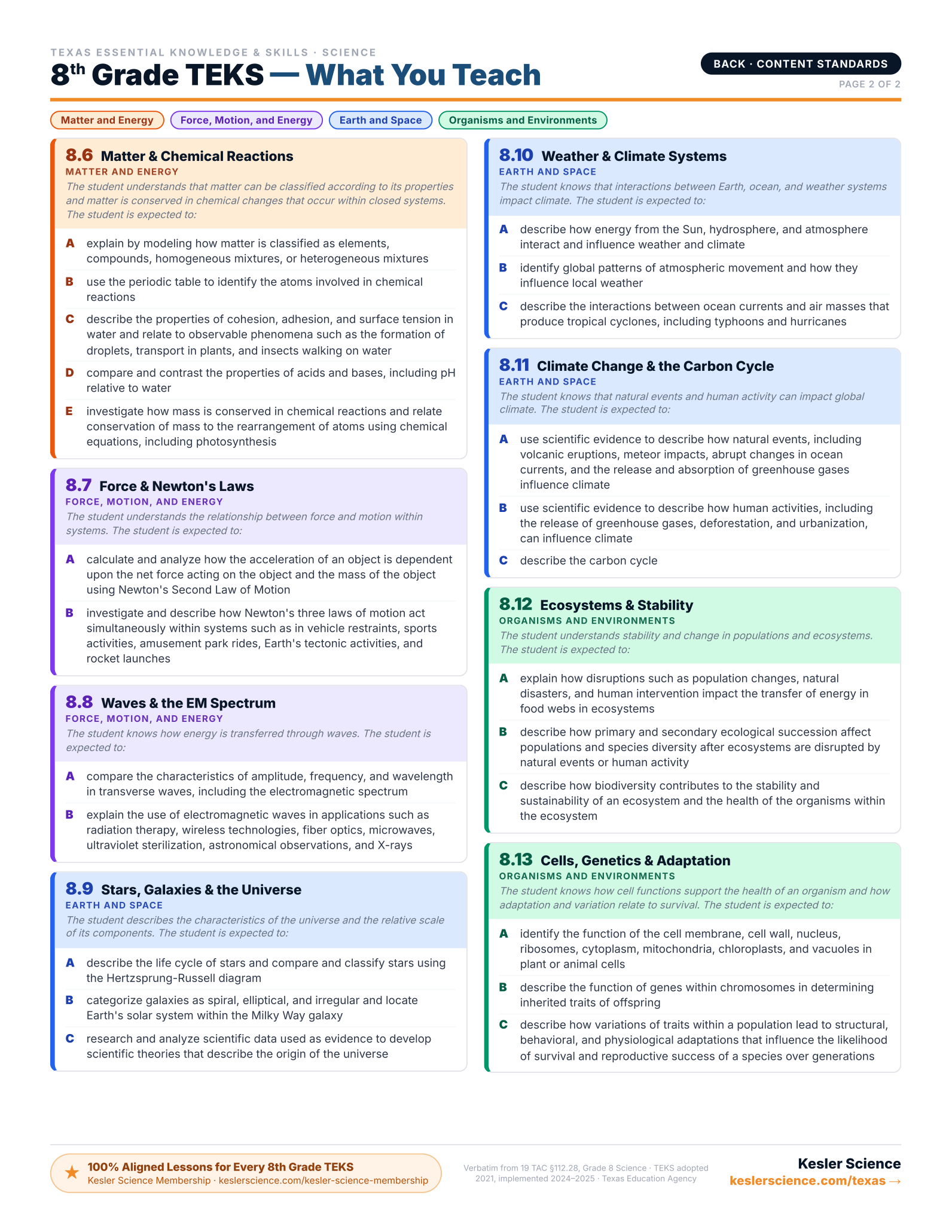
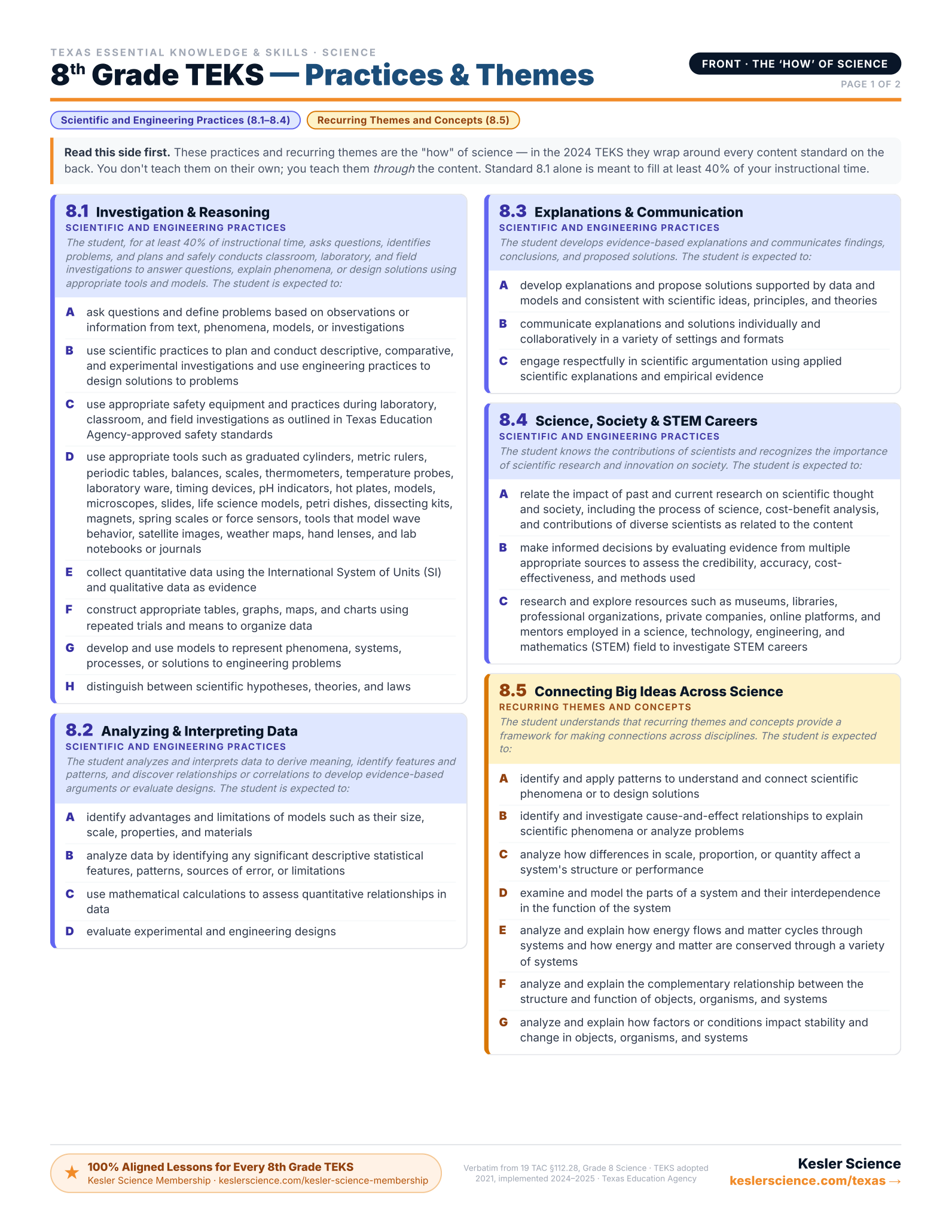
Every 8th-Grade Science TEKS on One Page
The color-coded, front-and-back cheat sheet I wish I'd had — every standard, organized by reporting category. Print it and reference it all year long. This will be your new favorite document!
Trusted Across Texas
From the Rio Grande Valley to the Panhandle, Texas science teachers are using Kesler Science to save time and engage students.
Texas Schools and Districts
Love Kesler Science

What Teachers Are Saying
Give Your Science Teachers Everything They Need
School and district licenses give your teachers access to every resource they need, including station labs, inquiry labs, anchoring phenomena, presentations, escape rooms, and much more. One purchase covers the grade levels you need.
- PO-friendly. We accept purchase orders
- Volume discounts for 11+ teachers
- Complimentary Kesler Science Plus orientation for 4+ teachers
- Three free implementation PD sessions for departments of 11+
- Aligned to the 2024 TEKS standards
See It in Action
Book a walkthrough and we'll show you how Kesler Science fits your campus.
Book Demo CallNo pressure, no hard sell