
8 hands-on stations for teaching electromagnetic waves
A station lab is a student-led activity where small groups rotate through 8 stations (plus a 9th challenge station for early finishers) at their own pace during one to two class periods. You become a facilitator instead of a lecturer. You walk around, spot-check, and break misconceptions while kids work through the rotation.
The Electromagnetic Waves Station Lab has four input stations (where students take in new info on the EM spectrum and its applications) and four output stations (where they show what they learned). Here's what's at each one.
4 input stations: how students learn the electromagnetic spectrum
A short YouTube video walks students through the full electromagnetic spectrum and the technologies that use each part. They answer three questions: name four machines or items that use the EM spectrum, what's the wavelength range of visible light in nanometers, and name two tools (on Earth and in space) that study different EM wavelengths. Visual learners come alive at this station.
A one-page passage called "Beyond the Rainbow: Exploring Invisible Energies" walks students through the EM spectrum from radio waves to gamma rays, with everyday examples for each. Three multiple-choice questions follow. Comes in two reading levels (Dependent and Modified) plus a Spanish version.
This is the heart of the lab. Three quick demos let kids see, hear about, and feel different parts of the spectrum. Part 1 (Visible light): shine a flashlight through a prism onto white paper and watch the rainbow split out. Part 2 (Ultraviolet): lay UV-sensitive beads on the table, shine a UV flashlight, and watch them change color (also works in direct sunlight). Part 3 (Microwaves): heat a small container of water in a microwave for a couple of minutes and discuss how microwaves vibrate water molecules to generate heat. By the end, students have seen three regions of the spectrum directly.
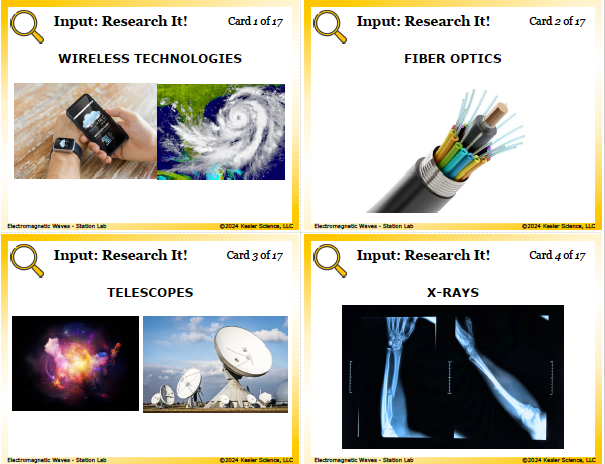
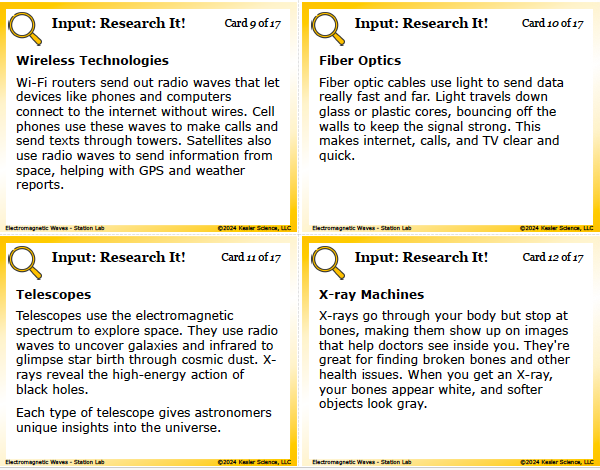
Students examine 17 reference cards covering wireless technologies, fiber optics, telescopes, X-rays, radiation therapy, infrared cameras, and how the atmosphere blocks or lets through different wavelengths. Five questions check whether they can identify which waves transmit best through Earth's atmosphere, how wireless tech uses EM waves, the pattern between high-energy and low-energy applications, and the role of EM waves in modern medicine.
4 output stations: how students show what they learned
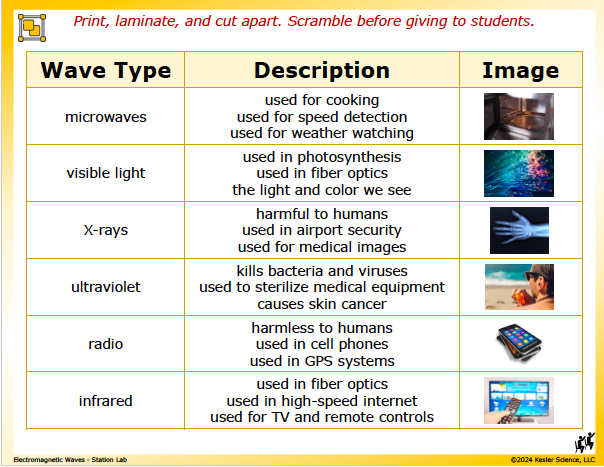
A card sort. Kids match six wave types (microwaves, visible light, X-rays, ultraviolet, radio, infrared) with their description and an image. Examples: "used for cooking, speed detection, weather watching" → microwaves; "kills bacteria, sterilizes medical equipment, causes skin cancer" → ultraviolet. Easy to spot-check at a glance, and the fastest way to see whether kids can pull EM uses apart from each other.
Students draw a room (home, school, or business) with various devices that use electromagnetic waves. They label each device, draw waves coming off it (wavy lines for Wi-Fi, etc.), and identify which type of wave it uses. This catches kids who can recite the spectrum but can't pick it out of their daily life. The Wi-Fi router, microwave, lamp, phone, and TV remote should all show up in a good drawing.
Three open-ended questions: how the EM spectrum is organized, how EM waves impact a typical daily routine, and a future-invention prompt that asks students to imagine a new technology built on EM waves. This is the writing practice middle schoolers need and rarely get in science class.
Eight multiple-choice and fill-in-the-paragraph questions tied to TEKS 8.8B vocabulary (electromagnetic spectrum, electromagnetic waves, visible light, ultraviolet waves, infrared waves). Includes a radio-vs-microwave-vs-X-ray scenario, a UV sterilization question, and an X-ray imaging question. The fill-in paragraph is built around the Sun and what it gives off. If you're grading the lab, this is the easiest station to grade.
Bonus Challenge It! station for early finishers
Four optional extensions: write a rap, rhyme, or song about the EM spectrum; write a 10-question quiz with answer key; design a poster for one type of EM wave; or research a real-world application of EM waves and analyze its impact. Requires teacher approval before they start.
How this fits into a complete electromagnetic waves unit
This Station Lab is the Explore day of our full Electromagnetic Waves Complete 5E Lesson for TEKS 8.8B. The complete two-week unit follows the 5E method of instruction and includes an Engage hook, the Electromagnetic Waves Station Lab for Explore, PowerPoint slides and interactive notebook pages for Explain, student choice projects to Elaborate, and an Evaluate assessment.
Most teachers grab the full 5E because the Station Lab lands hardest with the days around it. But if you just need a strong hands-on day on the EM spectrum, the Station Lab on its own does the job.

Get this electromagnetic waves activity

Or if you want the full two-week experience with the Engage hook, Explain day, Elaborate extension, and Evaluate assessment all included:
(Station Lab is included)
Frequently asked questions
What does TEKS 8.8B cover?
Texas TEKS 8.8B asks 8th grade students to explain the use of electromagnetic waves in applications such as radiation therapy, wireless technologies, fiber optics, microwaves, ultraviolet sterilization, astronomical observations, and X-rays. Students should be able to identify which type of EM wave is at work in a given technology and explain why that wavelength is the right choice.
What's the difference between visible light and the rest of the EM spectrum?
Visible light is the small range of EM waves that human eyes can see, with wavelengths between about 400 and 700 nanometers. The rest of the EM spectrum (radio, microwave, infrared on one side; ultraviolet, X-rays, gamma rays on the other) is invisible to us. We've built tools (radios, infrared cameras, X-ray machines) to use these invisible waves.
How long does this electromagnetic waves activity take?
One to two class periods (45 to 110 minutes total). The Explore It! station has three demos and is the longest, so plan for two periods the first time. Once your class has the routine down, most groups can finish all 8 stations in one period.
Do I need a UV flashlight?
You don't strictly need one, but it makes the demo work indoors. UV-sensitive beads also change color in direct sunlight (since the Sun gives off UV), so you can run that part of the Explore It! station near a sunny window if you don't want to buy a UV flashlight. A small UV LED flashlight is about $8 on Amazon if you'd rather have one.
Can I use this for 7th grade or in a 1:1 digital classroom?
Yes to both. The Modified version of every station works as a stretch lesson for advanced 7th graders. The full digital version (PowerPoint or Google Slides) works in 1:1 classrooms and Google Classroom. The Explore It! station still needs the prism, UV beads, and microwave for the full hands-on experience.