
8 hands-on stations for teaching Newton's laws in systems
A station lab is a student-led activity where small groups rotate through 8 stations (plus a 9th challenge station for early finishers) at their own pace during one to two class periods. You become a facilitator instead of a lecturer. You walk around, spot-check, and break misconceptions while kids work through the rotation.
The Laws of Motion in Systems Station Lab has four input stations (where students take in new info on how all three of Newton's laws act together) and four output stations (where they show what they learned). Here's what's at each one.
4 input stations: how students learn Newton's laws in systems
A short YouTube video reviews all three of Newton's laws back-to-back. Students answer three questions: what does Newton's first law say, how is force related to mass, and give five examples of Newton's third law in action. This is a refresher station. The video assumes kids have already met the three laws individually (TEKS 8.7A and prior); the goal here is to get them ready to see all three working together.
A one-page passage called "The Science Behind Systems" walks students through how all three of Newton's laws appear in two systems: shooting a basketball and wearing a seatbelt during a car crash. Each law is called out with its specific job in each system. Three multiple-choice questions follow. Comes in two reading levels (Dependent and Modified) plus a Spanish version.
This is the heart of the lab. Students run three quick demos and analyze a fourth scenario. (1) Bumper cars: roll toy cars at each other and label all three laws in the collision. (2) Box collision: push two small boxes toward each other and do the same. (3) Balloon rocket: blow up a balloon, let it go, and label all three laws in the launch. (4) Tectonic plates: read a short scenario about Earth's plates and identify which of Newton's laws applies. By the end, kids have seen all three laws appear simultaneously across four very different systems.
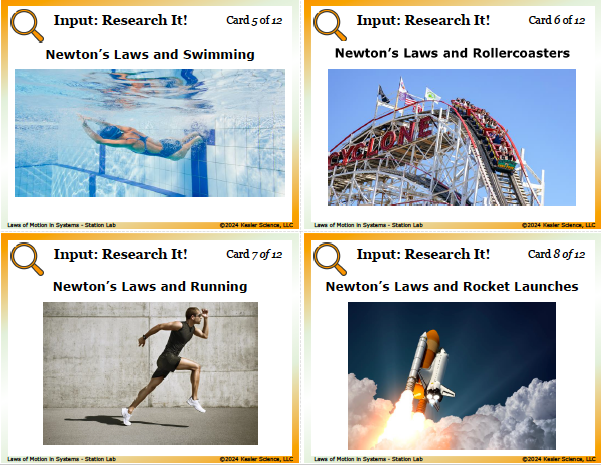
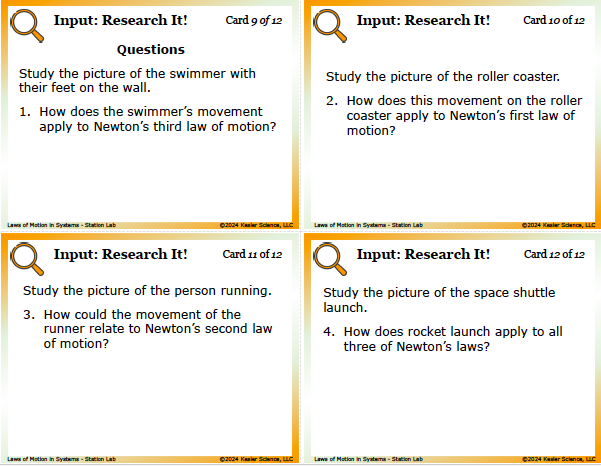
Students read 12 reference cards: definitions of each law, then four photos of real systems (a swimmer pushing off the wall, a roller coaster cresting a hill, a runner sprinting, a space shuttle launching). They answer four questions, each one asking them to identify which of Newton's laws is showing up in that system and explain why. The rocket launch question deliberately asks them to find all three laws in one image.
4 output stations: how students show what they learned
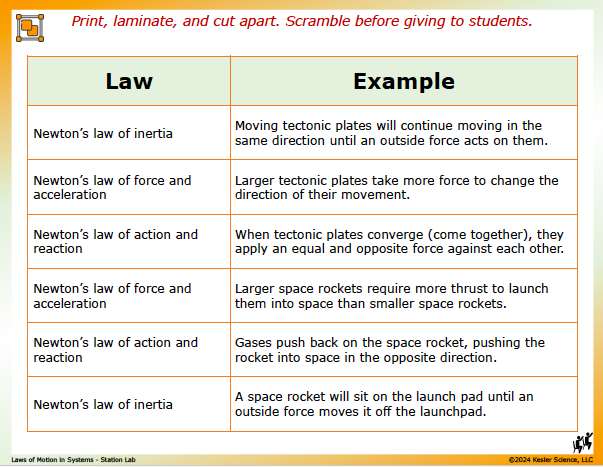
A card sort. Kids match real-world examples ("a driver slams on the brakes and passengers continue forward," "larger tectonic plates take more force to change direction," "the floor pushes back on a basketball, making it bounce") with the right Newton's law (Inertia, Force and Acceleration, or Action and Reaction). Examples come from car safety, basketball, tectonic plates, and rocket launches. Easy to spot-check at a glance.
Students choose one system (vehicle restraints, sports activities, amusement park rides, Earth's tectonic activities, or rocket launches) and draw it in detail. Then they label every part of their drawing with the specific Newton's law that's at work in that part. The point is to see all three laws inside a single system. This catches kids who can identify the laws individually but can't pick them out together.
Three open-ended questions: how Newton's laws work together in a seatbelt system, how they work in a rocket launch, and how the law of inertia applies to a bike rolling down a hill. This is the writing practice middle schoolers need and rarely get in science class.
Eight multiple-choice and fill-in-the-paragraph questions tied to TEKS 8.7B vocabulary (Newton's first/second/third law, inertia, acceleration). Includes a falling-book scenario, a baseball-bat-and-ball question, and a soccer-ball kick analysis. The fill-in paragraph weaves all three laws into a single passage. If you're grading the lab, this is the easiest station to grade.
Bonus Challenge It! station for early finishers
Four optional extensions: design an amusement park ride that shows all three laws, build a rocket-launch model and write a report, run a sports science investigation, or design and test an earthquake-resistant structure. Requires teacher approval before they start.
How this fits into a complete laws of motion in systems unit
This Station Lab is the Explore day of our full Laws of Motion in Systems Complete 5E Lesson for TEKS 8.7B. The complete two-week unit follows the 5E method of instruction and includes an Engage hook, the Laws of Motion in Systems Station Lab for Explore, PowerPoint slides and interactive notebook pages for Explain, student choice projects to Elaborate, and an Evaluate assessment.
Most teachers grab the full 5E because the Station Lab lands hardest with the days around it. But if you just need a strong hands-on day on Newton's three laws working together, the Station Lab on its own does the job.

Get this laws of motion in systems activity

Or if you want the full two-week experience with the Engage hook, Explain day, Elaborate extension, and Evaluate assessment all included:
(Station Lab is included)
Frequently asked questions
What does TEKS 8.7B cover?
Texas TEKS 8.7B asks 8th grade students to investigate and describe how Newton's three laws of motion act simultaneously within systems like vehicle restraints, sports activities, amusement park rides, Earth's tectonic activities, and rocket launches. Students should be able to look at one real-world system and identify all three of Newton's laws working together inside it.
How is this different from TEKS 8.7A (Newton's second law)?
TEKS 8.7A focuses on calculations using F=ma. TEKS 8.7B builds on that and asks students to see Newton's first, second, AND third laws happening at the same time in real-world systems. Most teachers run 8.7A first, then 8.7B as the application unit.
How long does this laws of motion in systems activity take?
One to two class periods (45 to 110 minutes total). Plan for two periods the first time you run a station lab. Once your class has the routine down, most groups can finish all 8 stations in one period.
Do I need to provide my own materials?
Yes, but everything is cheap and easy. You'll need toy cars (about 4 for the Explore It! station), small boxes (tissue boxes work), balloons, and colored pencils. Total cost for a class of 30: under $15. The Watch It! station also needs a device with internet.
Can I use this for 7th grade or in a 1:1 digital classroom?
This standard is specifically 8th grade and assumes students already understand Newton's three laws individually. The Modified version of every station works as a stretch lesson for advanced 7th graders if they've been introduced to the laws. The full digital version (PowerPoint or Google Slides) works in 1:1 classrooms and Google Classroom.