.png?width=375&height=100&name=WebPage%20logo%20with%20curves%202026%20(8).png)
Phases of the Moon
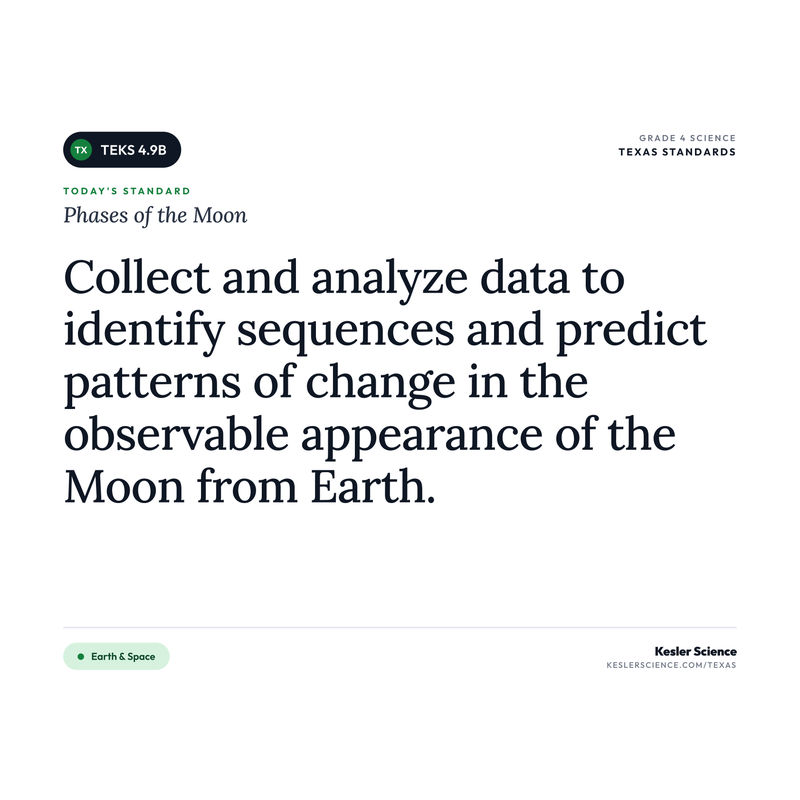
"Collect and analyze data to identify sequences and predict patterns of change in the observable appearance of the Moon from Earth."
💡 What This Standard Actually Means
"Collect and analyze data". Fourth graders are observing the Moon and recording what they see. The standard is laser-focused on the observable appearance of the Moon, meaning what it looks like in the sky, not the science of why. Over the course of about a month, the Moon goes through a repeating cycle: new moon (invisible), waxing crescent, first quarter, waxing gibbous, full moon, waning gibbous, third quarter, waning crescent, and back to new. The pattern repeats roughly every 29 days. Once kids see the sequence, they can predict what shape the Moon will be on any future night.
The Moon is one of the easiest things in science to actually study, because every kid can step outside at night and see it. 4.9B is the standard that turns Moon-watching into real data collection. The TEKS asks kids to collect and analyze data on how the Moon's appearance changes over time, find the sequence, and use that pattern to predict what comes next.
The Moon doesn't actually change shape. It just changes how much of it is lit up by the Sun from where we stand on Earth. The full cycle goes: new moon (we can't see it), waxing crescent (a small slice on the right side), first quarter (right half lit), waxing gibbous (more than half lit but not full), full moon (the whole side facing us is lit), waning gibbous, third quarter (left half lit), waning crescent, and back to new. The whole cycle takes about 29 days, which means every day the Moon looks just a little bit different from yesterday.
By the end of this unit, kids should be able to look at a Moon picture and name the phase. They should know the order the phases go in. And they should be able to use a Moon calendar to predict what the Moon will look like in two weeks, or what it looked like a week ago. The standard is asking for predictions based on the pattern, not memorized definitions.
If I were planning Moon phases for 4th grade, the project I'd build the unit around is a 28-day "Moon Watch." Every kid gets a calendar grid and is asked to step outside every clear night, look at the Moon, and sketch what it looks like in the right calendar box. They don't have to know the names yet. They just have to draw what they see. By week three, the kids who've been faithful about it end up with a beautiful curve of crescent-to-full-to-crescent right there on their page. THAT'S the lesson. Then you put names on the shapes, and the words actually mean something because they have data to attach them to. If you can't pull off a 28-day project, even one week of nightly drawing is powerful. Or use a Moon-phase app to create fake data the kids can graph. The TEKS verb is "collect and analyze data." Whatever it takes to get them looking, drawing, and noticing the pattern.
⚠️ Misconceptions Your Students May Have
These are some of the most common misconceptions. Knowing what to look for can help you get ahead of them.
"The Moon makes its own light"
The Moon doesn't make any light. It reflects sunlight, like a mirror. The bright part of the Moon you see at night is just the half that's facing the Sun. The dark part is the half facing away from the Sun. As the Moon moves around Earth, the angle changes, and we see different amounts of the lit half from where we stand.
"The phases happen because Earth's shadow falls on the Moon"
This is a really common one. The Moon's phases have nothing to do with Earth's shadow. Phases happen because the Moon moves around Earth, and from where we stand we see different amounts of the lit-up side. Earth's shadow only touches the Moon during a lunar eclipse, which is rare. Regular phases happen every single month.
"You can only see the Moon at night"
The Moon is up in the sky during the day a lot of the time. It's just hard to spot because the bright blue sky drowns it out. On a clear afternoon during the first or third quarter phase, you can usually find the Moon right above you. Have kids look up around lunchtime for a week and they'll spot it.
"The Moon changes shape"
The Moon stays the same shape (a sphere) all the time. What changes is how much of the lit-up side we can see from Earth. When we see a thin crescent, the Moon is still a full ball. We just can't see the dark side. A flashlight in a dark room shining on a basketball helps kids see this. The ball doesn't change shape, but you see different shapes of "lit-up" depending on where you stand.
📓 Teaching Resources for 4.9B
These resources are aligned to this standard.


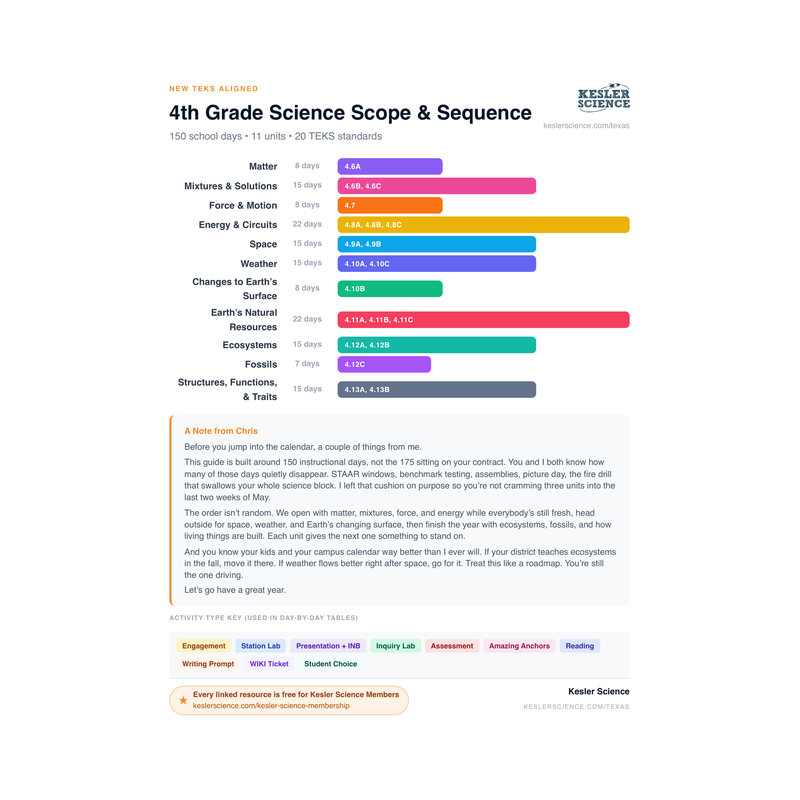
100% Aligned Lessons for Every TEKS You Teach
Kesler Science Plus puts thousands of ready-to-teach lessons and activities in your hands, so you can boost engagement and get your planning time back. Trusted by schools and districts all over the great state of Texas.
🌎 Phenomenon Ideas for 4.9B
Use these real-world phenomena to anchor your lesson. Show students the phenomenon first, let them wonder, then build toward Phases of the Moon as the explanation.
The Flashlight Moon
Turn off the lights. Have one student stand in the middle holding a Styrofoam ball on a stick. Have another student stand a few feet away holding a flashlight. The flashlight is the Sun. The ball is the Moon. The student in the middle is Earth. Slowly turn around in a circle. Watch the lit-up part of the ball appear, fill out, shrink back, and disappear, exactly like the Moon does in the sky.
"The ball never changed shape. So why did we see different shapes of light on it as we turned around? What does this tell us about why the Moon's appearance changes?"
The Calendar Surprise
Pull up a Moon-phase calendar for the current month. Show the class. The Moon goes from a thin crescent on the 3rd, to first quarter on the 10th, to full moon on the 17th, to third quarter on the 24th. Every day is a tiny bit different from the day before. Now flip to next month. Same pattern. Then to last month. Same pattern. The cycle repeats and repeats and repeats.
"How is it possible to print a calendar months in advance and know exactly what the Moon will look like? What kind of pattern would have to be that predictable?"
The Daytime Moon Hunt
Pick a day during a first or third quarter phase. Take the class outside in the middle of the day and have them scan the sky looking for the Moon. There it is, faint but real, in the middle of the blue sky. Most kids have never noticed the Moon during the day. The realization that it's there all the time, day and night, blows minds.
"Why don't most people notice the Moon during the day? Does this change how you think about when the Moon is in the sky?"
💡 Free Engagement Ideas for 4.9B
Ready-to-run activities you can drop straight into a lesson. Where one of these looks like a phenomenon from the section above, that is on purpose: show it first as the hook, then let students run it themselves.
28-Day Moon Watch
Give every kid a calendar grid covering the next 28 days. Each clear night, they go outside, look at the Moon, and draw what they see in the right square. After 28 days, their calendar shows the full cycle from one phase back to the same phase. They label the phases on their drawings and write a one-sentence pattern statement. Real data collection over real time.
Oreo Moon Phase Sequencing
Every kid gets eight Oreo cookies. They twist each one open and use a plastic knife to scrape the cream into the eight phase shapes: new (no cream), waxing crescent, first quarter, waxing gibbous, full, waning gibbous, third quarter, waning crescent. They line their Oreos up in order on a paper plate, label each with a sticky note, and then take a photo. Eat the data when finished. Forever lesson.
Moon Phase Card Sort
Print 8 large picture cards (one for each phase) and shuffle them. Each table gets a set. Kids race to put them in correct order starting with new moon and ending with waning crescent. Then they pull out the first quarter card and predict (without peeking) what the moon will look like one week later. Quick, repeatable warm-up.
Predict-the-Phase Calendar Game
Project a calendar showing the moon phase for each day of one month. Cover up days 15 through 30. Each kid picks three covered dates, predicts what the moon will look like that day, and explains how they knew. Reveal the answers. Award stickers for kids who used the pattern instead of guessing. Connects directly to the "predict patterns" verb.
🎯 What Approaches, Meets, and Masters Thinking Look Like
Here is what student thinking at each level looks like on this one task, so you know what to look for and how to move a student up.
A class watched the Moon for a few weeks and drew it each night. Here is the order they saw: full moon, then a little less than full, then half lit, then a thin sliver. The Moon was getting smaller each night. Look at the pattern. What will the Moon most likely look like a few nights after the thin sliver? Explain why the Moon looks like it is changing shape.
- A prediction that the next phase is a new moon (the Moon we cannot see), since the lit part keeps shrinking.
- The phases named or drawn in the correct order as they shrink: full, waning gibbous (a little less than full), third quarter (half lit), waning crescent (a thin sliver), new.
- Fourth graders are not expected to use the waning labels, so full, gibbous, half, crescent, new is a correct answer. Correct order and a correct prediction are what this task is testing.
- An understanding that the pattern is repeating, so it will start growing again after the new moon.
- A drawing that shows the lit shape getting smaller in steps, not random shapes.
- The big idea named: the Moon is not really changing shape, it is a ball the whole time.
- An explanation that the shape we see changes because of how much of the lit side faces us.
- The "why" handled correctly: phases come from sunlight on the Moon and where the Moon is, not from a shadow. That is the easiest place to slip.
The Moon will be a new moon next because it keeps getting smaller. The Moon looks like it changes shape because the Earth's shadow is on it. The shadow covers up more and more of the Moon each night, so we see less of it.
The next one will be a new moon, where we cannot see it. The lit part got smaller and smaller, so the next step is no lit part at all. The Moon is not really changing shape. It is a ball the whole time. We just see different amounts of the part that is lit up by the Sun. After the new moon it will start to grow again, because the pattern repeats.
The next one is a new moon, when the lit side is facing away from us so we cannot see it. The Moon is always a round ball. One half is always lit by the Sun. As the Moon moves around Earth, we see different amounts of that lit half, so it looks like it is changing shape, but it is not.
That also tells me what comes after the new moon. It will not stay dark. The Moon keeps moving, so we will start to see a thin sliver again, and then it will grow back to full. The pattern keeps repeating about every month, so I could even guess what the Moon will look like next week or last week.
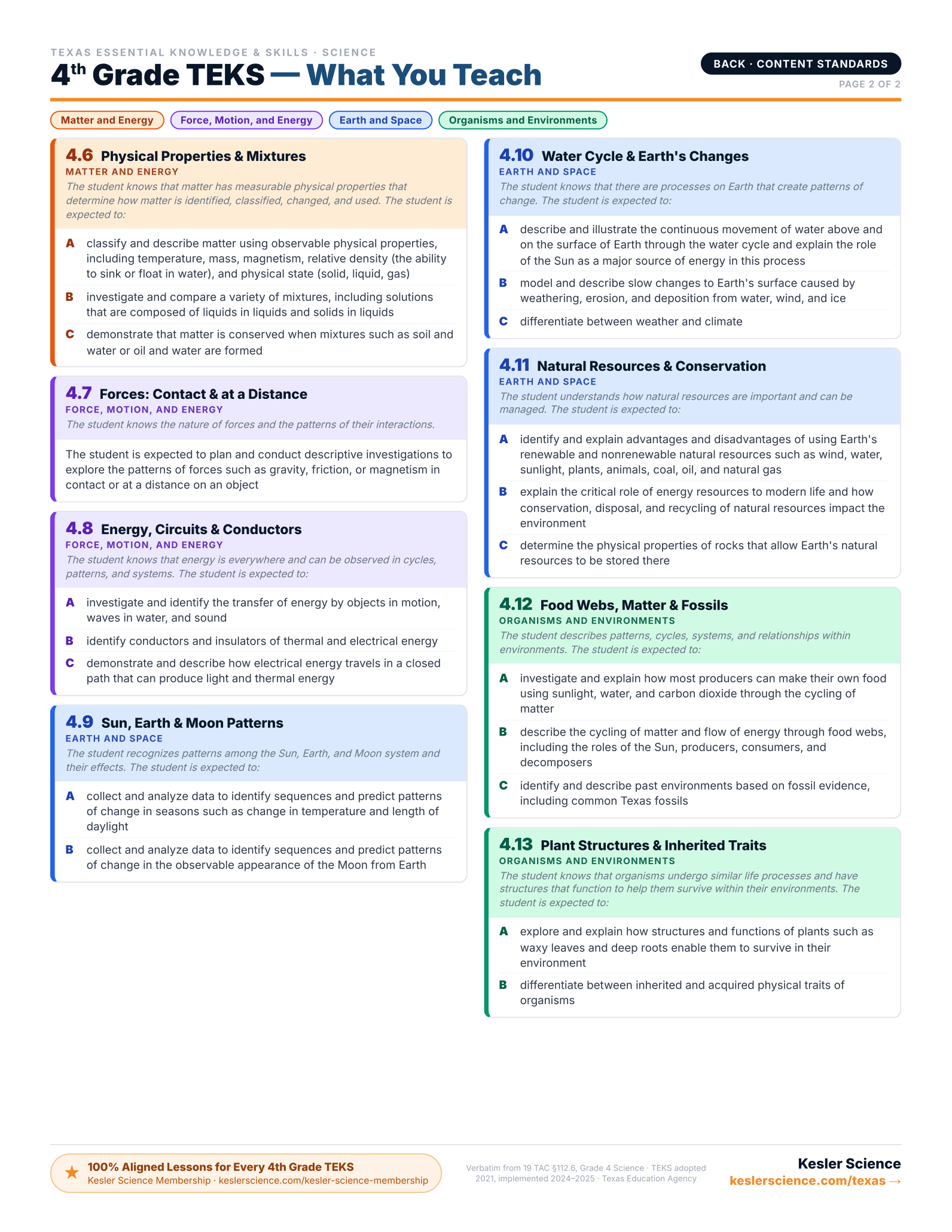
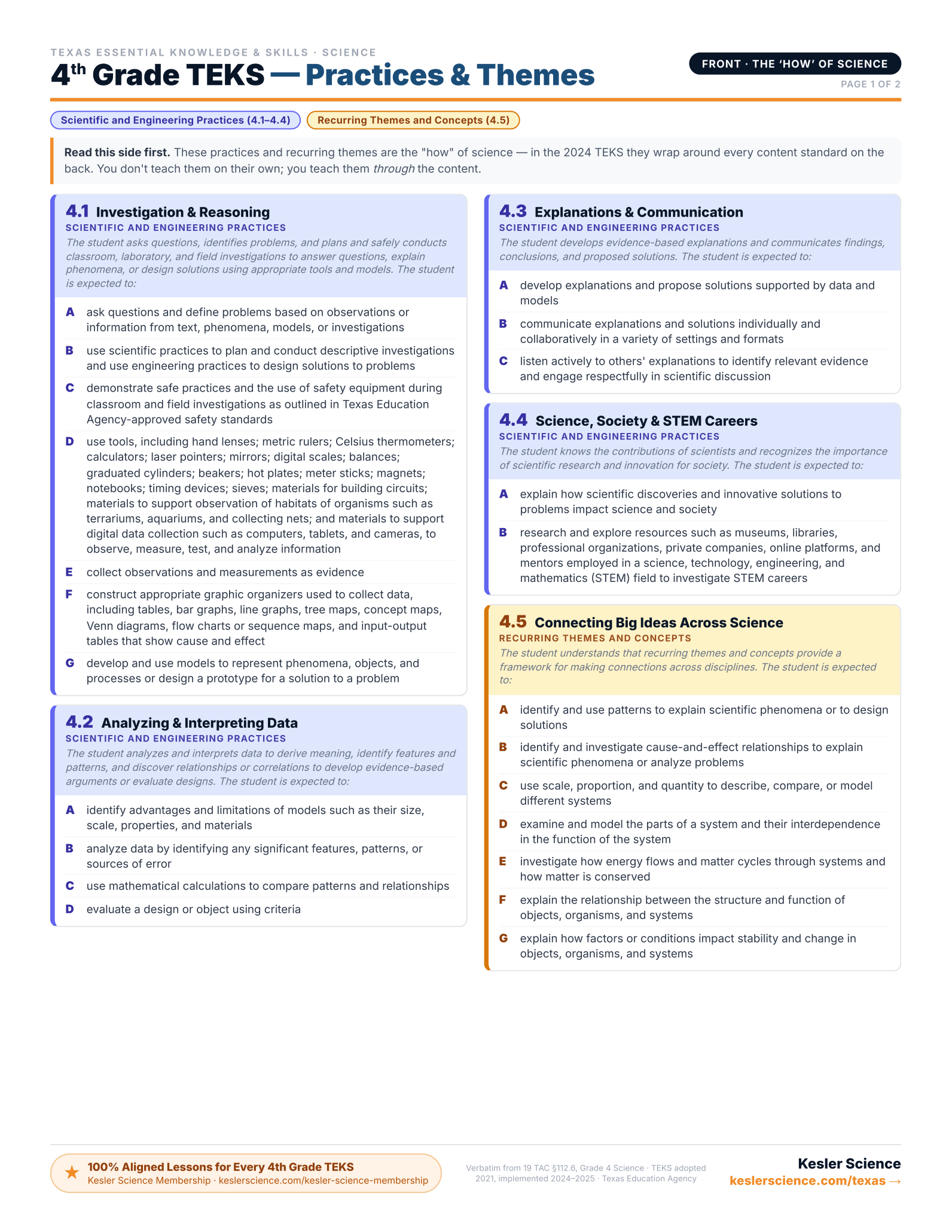
Every 4th-Grade Science TEKS on One Page
The color-coded, front-and-back cheat sheet I wish I'd had — every standard, organized by reporting category. Print it and reference it all year long. This will be your new favorite document!
Trusted Across Texas
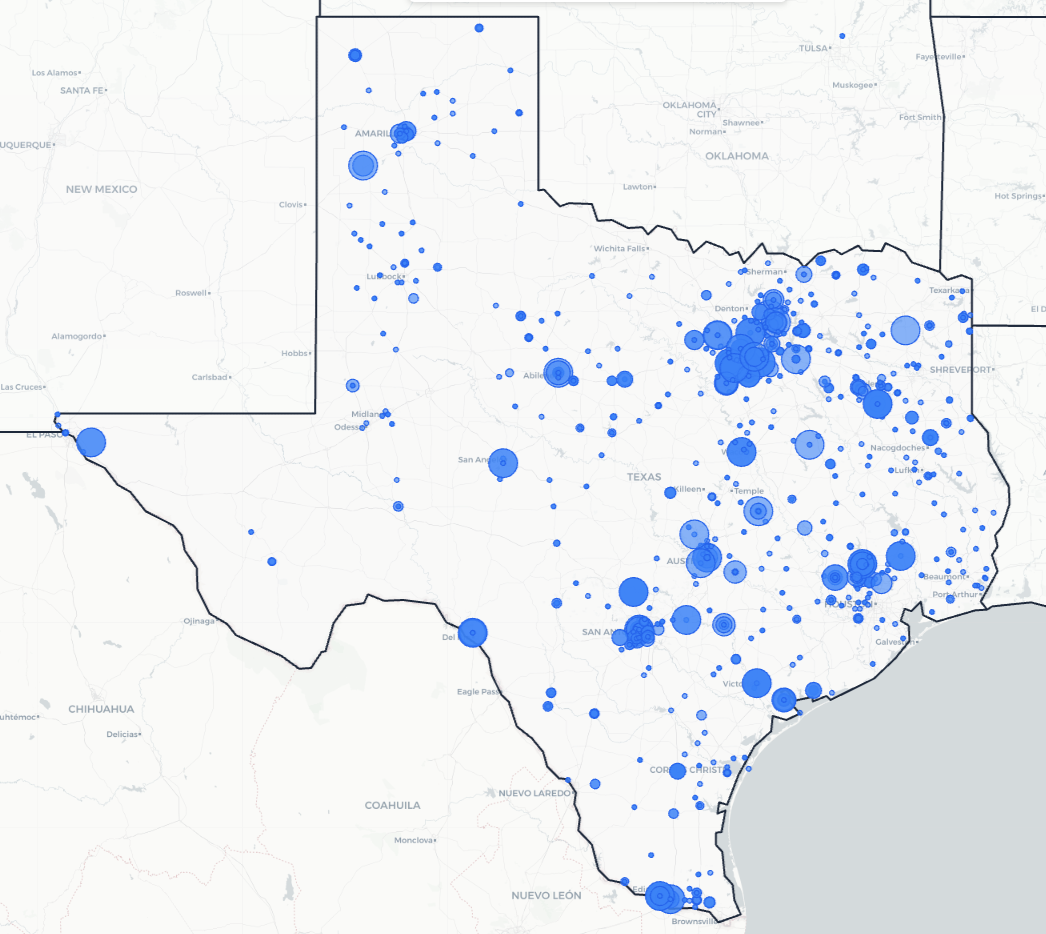
From the Rio Grande Valley to the Panhandle, Texas science teachers are using Kesler Science to save time and engage students.
Texas Schools and Districts
Love Kesler Science
What Teachers Are Saying
Give Your Science Teachers Everything They Need
School and district licenses give your teachers access to every resource they need, including station labs, inquiry labs, anchoring phenomena, presentations, escape rooms, and much more. One purchase covers the grade levels you need.
- PO-friendly. We accept purchase orders
- Volume discounts for 11+ teachers
- Complimentary Kesler Science Plus orientation for 4+ teachers
- Three free implementation PD sessions for departments of 11+
- Aligned to the 2024 TEKS standards
See It in Action
Book a walkthrough and we'll show you how Kesler Science fits your campus.
Book Demo CallNo pressure, no hard sell