.png?width=375&height=100&name=WebPage%20logo%20with%20curves%202026%20(8).png)
Rocks That Store Earth's Resources
"Determine the physical properties of rocks that allow Earth's natural resources to be stored there."
💡 What This Standard Actually Means
"Determine". Students aren't memorizing rock names. They're figuring out what makes some rocks good at holding stuff (water, oil, natural gas) and other rocks not. The load-bearing idea is that rocks have physical properties students already met in 4.6A (texture, hardness, layers) plus two new ones for this standard: tiny holes called pores and whether those holes connect. A rock that's full of connected pores can hold and release a resource. A rock that's solid all the way through can't. Instruction works best when students can squeeze a sponge, hold a piece of pumice, and pour water through different materials. Then they're not memorizing, they're noticing.
Most kids think rocks are just hard, solid lumps. This standard cracks that idea open. The water that comes out of a Texas faucet has been sitting inside a rock, usually limestone, for thousands of years. The natural gas that heats a Texas home was held in tiny spaces inside sandstone a mile underground. Even crude oil rests in spaces between sand grains in rocks deep below West Texas. The rocks aren't solid. They're more like underground sponges.
Two physical properties decide whether a rock can store a natural resource. The first is porosity, the amount of empty space inside. A sponge has very high porosity. Granite has almost none. The second is permeability, whether those empty spaces connect to each other so liquid or gas can travel through. A sponge is permeable; squeeze one end and water flows out the other. A rock can have lots of pores but if they're sealed off, nothing can get in or out. Both have to work together for storage to happen.
The big takeaway for 4th graders: not every rock can hold the natural resources we use. Sandstones, limestones, and porous shales work because they have connected pore spaces. Granite and most metamorphic rocks don't, because they're packed tight all the way through. By the end of this standard, kids should be able to look at a rock, or a model of a rock, and predict whether water, oil, or gas could move in and out, based on the holes they can see and feel.
The kitchen sponge demo is the move I'd lean on to make this stick. Bring one dry sponge and one block of clay to class on the first day of this standard. Pour an ounce of water on the sponge and it disappears inside. Pour an ounce on the clay and it puddles on top and runs off. Same amount of water, two completely different rocks. Then ask, "If you were oil deep underground a long time ago, which one would you rather end up inside?" Kids get it instantly. The sponge is what an oil reservoir actually looks like at a microscopic level. Millions of connected holes between grains of sand cemented together. Texas has more of those underground sponges than almost anywhere on Earth, which is why the state's been pumping oil for over a hundred years. The standard is short, but the demo carries it.
⚠️ Misconceptions Your Students May Have
These are some of the most common misconceptions. Knowing what to look for can help you get ahead of them.
"Rocks are solid all the way through, so nothing can be inside them"
Some rocks look solid but have tons of tiny holes. Pick up a piece of pumice (the rough volcanic rock you can get at any drugstore) and you'll see and feel the holes. Sandstone has microscopic spaces between every grain of sand. Limestone is full of tiny gaps. The water and oil that humans pump out of the ground have been sitting in those tiny spaces for thousands or millions of years. The rock doesn't have to be obviously squishy. The holes just have to be there.
"Underground water is in giant lakes or rivers under the ground"
Almost no underground water sits in open caves or rivers. The Edwards Aquifer in central Texas, the water source for San Antonio, isn't a lake. It's water held in millions of tiny holes inside limestone rock. When you drink Texas tap water from that aquifer, that water just came out of a rock. Picture a sponge a hundred feet thick stretching for hundreds of square miles. That's an aquifer. The "river" is the rock.
"Any rock with holes can hold and give back water or oil"
The holes have to connect to each other. A rock can have lots of separate, sealed-off pockets and still be useless for storage because nothing can move in or move out. The two physical properties scientists check are porosity (how much empty space) AND permeability (whether the empty spaces connect). A great storage rock has both. A bad one might have lots of holes but they're closed off, so the resource can't get in to be stored or out to be used.
"Granite would make a great place to store water or oil"
Granite is one of the worst storage rocks. Look at a piece up close, you'll see tightly interlocked crystals with almost no space between them. There's nowhere for water, oil, or natural gas to fit. That's why oil companies don't drill into granite layers and water wells aren't dug into granite bedrock. The rocks that store our natural resources are mostly sedimentary, sandstone, limestone, and certain shales, because they formed from grains piled together with spaces in between.
📓 Teaching Resources for 4.11C
These resources are aligned to this standard.


100% Aligned Lessons for Every TEKS You Teach
Kesler Science Plus puts thousands of ready-to-teach lessons and activities in your hands, so you can boost engagement and get your planning time back. Trusted by schools and districts all over the great state of Texas.
🌎 Phenomenon Ideas for 4.11C
Use these real-world phenomena to anchor your lesson. Show students the phenomenon first, let them wonder, then build toward Rocks That Store Earth's Resources as the explanation.
Two Rocks, One Cup of Water
Hold up two rocks the same size: one piece of sandstone and one piece of granite. Pour a small cup of water slowly over each one in front of the class. The granite repels the water, it runs off the sides and pools on the table. The sandstone soaks the water up like a sponge and disappears inside. Same amount of water. Same size of rock. Two completely different stories about what's happening on the inside.
"Where did the water go on each rock? What's different about the inside of the sandstone that lets the water disappear into it? If you were a drop of oil deep underground millions of years ago, which kind of rock would you end up inside?"
The Edwards Aquifer Map
Project a map of the Edwards Aquifer running underneath Austin, San Antonio, and the Texas Hill Country. The aquifer provides drinking water for over two million Texans. But it's not a lake or a river. It's water held inside a layer of limestone rock between 100 and 1,000 feet underground. When the city of San Antonio pumps water for kids to drink in the cafeteria, that water just came out of millions of tiny holes inside limestone.
"How can a rock hold enough water to be a major city's drinking supply? What property of the limestone makes that possible? What would happen if the rock didn't have those tiny holes inside?"
The Underground Sponge
Set up two clear cups, both filled to the brim with sand. Pour vegetable oil slowly into the first one and watch it disappear into the gaps between the grains until the oil seeps through to the bottom. Now squeeze the cup gently and watch a few oil droplets push back up to the surface. Show students a photo of a real oil well in West Texas next to the cup. The well is doing the same thing on a much bigger scale, in much deeper rock.
"Where exactly is the oil in the cup? What kind of rock might it be inside if this were happening underground? Why does pressing on the sand bring some oil back up, and what does that tell us about how oil wells work?"
💡 Free Engagement Ideas for 4.11C
Ready-to-run activities you can drop straight into a lesson. Where one of these looks like a phenomenon from the section above, that is on purpose: show it first as the hook, then let students run it themselves.
Sponge vs. Stone Test
Give each group three "rocks" to test: a kitchen sponge, a piece of pumice, and a smooth river rock or a piece of granite. Each group fills a measuring cup with 50 mL of water and pours it slowly over each "rock" while another student catches whatever drips through. They record how much water the rock held and predict which kind of real rock each "rock" represents. Reinforces porosity (how much it held) and permeability (how the water moved through).
Build an Aquifer in a Cup
Each group layers different materials in a clear plastic cup: a layer of clay on the bottom (the impermeable layer), a thick layer of sand or gravel above it (the storage layer), and a thin layer of soil on top (the surface). Slowly pour water on top and watch it travel down through the soil, fill up the sand layer, and stop at the clay. Students poke a straw "well" into the sand layer and use it to suck water up, exactly how an underground aquifer works.
Texas Resource Rock Map
Hand out a blank Texas state map and three colored stickers per student (blue, black, brown). Project a teacher version showing where each natural resource is stored: blue stickers on the Edwards Aquifer (central Texas, limestone storing water), black stickers on the Permian Basin (West Texas, sandstone storing oil and natural gas), brown stickers on East Texas (Carrizo-Wilcox sandstone aquifer). Students label each region with the rock type and what's stored there. Closes with a quick discussion: why are these the regions where we drill and pump?
Squeeze Test Comparison
Give each pair of students three small samples sealed in zip-top bags: dry sand, dry clay, and a small piece of sponge or pumice. Have them squeeze each one and describe what happens. Then add 20 mL of water to each bag, seal, and squeeze again. The sand and the sponge "release" water when squeezed (permeable). The clay holds onto the water and doesn't release it (porous but not permeable). (Teacher note: pumice porosity is high but permeability varies from sample to sample, so test ahead of class.) Students compare and write a sentence about which materials would make good rocks for storing a natural resource and why.
🎯 What Approaches, Meets, and Masters Thinking Look Like
Here is what student thinking at each level looks like on this one task, so you know what to look for and how to move a student up.
A class pours the same amount of water on top of two rocks. The water soaks all the way through the sandstone and drips out the bottom. The water just sits on top of the granite and never goes through. A town wants to store its water inside one of these rocks underground. Which rock should the town pick, and why? Use what you know about the tiny holes in rocks.
- A clear choice: the town should pick the sandstone.
- Talks about the tiny holes (pores) inside the rock, not just whether the rock looks hard.
- Says the sandstone has empty spaces for water to fit into, and the granite does not.
- Uses the water test as proof: water went through the sandstone but sat on top of the granite.
- Connects "water went through" to the holes being connected, so water can move in and back out later.
- Explains why granite is a bad choice: it is packed tight with no connected spaces, so water cannot get in or out.
- Sees that a rock needs holes that connect, not just holes. That is the easiest part to miss.
The town should pick the sandstone. It has holes in it so the water can go inside. The granite is too hard and smooth. Any rock that has holes can hold water, so as long as a rock has holes the town will be fine.
The town should pick the sandstone. The water soaked all the way through it and dripped out the bottom. That shows the sandstone has lots of tiny holes and the holes connect, so water can move in and then come back out when the town needs it. The granite is packed tight with no spaces, so the water just sat on top and could not get in. A good storage rock needs holes that connect, and the sandstone has them.
The town should pick the sandstone. Water went all the way through it, which means it has tiny holes and the holes connect to each other. That is what lets water move in to be stored and move back out to be used. Granite is the opposite. The water sat on top because the crystals are packed tight with no connected spaces, so nothing can get in or out.
The real rule is that a storage rock needs two things: empty spaces inside, and those spaces have to connect. That is how I would know about a rock I never tested. Pumice has tons of holes, but if the holes are sealed off and do not connect, water could not flow through, so it would be a bad choice too. It is not about how many holes a rock has. It is about whether the holes link up so the resource can travel in and out.
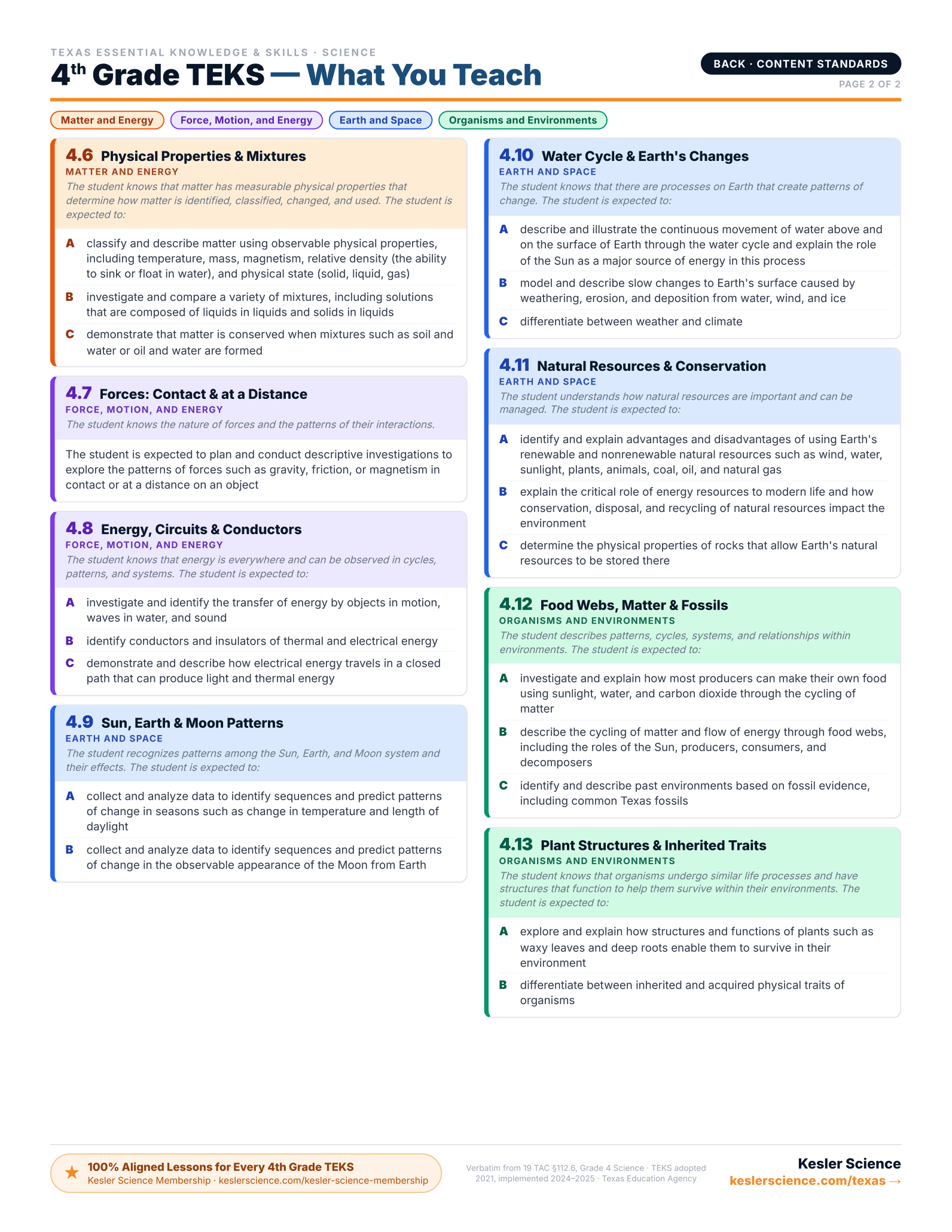
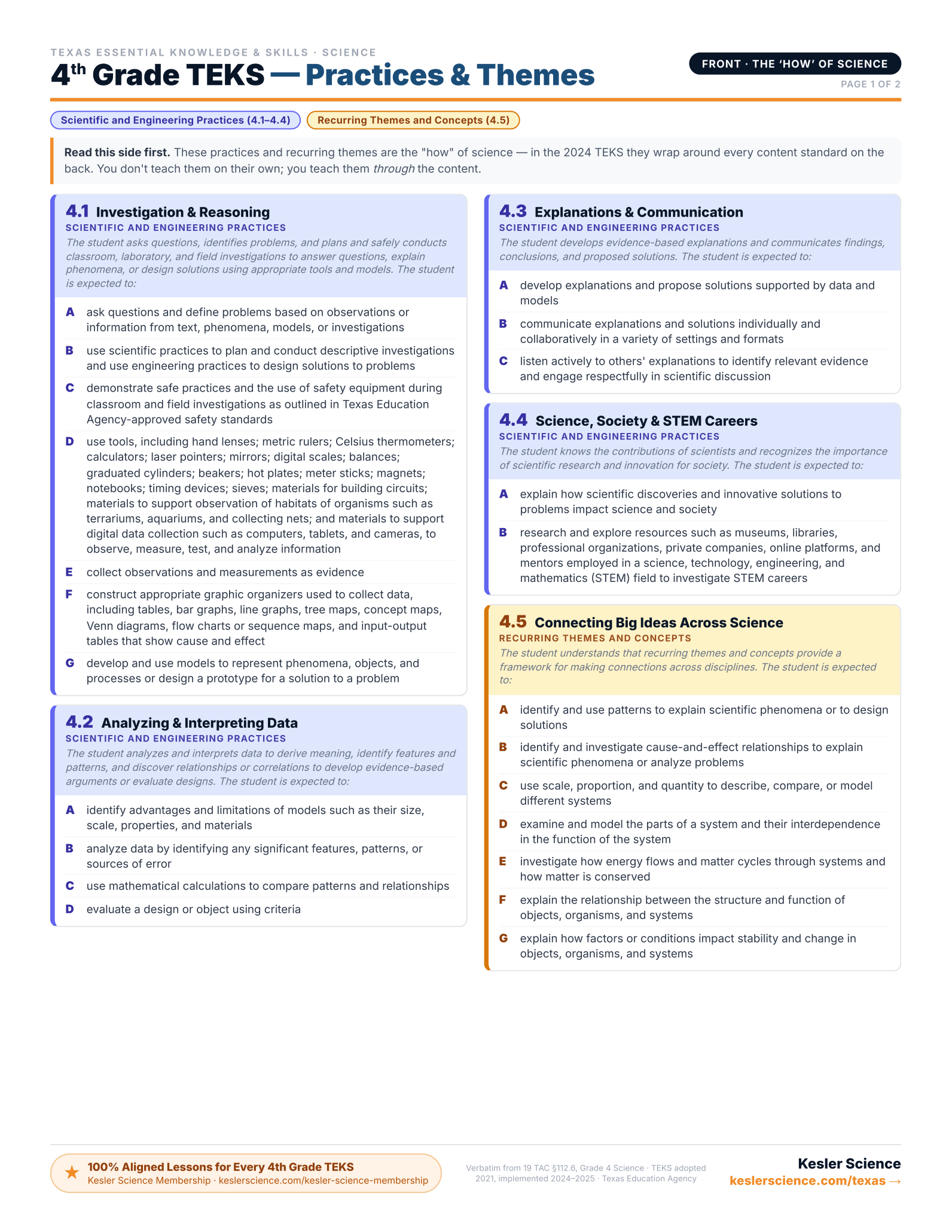
Every 4th-Grade Science TEKS on One Page
The color-coded, front-and-back cheat sheet I wish I'd had — every standard, organized by reporting category. Print it and reference it all year long. This will be your new favorite document!
Trusted Across Texas
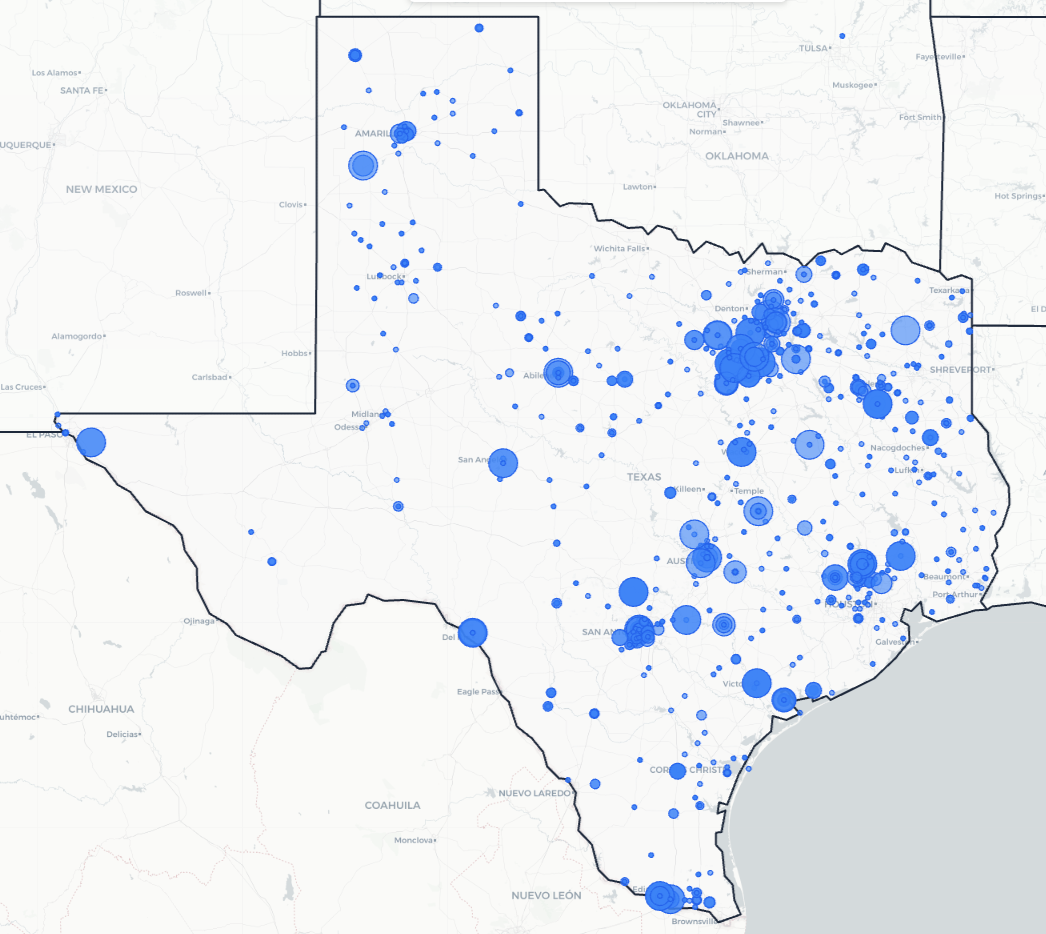
From the Rio Grande Valley to the Panhandle, Texas science teachers are using Kesler Science to save time and engage students.
Texas Schools and Districts
Love Kesler Science
What Teachers Are Saying
Give Your Science Teachers Everything They Need
School and district licenses give your teachers access to every resource they need, including station labs, inquiry labs, anchoring phenomena, presentations, escape rooms, and much more. One purchase covers the grade levels you need.
- PO-friendly. We accept purchase orders
- Volume discounts for 11+ teachers
- Complimentary Kesler Science Plus orientation for 4+ teachers
- Three free implementation PD sessions for departments of 11+
- Aligned to the 2024 TEKS standards
See It in Action
Book a walkthrough and we'll show you how Kesler Science fits your campus.
Book Demo CallNo pressure, no hard sell