.png?width=375&height=100&name=WebPage%20logo%20with%20curves%202026%20(8).png)
Conductors & Insulators
"Identify conductors and insulators of thermal and electrical energy; and"
💡 What This Standard Actually Means
"Identify". Fourth graders are testing materials and labeling them. The standard names two kinds of energy that move through stuff differently: thermal energy (heat) and electrical energy. A conductor is a material that lets the energy move through it easily. An insulator is a material that slows the energy down or blocks it. Metal spoon? Conductor of heat. Wooden spoon? Insulator of heat. Copper wire? Conductor of electricity. Plastic coating around the wire? Insulator. Kids identify which is which by testing.
4.8B is the standard where 4th graders learn that energy doesn't move through every material the same way. Some materials let heat or electricity pass through them easily. Those are conductors. Other materials slow them down or stop them entirely. Those are insulators. The TEKS specifies two kinds of energy that students need to test: thermal energy (heat) and electrical energy.
For thermal energy, the test is simple. Stick different materials in a cup of warm water and feel the top of each one after a minute. The metal spoon gets hot fast (good thermal conductor). The plastic spoon stays cool (insulator). The wooden craft stick stays cool too (insulator). For electrical energy, the test is just as simple. Build a tiny circuit with a battery and a bulb, and leave a gap. Put different materials across the gap and see if the bulb lights up. Copper wire? Bulb lights (good electrical conductor). Rubber band? Nothing happens (insulator). Aluminum foil? Bulb lights. Cardboard? Bulb stays dark.
By the end of this unit, kids should be able to grab any everyday material and predict whether it'll be a conductor or insulator for both kinds of energy. They should also know why this matters in real life. Pots have wooden or plastic handles so the heat doesn't burn your hand. Electric wires have plastic coatings so you don't get shocked. The standard isn't just about labeling materials. It's about understanding why the right material gets used for the right job.
If I were teaching this standard, I'd run a "two-table day." On one side of the room, set up the heat-conductor station: a coffee pot of warm water, a bunch of materials (metal spoon, wooden craft stick, plastic spoon, paperclip, cardboard strip), and a thermometer. Kids stick each material in the warm water and feel the top after a minute. They write H or C on a chart. On the other side of the room, set up the electric-conductor station: a tiny circuit with a battery, a bulb, and two alligator clips. Kids test the same materials by clipping them across the gap. The bulb either lights up or doesn't. They write Y or N on the same chart. By the end, every kid has a single chart showing which materials conduct heat, which conduct electricity, and which conduct both. Most metals end up being good at both, which is a great moment to point out the pattern. Don't make this harder than it needs to be. Test, observe, label.
⚠️ Misconceptions Your Students May Have
These are some of the most common misconceptions. Knowing what to look for can help you get ahead of them.
"All materials let heat through the same way"
They do not, and that difference is the whole standard. Metals move thermal energy through themselves much faster than wood, plastic, or rubber do. Stick a metal spoon, a wooden craft stick, and a plastic spoon in a mug of warm water. After a minute the metal one feels hot at the top. The other two still feel cool. Metals are conductors. Wood and plastic are insulators.
"Wood is an insulator, so wood blocks all energy"
"Insulator" doesn't mean "blocks everything." It means it slows the energy down a lot compared to a conductor. Heat still moves through a wooden spoon, just very slowly. After a long time in hot water, even a wooden handle will warm up a little. The point is that compared to a metal spoon, the wood is way slower at moving heat.
"If something conducts heat, it must conduct electricity too"
Most of the time, yes, especially with metals. But it's worth testing both because the two are different kinds of energy. Some materials surprise you. Most metals conduct both heat and electricity well. Most plastics, rubber, and wood are insulators for both. But you have to actually test it. Don't assume.
"Plastic is bad and metal is good"
Neither is bad or good. They're just used for different jobs. Pans are made of metal because metal conducts heat and cooks the food. Pan handles are made of plastic or wood so the heat doesn't move into your hand. Electric wires are made of metal because metal conducts electricity. The plastic coating around the wire is there to stop the electricity from shocking you. Both materials are doing exactly the right job.
📓 Teaching Resources for 4.8B
These resources are aligned to this standard.


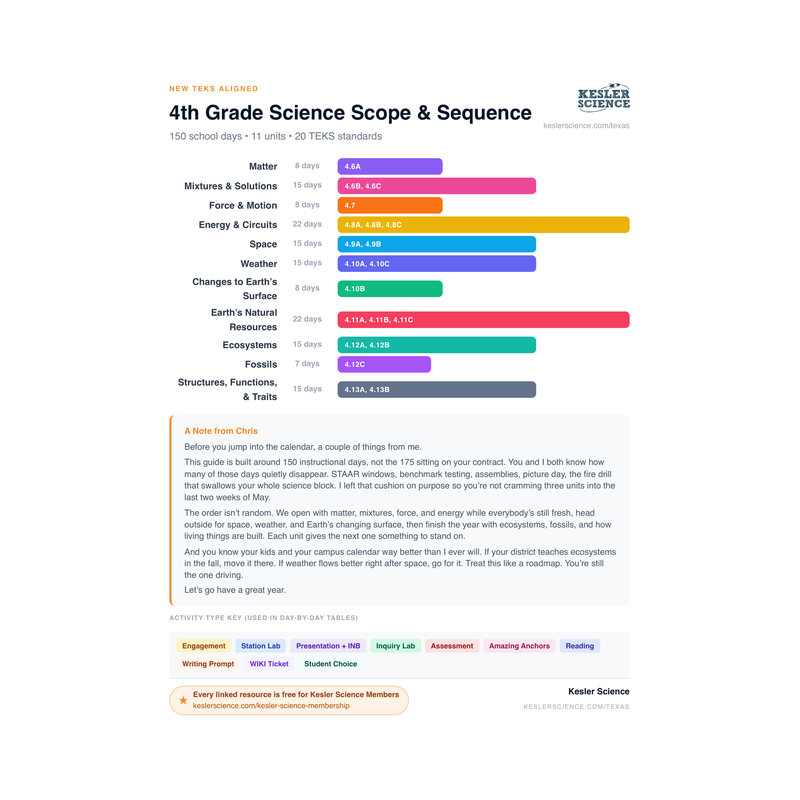
100% Aligned Lessons for Every TEKS You Teach
Kesler Science Plus puts thousands of ready-to-teach lessons and activities in your hands, so you can boost engagement and get your planning time back. Trusted by schools and districts all over the great state of Texas.
🌎 Phenomenon Ideas for 4.8B
Use these real-world phenomena to anchor your lesson. Show students the phenomenon first, let them wonder, then build toward Conductors & Insulators as the explanation.
The Spoon Race
Stand three spoons in a coffee mug of warm water: a metal spoon, a plastic spoon, and a wooden spoon. Stick a small dab of butter near the top of each handle. Wait two or three minutes. The butter on the metal spoon slides down first. The plastic stays mostly the same. The wooden one's butter doesn't move at all. Same water, same time, three different results.
"Why did the butter melt off only one spoon? What's different about how each handle moves heat?"
The Light-Up Material Test
Build a simple circuit with a battery, a bulb, and two alligator clips with a small gap between them. Touch a paperclip across the gap. The bulb lights up. Touch a rubber band across the gap. Nothing. Touch a piece of aluminum foil. Light. Touch a piece of cardboard. Dark. The kids can see live, in real time, which materials let the energy flow and which ones don't.
"Why did the bulb only light up for some materials? What property are we testing? Which group would you call conductors, and which group would you call insulators?"
The Pot-Handle Mystery
Hold up a real cooking pot. The bottom is metal. The handle is plastic or wood. Ask: "Why didn't they make the whole thing out of one material?" Then walk through it. The metal pot bottom needs to conduct heat to cook the food. The plastic handle needs to NOT conduct heat so you can hold it without getting burned. Two different jobs, two different materials, both perfect for what they're doing.
"Look around your house tonight. Where else do you see one object made out of a conductor AND an insulator? Why do they need both?"
💡 Free Engagement Ideas for 4.8B
Ready-to-run activities you can drop straight into a lesson. Where one of these looks like a phenomenon from the section above, that is on purpose: show it first as the hook, then let students run it themselves.
Heat-Conductor Test Lab
Each group gets a foam cup of very warm (not hot) water and a basket of materials: metal spoon, plastic spoon, wooden craft stick, paperclip, pencil, rubber band wrapped around a popsicle stick. Stick all of them in the water. After 60 seconds, feel the top of each. Record on a chart: "warm" or "cool." Group results into conductors (warm) and insulators (cool).
Electric-Conductor Circuit Test
Each group gets a battery (D cell), a small bulb in a holder, and three alligator clip wires. Wire it up: battery to bulb, bulb to a free clip, and a third clip back to the battery. The two free clips are the gap. Clip a test material between them. If the bulb lights, it is a conductor. If it stays dark, it is an insulator. Test 10 materials and record yes or no for each one: paperclip, aluminum foil, copper wire, plastic spoon, rubber band, cardboard, eraser, fabric, key, and pencil graphite. Sharpen the pencil at both ends before you hand it over, or the wood at the back end blocks the circuit and the surprise falls flat.
Why That Material? A Sorting Hunt
Send kids around the room with a clipboard and a two-column chart: "Chosen because of how it moves energy" and "Chosen for some other reason." They find eight objects and sort each one, writing the reason in their own words. Some are clear: the plastic coating on a lamp cord is there so the electricity stays inside, and the handle on a pan is plastic so the heat does not reach your hand. Others are the good arguments. A metal key is a conductor, but nobody made it metal for that. Scissors are metal so they stay sharp. The point they should land on by the end: knowing a material conducts does not tell you why it got picked. You have to ask what job it is doing.
Design a Coffee Cup
Pose the challenge: "Design a coffee cup that keeps the drink hot but doesn't burn your hand." Each group sketches a cup using at least one conductor and at least one insulator, labels each material, and explains why they chose it. They can build a quick model out of foam cups, foil, fabric strips, and cardboard if you want to extend it. Connects the standard to engineering.
🎯 What Approaches, Meets, and Masters Thinking Look Like
Here is what student thinking at each level looks like on this one task, so you know what to look for and how to move a student up.
A teacher fills a mug with warm water. She stands three things up in the mug: a metal spoon, a plastic spoon, and a wooden craft stick. After one minute, you touch the top of each one. Tell which ones are conductors of heat and which ones are insulators of heat, and explain how you know.
- The words conductor and insulator used the right way: a conductor lets heat move through it easily, an insulator slows the heat down.
- The metal spoon named as a conductor of heat.
- The plastic spoon and the wooden stick both named as insulators of heat.
- The reason tied to what they felt: the conductor got hot at the top, the insulators stayed cool.
- An idea that the heat moved up the metal from the warm water, instead of the spoon just "being hot."
- No claim that the insulator blocks all heat. It only slows the heat down a lot.
- The plastic and wood both handled correctly as insulators. Calling one of them a conductor is the easiest place to slip.
The metal spoon got hot, so it is a conductor. The plastic spoon stayed cool, so it is an insulator. The wooden stick is metal colored at the bottom so it is a conductor too. Metal things are all the same, they all conduct heat fast.
The metal spoon was hot at the top, so it is a conductor of heat. The heat moved up the metal from the warm water. The plastic spoon and the wooden stick both stayed cool at the top, so they are insulators of heat. The heat could not move up them fast like it did in the metal. So one conductor and two insulators.
The metal spoon is a conductor because heat moves through it easily. The heat went up the metal from the warm water and made the top hot. The plastic spoon and the wooden stick are insulators because heat moves through them very slowly, so the tops stayed cool after one minute. An insulator does not block all the heat. It just slows it down a lot. If you left the wooden stick in for a really long time, the top would warm up a little too.
That is why a metal pot at home has a plastic or wooden handle. The metal part is a conductor, so it gets hot and cooks the food. The handle is an insulator, so the heat moves through it slowly and your hand does not get burned when you pick it up.
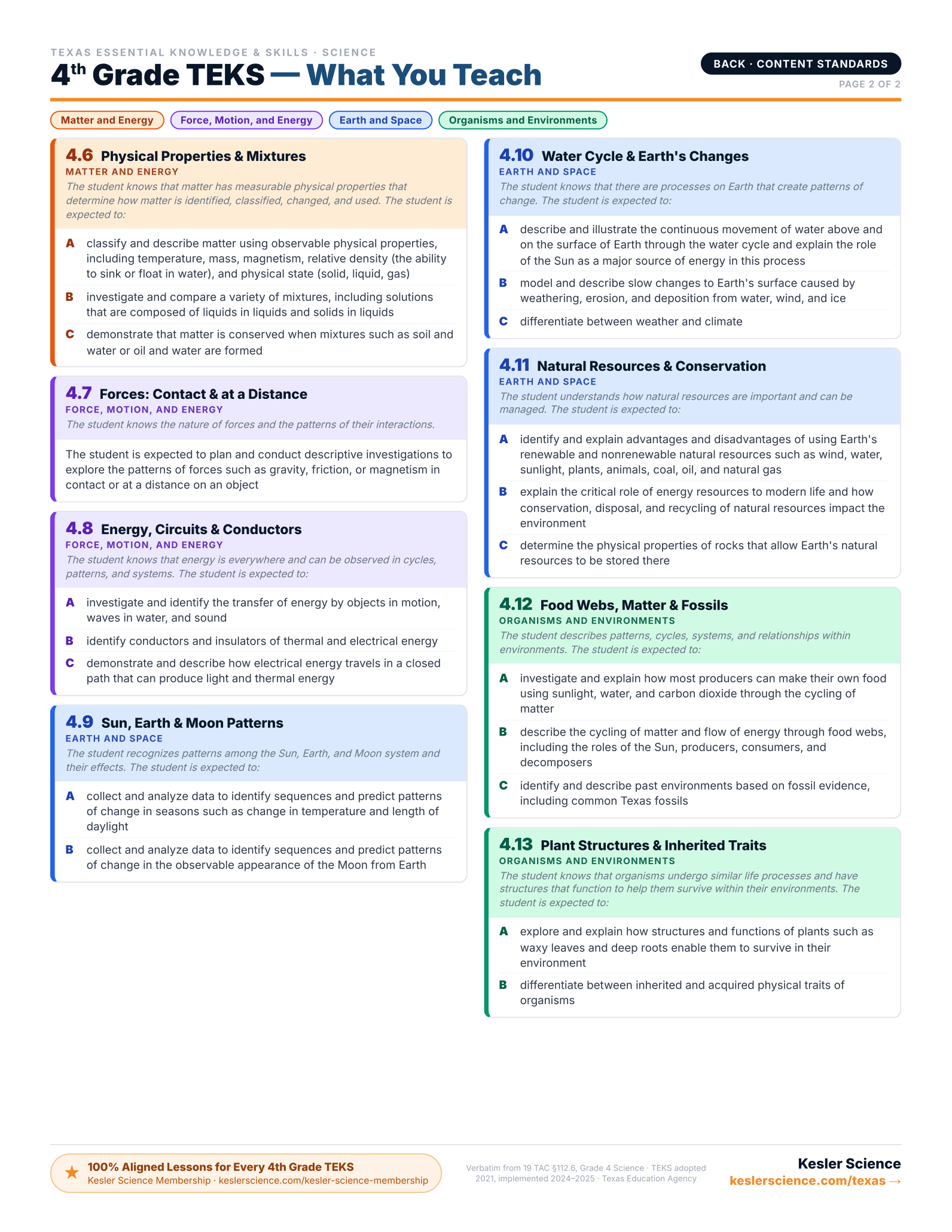
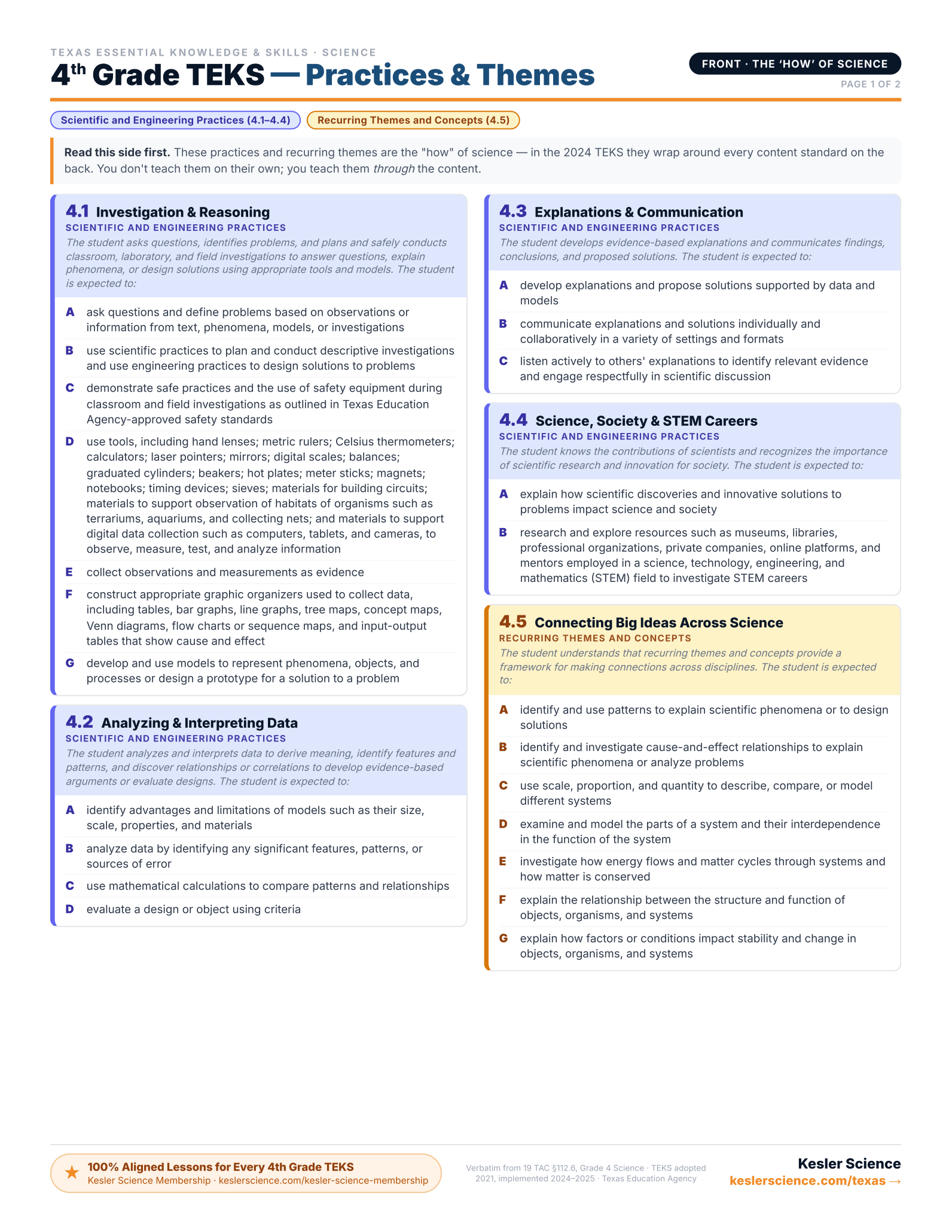
Every 4th-Grade Science TEKS on One Page
The color-coded, front-and-back cheat sheet I wish I'd had — every standard, organized by reporting category. Print it and reference it all year long. This will be your new favorite document!
Trusted Across Texas
From the Rio Grande Valley to the Panhandle, Texas science teachers are using Kesler Science to save time and engage students.
Texas Schools and Districts
Love Kesler Science

What Teachers Are Saying
Give Your Science Teachers Everything They Need
School and district licenses give your teachers access to every resource they need, including station labs, inquiry labs, anchoring phenomena, presentations, escape rooms, and much more. One purchase covers the grade levels you need.
- PO-friendly. We accept purchase orders
- Volume discounts for 11+ teachers
- Complimentary Kesler Science Plus orientation for 4+ teachers
- Three free implementation PD sessions for departments of 11+
- Aligned to the 2024 TEKS standards
See It in Action
Book a walkthrough and we'll show you how Kesler Science fits your campus.
Book Demo CallNo pressure, no hard sell