.png?width=375&height=100&name=WebPage%20logo%20with%20curves%202026%20(8).png)
Renewable & Nonrenewable Resources
"Identify and explain advantages and disadvantages of using Earth's renewable and nonrenewable natural resources such as wind, water, sunlight, plants, animals, coal, oil, and natural gas;"
💡 What This Standard Actually Means
"Identify and explain". Fourth graders are sorting resources into renewable vs. nonrenewable AND giving the pros and cons of using each one. The TEKS hands you the exact list of resources to discuss: wind, water, sunlight, plants, animals, coal, oil, and natural gas. The first five (wind, water, sunlight, plants, animals) are renewable: they come back or replace themselves over a short time. The last three (coal, oil, natural gas) are nonrenewable: they took millions of years to form and we can't make more in our lifetime. Each one has advantages (it's powerful, it's cheap, it's clean) and disadvantages (it's polluting, it runs out, it's unreliable).
Earth gives us all kinds of resources to power our lives. Some of them come back on their own. Others are gone for good once we use them up. 4.11A asks 4th graders to identify which is which and explain the advantages and disadvantages of each one. The TEKS even gives you the exact list to teach: wind, water, sunlight, plants, animals, coal, oil, and natural gas.
The five renewable resources keep coming back. The wind blows again tomorrow. Rivers keep flowing. The Sun rises every morning. Plants grow back. Animals reproduce. We can use these every day without running out, as long as we don't damage the systems that make them work. The three nonrenewable resources took millions of years to form deep underground. Coal, oil, and natural gas (often called fossil fuels) come from ancient organic matter that got squeezed and heated under the Earth for ages. Coal formed from ancient plants in giant swamps. Oil and natural gas formed from tiny ancient sea creatures that settled on the ocean floor. Once we burn them, they're gone. We can't make more in time for it to matter.
Every resource has trade-offs. Sunlight is clean and free, but solar panels don't make power on cloudy days or at night. Coal is powerful and cheap, but burning it pollutes the air. Wind is renewable, but a still day means no power. Oil makes the gas in cars but causes climate change when it's burned. By the end of this unit, kids should be able to look at any of the eight resources, say whether it's renewable or nonrenewable, give one good thing about using it, and give one not-so-good thing.
If I were planning this lesson, I'd build it around a giant T-chart on butcher paper labeled RENEWABLE on one side and NONRENEWABLE on the other. Each kid gets two sticky notes: a green one for "advantage" and a yellow one for "disadvantage." Walk through the eight resources from the TEKS one at a time. For each one, kids shout out an advantage and a disadvantage and stick them in the right column. By the end of the period, the wall has a beautiful messy chart with 50+ sticky notes, two for every resource. Kids can look at the wall and see the WHOLE picture: yes, these renewable resources are great, but they have weaknesses too. And yes, those fossil fuels are powerful, but they have serious downsides. The standard says "advantages AND disadvantages" for a reason. Don't let kids leave thinking renewable is automatically perfect or fossil fuels are automatically evil. Teach the trade-offs.
⚠️ Misconceptions Your Students May Have
These are some of the most common misconceptions. Knowing what to look for can help you get ahead of them.
"Renewable means we can never run out"
Renewable means the resource comes back on its own over a short time, like wind blowing again tomorrow or trees growing back. But that's only true if we don't damage the system. Cut down a forest faster than the trees can grow back, and even a "renewable" resource can disappear. Use water faster than rain can refill the aquifer, and the well runs dry.
"Coal, oil, and natural gas are the same thing"
They're all called fossil fuels because they all formed from ancient living things, but they're three different resources. Coal is a black solid rock you can hold in your hand, used in power plants. Oil (petroleum) is a thick liquid that gets refined into gasoline for cars. Natural gas is a gas (mostly methane) that heats homes and stoves. All three are nonrenewable, but they look and act differently.
"Renewable energy is always better than nonrenewable energy"
Renewable resources have advantages (they come back, they're cleaner) AND disadvantages (the wind doesn't always blow, the sun doesn't shine at night, dams change rivers). Nonrenewable resources have advantages (they're powerful, easy to store, work anytime) AND disadvantages (they pollute, they run out). The TEKS asks kids to weigh both sides, not just pick a winner.
"Sunlight isn't really a resource because nobody owns it"
Sunlight is a huge resource. Solar panels turn it into electricity. Plants use it to make food (which is one of the most important resources of all). Sunlight even drives the wind and the water cycle. The TEKS specifically lists sunlight as a renewable natural resource because we use it constantly to power our lives.
📓 Teaching Resources for 4.11A
These resources are aligned to this standard.


100% Aligned Lessons for Every TEKS You Teach
Kesler Science Plus puts thousands of ready-to-teach lessons and activities in your hands, so you can boost engagement and get your planning time back. Trusted by schools and districts all over the great state of Texas.
🌎 Phenomenon Ideas for 4.11A
Use these real-world phenomena to anchor your lesson. Show students the phenomenon first, let them wonder, then build toward Renewable & Nonrenewable Resources as the explanation.
The Solar Panel That Sleeps
Show a small solar-powered toy or yard light. In direct sun, it spins, glows, or turns on. Block the sun with your hand. It stops. Walk around the room with the toy and find a sunny spot, a shady spot, and a closet. The toy works perfectly outside, weakly in the shade, and not at all in the closet. Sunlight is renewable, but it's also unpredictable.
"Solar power is renewable and clean. So why couldn't we just use solar panels for everything? What's the disadvantage we just saw?"
The Coal Lump Story
Hold up a small piece of coal (or a photo of one). Tell the kids: "This black rock used to be plants and trees about 300 million years ago." That's older than the dinosaurs. Then explain that we burn this kind of rock to make some of the electricity in Texas, though natural gas, wind, and solar now produce more. The advantage is that coal is powerful and there's a lot of it underground. The disadvantage is that once we burn it, that 300-million-year-old plant is gone forever, and the burning makes pollution.
"Why do we call coal 'nonrenewable' if there are still tons of it underground? What does the timeline of how it formed have to do with that?"
The Texas Wind Farm Photo
Show a picture of a big West Texas wind farm with rows of giant white turbines. Texas leads the country in wind power. The advantages: the wind keeps blowing, no fuel cost, no pollution from the turbines. The disadvantages: the turbines are big and expensive to build, they only work when the wind is blowing, and birds sometimes fly into them. Real-world Texas resource example.
"Why do we have so many wind farms in West Texas but not in East Texas? What advantages does wind power have? What disadvantages?"
💡 Free Engagement Ideas for 4.11A
Ready-to-run activities you can drop straight into a lesson. Where one of these looks like a phenomenon from the section above, that is on purpose: show it first as the hook, then let students run it themselves.
Resource Sort with Sticky Notes
Tape two big posters to the wall: RENEWABLE and NONRENEWABLE. Each kid gets one sticky note for each of the eight TEKS resources (wind, water, sunlight, plants, animals, coal, oil, natural gas). On each sticky note they write one ADVANTAGE and one DISADVANTAGE. They post their sticky notes under the right header. The wall ends up with a chart full of evidence for both columns.
Resource Trading Card Game
Each pair gets a deck of 8 resource trading cards (one per TEKS resource). Each card has the resource name, a picture, and three blank lines: "Renewable or nonrenewable?" "One advantage" and "One disadvantage." Kids fill out the cards using their notes or a textbook. Then they share their decks with another pair and quiz each other.
Texas Energy Map
Project a map of Texas. Have the kids identify which kinds of resources are used in different parts of the state: wind in West Texas, oil in the Permian Basin, natural gas across the state, hydro power on rivers. Color each region of Texas a different color depending on the main resource it's known for. Real Texas data, real geography, real connection to the standard.
Pros and Cons Debate
Split the class in half. One side argues for renewable resources, the other for nonrenewable. Each side has to come up with at least three advantages of their resources and at least three disadvantages of the OTHER side's resources. Hold a quick "town hall" where each side shares. The point isn't to pick a winner. The point is to see that every resource has trade-offs, exactly what the TEKS verb "explain advantages and disadvantages" asks for.
🎯 What Approaches, Meets, and Masters Thinking Look Like
Here is what student thinking at each level looks like on this one task, so you know what to look for and how to move a student up.
A town is deciding how to make electricity. One choice is to build wind turbines, the big spinning fans that catch the wind. Is wind a renewable or a nonrenewable resource? Write one good thing (an advantage) and one not-so-good thing (a disadvantage) about using wind to make electricity.
- A clear answer that wind is a renewable resource.
- A reason that wind is renewable: it keeps coming back, the wind blows again and again, we will not run out of it.
- One real advantage of wind power (it is clean, it does not pollute the air, it is free once the turbine is built).
- One real disadvantage of wind power (on a calm day with no wind, the turbines stop and make no electricity).
- An explanation that connects the advantage and disadvantage back to wind itself, not just a guess.
- Both sides given, not just the good side. The student should weigh wind, not only cheer for it. That is the place most kids slip.
Wind is renewable. A good thing about wind is that it is clean and it does not make pollution. Wind is the best because it is renewable, so we will never run out and there are no bad things about it.
Wind is a renewable resource because the wind keeps blowing again and again, so we will not run out of it. A good thing about wind is that it is clean. It does not pollute the air like burning coal does. A bad thing about wind is that on a calm day there is no wind, so the turbines stop spinning and the town does not get any electricity.
Wind is renewable because it comes back on its own. It blows again the next day, so we will not run out of it. A good thing is that wind is clean and does not pollute the air. A bad thing is that the wind does not always blow, so on a still day the turbines make no electricity. So wind is reliable some days but not every day.
This is also how I can think about other resources. Sunlight is renewable too, because the Sun comes up every morning and is clean, but it has the same kind of problem: at night or on a cloudy day, solar panels cannot make much electricity. Coal is different. It is nonrenewable, so it runs out and pollutes the air, but it works anytime, even at night, because you can store it and burn it whenever you want.
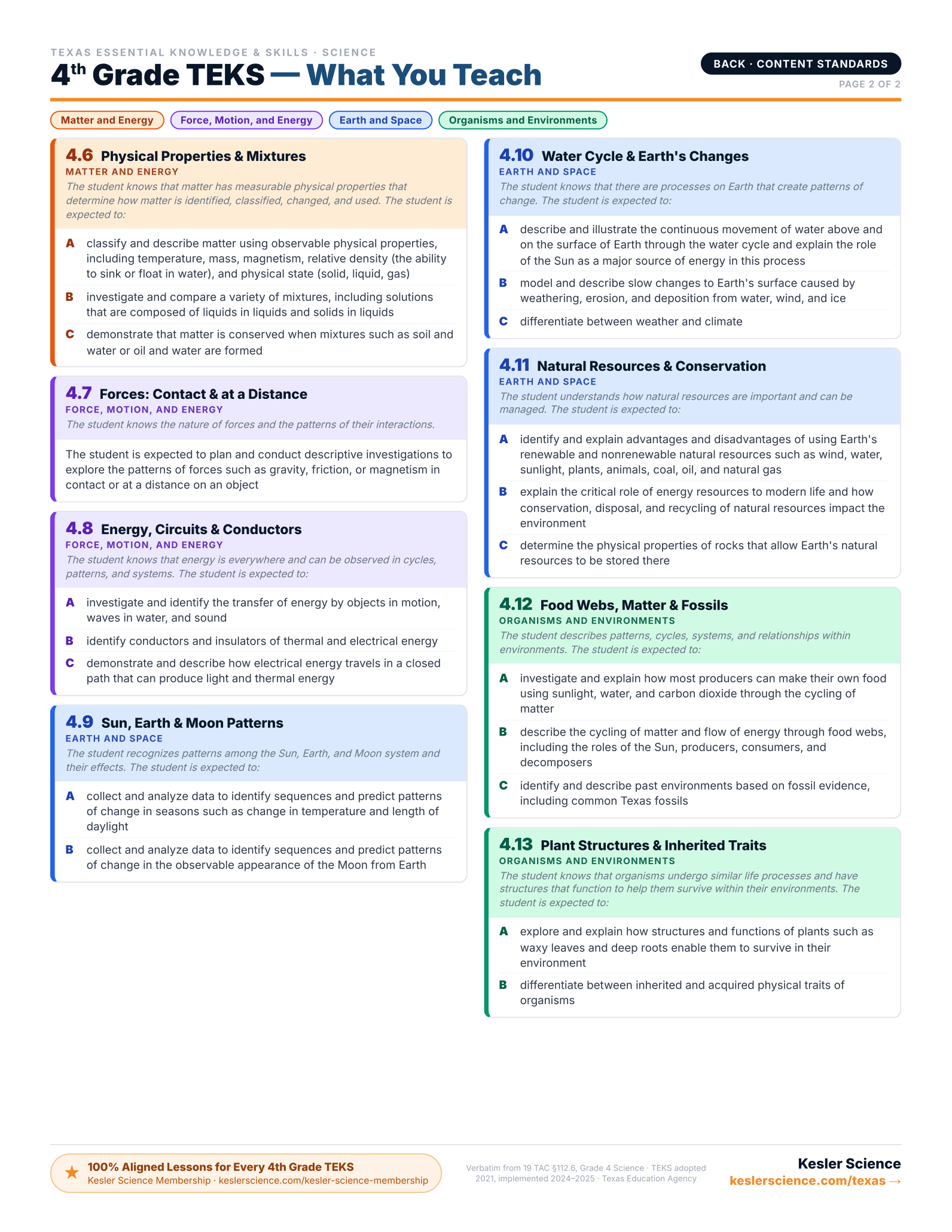
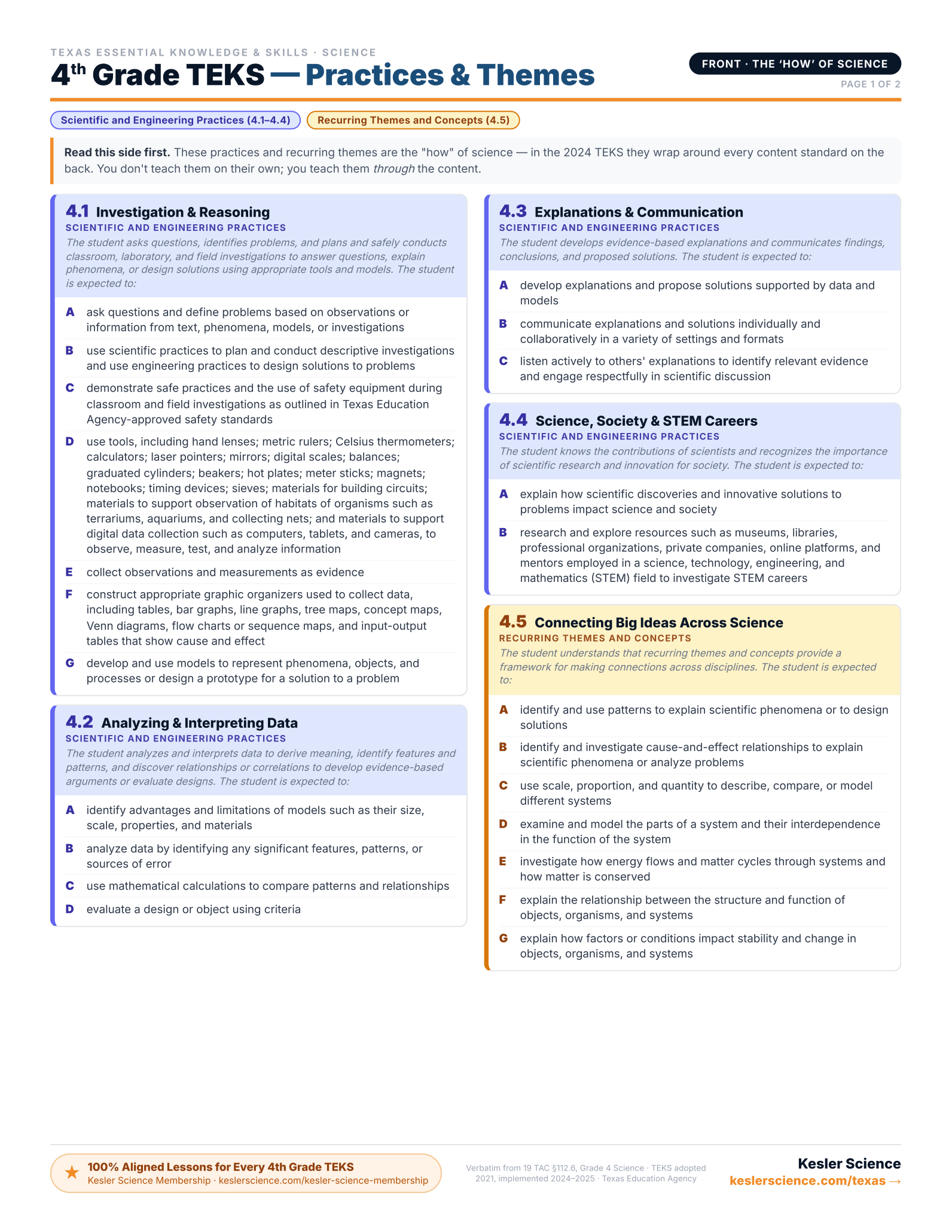
Every 4th-Grade Science TEKS on One Page
The color-coded, front-and-back cheat sheet I wish I'd had — every standard, organized by reporting category. Print it and reference it all year long. This will be your new favorite document!
Trusted Across Texas
From the Rio Grande Valley to the Panhandle, Texas science teachers are using Kesler Science to save time and engage students.
Texas Schools and Districts
Love Kesler Science
What Teachers Are Saying
Give Your Science Teachers Everything They Need
School and district licenses give your teachers access to every resource they need, including station labs, inquiry labs, anchoring phenomena, presentations, escape rooms, and much more. One purchase covers the grade levels you need.
- PO-friendly. We accept purchase orders
- Volume discounts for 11+ teachers
- Complimentary Kesler Science Plus orientation for 4+ teachers
- Three free implementation PD sessions for departments of 11+
- Aligned to the 2024 TEKS standards
See It in Action
Book a walkthrough and we'll show you how Kesler Science fits your campus.
Book Demo CallNo pressure, no hard sell