.png?width=375&height=100&name=WebPage%20logo%20with%20curves%202026%20(8).png)
Plant Structures & Functions
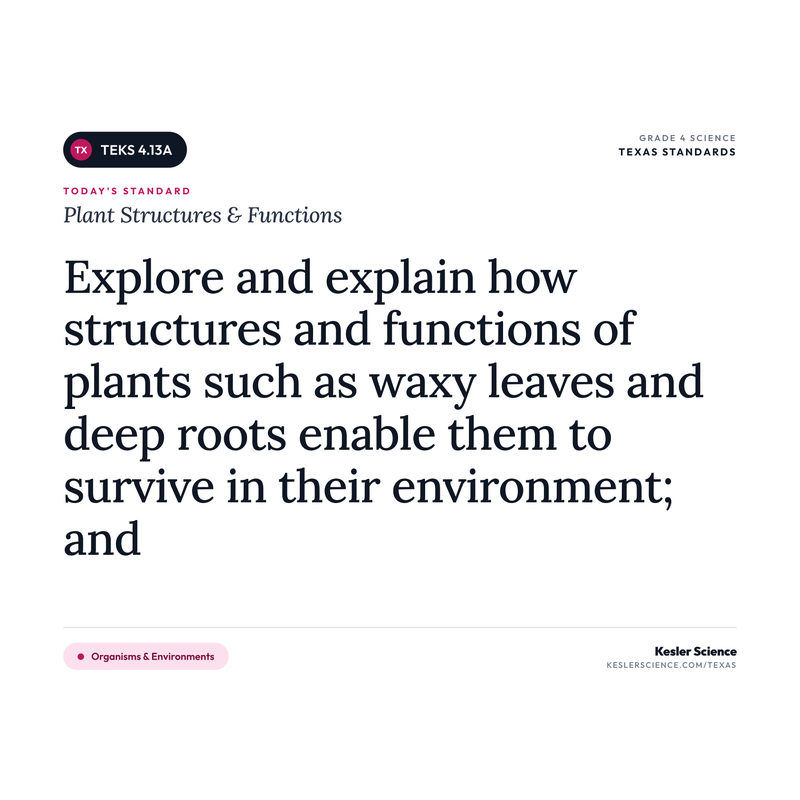
"Explore and explain how structures and functions of plants such as waxy leaves and deep roots enable them to survive in their environment; and"
💡 What This Standard Actually Means
"Explore and explain". Fourth graders are looking at real plant parts and explaining how each one helps the plant survive in its specific environment. The TEKS gives you two perfect examples to anchor on: waxy leaves (a structure that helps a plant hold onto water in a dry environment) and deep roots (a structure that lets a plant reach water far underground). The standard wants kids to connect a plant's body part (structure) to the job it does (function), and then connect that function to the environment the plant lives in. A cactus has thick waxy skin because it lives in the desert. A mesquite tree has crazy deep roots because Texas soil dries out fast.
Plants don't just sit there looking green. Every part of a plant is doing a specific job, and that job usually has something to do with surviving in the environment the plant lives in. 4.13A is the standard where 4th graders explore real plant structures and figure out why those structures exist.
The TEKS hands you two great examples right in the wording. Waxy leaves have a thick, shiny coating that holds water inside the leaf and keeps it from drying out. Plants in dry, sunny places (like cactuses, holly, magnolia trees) have waxy leaves because they live in environments where water is hard to keep. Deep roots reach far underground to find water that surface roots can't get to. Mesquite trees in Texas have roots that can stretch 50 feet down. Plants in places where the soil dries out at the surface need deep roots to find water below.
Beyond those two TEKS examples, plants have all kinds of structures with specific functions. Spines on a cactus protect it from animals and reduce water loss. Wide flat leaves on a maple tree catch lots of sunlight. Flowers attract pollinators. Fruits protect seeds and help them spread. By the end of this unit, kids should be able to look at any plant, point at a structure, name what job it does, and explain how that helps the plant survive where it lives.
The version of this lesson I'd lean on is a "plant detective walk." Take kids outside the school with clipboards. Each kid has to find five different plants and answer two questions for each: "What does this part LOOK like?" and "What job is it probably doing?" By the end, kids have pages full of observations like: "Tree leaves are wide and flat... probably catching lots of sun" or "This plant has tiny hairs on the stem... maybe stops bugs?" Then come inside and compare the school plants to plants from totally different environments (cactus from the desert, lily pad from a pond, pine tree needles). The TEKS-named examples (waxy leaves, deep roots) are perfect for class discussions, and a real cactus from the dollar store is the best teaching tool for waxy leaves. Don't get stuck on the textbook diagrams. Get kids looking at REAL plant parts. The TEKS verb is "explore," not "read about."
⚠️ Misconceptions Your Students May Have
These are some of the most common misconceptions. Knowing what to look for can help you get ahead of them.
"All plants have the same parts that do the same jobs"
Plants have different structures depending on where they live. A cactus has thick stems and spines instead of wide leaves because it lives in the desert. A pond plant has light, hollow stems so it can float. A pine tree has skinny needle-shaped leaves because it lives where snow could break wide leaves. Same general idea (a plant), but the structures are tuned to the environment.
"Roots only hold the plant in the dirt"
Roots have two main jobs. They anchor the plant in place AND they pull water and nutrients up from the soil into the plant. Deep roots reach down to find water in dry environments. Shallow, spread-out roots collect water from light rain. Both designs work, depending on where the plant lives. The structure of the roots fits the environment.
"Waxy leaves are just shiny for looks"
The waxy coating on a leaf does an important job. It keeps water from evaporating out of the leaf, which is critical in dry, sunny places. The wax is like a built-in raincoat. The shine is just a side effect. Plants like holly, magnolias, and many desert plants all have waxy leaves because their environments dry out fast and the wax holds water in.
"Plants don't really need to survive, they just sit there"
Plants are constantly fighting to survive: hot weather, cold weather, dry soil, hungry animals, blocked sunlight, lack of water. Their structures are what let them deal with each of those problems. Without the right roots, leaves, and stems for their environment, the plant would die. The whole reason plants have so many different shapes is because each kind has solved a different survival problem.
📓 Teaching Resources for 4.13A
These resources are aligned to this standard.


100% Aligned Lessons for Every TEKS You Teach
Kesler Science Plus puts thousands of ready-to-teach lessons and activities in your hands, so you can boost engagement and get your planning time back. Trusted by schools and districts all over the great state of Texas.
🌎 Phenomenon Ideas for 4.13A
Use these real-world phenomena to anchor your lesson. Show students the phenomenon first, let them wonder, then build toward Plant Structures & Functions as the explanation.
The Wax Test
Hold up two leaves: one shiny, waxy leaf (holly, magnolia, or any glossy-leaved houseplant) and one regular flat leaf (lettuce or a maple leaf). Drip a small drop of water on each. The drop on the waxy leaf beads up and rolls right off. The drop on the regular leaf soaks in or stays flat. Same drop, two completely different results. The wax is doing real work.
"Why did the water bead up on one leaf but not the other? What kind of environment would a plant with waxy leaves probably live in?"
The Mesquite Mystery
Show a photo of a mesquite tree growing alone in a dry Texas field. Then show a diagram of mesquite roots: the roots can go down 50+ feet into the ground. Mesquite trees survive in places that get very little rain because their roots reach water that's far too deep for most other plants. Same plant, completely shaped by its environment.
"How does having such deep roots help the mesquite survive in a dry Texas field? What would happen to a tree with shallow roots in the same place?"
The Cactus Survivor
Bring in a small potted cactus (or a photo). Have the kids look at it carefully. Where are the leaves? There aren't any normal leaves; instead the cactus has spines. Why is the stem so thick? It's full of stored water. Why is the outside waxy? To keep the water in. Every part of a cactus is solving the problem of "how do I survive with very little water?" Each structure has a function, and each function fits the desert.
"Why don't cactuses have wide flat leaves like other plants? What jobs are the spines and the thick stem doing? How do all these parts work together to keep the cactus alive?"
💡 Free Engagement Ideas for 4.13A
Ready-to-run activities you can drop straight into a lesson. Where one of these looks like a phenomenon from the section above, that is on purpose: show it first as the hook, then let students run it themselves.
Schoolyard Plant Detective
Take the class outside. Each kid finds five different plants and fills out a chart for each: a quick sketch, "What is this part?" (leaf, stem, root, flower), "What is its job?" and "How does it help the plant in our environment?" Real plants, real observations, real connection to structure and function.
Plant + Environment Match
Print 12 plant cards (cactus, palm tree, water lily, pine tree, mesquite tree, magnolia, mountain shrub, swamp grass) and 12 environment cards (desert, beach, pond, snowy mountain, dry Texas plains, southern forest, Texas Hill Country, swamp). Kids match each plant to its environment and explain WHY based on at least one structure of the plant. Forces them to connect structure to environment, exactly what the TEKS asks for.
Build Your Own Survival Plant
Pick an extreme environment (desert, freezing tundra, dark rainforest floor, windy mountain). Each kid designs a fictional plant that could survive there. They draw the plant, label five structures (roots, leaves, stem, flowers, etc.), and write what each structure does and HOW it helps in that environment. Forces real engineering thinking.
Compare Two Leaves
Each kid gets two real leaves: one waxy leaf (holly, magnolia, or rubber plant) and one non-waxy leaf (lettuce, maple, oak). They hold them up, feel them, drop water on them, and fill out a comparison chart: feel, shine, water reaction. Then they write: "Which leaf would survive better in a dry environment? Explain how its STRUCTURE helps it survive." Hits the TEKS verbs head-on.
🎯 What Approaches, Meets, and Masters Thinking Look Like
Here is what student thinking at each level looks like on this one task, so you know what to look for and how to move a student up.
A cactus lives in the desert, where it is hot and dry and it almost never rains. A cactus has thick, waxy skin instead of thin, flat leaves. Explain how the waxy skin helps the cactus stay alive in the desert.
- Names the plant part the question asks about: the thick, waxy skin.
- Tells what job the waxy skin does (it holds water inside the cactus and keeps that water from evaporating out into the dry air).
- Connects that job to the desert, where it is hot and dry and water is hard to find.
- Explains how the part helps the cactus survive, not just that it does.
- Uses the words structure (a plant part) and function (the job that part does), even in simple kid language.
- Shows the part and the environment go together: a desert plant needs this part because of where it lives.
- Treats the waxy coating as a survival tool, not just something shiny. That is the easiest place to slip.
The cactus has waxy skin. The wax is shiny and smooth, and it makes the cactus look nice and green. It helps the cactus look pretty in the desert so it stands out.
The waxy skin holds water inside the cactus and keeps it from drying out. The desert is hot and dry and it almost never rains, so the cactus has to save the water it has. The wax is like a coat that locks the water in. That is how the waxy skin helps the cactus stay alive in the desert.
The waxy skin holds water inside the cactus so the water does not dry out in the hot, dry desert. The cactus part matches where it lives. A plant's parts are built for its environment.
That is how I know a pine tree has skinny needle leaves instead of wide flat ones. Pine trees live where it gets cold and snowy, and skinny needles do not collect heavy snow that could snap them. Just like the cactus, the pine tree's part fits the place it lives.
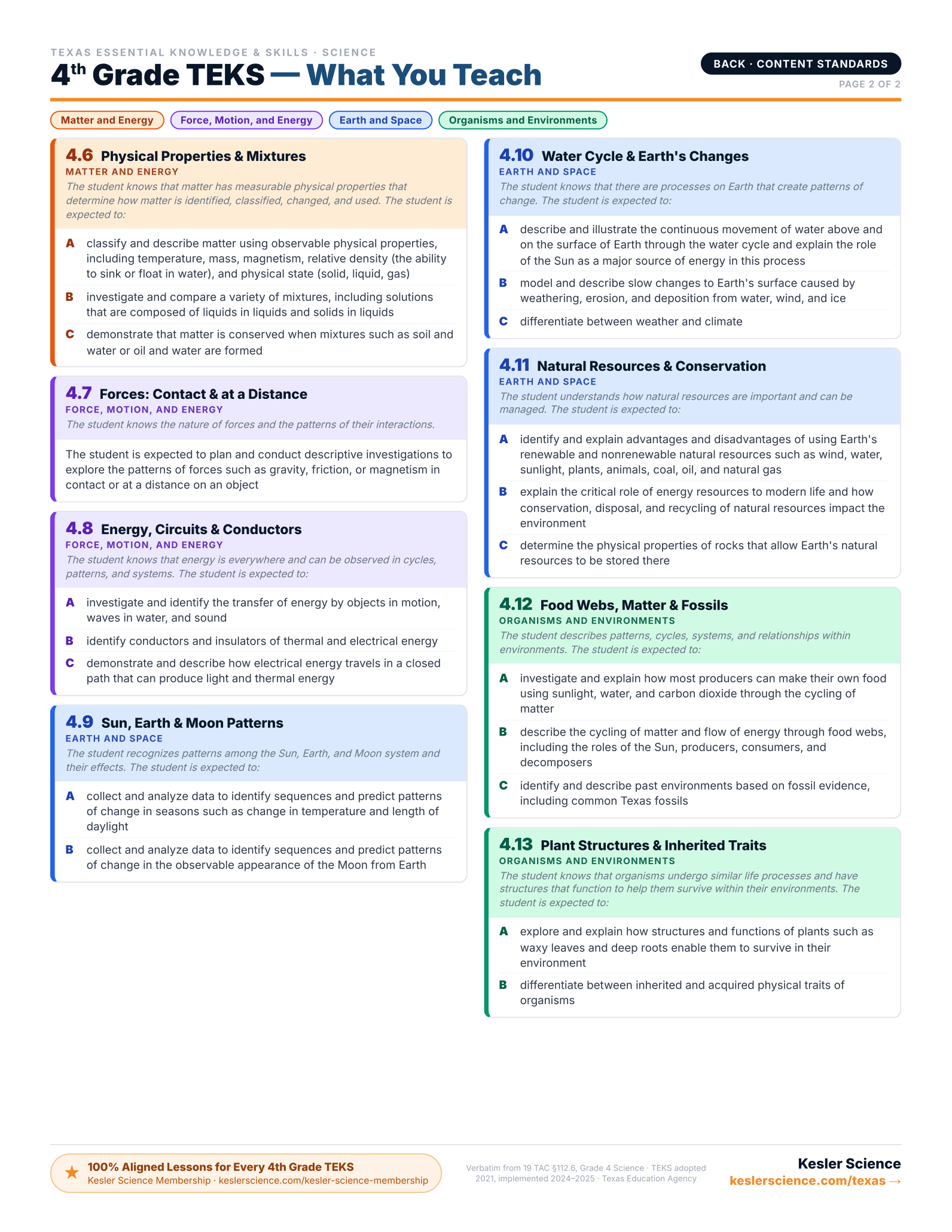
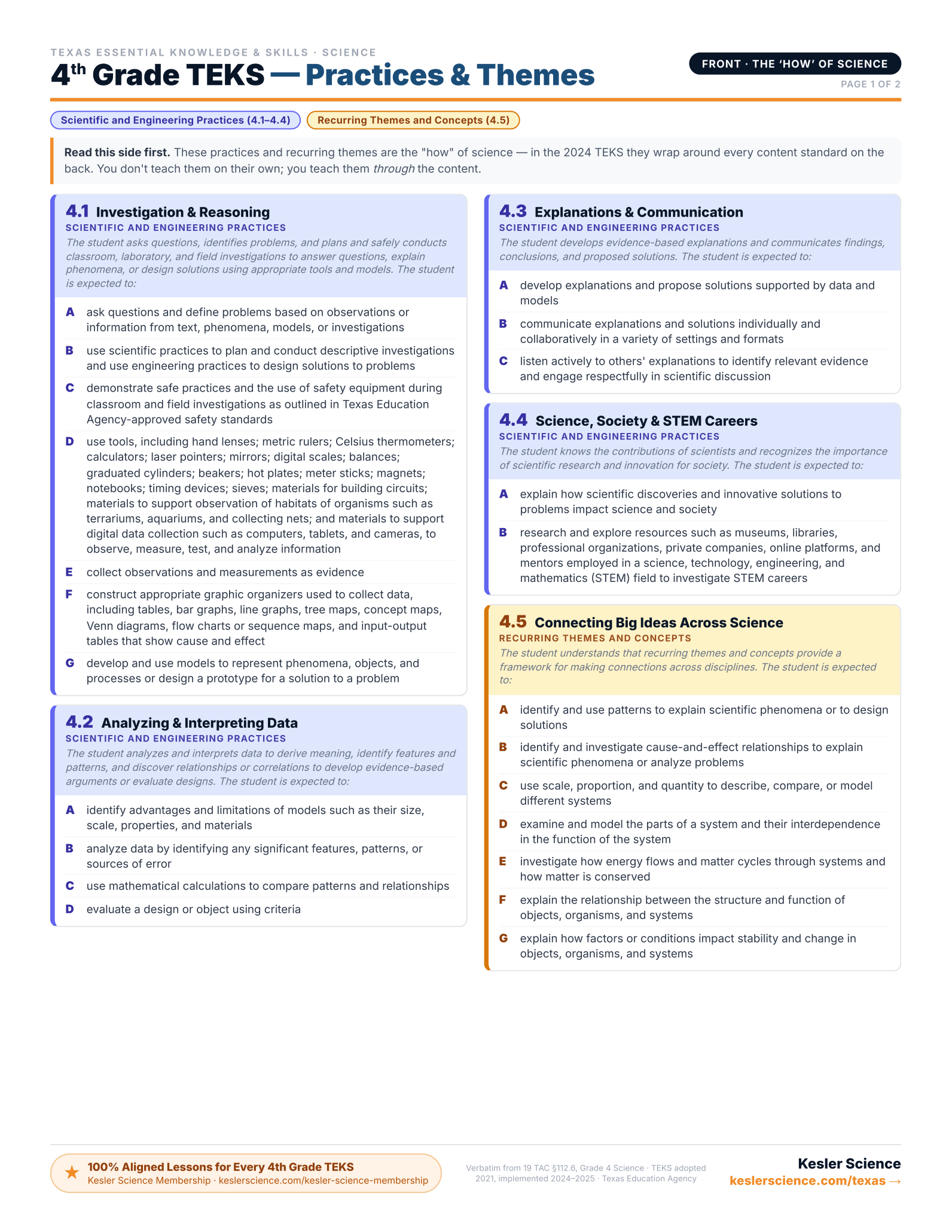
Every 4th-Grade Science TEKS on One Page
The color-coded, front-and-back cheat sheet I wish I'd had — every standard, organized by reporting category. Print it and reference it all year long. This will be your new favorite document!
Trusted Across Texas
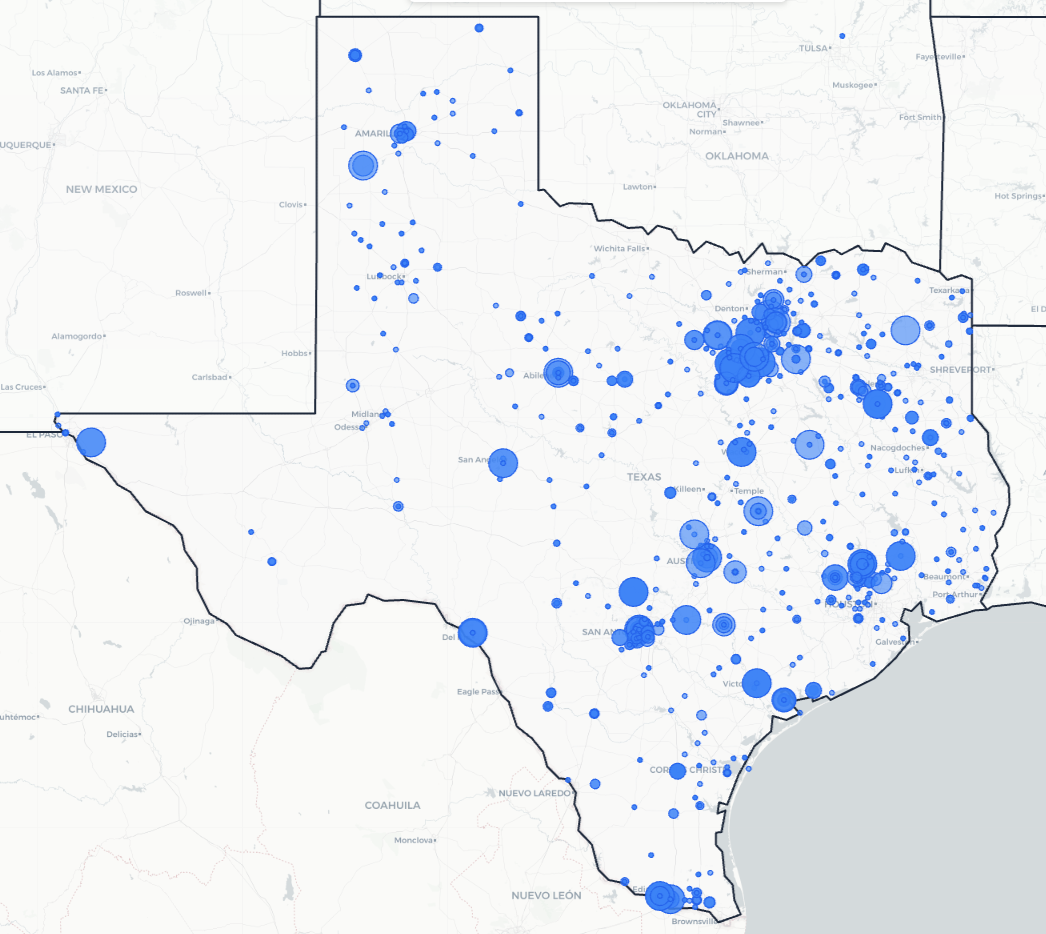
From the Rio Grande Valley to the Panhandle, Texas science teachers are using Kesler Science to save time and engage students.
Texas Schools and Districts
Love Kesler Science
What Teachers Are Saying
Give Your Science Teachers Everything They Need
School and district licenses give your teachers access to every resource they need, including station labs, inquiry labs, anchoring phenomena, presentations, escape rooms, and much more. One purchase covers the grade levels you need.
- PO-friendly. We accept purchase orders
- Volume discounts for 11+ teachers
- Complimentary Kesler Science Plus orientation for 4+ teachers
- Three free implementation PD sessions for departments of 11+
- Aligned to the 2024 TEKS standards

See It in Action
Book a walkthrough and we'll show you how Kesler Science fits your campus.
Book Demo CallNo pressure, no hard sell