.png?width=375&height=100&name=WebPage%20logo%20with%20curves%202026%20(8).png)
Classify Matter by Physical Properties
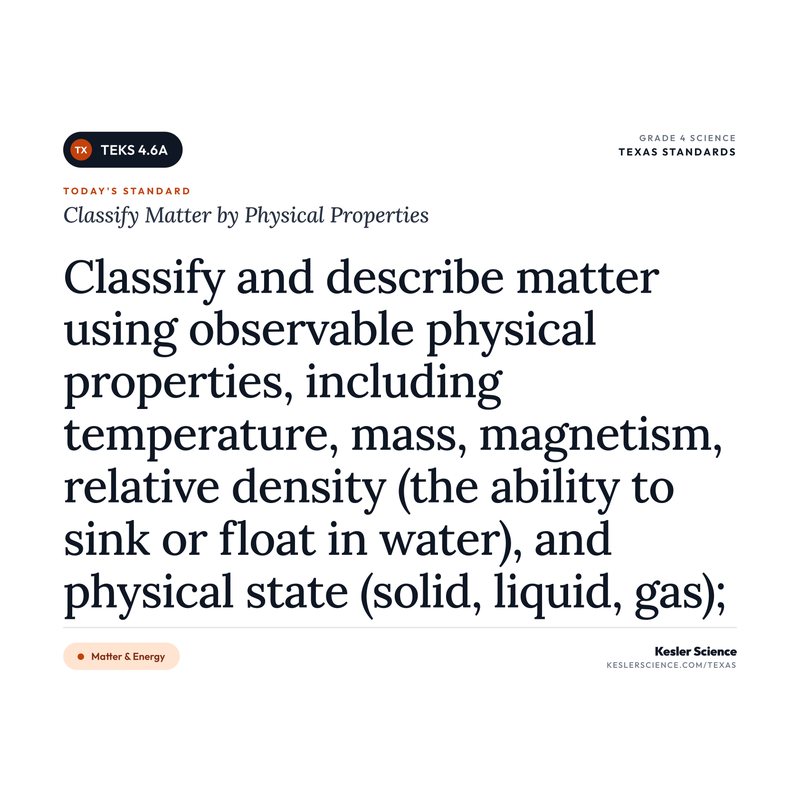
"Classify and describe matter using observable physical properties, including temperature, mass, magnetism, relative density (the ability to sink or float in water), and physical state (solid, liquid, gas);"
💡 What This Standard Actually Means
"Classify and describe". Fourth graders aren't memorizing definitions for this one. They're picking up real objects, testing one property at a time, and putting the objects into groups based on what they observed. The standard's "including" list spells out exactly which properties get tested: temperature, mass, magnetism, relative density (the ability to sink or float in water), and physical state (solid, liquid, gas). Each property has a tool. A thermometer for temperature. A balance for mass. A magnet for magnetism. A tub of water for sink-or-float. Their own eyes for solid, liquid, or gas. Kids should be able to look at any object on their desk and tell you how it would behave on each one of those tests.
4.6A is the standard where 4th graders finally start seeing the world the way scientists see it. Everything around them is matter. The pencil, the water in the cup, the air they're breathing, the magnet stuck to the file cabinet. Each one of those things has properties you can see, feel, or test, and those properties are how we tell one kind of matter apart from another. The job for the kids is simple: stop guessing, start testing.
The TEKS hands you the property list. Temperature is how hot or cold something is, measured with a thermometer. Mass is how much stuff is in the object, measured on a balance. Magnetism is whether a magnet sticks to it. Relative density is whether it sinks or floats when you drop it in water. Physical state is whether it's a solid, liquid, or gas right now. That's the whole list, and that's exactly what kids should be testing.
By the end of the unit, students should be able to grab any everyday object, predict how it'll do on each test, and then sort a group of objects into categories based on what they actually observed. Two objects might both be solid, but one floats and the other sinks. Both might feel cold, but only one is magnetic. Classifying matter means using the test results, not the look of the object, to decide what group it belongs in.
The biggest mistake to avoid with classifying matter is talking too much. If I were planning this lesson for 4th grade, I'd ditch the slideshow with definitions and the vocabulary list. Kids can repeat those words back at you but can't actually do anything with them. Switch to stations instead. Set up a temperature station, a mass station, a magnet station, a sink-or-float station, and a "name the state" station. Give each kid a clipboard with five mystery objects listed across the top and the five properties down the side. They go station to station, run the test, and fill in the box. By the time they get back to their seats, they've got a chart full of real data and they can classify those objects six different ways without you saying a word. With 4th graders especially, the testing has to come before the talking.
⚠️ Misconceptions Your Students May Have
These are some of the most common misconceptions. Knowing what to look for can help you get ahead of them.
"Anything shiny and metal-looking is magnetic"
Only certain metals are magnetic. A paperclip and a steel washer will jump to the magnet. A penny, an aluminum soda can, and a gold ring will not. Kids assume "metal = magnet" because the shiny silver objects in their world all look the same. Lay out a tray of metal-looking stuff and let them test every piece. Watching the magnet ignore the soda can is the moment the misconception breaks.
"Heavy things sink and light things float"
It's not about how heavy something feels in your hand. It's about how the object compares to water. A huge log floats. A tiny steel paperclip sinks. The log floats because wood is less dense than water. The paperclip sinks because steel is more dense than water. That's relative density, and water is what we compare it to.
"Mass and size are the same thing"
A big object isn't always the one with more mass. A balloon is huge but barely tips a balance. A small steel marble is tiny but heavy. Mass is how much stuff is packed inside, not how big the object looks. The only way to know is to put it on the balance and read the number.
"Air isn't matter because you can't see it"
Air is matter. It has mass, it takes up space, and it has a temperature. You just can't see it because it's a gas. Blow up a balloon and you can feel the air pushing back. Hold a thermometer in the room and it reads a temperature. Just because something is invisible doesn't mean it isn't there.
📓 Teaching Resources for 4.6A
These resources are aligned to this standard.


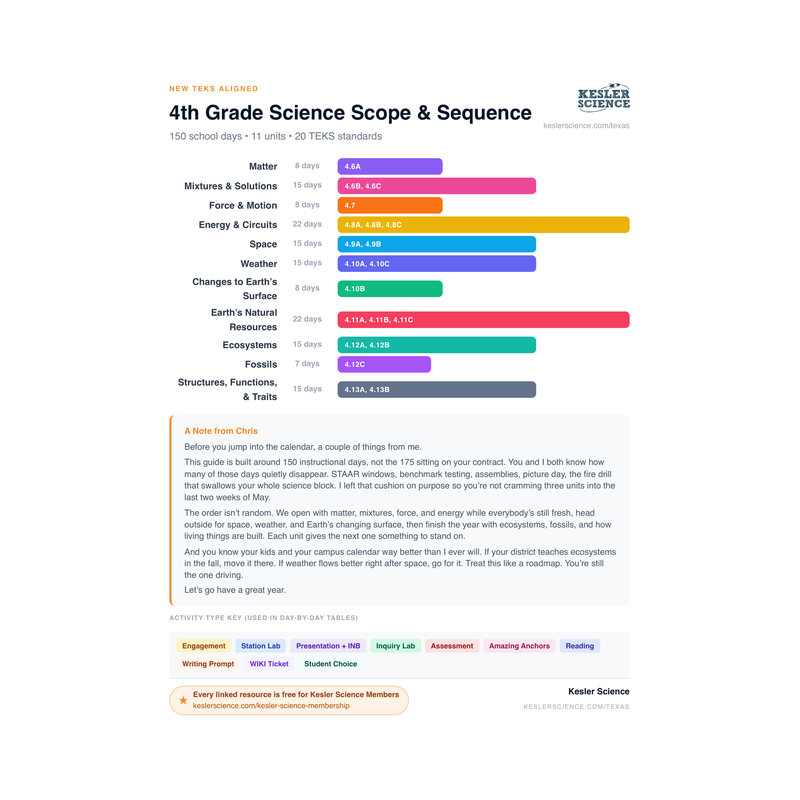
100% Aligned Lessons for Every TEKS You Teach
Kesler Science Plus puts thousands of ready-to-teach lessons and activities in your hands, so you can boost engagement and get your planning time back. Trusted by schools and districts all over the great state of Texas.
🌎 Phenomenon Ideas for 4.6A
Use these real-world phenomena to anchor your lesson. Show students the phenomenon first, let them wonder, then build toward Classify Matter by Physical Properties as the explanation.
The Sneaky Soda Can
Drop an unopened can of regular soda into a deep bin of water. It sinks straight to the bottom. Drop an unopened can of diet soda into the same bin. It floats. Same shape can, same amount of liquid inside, same metal on the outside. The kids will swear something is rigged. The only difference is the sugar in the regular soda makes that liquid heavier than the artificial sweetener in the diet soda.
"Why would two cans that look exactly the same act so differently in water? What property are we actually testing here?"
The Magnet That Picks Favorites
Lay out a tray of objects: a paperclip, a penny, an aluminum foil ball, a steel washer, a quarter, a plastic spoon, and a gold-colored bracelet. Run a strong magnet slowly over the tray. Some things leap up. Others just sit there. The penny doesn't move. The bracelet doesn't move. The aluminum ball doesn't move. The paperclip and the washer come up immediately.
"Every object on this tray looks like it could be metal. Why did the magnet only pull up some of them? What does that tell you about how to test a property instead of guessing?"
The Vanishing Ice Cube
Drop one ice cube into a clear plastic cup. Set it on a desk where everyone can see it. Walk around and teach for ten minutes. Come back and the cube is gone. There's water in the bottom of the cup. The kids saw a solid at the start of class and a liquid at the end. The same matter, just in a different state. Same molecules, same mass, same everything except how they're holding together.
"What changed about the ice when it became water? What stayed exactly the same? Could it change again into a third state if we let the water sit out?"
💡 Free Engagement Ideas for 4.6A
Ready-to-run activities you can drop straight into a lesson. Where one of these looks like a phenomenon from the section above, that is on purpose: show it first as the hook, then let students run it themselves.
Five-Property Mystery Object Stations
Set up five property stations around the room: temperature (thermometer in different cups), mass (a balance), magnetism (a strong magnet), relative density (a tub of water), and physical state (a tray of solid, liquid, and gas examples). Each group carries five mystery objects to every station and fills out a five-by-five grid. At the end, they sort their five objects into groups based on the data on their grid.
Sink-or-Float Prediction Tournament
Bring in a giant tub of water and 15 random objects (orange, candle, key, crayon, grape, paperclip, cork, etc.). Before any testing, every kid writes a prediction for each object: sink or float. Then test them one at a time as a class, with kids cheering when their prediction is right. Tally up how many each kid got. The winner gets a sticker. The losers learn that you can't tell density just by looking.
State of Matter Stations on the Wall
Tape three large posters to the wall: SOLID, LIQUID, GAS. Hand each kid a stack of object picture cards (ice cube, water, steam, rock, milk, balloon, juice, sand, etc.). They take turns walking up and sticking their card under the right poster, explaining why. Tricky cases like steam, jello, and toothpaste lead to the best class discussions.
Property Sorting Showdown
Give each table group a bag of 10 small objects. They have to sort the bag four different ways, one for each property: by temperature (warm vs. cool to touch), by magnetic vs. not magnetic, by sink vs. float, and by physical state. The same 10 objects get sorted into different groups every round, which drives home that an object can have lots of properties at once.
🎯 What Approaches, Meets, and Masters Thinking Look Like
Here is what student thinking at each level looks like on this one task, so you know what to look for and how to move a student up.
A student tests four objects with a magnet: a steel paperclip, a shiny aluminum soda can, an iron nail, and a penny. Classify each object as magnetic or not magnetic. Then explain how you would test an object to find out if it is magnetic.
- Each of the four objects is put into a group: magnetic or not magnetic.
- The paperclip and the iron nail are classified as magnetic (a magnet sticks to them).
- The soda can and the penny are classified as not magnetic (a magnet does not stick).
- An explanation that the way to find out is to bring a magnet close and see if it sticks, not to just look at the object.
- The student uses the test result to decide, not the color or shine of the object.
- The student shows they know that being shiny and metal does not mean a thing is magnetic. That is the easiest place to slip.
The paperclip and the nail are magnetic. The soda can is magnetic and the penny is magnetic too. All four are magnetic because they are all metal and shiny, so a magnet will stick to them. You can tell by looking that they are metal.
I held the magnet next to each object. The paperclip and the nail are magnetic because the magnet stuck to them. The soda can and the penny are not magnetic because the magnet did not stick, even though they are metal. To find out if something is magnetic, you bring a magnet close to it and see if it sticks. You cannot tell just by looking.
The paperclip and the nail are magnetic because the magnet stuck to them. The soda can and the penny are not magnetic because the magnet did not stick. Being shiny and metal does not make something magnetic. Only some metals, like iron and steel, stick to a magnet. That is why two shiny metal objects can act totally different on the same test.
That is also how I would test something new, like a gold ring. It looks like shiny metal, so people might guess it is magnetic. But I would bring a magnet close, and I think it would not stick, because gold is not one of the metals a magnet pulls on. You have to test it instead of guessing from the way it looks.
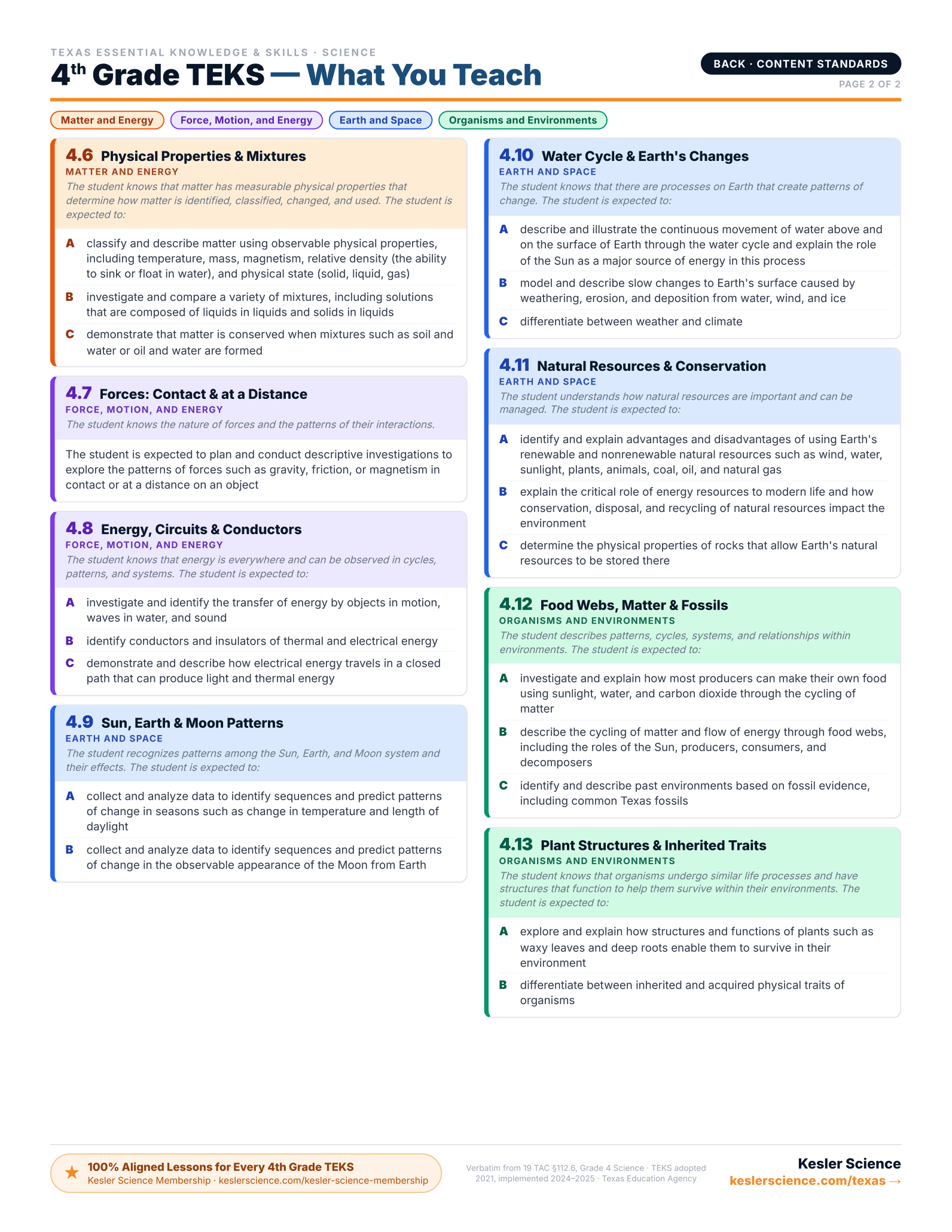
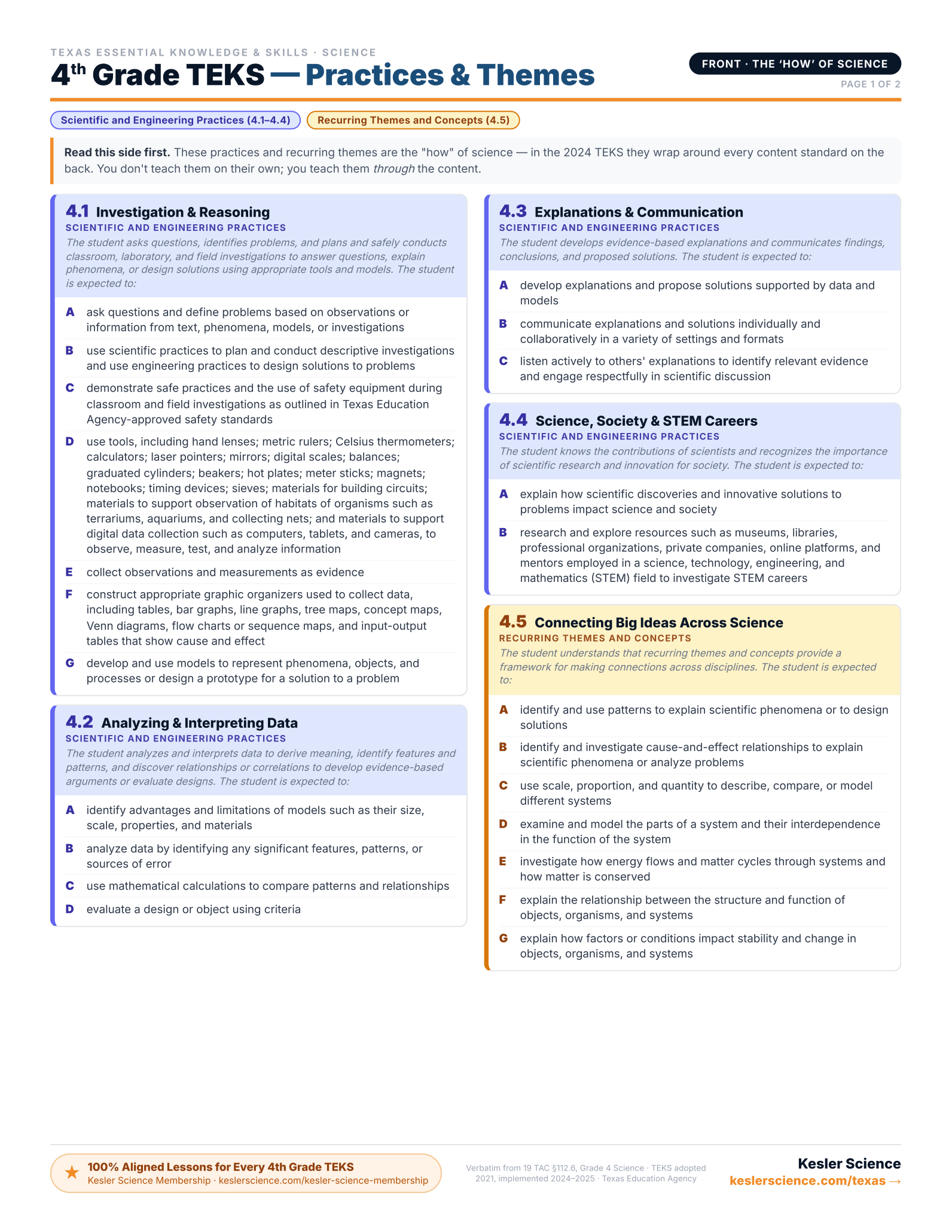
Every 4th-Grade Science TEKS on One Page
The color-coded, front-and-back cheat sheet I wish I'd had — every standard, organized by reporting category. Print it and reference it all year long. This will be your new favorite document!
Trusted Across Texas
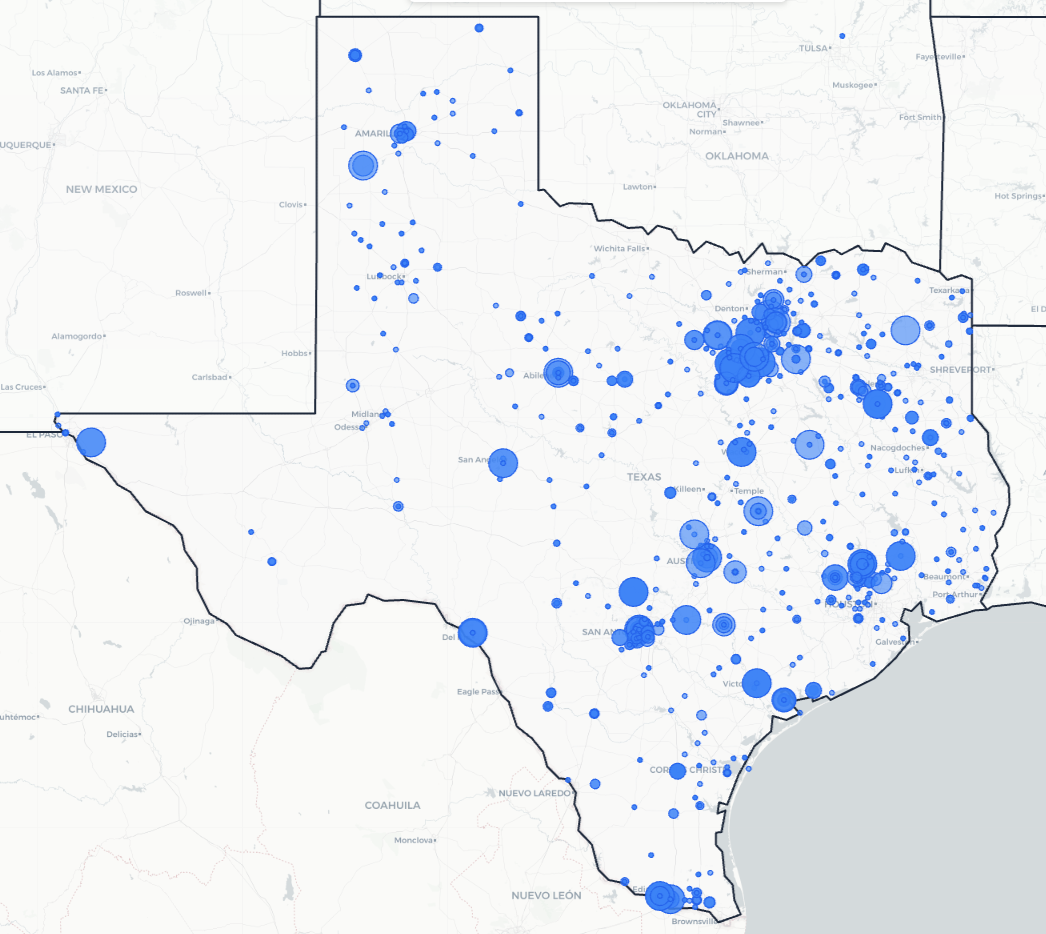
From the Rio Grande Valley to the Panhandle, Texas science teachers are using Kesler Science to save time and engage students.
Texas Schools and Districts
Love Kesler Science
What Teachers Are Saying
Give Your Science Teachers Everything They Need
School and district licenses give your teachers access to every resource they need, including station labs, inquiry labs, anchoring phenomena, presentations, escape rooms, and much more. One purchase covers the grade levels you need.
- PO-friendly. We accept purchase orders
- Volume discounts for 11+ teachers
- Complimentary Kesler Science Plus orientation for 4+ teachers
- Three free implementation PD sessions for departments of 11+
- Aligned to the 2024 TEKS standards
See It in Action
Book a walkthrough and we'll show you how Kesler Science fits your campus.
Book Demo CallNo pressure, no hard sell