.png?width=375&height=100&name=WebPage%20logo%20with%20curves%202026%20(8).png)
How Light Travels
"Demonstrate and explain how light travels in a straight line and can be reflected, refracted, or absorbed."
💡 What This Standard Actually Means
"Demonstrate and explain". Students show with real materials that light moves in a straight line until it hits something, and then they show what happens at that something. The standard names exactly three behaviors: light gets reflected (bounces off, like off a mirror), refracted (bends, like when it passes through water), or absorbed (soaks in and turns into heat, like sunlight hitting a dark shirt). The job is to set up situations where each one of those things happens and explain what they observe. By the end, kids should be able to look at any source of light and any object and predict whether the light will bounce, bend, or get soaked up.
Light goes in a straight line. That's the foundation of this whole standard. Shine a flashlight in a dark room and the beam goes straight where you point it. Stand a row of objects in front of you and you can only see the ones the light can reach in a direct path. Point it at the ceiling, point it at the floor, wave it around the room, and the beam is always a straight line from the bulb to whatever it lands on. Try to aim it around a corner and you can't, because light will not curve. That's why shadows have crisp edges. The light hits the object and stops, leaving a dark spot in the shape of the object behind it.
But what happens when light hits something? Three things, and the TEKS spells them out. Light can be reflected, which means it bounces off. A mirror is the best example. The light hits the silver back of the mirror and bounces back. That's how you see your face. Light can be refracted, which means it bends when it passes from one substance into another. A pencil sitting in a glass of water looks broken at the surface because the light from the underwater part of the pencil bends as it moves from water into air to reach your eyes. Light can be absorbed, which means it gets soaked into a material and usually turns into heat. A black T-shirt on a sunny day gets hot fast. The dark color absorbed the sunlight instead of reflecting it.
By the end of this standard, kids should be able to look at almost any everyday situation involving light and identify what's happening. The mirror reflects. The water bends the light. The black shirt absorbs. The wall does some of all three.
This is one of those standards where the demos do nine-tenths of the teaching. If I were planning it, I'd run three quick stations on day one and let kids cycle through them in pairs. Only station one needs a flashlight, so it stays put at that station instead of getting carried around the room. Station one: a small mirror flat on the desk. Station two: a clear plastic cup of water with a pencil sitting in it. Station three: two pieces of construction paper, one black, one white, sitting in the sun. No sun that day, or no window that gets it? Put a desk lamp a few inches above the two papers and leave it on while the other stations run. Same result, and it works in February. They shine the flashlight at the mirror and watch the light bounce off at an angle. They look at the pencil from the side and see how it appears bent at the water line. They feel the difference between the warm black paper and the cool white paper. Three two-minute stations and they've physically experienced reflection, refraction, and absorption. After that, the vocabulary is just labeling something they already know.
⚠️ Misconceptions Your Students May Have
These are some of the most common misconceptions. Knowing what to look for can help you get ahead of them.
"Light bends around corners on its own"
Light always travels in a straight line. It never bends around corners by itself. The only ways light changes direction are when it bounces off something (reflection) or passes through one substance into another like air to water (refraction). If light seems to "go around" a corner, what's really happening is the light bounced off a surface to get there.
"Only mirrors reflect light"
Almost everything reflects some light. That's how we see things. The reason you can see your desk is because light is bouncing off the desk and into your eyes. Mirrors are extra-good at reflecting because they're smooth and shiny, so all the light that hits them bounces off in the same direction. That is why you see a picture in a mirror instead of just a bright patch. Other surfaces (a wall, a piece of paper, a desk) reflect light too, just messier and in lots of directions at once.
"A pencil really breaks when it goes in water"
The pencil isn't broken. It just looks bent because the light coming from the part underwater bends as it moves from water into air to reach your eyes. That's refraction. Take the pencil out and it's perfectly straight. The bending is happening to the light, not to the pencil. Same with a straw in a soda or a coin at the bottom of a swimming pool.
"All colors of clothes get equally warm in the sun"
Dark colors absorb a lot more light than light colors do. A black T-shirt absorbs almost all the sunlight that hits it and turns that energy into heat. A white T-shirt reflects most of the sunlight back, so it stays cooler. That's why people wear light colors in summer and dark colors in winter. Same sunlight, very different amounts of absorption depending on the color.
📓 Teaching Resources for 5.8C
These resources are aligned to this standard.


100% Aligned Lessons for Every TEKS You Teach
Kesler Science Plus puts thousands of ready-to-teach lessons and activities in your hands, so you can boost engagement and get your planning time back. Trusted by schools and districts all over the great state of Texas.
🌎 Phenomenon Ideas for 5.8C
Use these real-world phenomena to anchor your lesson. Show students the phenomenon first, let them wonder, then build toward How Light Travels as the explanation.
The Pencil That Looks Broken
A regular yellow pencil is dropped into a clear plastic cup of water. From the side of the cup, the pencil looks like it's been snapped in half right at the water line. The top of the pencil sticking out of the water is in one place, and the bottom of the pencil under the water is shifted way to the side, like someone broke it at an angle. Pull the pencil out of the cup and it's perfectly straight, no marks, no break.
"The pencil isn't actually broken, but it sure looks like it. What is happening to the light coming from the pencil that makes it look that way? Draw a sketch of the path the light takes from the pencil to your eye."
Hot Black, Cool White
Two squares of construction paper sit side by side in the sunlight: one black, one white. After ten minutes, a kid touches each one. The black paper feels noticeably warm, almost hot. The white paper feels barely warmer than the air. Same sun. Same amount of time. Two completely different temperatures depending only on what color the paper is.
"Why did the black paper get warm and the white paper stay cool? What was the light doing differently when it hit each one? How could you use this to choose what to wear on a hot summer day?"
The Flashlight Maze
In a dark classroom, a teacher sets up three small mirrors at angles around the room and points a flashlight at the first mirror. The light beam bounces from the first mirror, to the second, to the third, and finally lands on a target on the back wall. The flashlight never moved. The light traveled around corners by bouncing off each mirror in a perfectly straight line between them.
"How did the light get from the flashlight to the target on the wall when the flashlight wasn't even pointed that way? What was each mirror doing to the light? Draw the path of the light beam through the maze."
💡 Free Engagement Ideas for 5.8C
Ready-to-run activities you can drop straight into a lesson. Where one of these looks like a phenomenon from the section above, that is on purpose: show it first as the hook, then let students run it themselves.
Three Light Behaviors Stations
Set up three two-minute stations. Reflection: small mirrors and flashlights to bounce light off at angles. Refraction: clear cups of water with pencils, straws, and coins to observe through the water. Absorption: black and white paper squares under a lamp or in the sun to feel temperature differences. Students rotate, observe, and record what happens at each one. Three stations cover the entire standard hands-on.
Light Maze with Mirrors
Each group has three or four small mirrors and a flashlight. Their challenge is to use the mirrors to bounce the light from a starting point at one corner of the desk to a target sticker at another corner. They sketch their setup and draw the path of the light. The straight-line behavior of light becomes obvious when they realize they have to aim each mirror exactly right.
Pencil in Water Investigation
Each pair has a clear plastic cup, water, and three different objects to put in the water: a pencil, a straw, and a coin at the bottom. They observe each from above and from the side and sketch what they see. They write a sentence describing how the objects look different from each angle and connect the observation to refraction.
Color Temperature Investigation
Lay out colored construction paper squares (black, white, red, blue, yellow, green) in the sun or under a strong lamp. Students predict which will get warmest and which will stay coolest, then check each square with a thermometer or by hand after fifteen minutes. They graph the temperatures and write a sentence about what color absorbed the most light. Connects directly to dark vs. light clothing choices in summer.
🎯 What Approaches, Meets, and Masters Thinking Look Like
Here is what student thinking at each level looks like on this one task, so you know what to look for and how to move a student up.
In a dark room, a student shines a flashlight straight at three things: a mirror, a glass of water with a pencil standing in it, and a sheet of black paper. Draw the path of the light hitting each one. Then explain what happens to the light at each object: does it get reflected (bounce off), refracted (bend), or absorbed (soak in)?
- The light drawn as a straight line from the flashlight to each object, not a curvy or bending beam on its way there.
- The mirror shown bouncing the light back (reflected), with the beam leaving the mirror, not stopping at it.
- The glass of water shown bending the light as it goes in (refracted), which is why the pencil looks broken at the water line.
- The black paper shown soaking the light in (absorbed), with no beam coming back out.
- An explanation that names the right word for each object: reflected, refracted, or absorbed.
- A reason for each one, not just the label: bounced off a shiny surface, bent going into the water, or soaked into the dark color.
- The light always going in a straight line until it hits something. That is the easiest idea to slip on.
The mirror reflects the light because it is shiny and bounces it back. The black paper absorbs the light so it does not come back. The light bends on its own to get to the water glass, and then it is refracted.
The light travels in a straight line until it hits something. The mirror reflects it, so the light bounces off and comes back. The glass of water refracts it. The light bends when it goes from the air into the water, and that is why the pencil looks broken at the top of the water. The black paper absorbs the light, so it soaks in and does not bounce back.
Light always goes in a straight line. It only changes when it hits something. The mirror reflects it because the smooth, shiny surface bounces the light back. The water refracts it because the light bends as it crosses from one substance (air) into another (water). The black paper absorbs it because the dark color soaks the light in and turns it into heat.
The big idea is that light keeps going straight until it meets a new surface or a new substance, and then it bounces, bends, or soaks in. That is how I know a coin at the bottom of a pool looks like it is in the wrong spot. The light coming from the coin bends as it leaves the water and goes into the air, so my eyes trace it back to the wrong place. The coin did not move. The light bent.
Every 5th-Grade Science TEKS on One Page
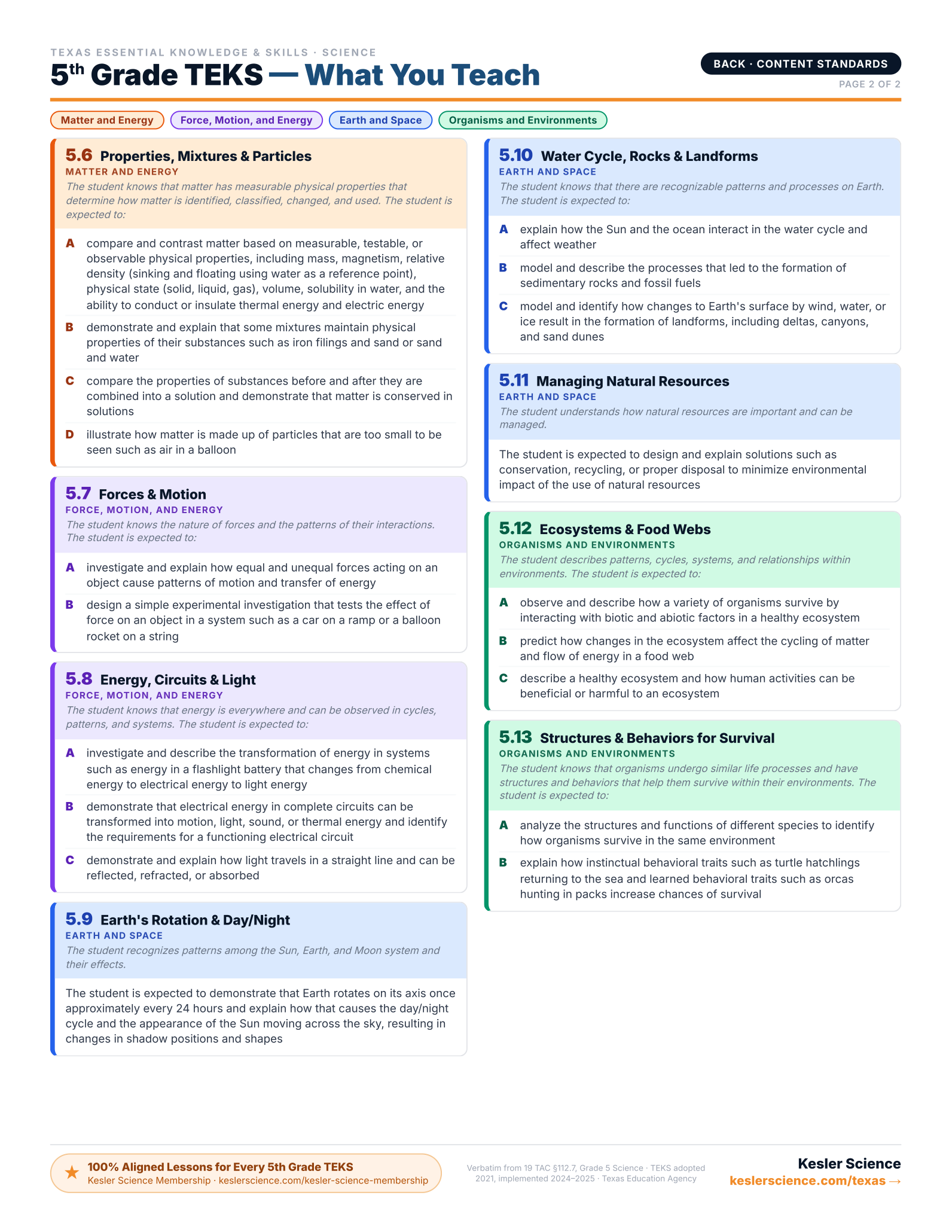
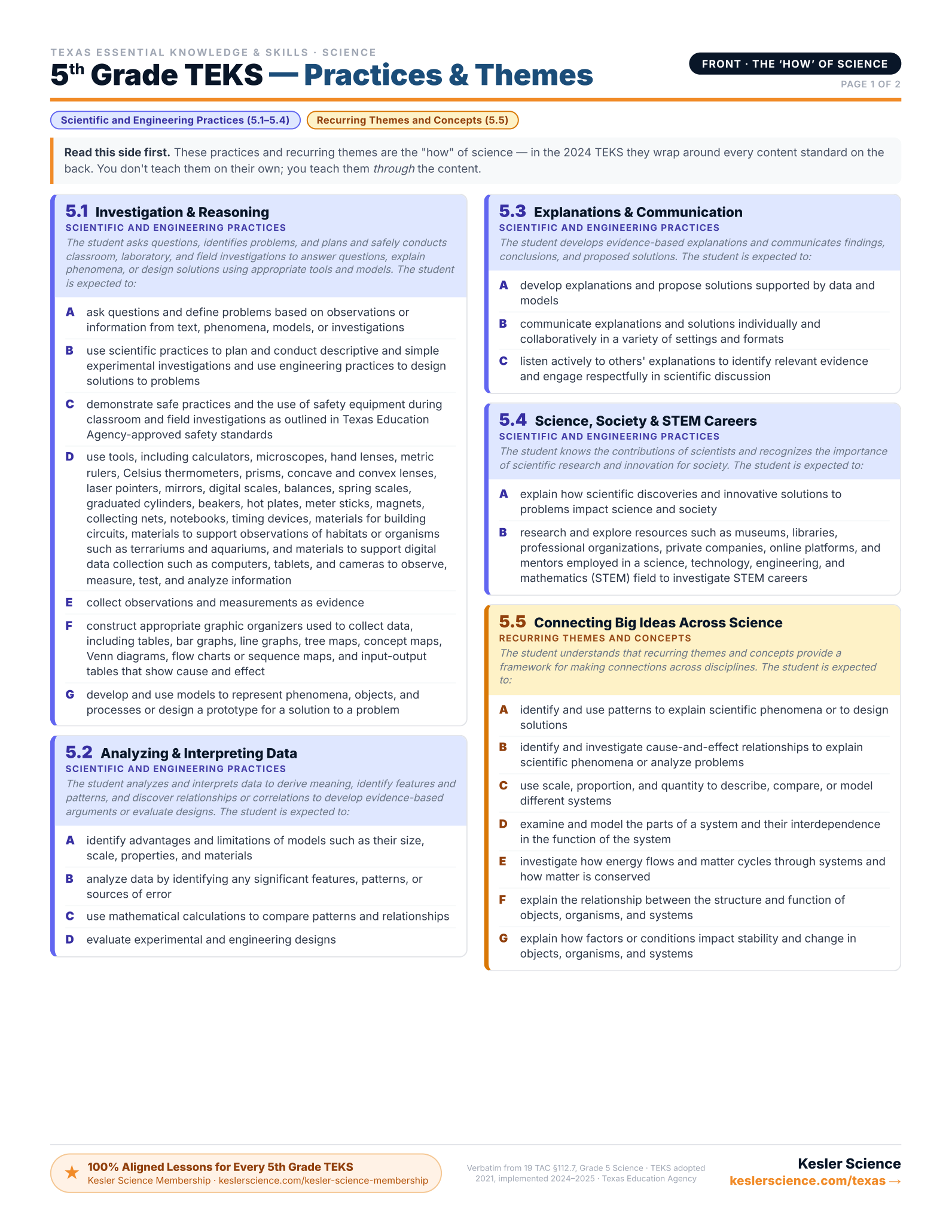
The color-coded, front-and-back cheat sheet I wish I'd had — every standard, organized by reporting category. Print it and reference it all year long. This will be your new favorite document!
Trusted Across Texas
From the Rio Grande Valley to the Panhandle, Texas science teachers are using Kesler Science to save time and engage students.
Texas Schools and Districts
Love Kesler Science
What Teachers Are Saying
Give Your Science Teachers Everything They Need
School and district licenses give your teachers access to every resource they need, including station labs, inquiry labs, anchoring phenomena, presentations, escape rooms, and much more. One purchase covers the grade levels you need.
- PO-friendly. We accept purchase orders
- Volume discounts for 11+ teachers
- Complimentary Kesler Science Plus orientation for 4+ teachers
- Three free implementation PD sessions for departments of 11+
- Aligned to the 2024 TEKS standards
See It in Action
Book a walkthrough and we'll show you how Kesler Science fits your campus.
Book Demo CallNo pressure, no hard sell