.png?width=375&height=100&name=WebPage%20logo%20with%20curves%202026%20(8).png)
Organism Structures & Functions
"Analyze the structures and functions of different species to identify how organisms survive in the same environment; and"
💡 What This Standard Actually Means
"Analyze". This standard is comparative. Students don't just describe the structures and functions of one organism. They compare different species that live in the SAME environment and figure out how each species' unique structures help it survive there. In a Texas pond, a frog has long sticky tongue and webbed feet. A turtle has a hard shell and clawed feet. A heron has long legs and a sharp beak. Three different species, same pond, completely different structures, and each one survives because of those structures. Students should be able to look at a group of species sharing an environment and explain how each one's structures fit it for that environment.
Take a single environment, like a Texas pond. Lots of different species live there: frogs, turtles, herons, dragonflies, fish, ducks, water lilies. Each species has its own unique structures (body parts, shapes, features) that perform functions (help the organism do something to survive). The job of this standard is for kids to analyze what's similar and what's different about how each species solves the same survival challenges in the same place.
The frog has long, powerful back legs for jumping after insects and webbed feet for swimming. Its long sticky tongue snatches bugs out of the air. Its skin can absorb water so it stays moist near the pond. The turtle solves the same survival challenges differently. It has a hard shell for protection from predators (the frog has speed instead). It has strong claws and a beak-like mouth for grabbing food underwater. It can pull its head and legs into the shell when threatened. The heron has long, thin legs to wade in shallow water (where the frog and turtle don't go), a sharp beak to spear fish, and excellent eyesight to spot food from above.
Three different species. Same pond. Completely different structures and functions. Each one survives because its body is built for what it does. By the end of this standard, kids should be able to look at any environment, pick three or four species that live there, and analyze how each one's structures fit it for the same shared environment. The big idea: there's no single "correct" way to survive in a place. Many sets of structures can work, as long as they fit the species' lifestyle.
Comparing species in the same environment is the move that turns this from a vocabulary lesson into a real analysis. The trap to avoid is having kids do "structures and functions" for a frog, then a polar bear, then a saguaro cactus, all separately. They learn the words but can't see the bigger picture. If I were teaching this, I'd pick ONE environment (a Texas pond, the Sahara Desert, the Antarctic ice, a coral reef) and have kids analyze three or four species that all live there together. Same environment, different bodies, different strategies. That's where it clicks. They start to see that survival isn't about one perfect body design. It's about how each species' body fits its job in the place where it lives. The pond is my favorite because every kid has seen one, and they can list the species without being prompted: frog, turtle, heron, fish, dragonfly, duck. Pick any three and the comparison takes care of itself.
⚠️ Misconceptions Your Students May Have
These are some of the most common misconceptions. Knowing what to look for can help you get ahead of them.
"Animals in the same environment all need the same body parts"
Different species in the same environment usually have very different body parts because they have different jobs. In a Texas pond, the frog has webbed feet to swim, the heron has long legs to wade, and the fish has fins. Same pond, three different ways to move through water. Each one works for that particular species' lifestyle. There's no one-size-fits-all body for any environment.
"Plants don't have structures that help them survive, only animals do"
Plants have lots of structures that help them survive. A cactus has spines (to discourage animals from eating it) and a thick stem (to store water). A tree has deep roots (to reach water and stay anchored) and broad leaves (to capture sunlight). Water lilies have wide, flat leaves that float on the pond surface to catch sunlight without getting submerged. Plants can't move, so their structures have to do all the work.
"A structure can only do one job"
Many structures do more than one thing at once. A turtle's shell protects it from predators AND helps it regulate body temperature AND houses internal organs. A frog's long tongue catches food AND helps it sense the environment. A heron's beak is used for catching fish, but also for grooming feathers and building nests. When kids analyze a structure, they should think about all the jobs it might be doing, not just one.
"If two species share the same environment, one will eventually win and push the other out"
Many species share environments without one pushing out the other because they have different roles, eat different food, and use different parts of the habitat. The frog and the turtle both live in the same pond, but the frog mostly eats insects while the turtle eats plants and small water creatures. The heron lives in the same pond but spends most of its time wading on the edges. Each species fits a different role in the shared environment.
📓 Teaching Resources for 5.13A
These resources are aligned to this standard.


100% Aligned Lessons for Every TEKS You Teach
Kesler Science Plus puts thousands of ready-to-teach lessons and activities in your hands, so you can boost engagement and get your planning time back. Trusted by schools and districts all over the great state of Texas.
🌎 Phenomenon Ideas for 5.13A
Use these real-world phenomena to anchor your lesson. Show students the phenomenon first, let them wonder, then build toward Organism Structures & Functions as the explanation.
Three Pond Animals, One Day
A small Texas pond has three different animals living and feeding in it on the same morning. A bullfrog sits motionless on a lily pad, then suddenly snaps its sticky tongue out and grabs a passing fly. A turtle paddles slowly along the muddy bottom, using its claws to dig up tasty plants. A great blue heron stands frozen in the shallow edge, then plunges its beak into the water and pulls up a fish. Same pond. Same day. Three completely different bodies, each catching dinner in a different way.
"Why do these three animals have such different bodies even though they all live in the same pond? Pick one structure from each animal and explain how it helps that animal survive in this environment."
Desert Survivors
A photograph of the West Texas desert shows three living things in the frame at once: a tall ocotillo with thorny stems reaching up like fingers, a roadrunner sprinting between bushes with its long legs, and a horned lizard half-buried in the sand. All three are surviving in the same hot, dry, sandy environment. The ocotillo drops its leaves during drought to conserve water and grows them back after rain. The roadrunner can run fast to chase prey or escape predators. The lizard's flat shape and earth-colored skin let it disappear into the sand. Three completely different bodies. Same environment. Same goal: survive.
"How does each of these three living things have structures that fit the desert environment? What's the same about their challenges? What's different about how each one solves them?"
Coral Reef Three-Way
A nature documentary clip shows a tropical coral reef teeming with life. A clownfish hides in the stinging tentacles of a sea anemone, protected by a special mucus coating on its skin that keeps the anemone from stinging it. A sea turtle paddles through the open water above with powerful flippers. A starfish creeps across a rock with its underside covered in tube feet. All three live on the same reef but use completely different structures to survive there. The clownfish's special skin. The turtle's flippers. The starfish's tube feet. Three solutions, one environment.
"Make a chart comparing one structure each from the clownfish, sea turtle, and starfish. How does each structure help the animal survive in the coral reef? Why do you think different species evolved such different ways to live in the same place?"
💡 Free Engagement Ideas for 5.13A
Ready-to-run activities you can drop straight into a lesson. Where one of these looks like a phenomenon from the section above, that is on purpose: show it first as the hook, then let students run it themselves.
Same Environment, Different Bodies Chart
Each group picks one environment from a list (Texas pond, Sahara Desert, ocean reef, Antarctic ice, rainforest canopy) and three species that live in that environment. They build a comparison chart with the species across the top and structures listed down the side (legs/feet, mouth/beak, body covering, eyes, special features). They fill in each box and write a 2-sentence summary: "Even though all three species live in the same environment, they survive by using different structures to do different jobs."
Pond Critter Investigation
Bring in pictures of five Texas pond species: bullfrog, snapping turtle, great blue heron, dragonfly, and largemouth bass. Each pair picks two species and analyzes their structures using a labeled diagram. They write three "comparison statements" describing how the two species are different in body design but both survive in the same pond. Forces deep comparison.
Build Your Own Mystery Animal
Each student gets a habitat card (desert, jungle, pond, arctic, ocean) and must design a brand-new mystery animal that could survive there. They draw the animal, label five structures, and write a function for each one (like "thick fur to keep warm in arctic cold," "long tongue to grab insects in deep flowers"). Then they compare their mystery animal to a real animal from the same environment. Creative way to lock in the structure-function-environment connection.
Beak Adaptation Lab
Set up a "feeding challenge" with different "beaks" (tweezers, spoons, chopsticks, clothespins, straws) and different "foods" (rice, marbles, water, large pasta, small seeds). Students try each beak with each food and record which beak works best for each food. Then they connect this to real birds: long-beaked birds for nectar, short-beaked birds for seeds. Tasty visual proof that structures fit functions.
🎯 What Approaches, Meets, and Masters Thinking Look Like
Here is what student thinking at each level looks like on this one task, so you know what to look for and how to move a student up.
A frog, a turtle, and a heron all live in the same Texas pond. Pick one body part (a structure) from each animal. Tell what job that body part does (its function), and explain how it helps that animal survive in the pond.
- One structure named for each of the three animals (frog, turtle, heron), not just one animal described over and over.
- Each structure paired with the job it does (its function), like webbed feet for swimming or a hard shell for protection.
- An explanation that connects the structure to surviving in the pond, not just a label of the body part.
- The three animals shown with different structures, because they have different jobs to do in the same pond.
- Correct facts (a heron has long legs for wading, not webbed feet; a turtle has a shell, not speed).
- An idea that there is more than one way to survive in the same pond: each animal's body fits its own way of living.
The frog has webbed feet so it can swim in the pond. The turtle has webbed feet too so it can swim. The heron has webbed feet to swim in the water. They all live in the same pond, so they all need the same feet to get around in the water.
The frog has webbed feet. The job of webbed feet is to push water, so the frog can swim fast to catch bugs and get away. The turtle has a hard shell. The shell's job is to protect the turtle, so it can hide inside when something tries to eat it. The heron has long legs. Its long legs let it stand in the shallow water and wade around looking for fish. They all live in the same pond, but each one has a different body part for what it needs to do.
The frog has webbed feet to swim and catch bugs in the open water. The turtle has a hard shell to protect itself when a predator comes. The heron has long legs to wade in the shallow edges where the frog and turtle don't go. Each animal has a different body part because each one survives a different way in the same pond. There is no one perfect body for the pond. Many different bodies can work.
That made me think about a dragonfly at the same pond. It doesn't have webbed feet or a shell or long legs. It has big wings to fly above the water and big eyes to spot bugs. So it survives in the same pond a totally different way. Its body is built for its own job, just like the others.
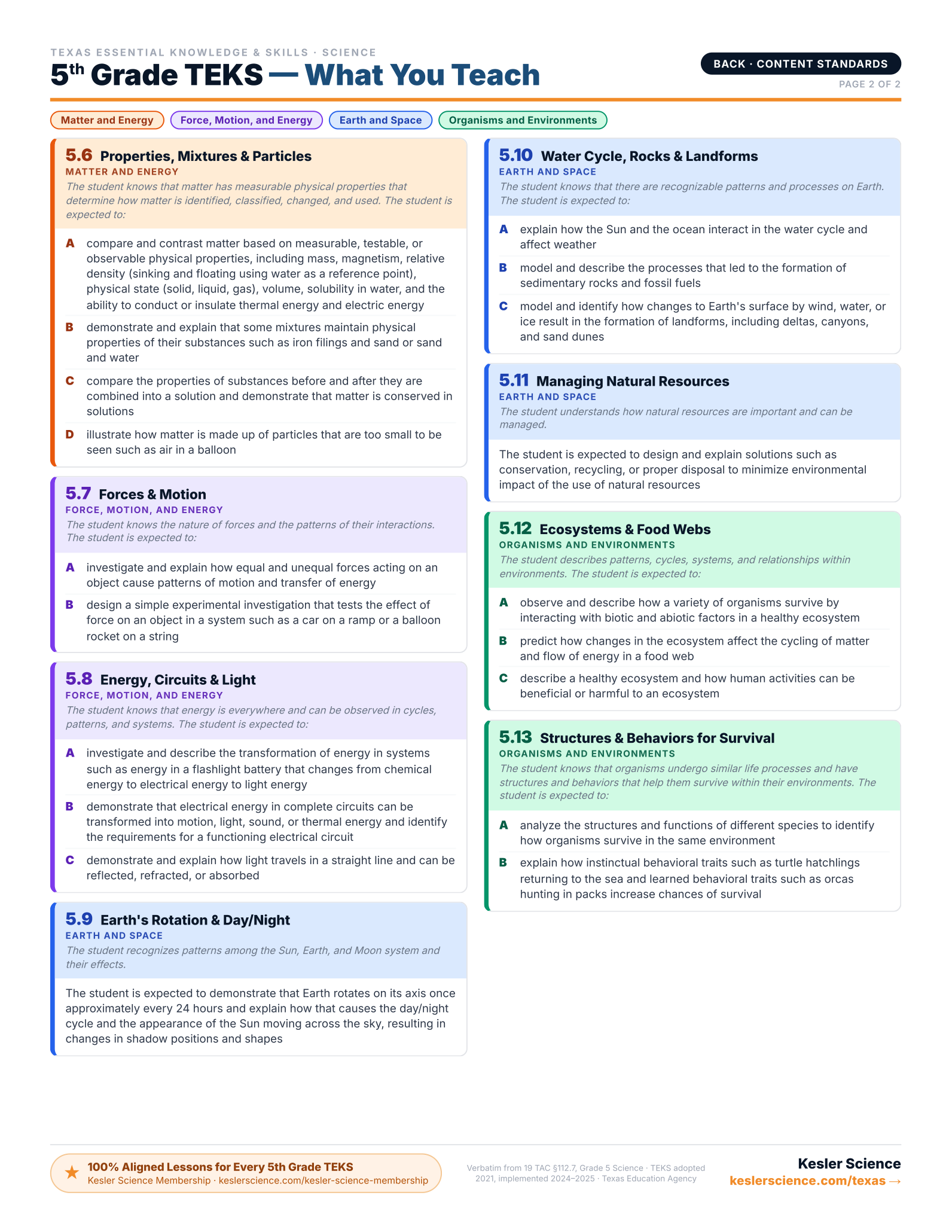
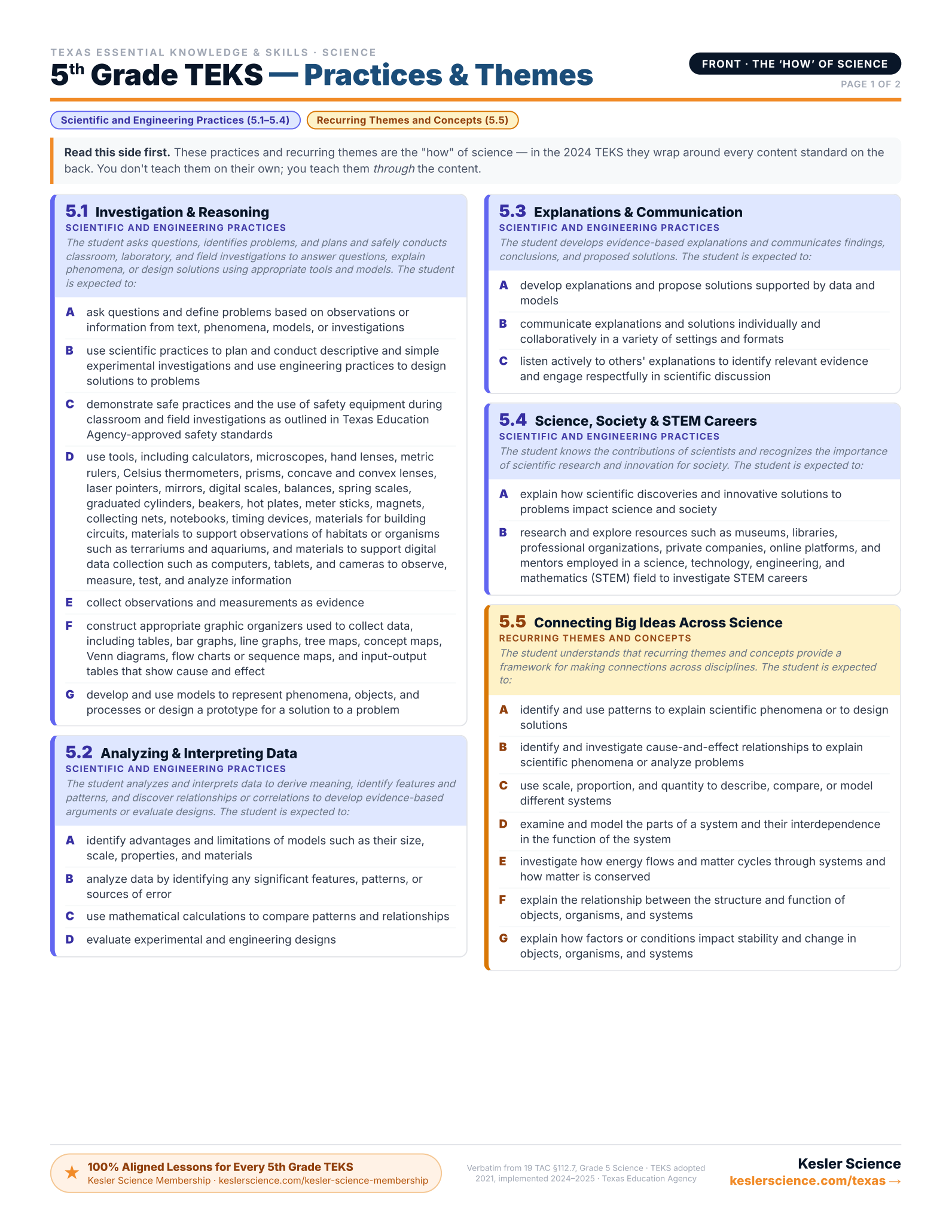
Every 5th-Grade Science TEKS on One Page
The color-coded, front-and-back cheat sheet I wish I'd had — every standard, organized by reporting category. Print it and reference it all year long. This will be your new favorite document!
Trusted Across Texas
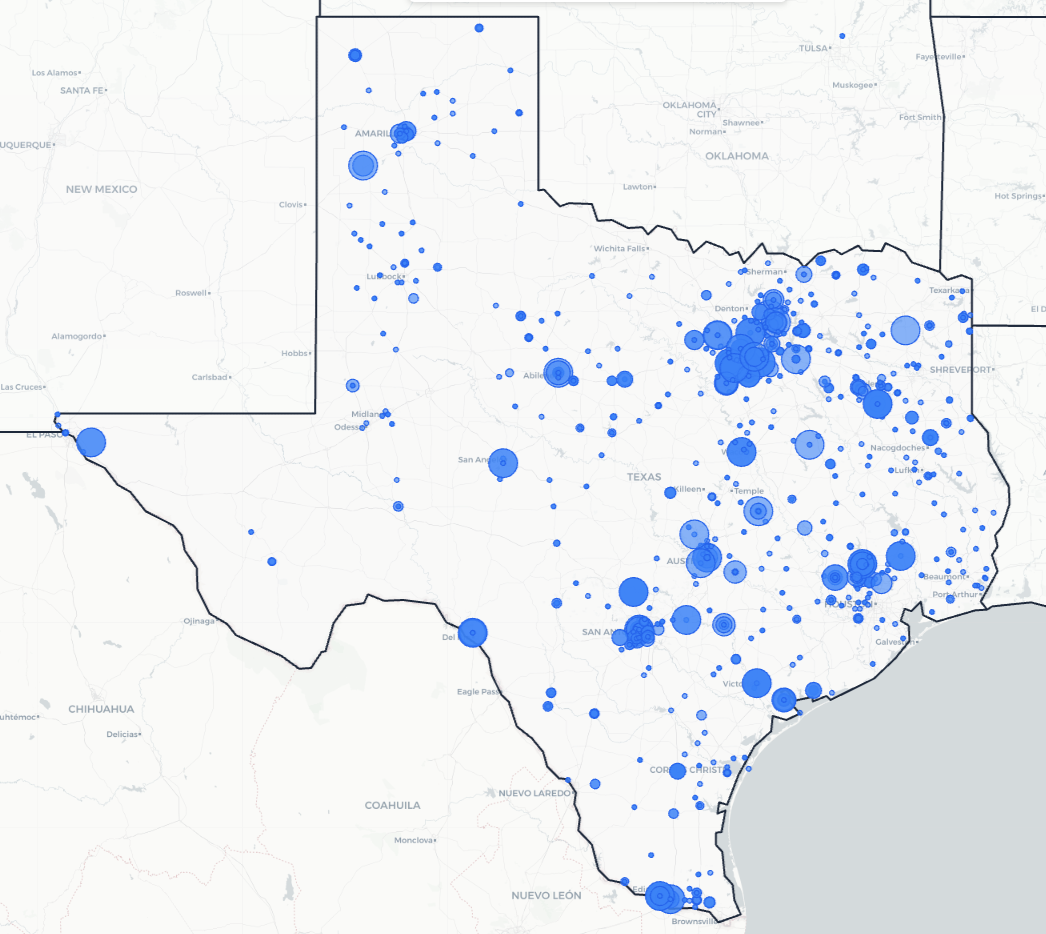
From the Rio Grande Valley to the Panhandle, Texas science teachers are using Kesler Science to save time and engage students.
Texas Schools and Districts
Love Kesler Science
What Teachers Are Saying
Give Your Science Teachers Everything They Need
School and district licenses give your teachers access to every resource they need, including station labs, inquiry labs, anchoring phenomena, presentations, escape rooms, and much more. One purchase covers the grade levels you need.
- PO-friendly. We accept purchase orders
- Volume discounts for 11+ teachers
- Complimentary Kesler Science Plus orientation for 4+ teachers
- Three free implementation PD sessions for departments of 11+
- Aligned to the 2024 TEKS standards
See It in Action
Book a walkthrough and we'll show you how Kesler Science fits your campus.
Book Demo CallNo pressure, no hard sell