.png?width=375&height=100&name=WebPage%20logo%20with%20curves%202026%20(8).png)
Electrical Circuits
"Demonstrate that electrical energy in complete circuits can be transformed into motion, light, sound, or thermal energy and identify the requirements for a functioning electrical circuit."
💡 What This Standard Actually Means
"Demonstrate" and "identify the requirements". Two jobs in this standard. First, students build complete circuits and watch the electrical energy turn into something they can sense: motion (a small motor spinning), light (a bulb glowing), sound (a buzzer beeping), or thermal energy (the bulb itself, warm to the touch after it has been lit a minute). Second, students figure out what every functioning circuit needs to actually work: a power source (battery), a complete path for the electricity to travel through (wires, with no breaks), and a device that uses the electrical energy (bulb, motor, buzzer). Break the path or remove the battery and the circuit stops working. That's the test of a "complete" circuit.
An electrical circuit is a path that lets electricity flow in a complete loop. The standard wants 5th graders doing two big things. One: build circuits that use electrical energy to do something useful, like make a bulb light up, a motor spin, a buzzer beep, or a lit bulb get warm enough to feel. Two: figure out what every circuit needs to actually work.
Every functioning circuit has three things. A power source, usually a battery, that provides the electrical energy. A complete path made of wires (or other conductors) that carries the electricity from one end of the battery, through the device, and back to the other end. And a device that uses the energy: a bulb, a motor, a buzzer, or a heating element. If any of those three pieces is missing or the path has a break in it, the circuit doesn't work.
The "transformation" part of the standard ties straight back to 5.8A. Electrical energy doesn't stay electrical energy forever. When it reaches the bulb, it becomes light. When it reaches a motor, it becomes motion. When it reaches a buzzer, it becomes sound. And the bulb making that light is making thermal energy at the same time, which is why it is warm to the touch after it has been lit for a minute. Worth knowing before a student asks: the hookup wire in a classroom kit will not get warm. It is insulated and chosen precisely so it does not waste energy as heat. What heats up is whatever resists the current, and in a 5th grade kit that is the bulb's filament. So a circuit isn't just about wiring. It's about turning electrical energy into something a kid can see, hear, or feel.
You cannot teach circuits without putting actual circuits in kids' hands. Drawing on the board, showing a video, and assuming the diagrams are enough is the trap to avoid. Half the class still can't draw a working circuit on the test. If I were teaching this, I'd reach for a tub of cheap snap circuits or a class set of D-cell batteries, mini bulbs, alligator clip wires, and small motors. Every kid builds. Once they've built one circuit that lights a bulb, let them swap the bulb for a buzzer, then for a motor, and watch the same battery and wires now produce sound and motion. The "aha" moment is when a kid disconnects one wire and the bulb goes out. That tiny break in the path is everything. Once they've felt that, the requirements of a working circuit make sense without needing to memorize a list.
⚠️ Misconceptions Your Students May Have
These are some of the most common misconceptions. Knowing what to look for can help you get ahead of them.
"You only need a battery and a bulb to make it light up, wires aren't required"
The bulb has to be connected to BOTH ends of the battery for the circuit to work. Just touching the bulb to one end won't make it light up. The wires (or some other path) carry the electrical energy from one terminal of the battery, through the bulb, and back to the other terminal. No complete loop, no light. Try connecting just one wire and watch the bulb stay dark.
"Electricity is used up by the bulb"
The electricity flows through the bulb and continues right back to the battery. It's not used up like food. Think of it like water flowing in a circle. Energy gets transformed (electrical to light, with some heat) but the electricity itself keeps moving. The battery loses its stored chemical energy over time, but the electricity isn't disappearing inside the bulb.
"All wires can carry electricity equally well"
Most wires used in a circuit are made of copper or aluminum, which are great conductors. But not everything works as a wire. A piece of string, a wooden stick, or a rubber band won't carry electricity at all. Those are insulators. The wire has to be made of a material that lets electricity flow, which is why circuits use metal wires.
"A circuit will work no matter where you connect the wires"
The path has to actually go from one end of the battery, through the device, and back to the other end of the battery. If both wires connect to the same terminal, no electricity flows. If a wire skips the bulb entirely (called a short circuit), the bulb stays dark, the wire heats up fast, and the battery drains within seconds and can leak or get hot enough to burn skin. Don't set up a short circuit on purpose. Where the wires connect matters a lot.
📓 Teaching Resources for 5.8B
These resources are aligned to this standard.


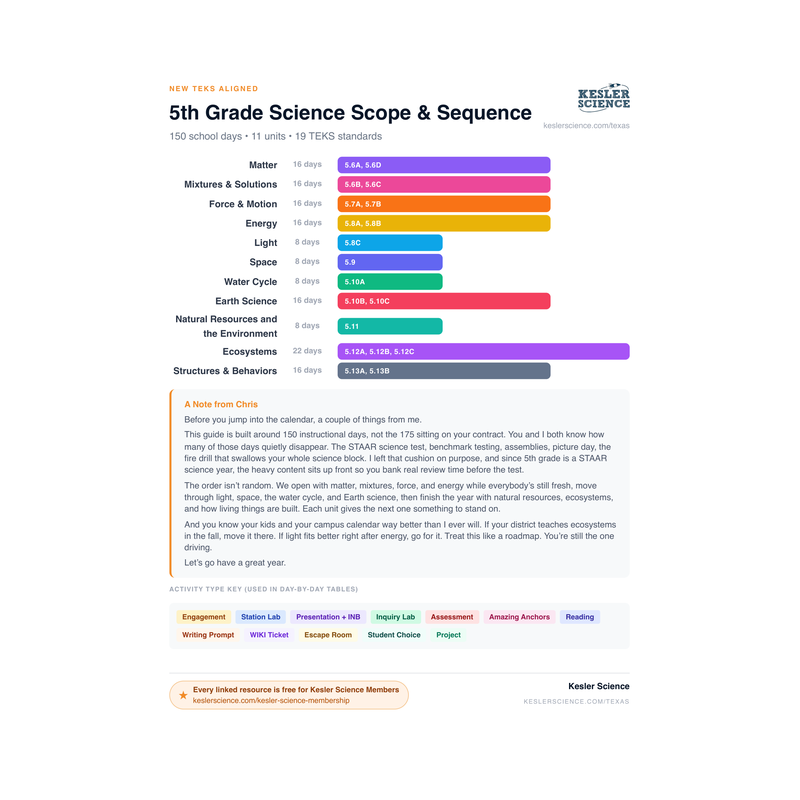
100% Aligned Lessons for Every TEKS You Teach
Kesler Science Plus puts thousands of ready-to-teach lessons and activities in your hands, so you can boost engagement and get your planning time back. Trusted by schools and districts all over the great state of Texas.
🌎 Phenomenon Ideas for 5.8B
Use these real-world phenomena to anchor your lesson. Show students the phenomenon first, let them wonder, then build toward Electrical Circuits as the explanation.
The Lonely Bulb
A teacher sets a fresh D-cell battery, a small bulb, and one piece of wire on the desk. He rests the bottom tip of the bulb on the little bump at the top of the battery. Nothing. He lays the bulb on its side against that same bump. Still nothing. Then he holds the bulb's bottom tip down on the bump and runs the wire from the metal screw base on the side of the bulb to the flat bottom of the battery. The bulb glows. Same parts, same battery, one wire. The bulb only lights when the parts make a complete loop: from one end of the battery, through the tip of the bulb and its filament, out the metal side, along the wire, and back to the other end.
"What had to happen before the bulb lit up? Why didn't just touching the bulb to the battery work? Draw the path the electrical energy travels in the working circuit."
One Battery, Three Devices
A simple circuit with a battery and two alligator clip wires sits on the table. First, a small bulb is clipped in. The bulb lights up. The bulb is unclipped. Next, a tiny buzzer goes in. The buzzer beeps. The buzzer is unclipped. Last, a small motor is clipped in. The motor spins. Same battery. Same wires. Three completely different things happen depending on what device is in the circuit.
"The same electrical energy from the battery turned into three different forms of energy: light, sound, and motion. Why? What does that tell you about what an electrical circuit actually does?"
The Broken Wire Mystery
A working circuit lights a bulb at the front of the room. The teacher reaches over and pinches one of the wires between two fingers, gently pulling it loose from a clip. The bulb instantly goes dark. He pushes the wire back in. The bulb pops back on. Pulls it loose. Off. Back in. On. Same battery, same bulb, same wires, but a tiny break in the loop is the difference between a glowing classroom and a dark one.
"What did unhooking the wire do to the path the electricity travels? What does that tell you about what every working circuit needs? Make a list of the parts a circuit must have to work."
💡 Free Engagement Ideas for 5.8B
Ready-to-run activities you can drop straight into a lesson. Where one of these looks like a phenomenon from the section above, that is on purpose: show it first as the hook, then let students run it themselves.
Build-a-Circuit Challenge
Each pair gets a D-cell battery in a holder, two alligator clip wires, and a small bulb in a holder. Their challenge: get the bulb to light. They figure it out by experimenting. Once it's lit, they swap the bulb for a small motor or buzzer and watch the same circuit produce a different form of energy. They sketch each working circuit and label the energy transformation.
Conductor or Insulator Test
Set up a basic circuit with a gap in the middle: battery, two wires, bulb, with the ends of the wires not touching anything. Each group tests household items by laying them across the gap to complete the circuit: paperclip, plastic spoon, piece of aluminum foil, rubber band, pencil lead, eraser, penny. Items that complete the circuit (light the bulb) are conductors. Items that don't are insulators. Students record each result.
Circuit Requirements Diagram
After building a working circuit, students draw a diagram of their setup and label every part: power source, wires, device, switch (if used). Then they draw a second diagram with one part missing or broken (no wire, no battery, broken loop) and write a sentence explaining why it doesn't work. Forces them to identify the requirements without it being a list to memorize.
Energy Output Match-Up
Show students four working circuits, one with each output: a bulb (light), a motor (motion), a buzzer (sound), and a small heating coil or hand-warmer wire (thermal). Students rotate through, observe each one, feel or listen to the energy it produces, and fill in a chart matching the device to the energy form it produces. Reinforces that one electrical energy source can become four different things.
🎯 What Approaches, Meets, and Masters Thinking Look Like
Here is what student thinking at each level looks like on this one task, so you know what to look for and how to move a student up.
A student wants to make a light bulb glow. They have one battery, one small bulb, and two wires. Draw how to connect the parts so the bulb lights up. Then explain what your circuit needs to work and what kind of energy the electrical energy turns into.
- A drawing that shows the parts connected, not just the parts sitting next to each other.
- Both wires used, with the bulb connected to both ends of the battery so the path makes a full loop.
- The three things every circuit needs named: a power source (the battery), a complete path (the wires with no breaks), and a device that uses the energy (the bulb).
- A clear statement that the electrical energy turns into light (and a little heat) at the bulb.
- The word "complete" or "loop" used to explain why the bulb glows.
- An understanding that if the loop has a break, or only one end is connected, the bulb stays dark.
- The loop idea handled correctly: the bulb must touch both ends of the battery, not just one. That is the easiest place to slip.
The bulb lights up because it has a battery. The battery gives it power. You just need a battery and a bulb to make light. The electrical energy turns into light.
My circuit needs three things. It needs the battery for power. It needs two wires that make a complete path with no breaks. And it needs the bulb, which is the device that uses the energy. The electrical energy travels around the loop and turns into light at the bulb. If I take one wire off and break the loop, the bulb goes dark.
My circuit needs a power source (the battery), a complete path (two wires with no breaks), and a device that uses the energy (the bulb). The electrical energy flows all the way around the loop, and at the bulb it turns into light and a little heat. It only works if the path is complete, because the electricity has to leave one end of the battery and come back to the other end.
That is how a flashlight works too. Inside there is a battery, a metal path, and a bulb. When you slide the switch on, it closes the loop and the bulb lights. When you slide it off, it makes a break in the path, so the loop is open and the light goes out. It is the same complete loop, just with a switch that opens and closes it.
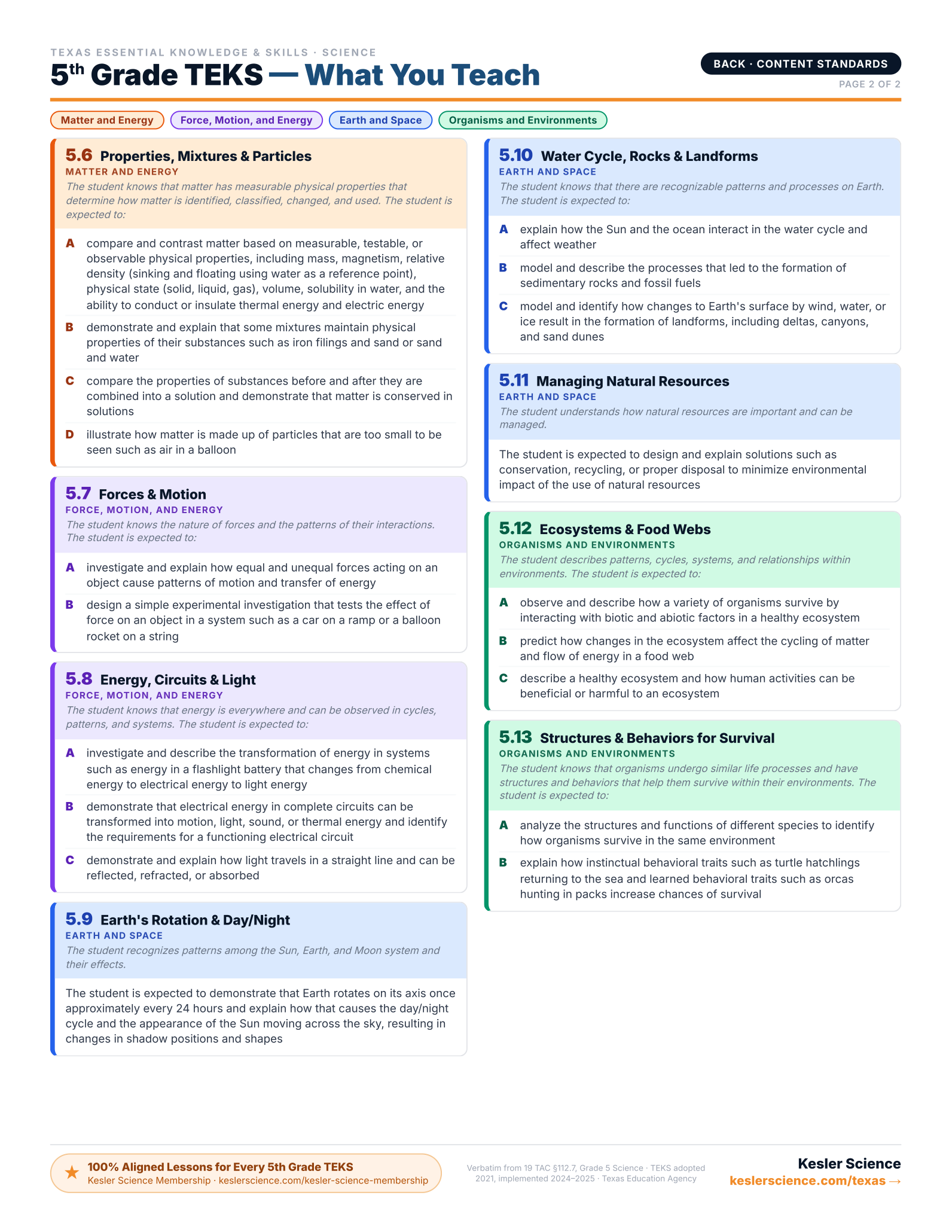
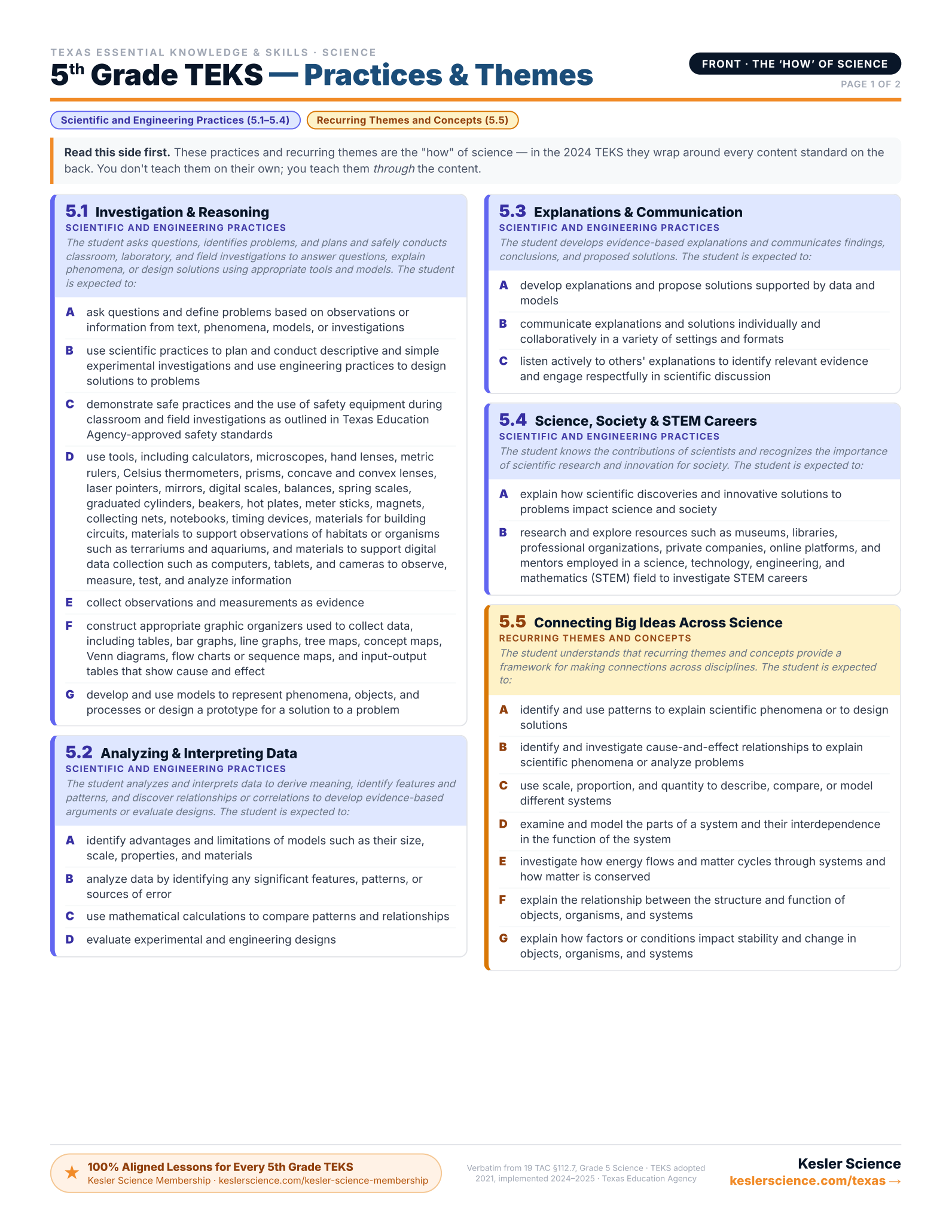
Every 5th-Grade Science TEKS on One Page
The color-coded, front-and-back cheat sheet I wish I'd had — every standard, organized by reporting category. Print it and reference it all year long. This will be your new favorite document!
Trusted Across Texas
From the Rio Grande Valley to the Panhandle, Texas science teachers are using Kesler Science to save time and engage students.
Texas Schools and Districts
Love Kesler Science

What Teachers Are Saying
Give Your Science Teachers Everything They Need
School and district licenses give your teachers access to every resource they need, including station labs, inquiry labs, anchoring phenomena, presentations, escape rooms, and much more. One purchase covers the grade levels you need.
- PO-friendly. We accept purchase orders
- Volume discounts for 11+ teachers
- Complimentary Kesler Science Plus orientation for 4+ teachers
- Three free implementation PD sessions for departments of 11+
- Aligned to the 2024 TEKS standards

See It in Action
Book a walkthrough and we'll show you how Kesler Science fits your campus.
Book Demo CallNo pressure, no hard sell