.png?width=375&height=100&name=WebPage%20logo%20with%20curves%202026%20(8).png)
Test Force Effects in a System
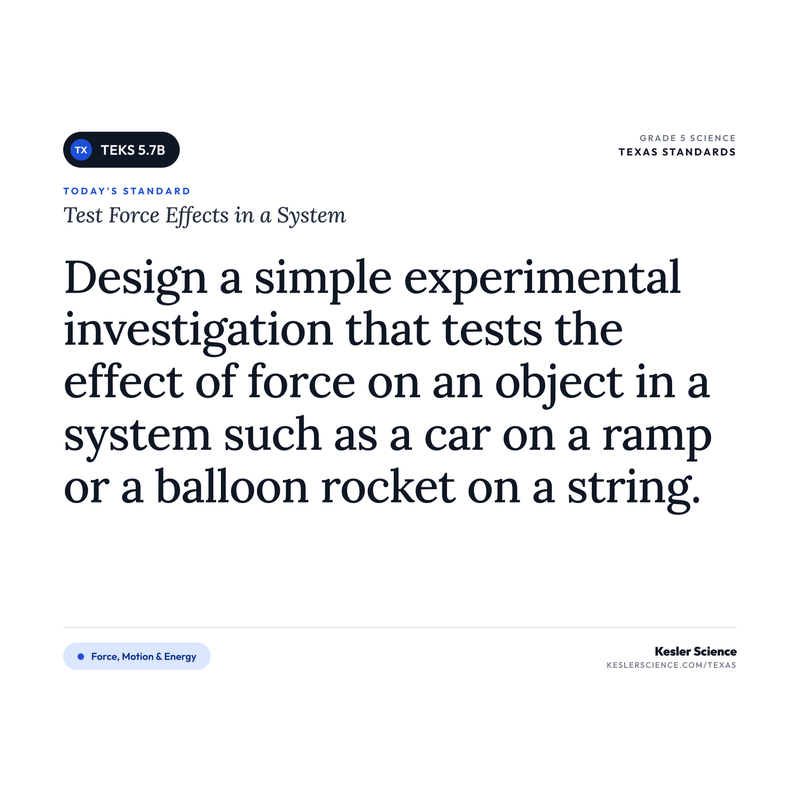
"Design a simple experimental investigation that tests the effect of force on an object in a system such as a car on a ramp or a balloon rocket on a string."
💡 What This Standard Actually Means
"Design a simple experimental investigation". One verb does all the work in this standard: design. Students aren't just observing or describing, and they aren't running a lab someone else already wrote for them. They are building the setup themselves and deciding what to change and what to keep the same, so that the test actually shows how a force changes what happens to an object inside a small system. The TEKS gives two anchor examples that lock in exactly what kind of system: a car on a ramp (the force is gravity pulling the car down, and students can change ramp height, surface texture, or car weight) and a balloon rocket on a string (the force is the air rushing out of the balloon, and students can change balloon size, string angle, or rocket weight). The job is to pick one variable to change, predict what will happen, run the test, and explain the result.
This standard moves kids from observing forces to designing investigations about them. The shift is huge. Instead of the teacher saying "watch what happens," students are now the ones planning the test, deciding what to change, and predicting what will happen before they run it. The TEKS spells out two perfect setups for 5th grade: a car rolling down a ramp and a balloon rocket on a string.
A car on a ramp is a system. The car, the ramp, and gravity all work together. Students can change one thing at a time and see how the car responds. Make the ramp steeper. The car rolls faster. Add a textured surface. The car slows down. Stack pennies on the car. The car still rolls but with different motion. A balloon rocket on a string is also a system. Tape a balloon to a straw, thread the straw on a long string, blow the balloon up, and let go. The air rushing out pushes the balloon forward along the string. Students can change the size of the balloon, the angle of the string, or the weight of the rocket and see how it moves.
The takeaway: every investigation has a question, a thing the student changes (the variable), and an outcome the student measures. By the end, kids should be able to look at a simple system and say, "If I change this one thing, here's what I think will happen, and here's how I'll test it."
Balloon rockets are my favorite teaching tool for this standard. Every kid wants to do it because it looks like play, but the science is loaded in. If I were running it, I'd tape a long piece of fishing line from one side of the room to the other, thread a straw onto it, and have each group tape a balloon to the straw. The first round, everyone blows up the balloon to about the size of a baseball, lets go, and watches it zip down the line. Then ask the question that turns play into science: "If you wanted your rocket to go farther, what's ONE thing you would change?" Kids say bigger balloon, straighter string, lighter straw, taping it differently, and so on. Pick one and test it. Don't change two at once. The balloon size group blows up huge balloons next round. The string-angle group tilts the line. They run the test, measure how far it traveled, and write up which variable mattered. Once they've done it once, they own the design-an-investigation move forever.
⚠️ Misconceptions Your Students May Have
These are some of the most common misconceptions. Knowing what to look for can help you get ahead of them.
"You can change a bunch of things at once and still tell which one mattered"
If you change two things at the same time, you can't tell which one caused the result. If a kid makes the ramp steeper AND adds a heavier car, and the car goes faster, was it the ramp or the weight? No way to know. The whole point of designing an investigation is changing exactly one thing at a time and keeping everything else the same.
"A heavier car always rolls faster down a ramp"
Not always. On a smooth, low-friction ramp, a heavier car and a lighter car often arrive at the bottom at almost the same time because gravity makes all objects speed up at the same rate when they're rolling or falling freely. The weight only matters when friction comes into play. Kids assume "heavier means faster" but the test will sometimes surprise them. That's the point of running the experiment instead of just guessing.
"The investigation is just running the experiment"
The investigation includes everything around the experiment too. You design it (decide what to test), predict what'll happen, run the trials (more than once is better), measure the results, and explain what you found. Just rolling a car down a ramp and saying "that was fun" isn't a full investigation. The thinking before and after is the science.
"If your prediction is wrong, the experiment failed"
A wrong prediction is one of the most useful results in science. It means you learned something you didn't expect. The experiment didn't fail. The prediction was just incomplete. Real scientists make wrong predictions all the time and write up what they figured out from being wrong. Tell kids that being wrong on purpose, then explaining why, is a great answer.
📓 Teaching Resources for 5.7B
These resources are aligned to this standard.


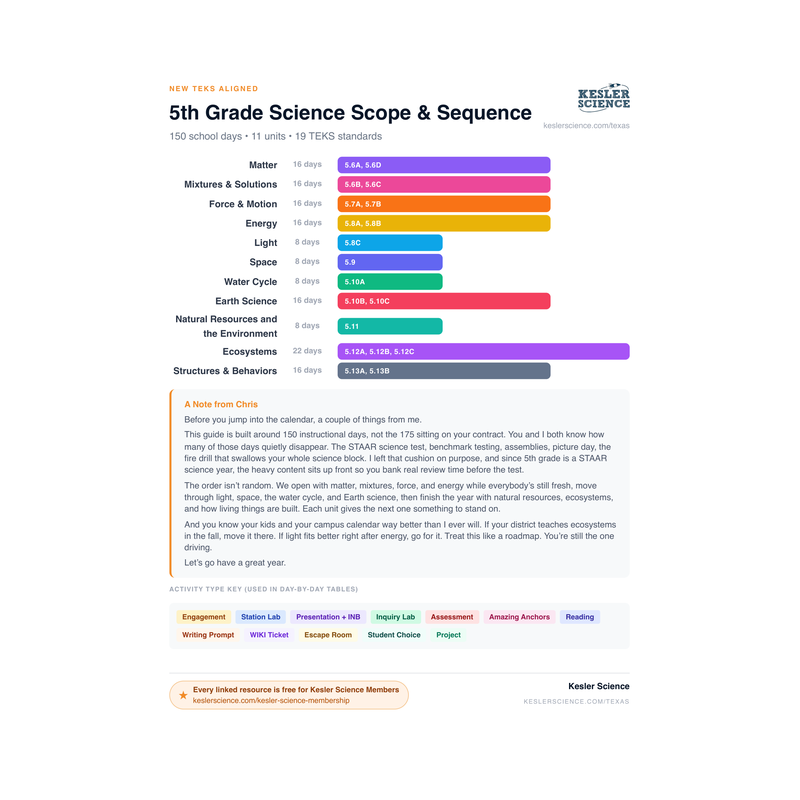
100% Aligned Lessons for Every TEKS You Teach
Kesler Science Plus puts thousands of ready-to-teach lessons and activities in your hands, so you can boost engagement and get your planning time back. Trusted by schools and districts all over the great state of Texas.
🌎 Phenomenon Ideas for 5.7B
Use these real-world phenomena to anchor your lesson. Show students the phenomenon first, let them wonder, then build toward Test Force Effects in a System as the explanation.
The Ramp Race That Surprised Everyone
A teacher sets up a smooth wooden ramp on the floor. Two toy cars line up at the top: one tiny lightweight matchbox car and one heavier metal car. Both get released at the same moment. Students bet on the heavier one. The cars roll down side by side, hit the bottom at almost the exact same instant, and skid to a stop next to each other. The kids who bet "heavier wins" stare in disbelief.
"If both cars start at the same height and the ramp is the same, why did they get to the bottom at almost the same time? What test could you design to figure out what really makes a car roll faster?"
The Balloon Rocket Mystery
A balloon is taped to a straw threaded on a long fishing line stretched across the room. Without blowing it up, the teacher releases the balloon. It just hangs there. Then she blows up the same balloon, pinches it shut, tapes it to the straw, and lets go. The balloon zooms across the room in three seconds, going from one wall to the other before deflating. Same balloon. Same string. Two completely different results.
"What force pushed the balloon along the string? How much air would be just right to send the rocket the farthest? Design a test that would help you find out."
The Sliding Book Mystery
A textbook is shoved across a smooth, polished tabletop. It slides three feet before stopping. The same book is shoved with the same push across a piece of carpet. It barely moves at all. Same book. Same push. The only thing different was the surface under it. Some force inside the system slowed the book on the carpet way faster than on the smooth table.
"What force is acting on the book that makes it travel different distances on different surfaces? How could you design a fair test to compare three different surfaces and figure out which one slows the book down the most?"
💡 Free Engagement Ideas for 5.7B
Ready-to-run activities you can drop straight into a lesson. Where one of these looks like a phenomenon from the section above, that is on purpose: show it first as the hook, then let students run it themselves.
Car-on-a-Ramp Investigation
Each group gets a piece of cardboard or a wooden plank, a small toy car, books to prop up the ramp, and a tape measure. Their job: design a test that answers ONE question about the car. Examples: "Does ramp height affect distance?" "Does adding weight to the car change how far it rolls?" "Does the surface texture matter?" They predict, run three trials, average their results, and write up what they found. Bring the whole class together at the end to compare findings.
Balloon Rocket Distance Challenge
Stretch a long fishing line or yarn from one corner of the room to another and thread a straw on it. Each group tapes a balloon to the straw and tests one variable they pick: balloon size, string tension, string angle (tilt the line uphill or downhill), or balloon shape. They run three trials, measure the distance traveled, and report back. Make a class chart of which variables had the biggest effect.
Surface Friction Race
Each group has a small toy car or wooden block, a smooth ramp, and three different surface squares: wax paper, cardboard, and a piece of carpet or felt. They roll the car off the ramp onto each surface and measure how far it travels before stopping. They repeat each trial three times and average the distances. Then they design a written explanation of which surface had the most "slowing force" and why.
Design Your Own Force Test
Give each pair a tray of supplies: a toy car, a ramp, a balloon, a straw, string, tape, and a few household items. Their challenge is to design ANY simple investigation that tests how a force affects an object in a system. They write a one-page plan: question, prediction, materials, steps, what they'll measure. Other groups read the plan and check whether it changes only one variable. Once approved, they run it.
🎯 What Approaches, Meets, and Masters Thinking Look Like
Here is what student thinking at each level looks like on this one task, so you know what to look for and how to move a student up.
A student wants to find out if a steeper ramp makes a toy car roll farther after it leaves the ramp. Design a simple test to answer this question. Tell what one thing you would change, what things you would keep the same, and what you would measure. Then predict what you think will happen and explain why.
- A clear plan that changes one thing: the height (steepness) of the ramp.
- The same toy car and the same ramp used every time, so only the steepness changes.
- Something to measure written down, like how far the car rolls after the ramp in inches or centimeters.
- A prediction made before the test (steeper ramp will make the car roll farther because gravity gives it more speed).
- A plan to run the test more than once at each height, not just one try.
- An explanation that connects the force (gravity pulling the car down the ramp) to the result.
- Only the steepness is changed while the car, the floor, and the way the car is let go stay the same. Mixing in a second change is the easiest place to slip.
I would make the ramp steeper and use a heavier car so it really goes fast. I will measure how far it rolls. I think the car will roll way farther because the ramp is taller and the heavy car pushes harder. That will prove a steeper ramp makes it go farther.
I will change only one thing: how steep the ramp is. First I will prop the ramp up on one book, then on three books to make it steeper. I will use the same toy car and the same floor every time, and I will let the car go from the top without pushing it. I will measure how far the car rolls past the ramp with a ruler. I will do each height three times so it is fair. I predict the car will roll farther with three books because the steeper ramp lets gravity pull it down faster, so it has more speed at the bottom.
I will change only the ramp height and keep the same car, floor, and starting spot. I will test one book, two books, and three books, three rolls each, and measure how far the car rolls past the ramp. I predict it rolls farther each time it gets steeper, because a steeper ramp lets gravity pull the car down faster, so it leaves the ramp with more speed.
The big idea is that I am testing how changing one part of a system changes the force and the motion. I could test the same idea on a balloon rocket on a string. I would keep the string and straw the same and only change how big I blow up the balloon. The bigger balloon pushes out more air, so I predict it would zip farther along the string. It is the same plan: change one thing, keep the rest the same, and watch how the force changes the motion.
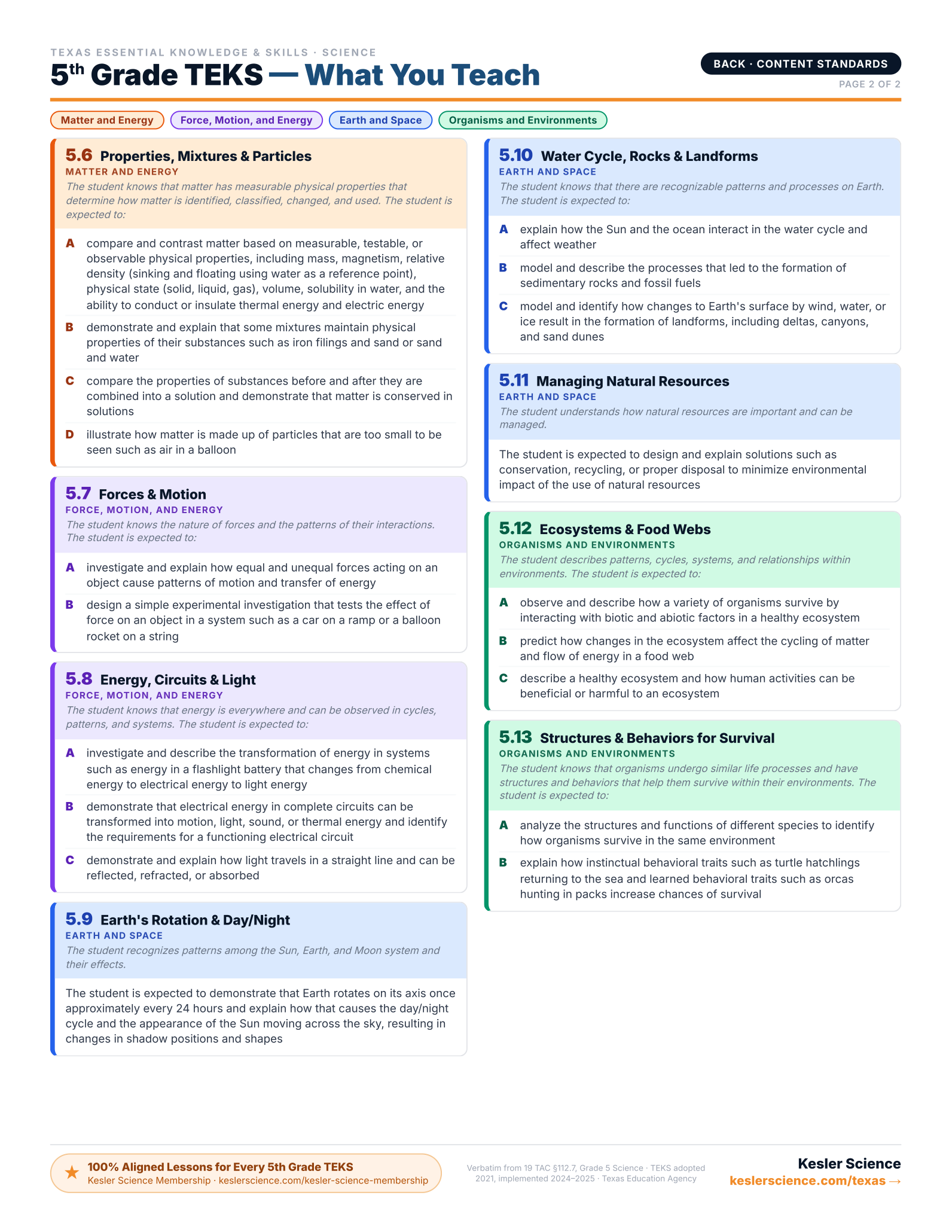
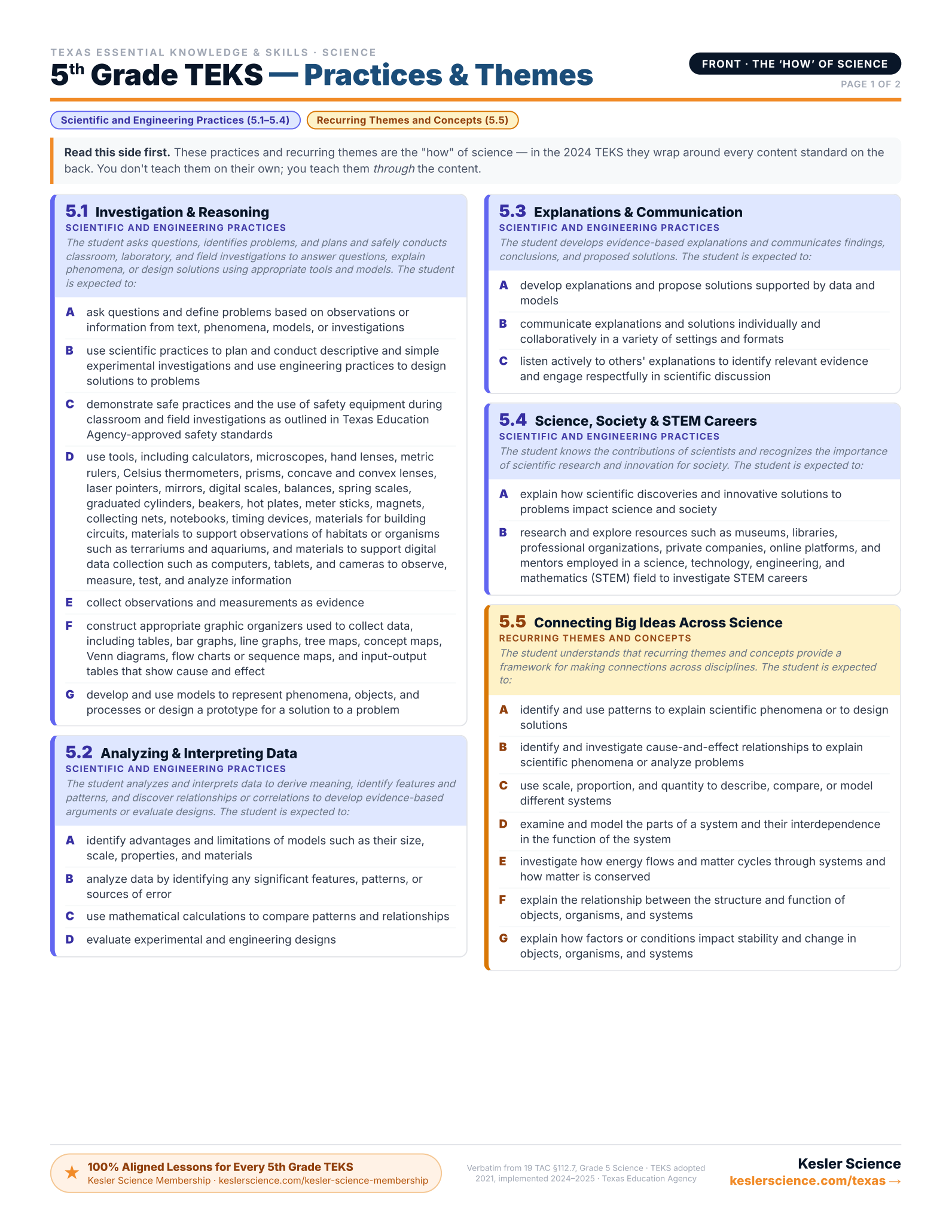
Every 5th-Grade Science TEKS on One Page
The color-coded, front-and-back cheat sheet I wish I'd had — every standard, organized by reporting category. Print it and reference it all year long. This will be your new favorite document!
Trusted Across Texas
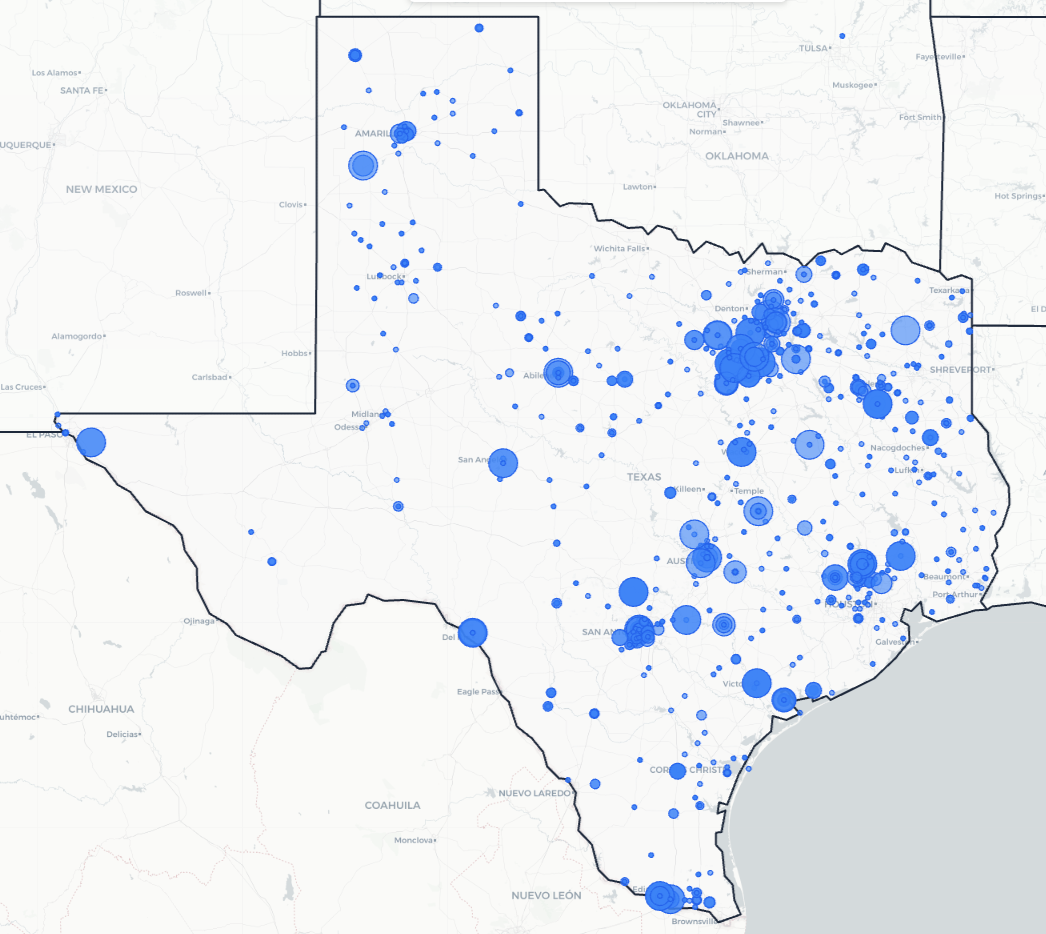
From the Rio Grande Valley to the Panhandle, Texas science teachers are using Kesler Science to save time and engage students.
Texas Schools and Districts
Love Kesler Science
What Teachers Are Saying
Give Your Science Teachers Everything They Need
School and district licenses give your teachers access to every resource they need, including station labs, inquiry labs, anchoring phenomena, presentations, escape rooms, and much more. One purchase covers the grade levels you need.
- PO-friendly. We accept purchase orders
- Volume discounts for 11+ teachers
- Complimentary Kesler Science Plus orientation for 4+ teachers
- Three free implementation PD sessions for departments of 11+
- Aligned to the 2024 TEKS standards
See It in Action
Book a walkthrough and we'll show you how Kesler Science fits your campus.
Book Demo CallNo pressure, no hard sell