.png?width=375&height=100&name=WebPage%20logo%20with%20curves%202026%20(8).png)
Equal & Unequal Forces
"Investigate and explain how equal and unequal forces acting on an object cause patterns of motion and transfer of energy; and"
💡 What This Standard Actually Means
"Investigate and explain". Students push, pull, roll, and tug on objects to figure out a rule about forces. The rule is the load-bearing concept: when forces are equal (balanced), the object stays still or keeps moving the same way. When forces are unequal (unbalanced), the object speeds up, slows down, changes direction, or starts to move. Both halves of the standard matter. Students explain the patterns of motion that come from those forces (the object moves in a straight line, slows to a stop, speeds up) AND they explain the transfer of energy that happens when one object pushes or pulls another (the cue ball hits the eight ball and the energy moves from one to the other).
Forces are pushes and pulls. Every time you nudge a book across the desk, push a swing, kick a soccer ball, or pull a wagon, you're applying a force. The big idea of this standard is that the result of a force depends on whether the forces on the object are equal or unequal. Equal forces cancel each other out. Unequal forces make stuff happen.
Think about a tug-of-war. If both teams pull with the exact same strength, the rope doesn't move. The forces are equal. The team that pulls just a tiny bit harder makes the rope move toward them. Unequal forces caused a change in motion. That change is one of the patterns of motion the standard wants kids to spot: an object speeds up, slows down, starts moving, stops moving, or changes direction.
The second half of the standard is energy transfer. When one object pushes another, energy moves from the first object to the second. A bowling ball rolls down the lane, hits the pins, and the pins fly. The energy that was in the rolling ball got transferred into the pins. Same idea when a car bumps another car at low speed, when one billiard ball hits another, or when a kid kicks a ball and sends it flying. Wherever you see motion change because of a push or pull, you can also see energy moving from one object to the next.
Tug-of-war is the cheat code for teaching this standard. If I were running it, I'd split the room into two teams, give them a length of thick rope (or a long towel if rope is a problem), and start with two perfectly even teams. Big kids tied with big kids, small kids tied with small kids. The rope doesn't move. Yell "freeze" and ask, "Are forces being applied right now?" Both teams say yes. Then ask, "Is the rope moving?" They say no. Boom. Equal forces. Then have one extra kid join one of the teams. Same rope. Same setup. Now the rope crawls toward the bigger team. Unequal forces. Same demo, two completely different results. After that, the energy transfer piece slides right in. The team that pulled hardest transferred energy through the rope and pulled the other team forward. They get it because they felt it.
⚠️ Misconceptions Your Students May Have
These are some of the most common misconceptions. Knowing what to look for can help you get ahead of them.
"If something is sitting still, no forces are acting on it"
Sitting still doesn't mean no forces. It means equal forces. A book sitting on a desk has gravity pulling it down AND the desk pushing up on it with the same strength. Both forces are happening. They just cancel each other out, so the book doesn't move. Equal forces are still forces.
"The bigger force always wins"
This one is half right, which is what makes it stick. When two forces push in opposite directions, the object does move toward the bigger one. What kids miss is that it does not move as if the bigger force were acting alone. Only the difference between the two forces does anything. Picture a tug-of-war where one team is pulling just a little harder: the rope creeps slowly toward them instead of flying, because most of each team's pull is being cancelled out by the other team. Make the two pulls exactly equal and the difference is zero, so nothing moves at all, even though both teams are straining as hard as they can.
"Energy disappears when an object stops moving"
Energy doesn't disappear. It transfers somewhere else. When a bowling ball stops after hitting the pins, the energy that was in the ball moved into the pins (which fly across the lane), into sound waves (the crash), and into a tiny bit of heat from friction. The ball didn't lose its energy. The energy moved.
"Motion only changes when something pushes harder, not when something stops pushing"
Motion can change either way. If you stop pushing a wagon, friction (still a force) eventually slows it to a stop. If a goalie catches a soccer ball, the goalie's hands apply a force that stops the ball. Speeding up, slowing down, AND stopping all count as changes in the pattern of motion. Anywhere there's an unequal force, the motion changes.
📓 Teaching Resources for 5.7A
These resources are aligned to this standard.


100% Aligned Lessons for Every TEKS You Teach
Kesler Science Plus puts thousands of ready-to-teach lessons and activities in your hands, so you can boost engagement and get your planning time back. Trusted by schools and districts all over the great state of Texas.
🌎 Phenomenon Ideas for 5.7A
Use these real-world phenomena to anchor your lesson. Show students the phenomenon first, let them wonder, then build toward Equal & Unequal Forces as the explanation.
The Tug-of-War Tie
Two teams of equal size pull on a rope as hard as they can. They're red-faced, leaning back, sweating. The rope is bowed tight. Neither team moves an inch. After thirty seconds, one tiny kid joins the team on the left and grabs the rope. Suddenly the rope starts crawling toward the left team. The kids on the right are pulling just as hard as before, but now they're being dragged forward, one shuffle at a time.
"Why didn't the rope move at first, even though both teams were pulling with all their strength? What changed when the extra kid joined? How would you describe the forces before and after?"
The Bowling Pin Domino
A bowling ball rolls smoothly down a lane and crashes into ten pins standing perfectly still at the end. The ball slows down dramatically. The pins fly in every direction, some bouncing off each other, some flipping into the air. The ball that hit them ends up rolling slower than it started. The pins, which weren't moving at all a second ago, are now flying. Something moved from the ball into the pins.
"The pins weren't moving before the ball hit them. After the ball hit, they were flying. The ball was rolling fast and now it's rolling slower. What got transferred from the ball to the pins, and how do you know?"
The Stuck Door
A heavy classroom door is wedged shut. One student leans against it, pushing hard with her shoulder. Nothing. Another student comes over and pushes from the other side at the same time. The door is now pushed from both sides, but still doesn't move. Then the second student lets go. The door pops open and the first student stumbles forward into the hallway.
"Why didn't the door move when both kids were pushing on it, even though they were both working hard? Why did it pop open the moment one kid stopped pushing? Where did the second kid's energy go when the door finally moved?"
💡 Free Engagement Ideas for 5.7A
Ready-to-run activities you can drop straight into a lesson. Where one of these looks like a phenomenon from the section above, that is on purpose: show it first as the hook, then let students run it themselves.
Tabletop Tug-of-War
Each group of four sits at a table with a small toy car in the middle and two pieces of string tied to opposite ends of the car. Two students pull at the same time with what feels like equal force. The car stays put. Then they switch so one student pulls harder than the other. The car slides toward the harder puller. Students record which trial was equal and which was unequal, and what happened to the car each time.
Marble Energy Transfer Track
Set up a line of three marbles touching each other on a flat track or in a groove. Roll a fourth marble into the line from one end. The marble at the far end shoots off, while the two in the middle stay almost perfectly still, and the marble you rolled stops dead where it hit. Energy traveled from the rolling marble through the line and out the other end. Students draw arrows showing where the energy went and write a one-paragraph explanation of how the marbles transferred energy without all flying off at once.
Push-and-Pull Force Map
Walk around the classroom and identify ten things that involve a push or pull (opening a door, pulling out a chair, picking up a backpack, shoving a desk). Each student picks five of those examples and draws a quick force diagram with arrows showing the direction of the push or pull. They label each as "equal" (no motion) or "unequal" (motion). Five minutes of work produces a great class discussion about which forces produce motion and which don't.
Tennis Ball vs. Ping Pong Ball Collision
Each group rolls a tennis ball into a stationary ping pong ball and watches what happens. The ping pong ball flies. Then they reverse it: roll the ping pong ball into a stationary tennis ball. The tennis ball barely budges and the ping pong ball bounces backward. Students sketch both collisions and write about which way the energy got transferred and why the lighter ball reacted so differently.
🎯 What Approaches, Meets, and Masters Thinking Look Like
Here is what student thinking at each level looks like on this one task, so you know what to look for and how to move a student up.
Two students play tug-of-war with a rope. A ribbon is tied to the middle of the rope, and a cone sits on the ground to mark the spot right under it at the start. In Round 1, both students pull with the same strength and the ribbon stays right over the cone. In Round 2, the student on the left pulls harder, and the ribbon moves to the left of the cone. For each round, tell whether the forces are equal or unequal, and explain why the ribbon moved or stayed still.
- Round 1 named as equal (balanced) forces and Round 2 named as unequal (unbalanced) forces.
- An explanation that links equal forces to no change in motion (the ribbon stays over the cone).
- An explanation that links unequal forces to a change in motion (the ribbon starts to move).
- The ribbon moving toward the side that pulled harder, because that side had the stronger force.
- A clear statement that in Round 1 both students are still pulling, so forces are acting on the rope even though the ribbon does not move.
- Some mention of energy moving from the puller into the rope when the ribbon slides.
- That "still" does not mean "no force." Both teams are pulling in Round 1. That is the easiest place to slip.
In Round 2 the forces are unequal because the left student pulled harder, so the ribbon moved to the left. The bigger force won. In Round 1 the ribbon did not move, so no forces were acting on it. Nobody was winning, so there was no force on the rope.
In Round 1 the forces are equal because both students pull with the same strength. The two pulls cancel out, so the ribbon stays still. They are both still pulling, the forces just match. In Round 2 the forces are unequal because the left student pulls harder. The pulls do not match anymore, so the ribbon starts to move toward the left, the stronger side. Unequal forces made the motion change.
In Round 1 the forces are equal. Both students pull, but the pulls are the same strength in opposite directions, so they cancel out and the ribbon does not move. In Round 2 the left student pulls harder, so the forces are unequal. The stronger pull is not canceled out, so the ribbon speeds up and slides left. When it slides, the energy from the puller moves through the rope. That is energy transferring from one thing to the next.
The real rule is that motion only changes when the forces are unequal. It does not matter how strong a force is by itself. A book just sitting on my desk has gravity pulling it down and the desk pushing it up with the same strength, so it stays still, just like the rope in Round 1. The forces are there, they are just balanced.
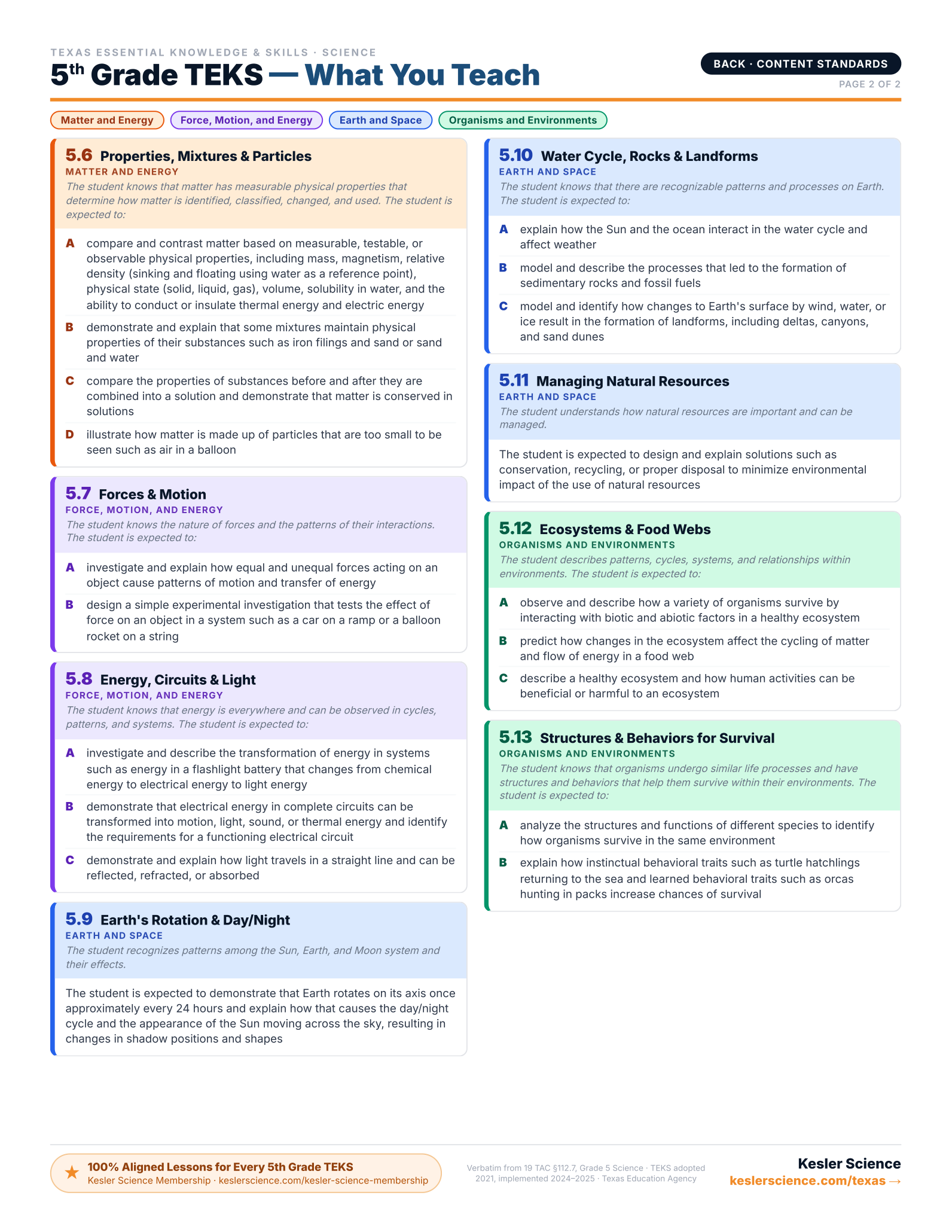
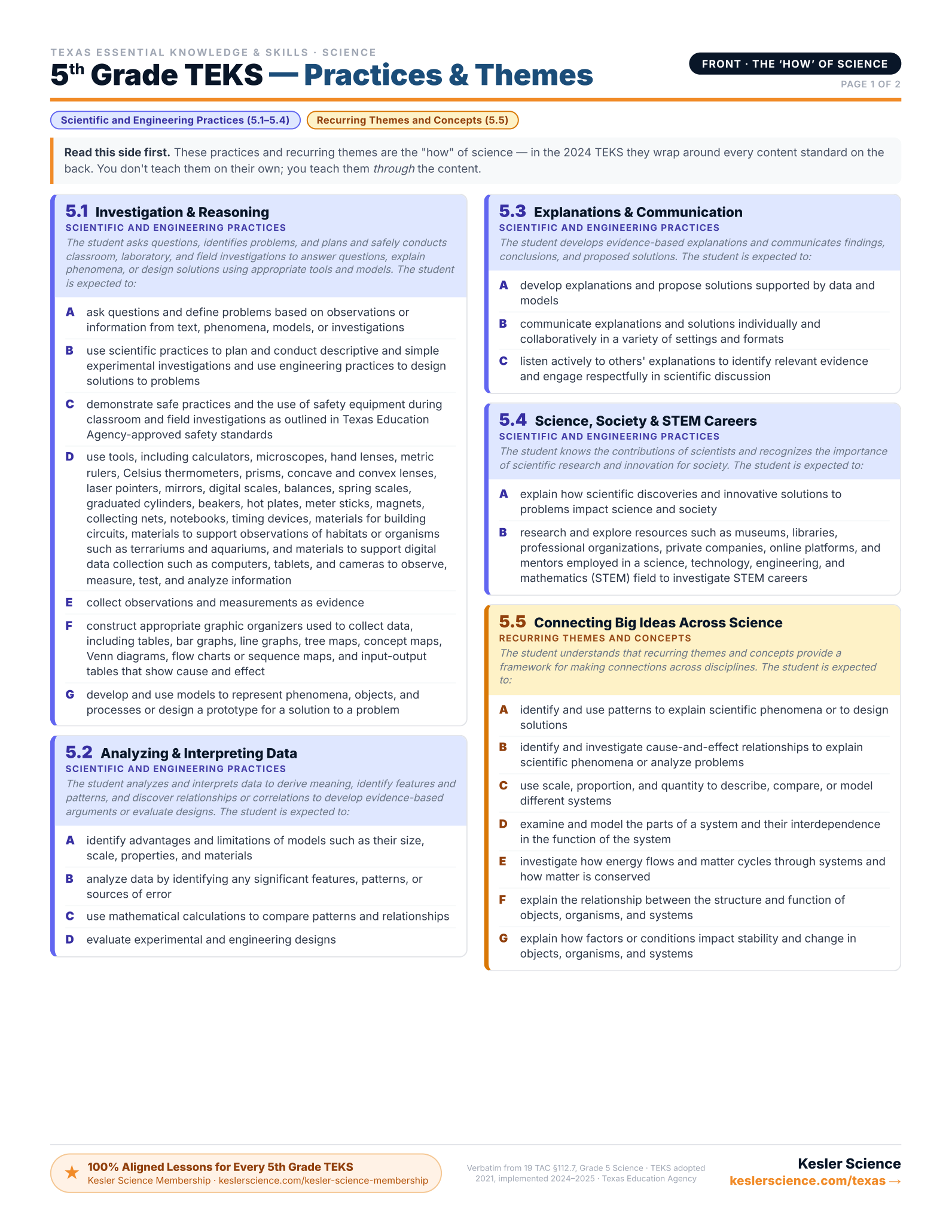
Every 5th-Grade Science TEKS on One Page
The color-coded, front-and-back cheat sheet I wish I'd had — every standard, organized by reporting category. Print it and reference it all year long. This will be your new favorite document!
Trusted Across Texas
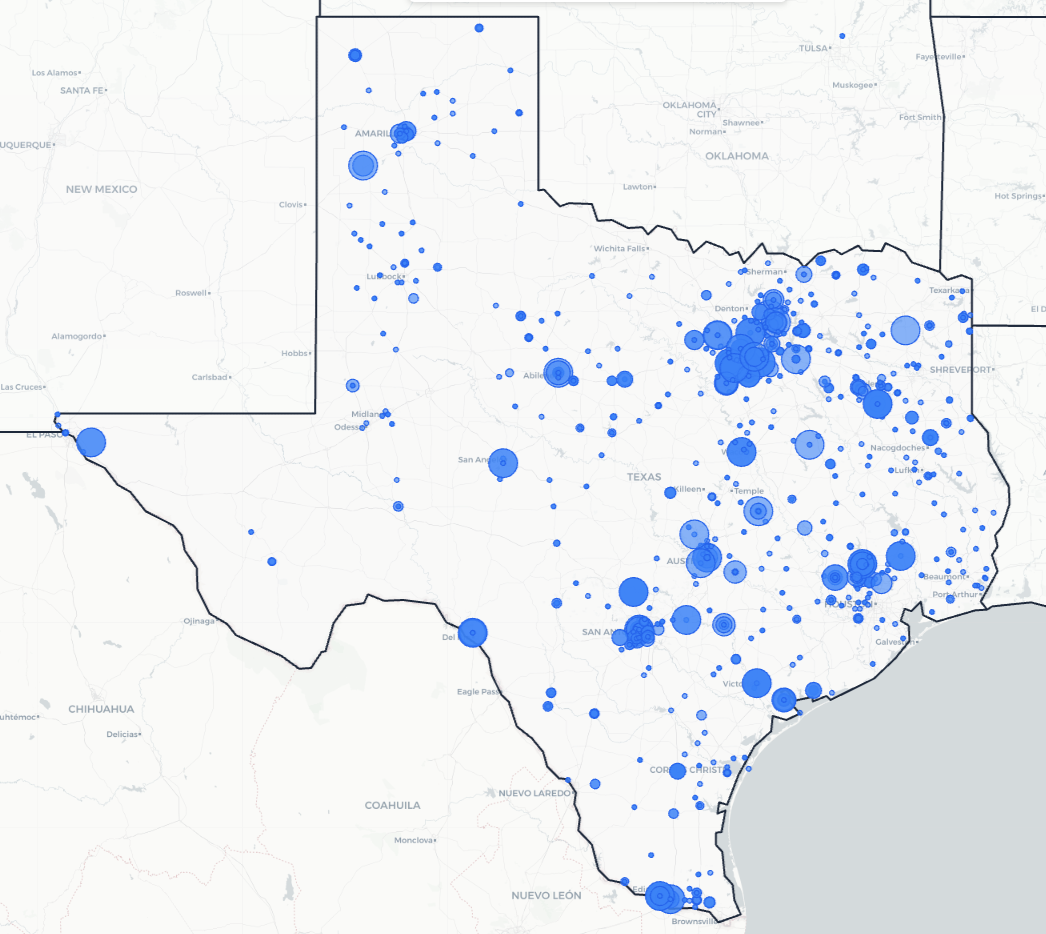
From the Rio Grande Valley to the Panhandle, Texas science teachers are using Kesler Science to save time and engage students.
Texas Schools and Districts
Love Kesler Science
What Teachers Are Saying
Give Your Science Teachers Everything They Need
School and district licenses give your teachers access to every resource they need, including station labs, inquiry labs, anchoring phenomena, presentations, escape rooms, and much more. One purchase covers the grade levels you need.
- PO-friendly. We accept purchase orders
- Volume discounts for 11+ teachers
- Complimentary Kesler Science Plus orientation for 4+ teachers
- Three free implementation PD sessions for departments of 11+
- Aligned to the 2024 TEKS standards
See It in Action
Book a walkthrough and we'll show you how Kesler Science fits your campus.
Book Demo CallNo pressure, no hard sell