.png?width=375&height=100&name=WebPage%20logo%20with%20curves%202026%20(8).png)
Properties of Solutions
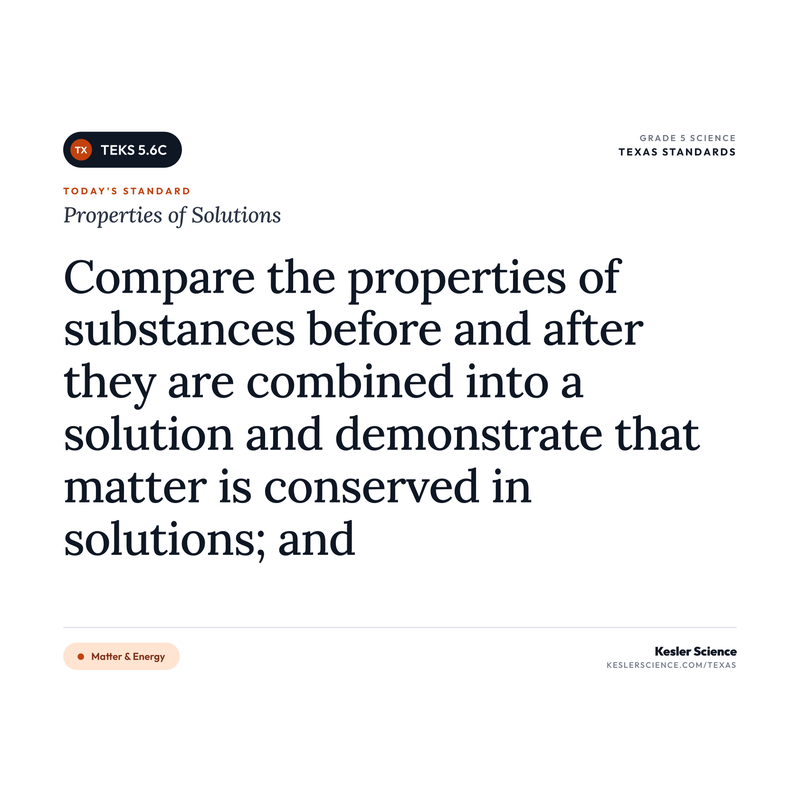
"Compare the properties of substances before and after they are combined into a solution and demonstrate that matter is conserved in solutions; and"
💡 What This Standard Actually Means
"Compare... before and after" and "demonstrate that matter is conserved". Two big jobs in one standard. First, students compare the properties of substances (like salt and water) before they're combined and after they've dissolved together into a solution. Salt is white and grainy before. After dissolving, it's invisible, but the water tastes salty. Second, students show that the matter is still all there. If they weigh the salt and water before mixing, then weigh the solution after, the mass stays the same. Nothing disappears. Mass in equals mass out. That's conservation of matter, and it's the load-bearing concept of this standard.
Stir a spoonful of salt into a clear cup of water and watch it disappear. To a 5th grader, that's magic. Where did the salt go? It looks gone. The water looks the same as it did before. But take a sip and the salt is right there. The salt didn't vanish. The particles spread out evenly between the water particles, too small to see anymore. That's a solution.
This standard asks students to do two things. First, compare the properties before and after. Before mixing, the salt is white, grainy, dry, and visible. The water is clear and tastes like water. After dissolving, the salt is invisible. The water still looks clear, but now it tastes salty. Some properties stayed the same. Some changed. The salt is still salty. Second, students demonstrate that matter is conserved. If you put a sealed cup of water on a balance, weigh it, add a measured spoonful of salt, seal it, and weigh again after the salt dissolves, the total mass before and after is exactly the same. The matter didn't go anywhere.
The takeaway: dissolving doesn't destroy matter. The substances are still all there, just rearranged at a scale you can't see. The proof is the balance. Same mass before, same mass after, every single time.
If I were teaching conservation of matter with solutions, I'd skip the diagram-and-explanation approach because you lose most kids by the third sentence. The move I'd lean on is a balance and a sealed bottle. Get a small water bottle, half-full of water, and put it on a digital scale with a measured pile of salt sitting next to it on a square of paper. Record the total mass. Pour the salt into the bottle, cap it tight, swirl until the salt dissolves, and put the whole thing back on the scale. Same mass. To the gram. Kids stare at the number, do the math in their heads, and you can watch the realization land. The salt didn't disappear. It just got too small to see. Don't tell them. Let the scale tell them. Then ask them to write the explanation.
⚠️ Misconceptions Your Students May Have
These are some of the most common misconceptions. Knowing what to look for can help you get ahead of them.
"When salt dissolves in water, it disappears"
The salt doesn't disappear. It breaks into particles too small to see and spreads out evenly through the water. The proof? Take a sip. The salt is right there. Or let the water evaporate over a few days and watch the salt come back, sitting in the bottom of the dish. It was there the whole time, just invisible.
"The salt water weighs less than the salt and water did separately"
The mass before and the mass after are exactly the same. If 50 grams of water and 5 grams of salt go in, you get 55 grams of salt water out. Every time. Every gram of matter that started in the cup is still in the cup. That's conservation of matter, and a digital scale will prove it on demand.
"Solutions and mixtures are different things, solutions aren't mixtures"
A solution IS a mixture. It's just a special kind of mixture where one substance dissolves so completely into another that it looks like one liquid. Salt water is a solution and a mixture. Sand water is a mixture but not a solution (because the sand doesn't dissolve). All solutions are mixtures, but not all mixtures are solutions.
"Once salt dissolves, you can't get it back"
You absolutely can get it back. Pour the salt water into a shallow dish and leave it out for a few days. The water evaporates and the salt is left sitting in the bottom of the dish, white and grainy, exactly like it started. The salt was always still salt. It was just spread out among the water particles, waiting for the water to leave.
📓 Teaching Resources for 5.6C
These resources are aligned to this standard.


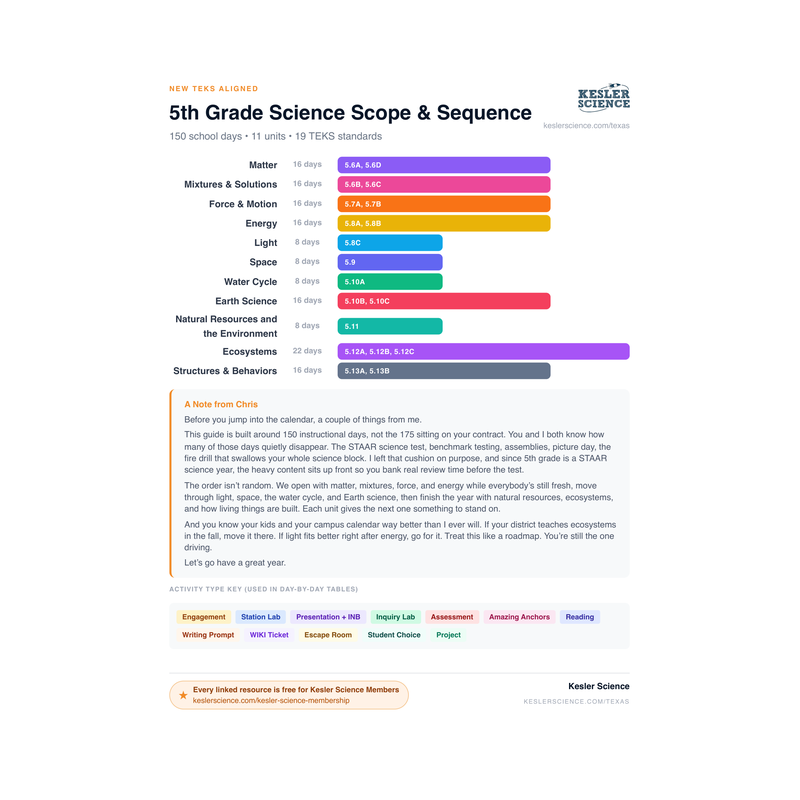
100% Aligned Lessons for Every TEKS You Teach
Kesler Science Plus puts thousands of ready-to-teach lessons and activities in your hands, so you can boost engagement and get your planning time back. Trusted by schools and districts all over the great state of Texas.
🌎 Phenomenon Ideas for 5.6C
Use these real-world phenomena to anchor your lesson. Show students the phenomenon first, let them wonder, then build toward Properties of Solutions as the explanation.
The Vanishing Sugar
A teacher places a small pile of sugar on a digital scale next to a cup of water. The total reads exactly 250 grams. The sugar gets stirred into the water and dissolves completely. The cup goes back on the scale. It still reads 250 grams. The sugar is invisible now, but the scale insists it's all still there. A drop of the water tasted on the tip of a spoon proves it.
"The sugar disappeared from sight, but the scale didn't change at all. How is that possible? What does the scale tell you about what happened to the sugar particles?"
Salt That Came Back
A spoonful of salt is dissolved into a shallow black dish of warm water. After a few minutes of stirring, the salt is gone. The water is clear. The dish gets put on a sunny windowsill for three days. Each day, the puddle gets smaller. By day three, the water is gone and the dish is dotted with tiny white salt crystals scattered across the bottom, exactly where the water used to be.
"Where did the water go, and where did the salt come from? If we never added anything to the dish, what does that tell you about whether the salt was really gone in the first place?"
Hot Water vs. Cold Water
Two clear cups sit side by side. One has very warm water. The other has ice-cold water. A teaspoon of sugar goes into each. The cups are stirred at the same speed for ten seconds. The sugar in the warm water disappears almost instantly. The sugar in the cold water sits at the bottom in a stubborn pile, refusing to dissolve no matter how much stirring it gets. Same sugar. Same amount of water. Two completely different results.
"What property of the water seems to make a difference in how fast the sugar dissolves? Is the sugar in the cold cup gone, or just not dissolved yet? How would you test it?"
💡 Free Engagement Ideas for 5.6C
Ready-to-run activities you can drop straight into a lesson. Where one of these looks like a phenomenon from the section above, that is on purpose: show it first as the hook, then let students run it themselves.
Conservation of Matter Mass Lab
Each group gets a small water bottle half-filled with water, a sealed packet of salt, and access to a digital scale. They weigh the bottle (with cap on) plus the unopened salt packet together and record the mass. They pour the salt in, cap the bottle tight, swirl until dissolved, and weigh again. Same mass. They write a sentence explaining why nothing changed even though the salt vanished from sight.
Before-and-After Property Chart
Each pair has a chart with two columns: "Before" and "After." They observe a teaspoon of salt and a cup of water and record the properties of each separately (color, texture, taste, look). Then they stir the salt into the water and record the properties of the solution. They circle the properties that stayed the same (saltiness) and underline the ones that changed (the salt is no longer visible, no grainy texture).
Solution Speed Race
Each group sets up three identical clear cups: one with cold water, one with room-temperature water, one with hot water from a kettle. Drop a sugar cube into each at the same time and start a stopwatch. Time how long it takes the cube to fully dissolve in each cup. Hot water wins by a mile. Connects "rate of dissolving" to particle motion in a way that locks in even though it's optional content.
Evaporation Recovery Dish
Each pair stirs a half teaspoon of salt into a shallow black plastic dish with a tiny amount of warm water. The dish goes on the windowsill or under a sunny lamp. Each day, the kids check it and sketch what they see. By the end of the week, the water is gone and the salt has reappeared as crystals in the dish. They write a one-paragraph explanation of where the salt was the whole time.
🎯 What Approaches, Meets, and Masters Thinking Look Like
Here is what student thinking at each level looks like on this one task, so you know what to look for and how to move a student up.
A student puts a cup with 100 grams of water on a scale and adds 10 grams of salt. The scale reads 110 grams. They stir until the salt dissolves and the water looks clear again. Without weighing again, predict what the scale will read now. Then explain what happened to the salt and why you predicted that number.
- A clear prediction of the mass after stirring (it should still read 110 grams).
- A note that a property changed: the salt is no longer visible after it dissolves.
- A note that a property stayed the same: the water would taste salty now, so the salt is still there.
- The idea that the salt did not disappear, it just broke into tiny pieces and spread out evenly in the water.
- A reason for the prediction that connects to matter being conserved (nothing left the cup, so the mass is the same).
- The before-and-after comparison handled correctly: some properties change (you can see it, then you cannot) while the matter itself stays. That is the easiest place to slip.
The salt dissolved so now you cannot see it anymore. The water looks clear again. I think the scale will say about 100 grams now, because the salt is gone into the water and the cup is just water again. So it should weigh less than 110.
I predict the scale will still say 110 grams. The salt looks like it is gone because it dissolved, but it did not really leave. It broke into tiny pieces too small to see and spread out evenly in the water. The water would taste salty now, so the salt is still in there. Before, the salt was white and you could see it. After, you cannot see it, but it is still the same amount of stuff. Nothing went out of the cup, so the mass stays 110.
The scale will still read 110 grams. When the salt dissolves it does not get destroyed. It just breaks into pieces too tiny to see and spreads out evenly between the water pieces. Some properties change, like you cannot see it and the water now tastes salty, but the matter is all still in the cup. The mass is the same because no matter went in or out. 100 plus 10 is 110 before and after.
This works for other things too, not just salt. If I dissolved 10 grams of sugar in the same water, the scale would still read 110, because the sugar pieces just spread out in the water the same way. And if I left either cup out for a few days so the water dried up, the salt or the sugar would be sitting in the bottom again, proving it was there the whole time.
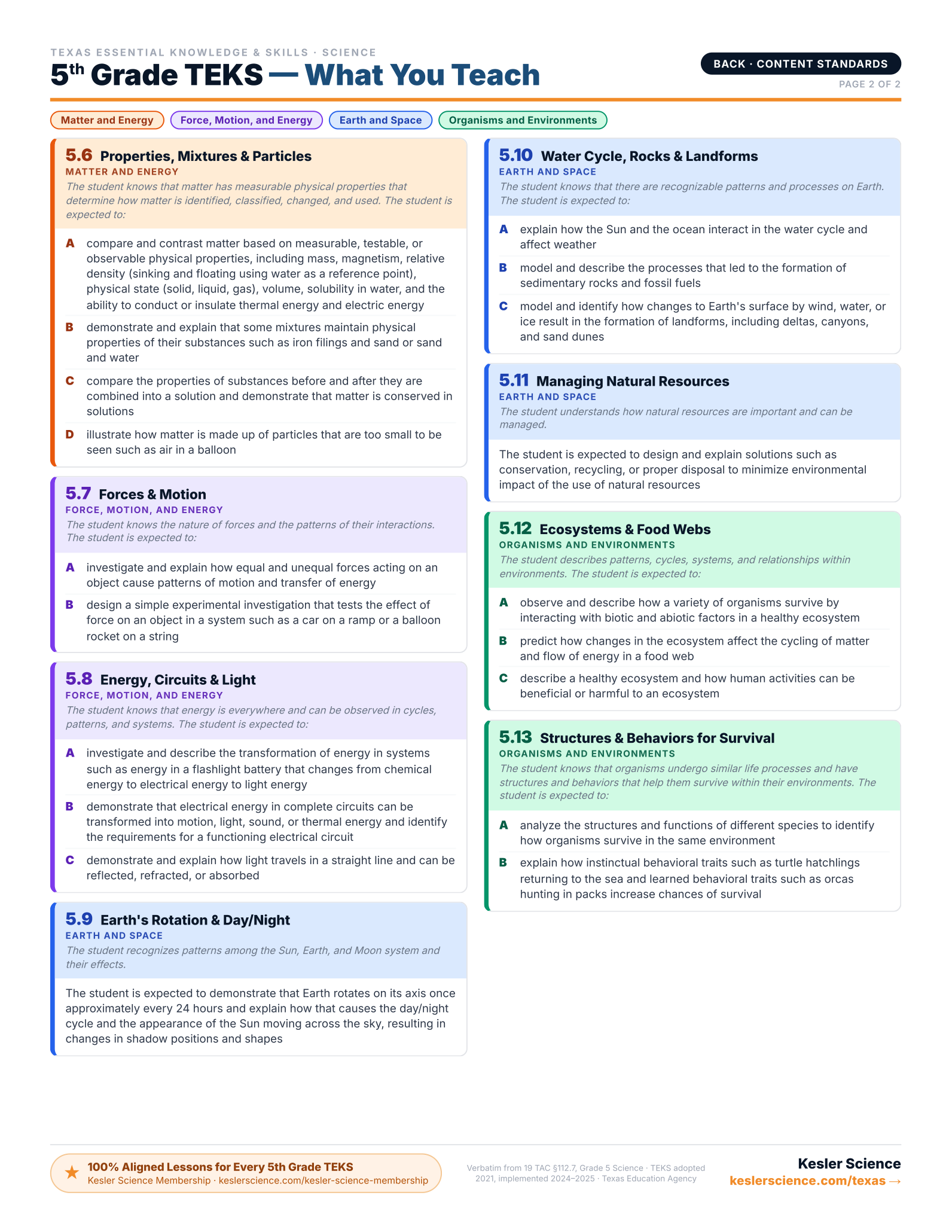
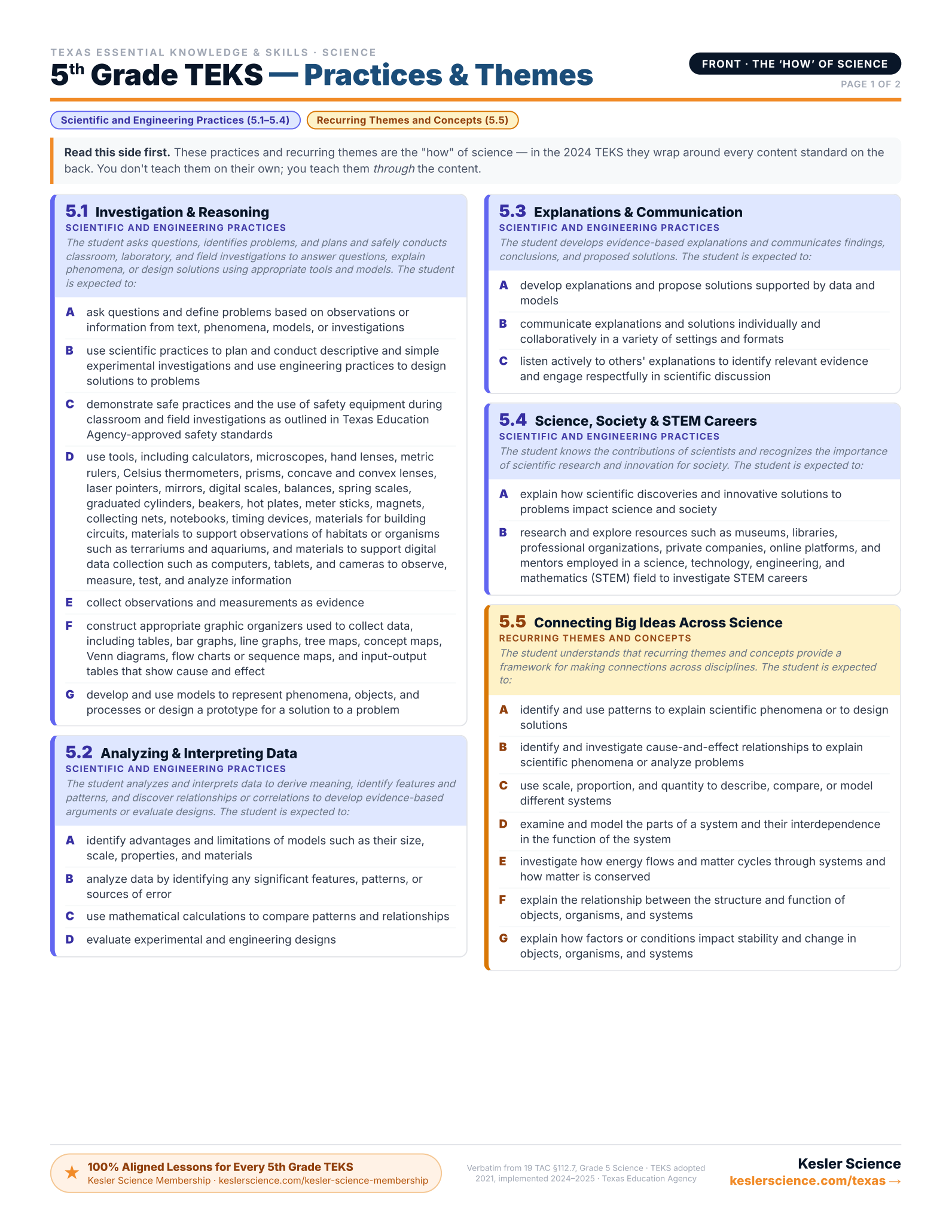
Every 5th-Grade Science TEKS on One Page
The color-coded, front-and-back cheat sheet I wish I'd had — every standard, organized by reporting category. Print it and reference it all year long. This will be your new favorite document!
Trusted Across Texas
From the Rio Grande Valley to the Panhandle, Texas science teachers are using Kesler Science to save time and engage students.
Texas Schools and Districts
Love Kesler Science

What Teachers Are Saying
Give Your Science Teachers Everything They Need
School and district licenses give your teachers access to every resource they need, including station labs, inquiry labs, anchoring phenomena, presentations, escape rooms, and much more. One purchase covers the grade levels you need.
- PO-friendly. We accept purchase orders
- Volume discounts for 11+ teachers
- Complimentary Kesler Science Plus orientation for 4+ teachers
- Three free implementation PD sessions for departments of 11+
- Aligned to the 2024 TEKS standards
See It in Action
Book a walkthrough and we'll show you how Kesler Science fits your campus.
Book Demo CallNo pressure, no hard sell