.png?width=375&height=100&name=WebPage%20logo%20with%20curves%202026%20(8).png)
Objects in the Solar System
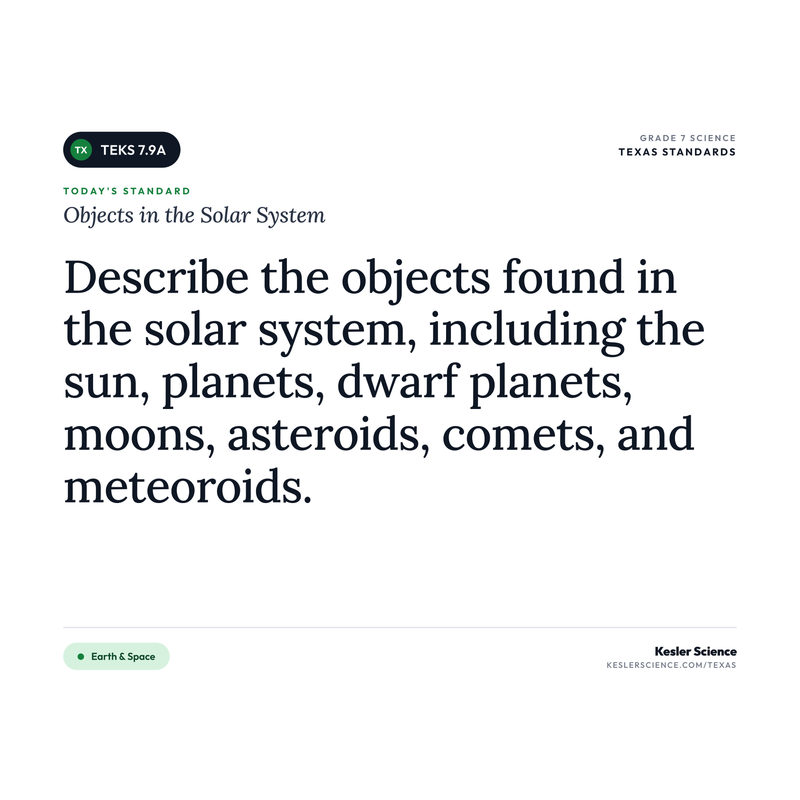
"Describe the physical properties, locations, and movements of the Sun, planets, moons, meteors, asteroids, comets, Kuiper belt, and Oort cloud."
💡 What This Standard Actually Means
"Describe". Students are describing the physical properties, locations, and movements of objects in our solar system. The TEKS lists exactly which objects to focus on: the Sun, planets, moons, meteors, asteroids, comets, the Kuiper belt, and the Oort cloud. The new additions to this standard are the Kuiper belt and Oort cloud, which weren't called out before. Kids need to know not just what these objects are but where they are and how they move. Instruction can take many forms, such as scaled solar system models, object-comparison research projects, orbit animation analysis, and Kuiper belt and Oort cloud reading activities.
Our solar system is held together by the Sun, a G-type main-sequence star (often called a yellow dwarf) that is actually larger than most stars in our galaxy and contains roughly 99.8 percent of all the mass in the system. The Sun gives off light and heat, and its gravity keeps everything else in orbit around it. The planets come next. The four inner ones (Mercury, Venus, Earth, Mars) are smaller, rocky, and closer to the Sun. The four outer ones (Jupiter, Saturn, Uranus, Neptune) are huge, made mostly of gas or ice, and live far from the Sun. Moons are natural satellites that orbit planets. Earth has one. Jupiter and Saturn each have dozens.
Asteroids are small rocky or metallic bodies, and most of them live in the asteroid belt between Mars and Jupiter. Comets are icy bodies that grow a glowing tail when they swing close enough to the Sun for their ice to vaporize. Meteors are the streaks of light we see when small space rocks (meteoroids) burn up in Earth's atmosphere. If a piece survives and hits the ground, it's a meteorite.
The new additions to the 2024 standard are the Kuiper belt and the Oort cloud. The Kuiper belt is a donut-shaped region beyond Neptune's orbit, packed with icy bodies and dwarf planets like Pluto. Most short-period comets come from there. The Oort cloud is a giant spherical shell of icy objects that surrounds the entire solar system at a much greater distance, far past the Kuiper belt. It's the source of long-period comets that take thousands of years to swing through the inner solar system. Students should walk away able to describe each object's properties (size, makeup, what makes it different), where it lives in the solar system, and how it moves relative to the Sun.
The move that worked for me on this one was handing each student a scrap of paper with the name of one solar system object and asking them to line up from "closest to the sun" to "farthest from the sun." Kids would argue. They'd check each other. Someone would realize the asteroid belt goes between Mars and Jupiter. Someone else would catch that Pluto isn't a full planet anymore. The physical line did the teaching for me. From there, I'd ask, "Which of these belong to the same category?" and we'd regroup into planets, dwarf planets, moons, asteroids, comets, and meteoroids. Way more sticky than a PowerPoint.
⚠️ Misconceptions Your Students May Have
These are some of the most common misconceptions. Knowing what to look for can help you get ahead of them.
"Pluto is a planet"
Pluto was reclassified as a dwarf planet in 2006 by the International Astronomical Union. The solar system has eight planets, not nine. Dwarf planets are their own category: they orbit the sun and are roughly round, but they haven't cleared other objects out of their orbital path. Pluto, Eris, Haumea, Makemake, and Ceres are the currently recognized dwarf planets.
"Asteroids, comets, and meteors are all basically the same thing"
Asteroids are rocky or metallic objects, mostly found in the asteroid belt between Mars and Jupiter. Comets are icy objects that grow a glowing tail when they pass close to the sun. Meteoroids are small rocks traveling through space. A "meteor" is the streak of light when a meteoroid burns up in the atmosphere. If a piece survives and hits the ground, it's called a meteorite. Different words for different things.
"The asteroid belt is packed full of rocks like in the movies"
The asteroid belt between Mars and Jupiter is extremely spread out. Spacecraft like Pioneer 10, Voyager, and Cassini have all passed through it without ever coming close to an asteroid. (Galileo actually did get close to two asteroids, Gaspra and Ida, on its way to Jupiter, but only because mission planners deliberately targeted them, which shows just how empty the rest of the belt really is.) The belt holds a lot of objects, but the space between them is enormous. Hollywood makes it look dense for dramatic effect, but real asteroids can be millions of miles apart.
"The planets are all about the same size and roughly evenly spaced from the sun"
Textbook diagrams shrink the solar system to fit a page, so students get a false sense of scale. In reality, Jupiter could hold more than 1,300 Earths inside it. Neptune is about 30 times farther from the sun than Earth is. If Earth were the size of a pea, Jupiter would be the size of a grapefruit and Neptune would be a football field away. Scale matters.
📓 Teaching Resources for 7.9A
These resources are aligned to this standard.


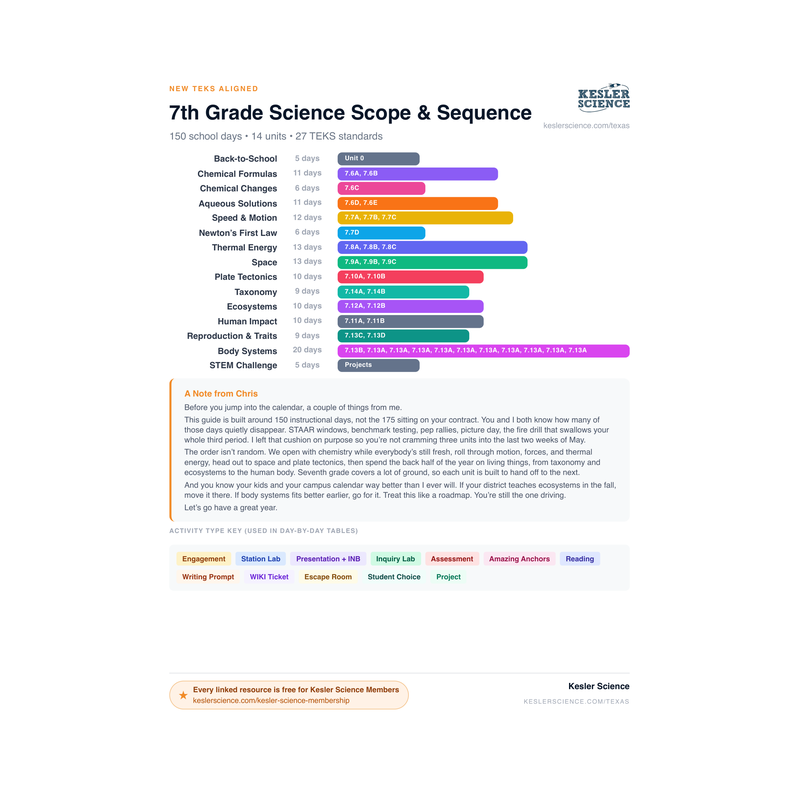
100% Aligned Lessons for Every TEKS You Teach
Kesler Science Plus puts thousands of ready-to-teach lessons and activities in your hands, so you can boost engagement and get your planning time back. Trusted by schools and districts all over the great state of Texas.
🌎 Phenomenon Ideas for 7.9A
Use these real-world phenomena to anchor your lesson. Show students the phenomenon first, let them wonder, then build toward Objects in the Solar System as the explanation.
A Comet's Glowing Tail
Show students a photo of a comet in the sky, like Comet NEOWISE from 2020 or Hale-Bopp from the 1990s. The comet has a bright nucleus and a long, streaking tail. Most of the time, that same comet has no tail at all. It's just a dark chunk of ice and dust floating far from the sun. So what makes the tail appear?
"A comet only grows a tail when it comes close to the sun. What does that tell you about what the comet is made of? Why don't asteroids grow tails?"
The Night a "Shooting Star" Streaks Across the Sky
You're outside on a clear night and you see a streak of light flash across the sky. People call it a shooting star, but it's not a star at all. It's a small piece of rock from space hitting our atmosphere. Most of these "shooting stars" are no bigger than a grain of sand.
"If that bright streak is just a grain of sand, how can it glow so brightly? And what's the difference between what we call a meteoroid, a meteor, and a meteorite?"
Pluto, the Kuiper Belt, and the Oort Cloud
Pluto was considered a planet from its discovery in 1930 until 2006. Then scientists reclassified it as a dwarf planet. What changed is that astronomers found something incredible out beyond Neptune: a wide ring of icy objects called the Kuiper belt, with Pluto sitting right inside it. Even further out, way past the Kuiper belt, is the Oort cloud, a huge spherical shell of frozen objects that's the source of most long-period comets. Pluto didn't shrink. The map of our solar system just got bigger.
"What's the difference between the Kuiper belt and the Oort cloud? Why does it matter that Pluto sits inside the Kuiper belt instead of orbiting the sun by itself like the eight planets do?"
💡 Free Engagement Ideas for 7.9A
Ready-to-run activities you can drop straight into a lesson. Where one of these looks like a phenomenon from the section above, that is on purpose: show it first as the hook, then let students run it themselves.
Toilet Paper Solar System
Unroll toilet paper or a long strip of adding-machine tape down a hallway. Using a scaled distance chart, have student teams place a label for each object at the correct distance from the sun. Kids immediately see how huge the gaps are, especially between Mars and Jupiter and between Neptune and the outer dwarf planets.
Solar System Object Sort
Prepare a deck of 25 to 30 cards, each with a clue on it (icy body with a tail, rocky object between Mars and Jupiter, has 95 known moons, orbits Earth, dwarf planet found beyond Neptune, the spherical shell where most comets come from, etc.). Students sort the cards into the eight categories called out in the TEKS: Sun, planets, moons, meteors, asteroids, comets, Kuiper belt, and Oort cloud. The Kuiper belt and Oort cloud cards usually spark the most discussion since they're the newest pieces students are learning. Trickier cards spark real debate, which is where the learning happens.
Scale Model With Kitchen Items
Compare planet sizes using grocery store items. Sun: a large watermelon. Jupiter: a softball. Saturn: a grapefruit. Uranus and Neptune: oranges. Earth: a pea. Mars: a small pea or chickpea. Mercury: a peppercorn. Students set them out in order and realize how unlike-scale most textbook images are.
Meteoroid, Meteor, Meteorite Demo
Wad up a small piece of paper and label it "meteoroid." Set a lamp or flashlight on a desk labeled "atmosphere." Pass the paper through the light beam (quickly) and call it a "meteor" during that moment. Land it on the desk and relabel it "meteorite." Three words, one object, one journey.
🎯 What Approaches, Meets, and Masters Thinking Look Like
Here is what student thinking at each level looks like on this one task, so you know what to look for and how to move a student up.
Three small space objects are described below. An asteroid out past Mars, a comet swinging close to the Sun, and a meteor seen as a streak of light in the night sky. Describe what each object is made of, where it is, and how it moves. Then explain how a comet and a meteor are different, even though both can look like a bright object in the sky.
- A clear description of the asteroid: rocky or metallic, and located mostly in the asteroid belt between Mars and Jupiter.
- A clear description of the comet: an icy object that grows a glowing tail when it gets close to the Sun, in a long orbit around the Sun.
- A clear description of the meteor: the streak of light made when a small space rock burns up in Earth's atmosphere.
- Each object connected to its location and movement, not just what it is made of.
- The comet vs. meteor difference explained using a real reason, not just "one is brighter."
- Correct vocabulary used in the right place (a meteor is the streak of light, not the rock itself).
- The understanding that these are three different kinds of objects, not the same thing with different names. That is the easiest place to slip.
The asteroid is a big rock floating in space near Mars. The comet is a rock with a tail flying through space. The meteor is also a rock flying through space. They are all basically space rocks that fly around, so a comet and a meteor are pretty much the same thing. A comet just has a tail and a meteor is moving faster.
The asteroid is a rocky, metal object. Most asteroids are in the asteroid belt between Mars and Jupiter, and they orbit the Sun. The comet is an icy object. When it gets close to the Sun, some of its ice turns to gas and it grows a glowing tail. It also orbits the Sun, but in a long path. The meteor is not really an object by itself. It is the streak of light you see when a small space rock burns up in Earth's atmosphere.
So a comet and a meteor are different. A comet is an icy object far out in space orbiting the Sun. A meteor is just the flash of light made when a tiny rock burns up in our sky.
The asteroid is a rocky or metallic object, and most asteroids orbit the Sun in the asteroid belt between Mars and Jupiter. The comet is an icy object in a long orbit around the Sun, and it grows a glowing tail when it gets close enough for the Sun's heat to turn some of its ice into gas. The meteor is different from both. It is not an object, it is the streak of light made when a small space rock hits Earth's atmosphere and burns up.
The real way to tell a comet and a meteor apart is to ask where the object is and what you are actually seeing. A comet is the object itself, far out in space, and the tail is gas and dust pushed away from it. A meteor is light made right here in Earth's atmosphere, not the rock itself. That is also how I know the word for the rock when it lands on the ground is a meteorite. Same rock, but a different word for where it is in its trip: a meteoroid in space, a meteor as a streak of light in the air, and a meteorite once it hits the ground.
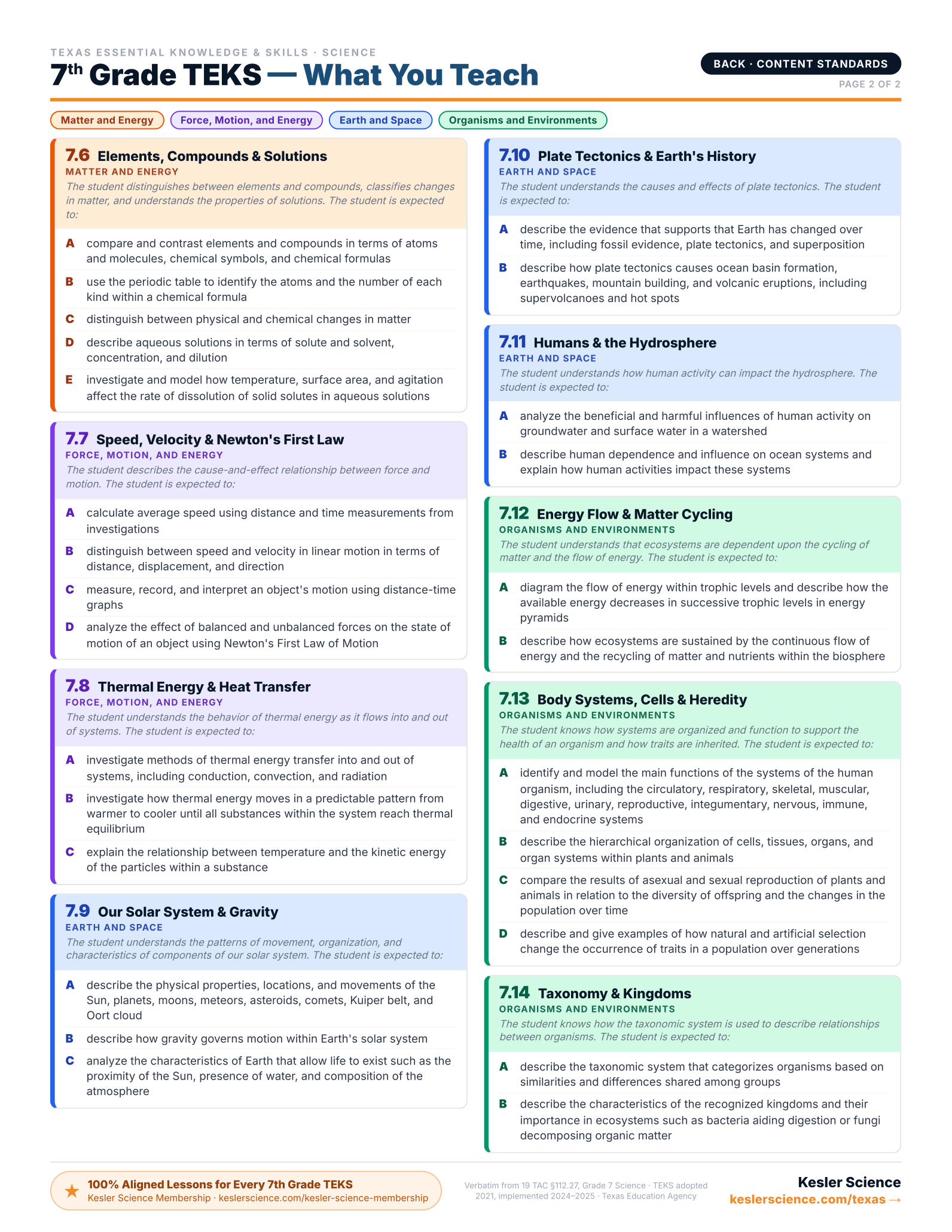
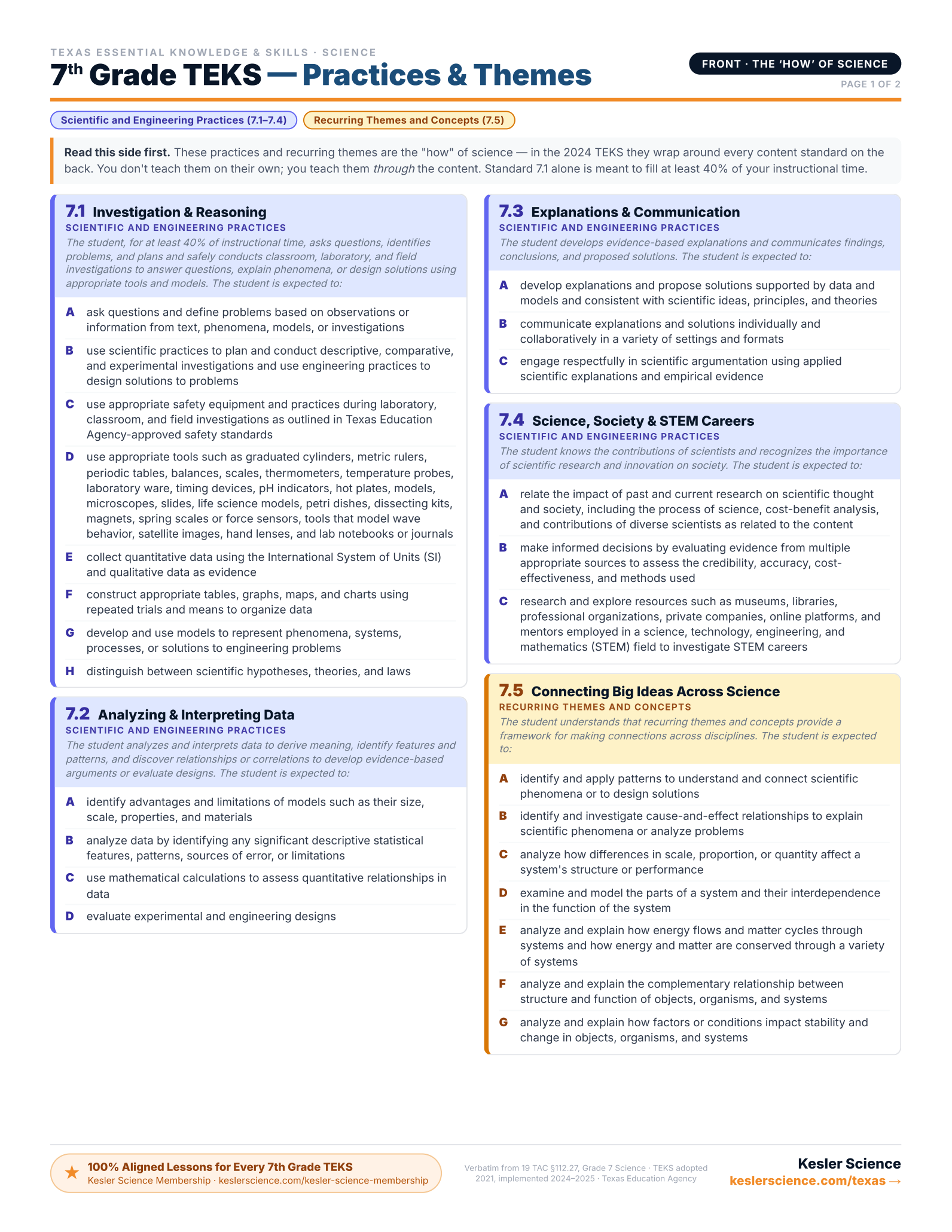
Every 7th-Grade Science TEKS on One Page
The color-coded, front-and-back cheat sheet I wish I'd had — every standard, organized by reporting category. Print it and reference it all year long. This will be your new favorite document!
Trusted Across Texas
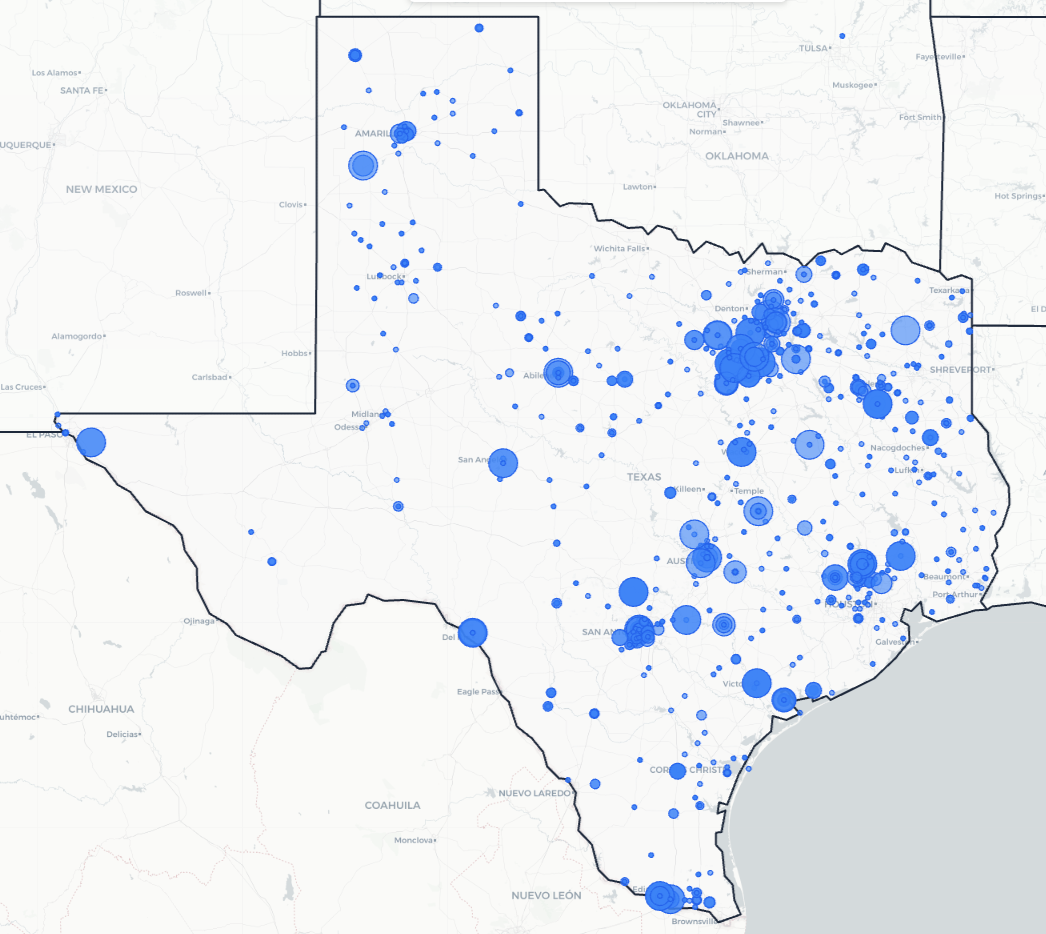
From the Rio Grande Valley to the Panhandle, Texas science teachers are using Kesler Science to save time and engage students.
Texas Schools and Districts
Love Kesler Science
What Teachers Are Saying
Give Your Science Teachers Everything They Need
School and district licenses give your teachers access to every resource they need, including station labs, inquiry labs, anchoring phenomena, presentations, escape rooms, and much more. One purchase covers the grade levels you need.
- PO-friendly. We accept purchase orders
- Volume discounts for 11+ teachers
- Complimentary Kesler Science Plus orientation for 4+ teachers
- Three free implementation PD sessions for departments of 11+
- Aligned to the 2024 TEKS standards
See It in Action
Book a walkthrough and we'll show you how Kesler Science fits your campus.
Book Demo CallNo pressure, no hard sell