.png?width=375&height=100&name=WebPage%20logo%20with%20curves%202026%20(8).png)
Rate of Dissolution
"Investigate and model how temperature, surface area, and agitation affect the rate of dissolution of solid solutes in aqueous solutions."
💡 What This Standard Actually Means
"Investigate and model". Students are investigating how three factors affect the rate of dissolution: temperature, surface area, and agitation. The standard now adds modeling to the verb list, so kids should also be able to draw or build a model that shows what's happening at the particle level when a solid dissolves. The setting is specifically aqueous solutions with solid solutes. Instruction can take many forms, such as hot-water-vs-cold-water dissolution races, sugar-cube-vs-powdered-sugar comparisons, stirring-vs-no-stirring stations, and particle model drawings of each variable.
The rate of dissolution is how fast a solute dissolves in a solvent. For a solid solute dissolving in water (an aqueous solution), three factors have the biggest effect on speed.
Temperature is the first. Warmer water has faster-moving particles. Those particles bump into the solid more often and harder, breaking pieces away faster. Most solids dissolve more quickly in hot water than in cold. Surface area is the second. Breaking a solid into smaller pieces exposes more of its surface to the water. Powdered sugar dissolves faster than a sugar cube because there's more surface area for water to attack at once. Crushing, grinding, or grating a solid speeds up the rate. Agitation is the third. Stirring or shaking moves the water around. That brings fresh, unsaturated solvent into contact with the solid and carries dissolved particles away from the surface so new ones can dissolve. Stir a cup of hot tea with a sugar cube and the cube disappears way faster than if you let it sit still.
The big idea students should walk away with is that all three factors change how fast the solute dissolves, not how much can dissolve. Every solution has a saturation point, the maximum amount of solute that water at a given temperature can hold. Past that point, extra solute just sits at the bottom no matter how much you stir or how long you wait. When students model this, they should be able to draw what's happening at the particle level: hot particles moving faster, more surface exposed, water carrying dissolved particles away.
I always opened this one with a simple challenge: "Who can dissolve a sugar cube fastest?" Give each group the same sugar cube and a cup of water, and tell them they can do anything except add more sugar or add more water. Kids crush it, they stir it, they use warm water, they use ice water on purpose to see what happens. Within 10 minutes the three factors are on the board because they tried them. It's the easiest way to get students owning the discovery instead of just reading the list out of a book.
⚠️ Misconceptions Your Students May Have
These are some of the most common misconceptions. Knowing what to look for can help you get ahead of them.
"Stirring makes more sugar dissolve in the water"
Stirring makes the sugar dissolve FASTER, not MORE. At a given temperature, water can only hold a certain amount of dissolved sugar before it's saturated. After that point, extra sugar just sits at the bottom of the cup no matter how much you stir. Stirring speeds up the process by bringing fresh water to the solid surface.
"A bigger chunk dissolves faster because there's more of it"
The opposite is true. A bigger chunk has less surface area compared to its total mass. Water can only touch the outside of the chunk, so there's a small area where dissolving can happen. Crushing the same piece into powder exposes far more surface for the water to work on, so it dissolves much faster.
"Hot water always dissolves more of every substance"
Hot water speeds up the dissolving of most solids like sugar and salt, and can hold more of them. But for gases dissolved in liquid (like carbon dioxide in soda), the opposite is true. Warm liquids actually hold LESS dissolved gas, which is why warm soda goes flat faster than cold soda.
"The sugar is still there as whole sugar grains, we just can't see them"
When sugar dissolves, the individual sugar molecules break away from the crystal and spread out between the water molecules. It's not that the sugar grains are floating around invisibly. They've been taken apart down to the molecular level. Particle diagrams help students see this.
📓 Teaching Resources for 7.6E
These resources are aligned to this standard.


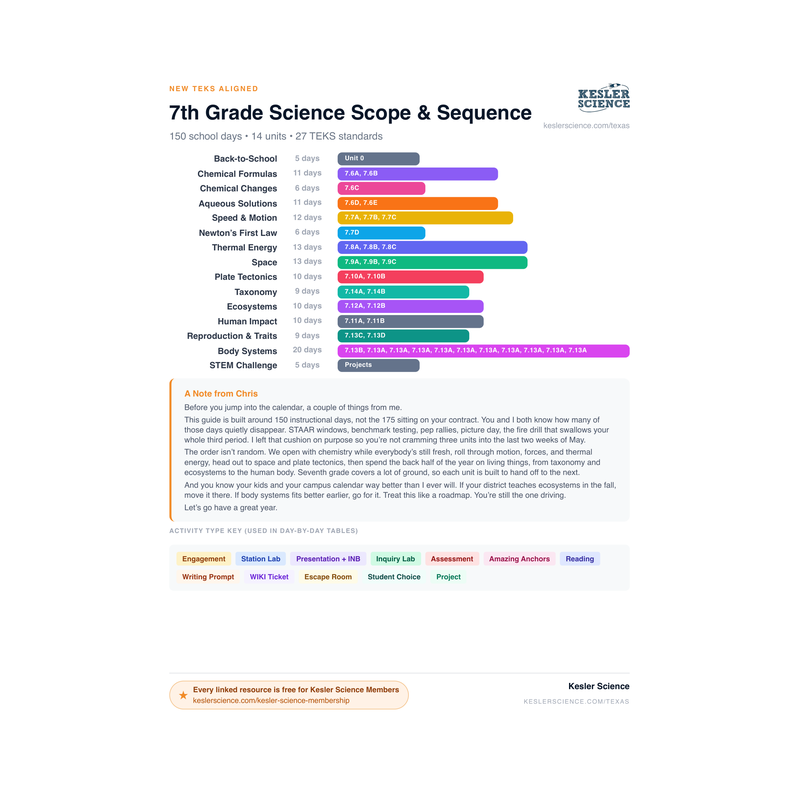
100% Aligned Lessons for Every TEKS You Teach
Kesler Science Plus puts thousands of ready-to-teach lessons and activities in your hands, so you can boost engagement and get your planning time back. Trusted by schools and districts all over the great state of Texas.
🌎 Phenomenon Ideas for 7.6E
Use these real-world phenomena to anchor your lesson. Show students the phenomenon first, let them wonder, then build toward Rate of Dissolution as the explanation.
Iced Tea vs. Hot Tea
Ever tried stirring a spoonful of sugar into iced tea? The sugar sits at the bottom forever, and the drink stays bitter unless you use a simple syrup. In hot tea, the same spoonful disappears in seconds. Both drinks are water-based. The only real difference is temperature.
"Why does sugar dissolve so much faster in hot tea than in iced tea? What is happening at the particle level that makes temperature matter?"
Chewable vs. Whole Vitamin Tablets
A whole vitamin tablet can take a while to break down in your stomach. Chewable or crushable versions start dissolving the moment they hit saliva. That's why a lot of children's medications are chewable. The smaller the pieces, the more of the tablet is exposed to the liquid, and the faster it dissolves.
"Why do crushed or chewed tablets dissolve faster than whole ones? How does the total surface area change when a solid is broken into smaller pieces?"
Lemonade Mix at a Pool Party
You dump a packet of powdered lemonade mix into a pitcher of cold water. At first, the powder just floats around and clumps up at the bottom. Grab a long spoon and stir vigorously for about a minute, and the color spreads evenly and the clumps disappear. No heat added, no crushing. The stirring alone makes the difference.
"What does stirring actually do at the particle level? Why would moving the water around help more powder dissolve?"
💡 Free Engagement Ideas for 7.6E
Ready-to-run activities you can drop straight into a lesson. Where one of these looks like a phenomenon from the section above, that is on purpose: show it first as the hook, then let students run it themselves.
Sugar Cube Race
Give each group four clear cups with the same amount of water at the same temperature. In cup 1, drop a whole sugar cube. In cup 2, drop a sugar cube and stir. In cup 3, crush a sugar cube into powder and add. In cup 4, crush it AND stir. Time how long the sugar takes to fully dissolve in each. Students see surface area and agitation at work side by side.
Temperature Showdown
Set up three cups: one with ice water, one with room-temperature water, one with hot tap water. Add the same amount of Kool-Aid mix or food coloring to each at the same time, without stirring. Students watch which one spreads fastest. A clear visual for how temperature changes the rate of dissolution.
Alka-Seltzer Surface Area Test
Give each group two Alka-Seltzer tablets and two cups of room-temperature water. Drop one whole tablet in cup A. Break the second tablet into as many tiny pieces as possible and drop them into cup B at the same time. Time how long each takes to fully dissolve. Crushed pieces finish much faster, and students can connect that to surface area.
Design Your Own Investigation
Give students salt, sugar, water, warm water, ice water, spoons, and cups. Ask them to design an investigation that changes only one variable at a time (temperature, surface area, OR stirring) and keeps everything else the same. They write a hypothesis, run the investigation, and report results. Great practice with controlled variables and supporting the TEKS process skills.
🎯 What Approaches, Meets, and Masters Thinking Look Like
Here is what student thinking at each level looks like on this one task, so you know what to look for and how to move a student up.
Two students each drop a spoonful of sugar into a glass of room-temperature water. One uses a whole sugar cube. The other crushes the same size cube into powder first. They do not stir either glass. Predict which sugar will finish dissolving first, then draw a particle model of each glass to explain why.
- A clear prediction that the powdered sugar dissolves faster.
- The word "dissolve" used to mean the sugar breaks apart and spreads out, not that it disappears.
- A particle model for each glass that shows individual sugar particles and water particles, not just a labeled glass.
- The powdered sugar drawn as many small pieces, so more of the sugar is touching water at once.
- The whole cube drawn as one block, so water can only reach the outside.
- An explanation that ties the speed to surface area: more surface touching water means faster dissolving.
- Speed (how fast) kept separate from amount (how much). Both glasses can dissolve the same total amount of sugar. The powder just gets there faster. That is the easiest place to slip.
I think the cube dissolves faster because it is one big piece, so there is more sugar in it. The powder is in tiny pieces so there is less sugar. The big chunk has more, so it goes faster.
The powder dissolves faster. When sugar dissolves, the water pulls the sugar particles off and they spread out in the water. Water can only touch the outside of the sugar. The cube is one big piece, so only the outside is touching water. The powder is broken into lots of little pieces, so way more sugar is touching water at the same time. That is more surface area, so it dissolves faster.
The powder dissolves faster. Dissolving only happens where water actually touches the solid, because that is where water particles pull the sugar particles off and carry them away. The cube is one block, so only the outside is touching water and the inside has to wait its turn. Breaking it into powder makes a lot more surface, so water is working on way more of the sugar at the same time.
But both glasses can still dissolve the same total amount of sugar in the end. Surface area only changes how fast it happens, not how much. That is the same reason crushed ice melts faster than one big ice cube in a drink. The crushed ice has more surface touching the warm liquid, so it melts quicker, even though it is the same amount of frozen water either way.
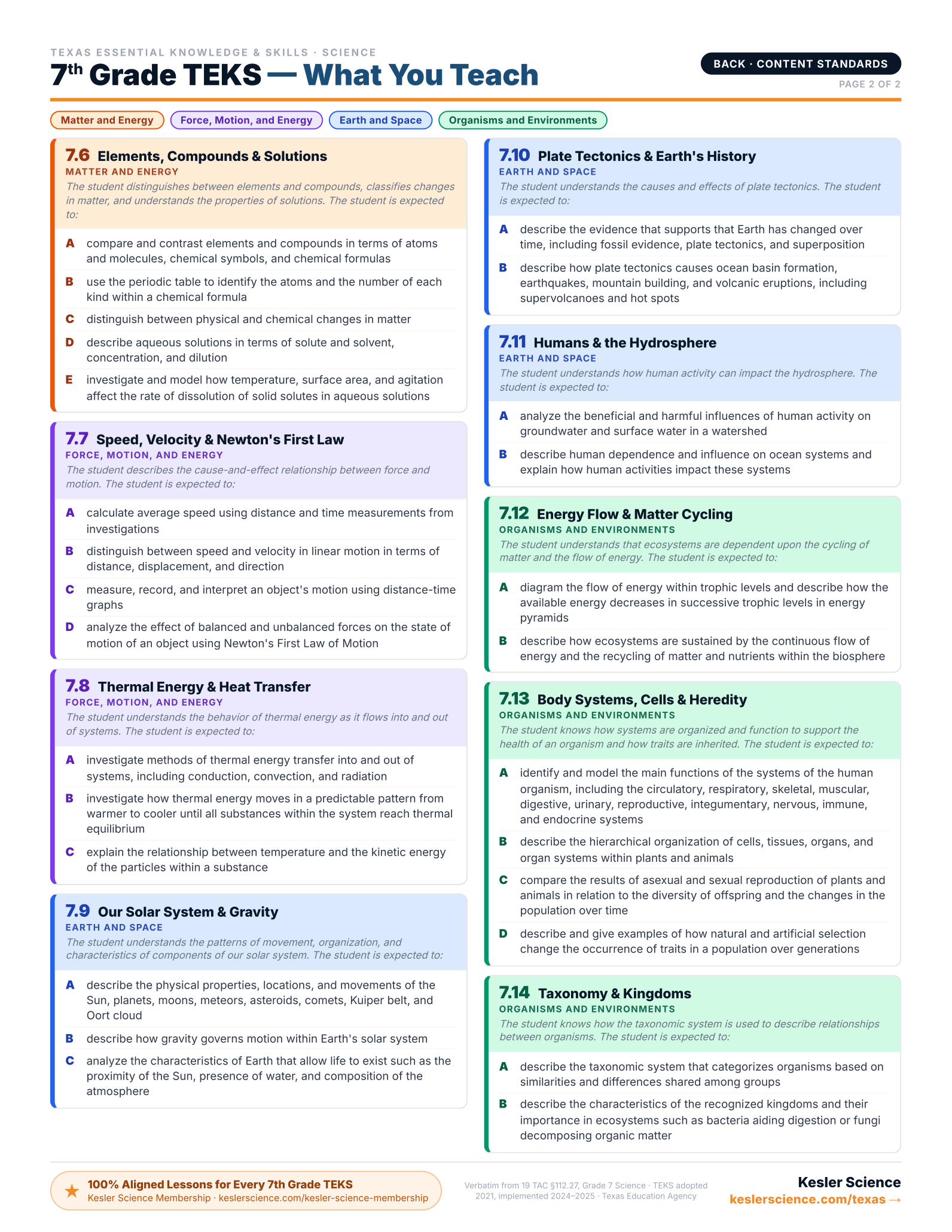
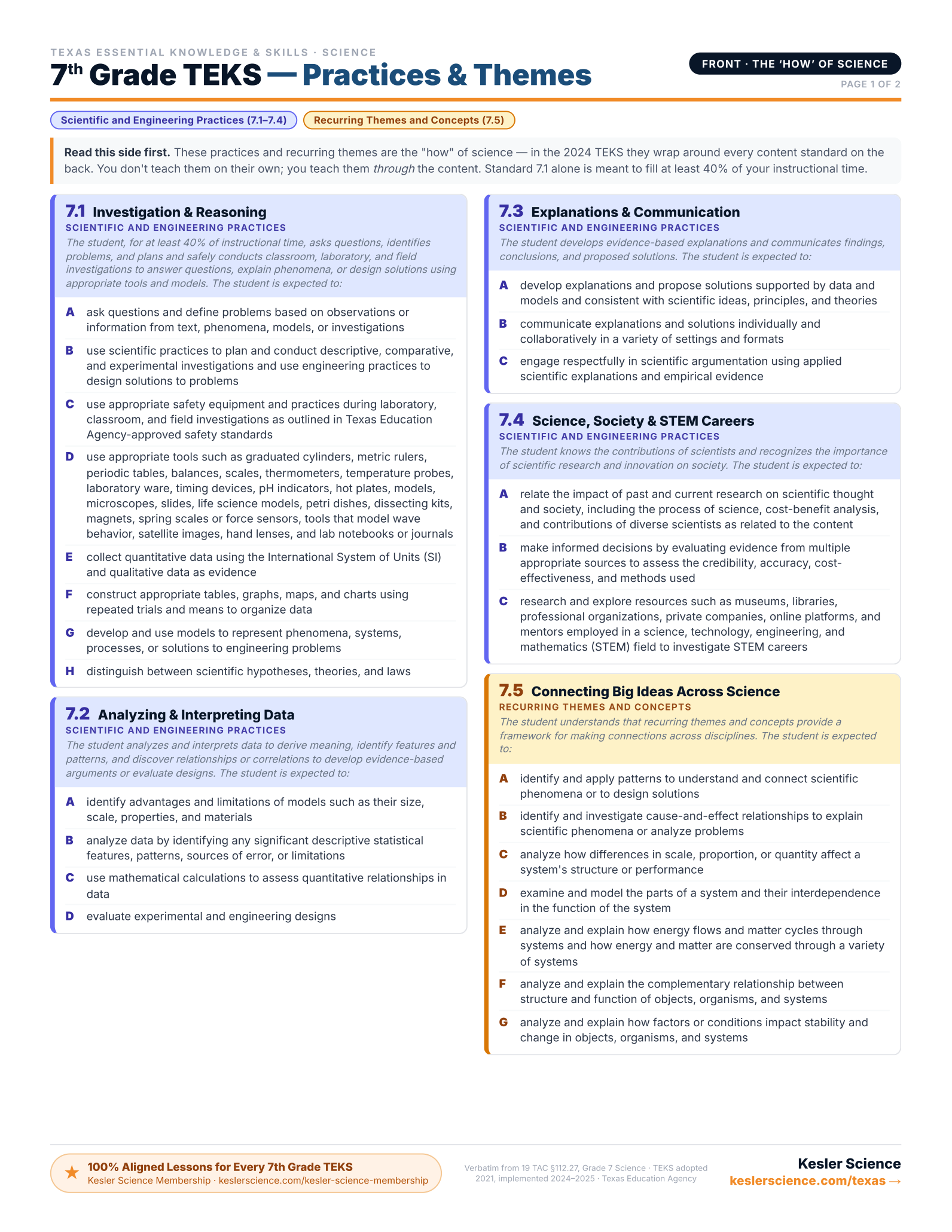
Every 7th-Grade Science TEKS on One Page
The color-coded, front-and-back cheat sheet I wish I'd had — every standard, organized by reporting category. Print it and reference it all year long. This will be your new favorite document!
Trusted Across Texas
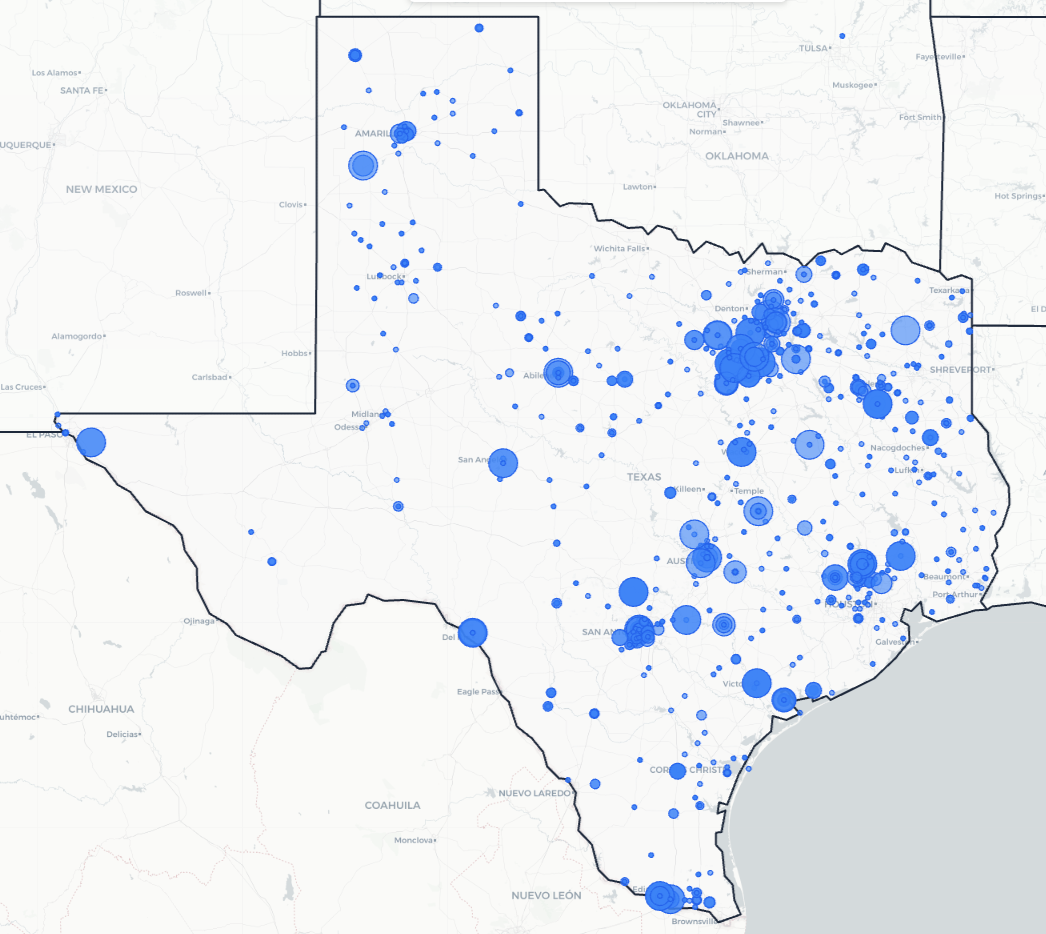
From the Rio Grande Valley to the Panhandle, Texas science teachers are using Kesler Science to save time and engage students.
Texas Schools and Districts
Love Kesler Science
What Teachers Are Saying
Give Your Science Teachers Everything They Need
School and district licenses give your teachers access to every resource they need, including station labs, inquiry labs, anchoring phenomena, presentations, escape rooms, and much more. One purchase covers the grade levels you need.
- PO-friendly. We accept purchase orders
- Volume discounts for 11+ teachers
- Complimentary Kesler Science Plus orientation for 4+ teachers
- Three free implementation PD sessions for departments of 11+
- Aligned to the 2024 TEKS standards
See It in Action
Book a walkthrough and we'll show you how Kesler Science fits your campus.
Book Demo CallNo pressure, no hard sell