.png?width=375&height=100&name=WebPage%20logo%20with%20curves%202026%20(8).png)
Newton's First Law of Motion
"Analyze the effect of balanced and unbalanced forces on the state of motion of an object using Newton’s First Law of Motion."
💡 What This Standard Actually Means
"Analyze". Students are analyzing how balanced and unbalanced forces affect the state of motion of an object using Newton's First Law of Motion. The new wording puts the focus on force balance: whether the forces on an object are balanced is what decides if its motion changes. Inertia is still part of the conceptual picture, but the verb-driven work is now about analyzing balanced vs unbalanced situations. Instruction can take many forms, such as tablecloth-pull demonstrations, coin-and-card investigations, free-body diagrams, and balanced-vs-unbalanced scenario sorting.
Newton's First Law states that an object at rest stays at rest, and an object in motion stays in motion at constant velocity, unless acted on by an unbalanced force. Objects don't change their state of motion on their own. Something has to push or pull them with a net force to make them speed up, slow down, change direction, or start or stop moving.
The shift in this standard is the focus on balanced vs. unbalanced forces and what they do to an object's state of motion. When the forces on an object are balanced (the net force is zero), the object's state of motion doesn't change. A book sitting on a desk has gravity pulling it down and the desk pushing it up with equal strength. The forces are balanced, so the book stays still. A car cruising at a steady speed in a straight line also has balanced forces. The push from the engine equals the resistance from friction and air, so the speed and direction stay the same. Balanced forces don't always mean no motion. They mean no change in motion.
When the forces on an object are unbalanced (the net force is not zero), the state of motion changes. The object speeds up, slows down, or changes direction. A ball at rest gets kicked. A car hits the brakes. A puck on ice eventually slows because friction is unbalanced against it. The deeper concept underneath is inertia, the tendency of every object with mass to resist changes to its state of motion. The more mass an object has, the more inertia it has, and the bigger the unbalanced force needed to change what it's doing. The big idea students should walk away with is that balanced forces preserve motion. Unbalanced forces change it.
Newton's First Law made a lot more sense to my students once we ran the "unstoppable cart" demo. I'd give a group a skateboard with a heavy box on it, have them push it across the classroom floor, and watch it finally slow to a stop. Then I'd ask them, "Why did the cart stop? Did it just decide to?" Once they named friction as the unbalanced force, the whole law clicked. From there, inertia became easier because students already understood that the cart wanted to keep going. Inertia was just the name for the "wanting to keep going" part. Then I'd swap the heavy box for a lighter one and ask what changed. That's where mass and inertia connected for them.
⚠️ Misconceptions Your Students May Have
These are some of the most common misconceptions. Knowing what to look for can help you get ahead of them.
"Inertia is a force that keeps things moving"
This is the most common mix-up in the whole standard. Inertia is not a force. It's a property of matter, specifically, the resistance an object has to changes in its motion. Every object with mass has it, whether it's moving or sitting still. Forces push and pull. Inertia just describes how hard it is to change the motion that's already happening.
"Moving things eventually stop on their own"
Students see skateboards roll to a stop and conclude that motion naturally runs out. Newton's First Law says the opposite. Objects keep moving at the same velocity until an unbalanced force stops them. Here on Earth, that force is usually friction or air resistance. In outer space, where there's almost no friction or air, objects can travel at the same speed for incredibly long distances before anything slows them down.
"Heavier objects have more force"
Mass and force are not the same thing. A heavier object has more inertia, which means more resistance to changes in motion. It takes more force to start it moving, stop it, or change its direction. The object itself isn't "holding" any extra force. Mass is a measure of how much matter is in an object. Force is a push or pull applied to it.
"If forces are acting on an object, the object has to be moving"
An object can have plenty of forces acting on it and still be sitting completely still. A book on your desk has gravity pulling it down and the desk pushing it up. The forces are equal and opposite, so they cancel out. We call that balanced. The book doesn't move because the forces balance, not because no forces are present. Motion only changes when forces become unbalanced and one direction "wins."
📓 Teaching Resources for 7.7D
These resources are aligned to this standard.


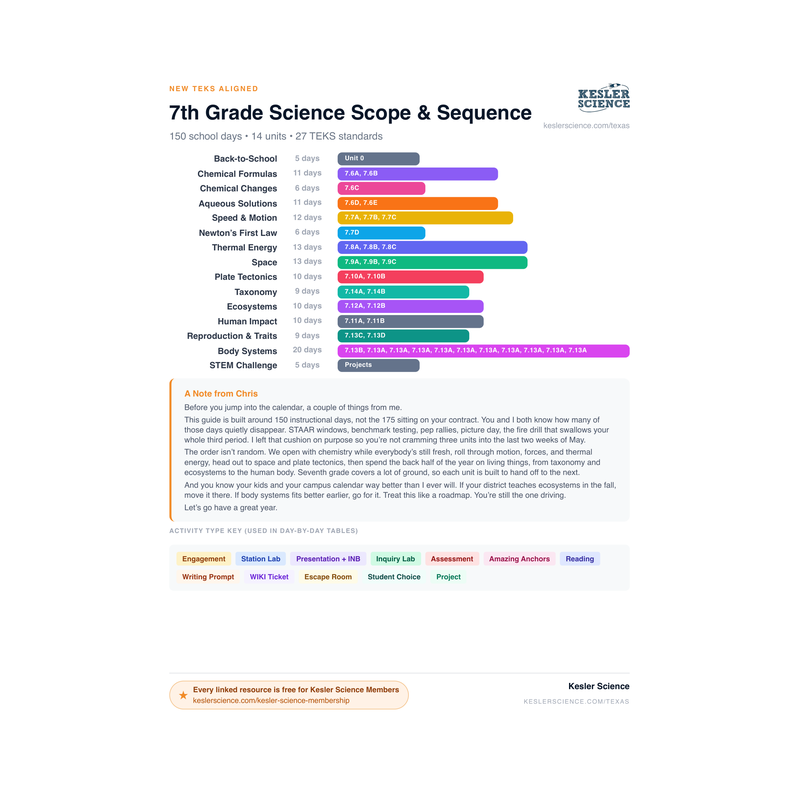
100% Aligned Lessons for Every TEKS You Teach
Kesler Science Plus puts thousands of ready-to-teach lessons and activities in your hands, so you can boost engagement and get your planning time back. Trusted by schools and districts all over the great state of Texas.
🌎 Phenomenon Ideas for 7.7D
Use these real-world phenomena to anchor your lesson. Show students the phenomenon first, let them wonder, then build toward Newton's First Law of Motion as the explanation.
The Seatbelt Snap in a Sudden Stop
A car is driving down the road at 40 mph. The driver slams on the brakes. The car stops quickly, but the people inside feel themselves jerk forward, and anything loose on the dashboard slides toward the windshield. The seatbelt catches the driver and the passenger before they keep going. The brakes stopped the car. What stopped the people?
"Why do passengers keep moving forward even after the car stops? What does this tell us about inertia and why seatbelts are designed the way they are?"
The Voyager Probes Still Flying Today
NASA launched Voyager 1 and Voyager 2 in 1977. They passed Jupiter and Saturn in the early 1980s. Nearly 50 years later, both probes are still flying through space, and both are now in interstellar space beyond the edge of our solar system. Their thrusters haven't been pushing them forward the whole time. They've mostly been coasting. For decades.
"Why don't the Voyager probes slow down and stop out in space, the way a car or a skateboard does here on Earth? What makes space such a different environment for studying Newton's First Law?"
The Tablecloth Trick
A magician sets a full table with plates, glasses, and silverware on top of a tablecloth. With one quick pull, the tablecloth flies out from underneath, but everything on the table stays in place. The dishes barely move. It looks like magic, but it's really Newton's First Law doing its job. The dishes had inertia, so they resisted the quick change in motion.
"Why do the dishes stay in place when the tablecloth gets yanked out? Would this trick work better with heavier dishes or lighter ones? Why?"
💡 Free Engagement Ideas for 7.7D
Ready-to-run activities you can drop straight into a lesson. Where one of these looks like a phenomenon from the section above, that is on purpose: show it first as the hook, then let students run it themselves.
Penny and Index Card Drop
Balance an index card on top of a cup. Place a penny on top of the card, directly over the cup's opening. Flick the card sideways fast. The card flies off, but the penny drops straight into the cup. Students see inertia in action: the penny didn't move sideways because no unbalanced force acted on it horizontally, so it just fell down when the card was out of the way.
Egg-in-the-Cup Inertia Demo
Set a cup of water on the desk. Place a flat piece of cardboard (like from a cereal box) across the top. Put a cardboard tube (toilet paper or paper towel roll) on the cardboard, directly over the cup. Balance a plastic egg on top of the tube (fill the egg with rice, coins, or water and tape it shut so it has enough mass to drop straight down; a hollow plastic egg is usually too light to work). Quickly flick the cardboard sideways. The tube flies off and the egg drops into the water. Works the same way as the tablecloth trick. Very memorable. Works best with plastic eggs for classroom safety.
Mass and Inertia Race
Line up three shoeboxes. Fill one with something light (paper), one with something medium (a few books), and one with something heavy (a brick or phonebook). Students push each box the same way and see which one takes more force to start moving, stop, or change direction. Perfect for connecting mass and inertia in a hands-on way.
Skateboard or Rolling Chair Demo
Have a student sit on a skateboard or rolling chair holding a bag of books. Give them a gentle push. While they're rolling, have them toss the bag off to the side (toward a safe target). They'll notice their own motion change the moment they throw the bag. Show how an unbalanced force (the throw) changed the system's motion. Great partner discussion piece on how outside forces interact with inertia.
🎯 What Approaches, Meets, and Masters Thinking Look Like
Here is what student thinking at each level looks like on this one task, so you know what to look for and how to move a student up.
A hockey puck is sliding across smooth ice at a steady speed in a straight line. Slowly, it starts to slow down and finally stops. Use Newton's First Law to explain whether the forces on the puck are balanced or unbalanced while it is slowing down, and explain what is making it stop.
- A clear statement that the forces on the puck become unbalanced while it is slowing down.
- Names the force that slows the puck: friction between the puck and the ice (and a little air resistance).
- Connects "slowing down" to a change in the state of motion, which only an unbalanced force can cause.
- Uses Newton's First Law correctly: an object in motion stays in motion unless an unbalanced force acts on it.
- Does not claim the puck stops on its own or that motion just "runs out."
- Explains that while the puck slid at a steady speed, the forces were balanced, and the change only happened when friction made them unbalanced.
- The trickiest part: realizing the puck would keep going if there were no friction. Stopping is caused by a force, not by the motion wearing off.
The puck slows down and stops because moving things always slow down and stop after a while. It runs out of the speed it had. The puck was moving fast but the motion wears off, so it does not need a force to stop. That is just what happens when something slides.
While the puck slowed down, the forces on it were unbalanced. Newton's First Law says an object in motion stays in motion unless an unbalanced force acts on it. The force slowing the puck is friction between the puck and the ice, plus a little air resistance. Those forces push against the puck's motion, so they are not balanced. That unbalanced force changes the puck's state of motion and makes it stop. It does not stop on its own.
While the puck slid at a steady speed in a straight line, the forces were balanced, so its state of motion did not change. When it slowed down, the forces became unbalanced. Friction with the ice, plus a little air resistance, pushed against the motion. That net force is what changed the puck's motion and stopped it. The puck never stops on its own. A force has to act on it.
The real idea is that balanced forces keep motion the same and unbalanced forces change it. That is how I know what would happen in a curling rink that is waxed super smooth: the puck would slide much farther before stopping, because there is less friction, so the unbalanced force is smaller. And on a long space probe with almost no friction or air, the same kind of object would just keep moving at the same speed for a very long time, because nothing is left to unbalance the forces.
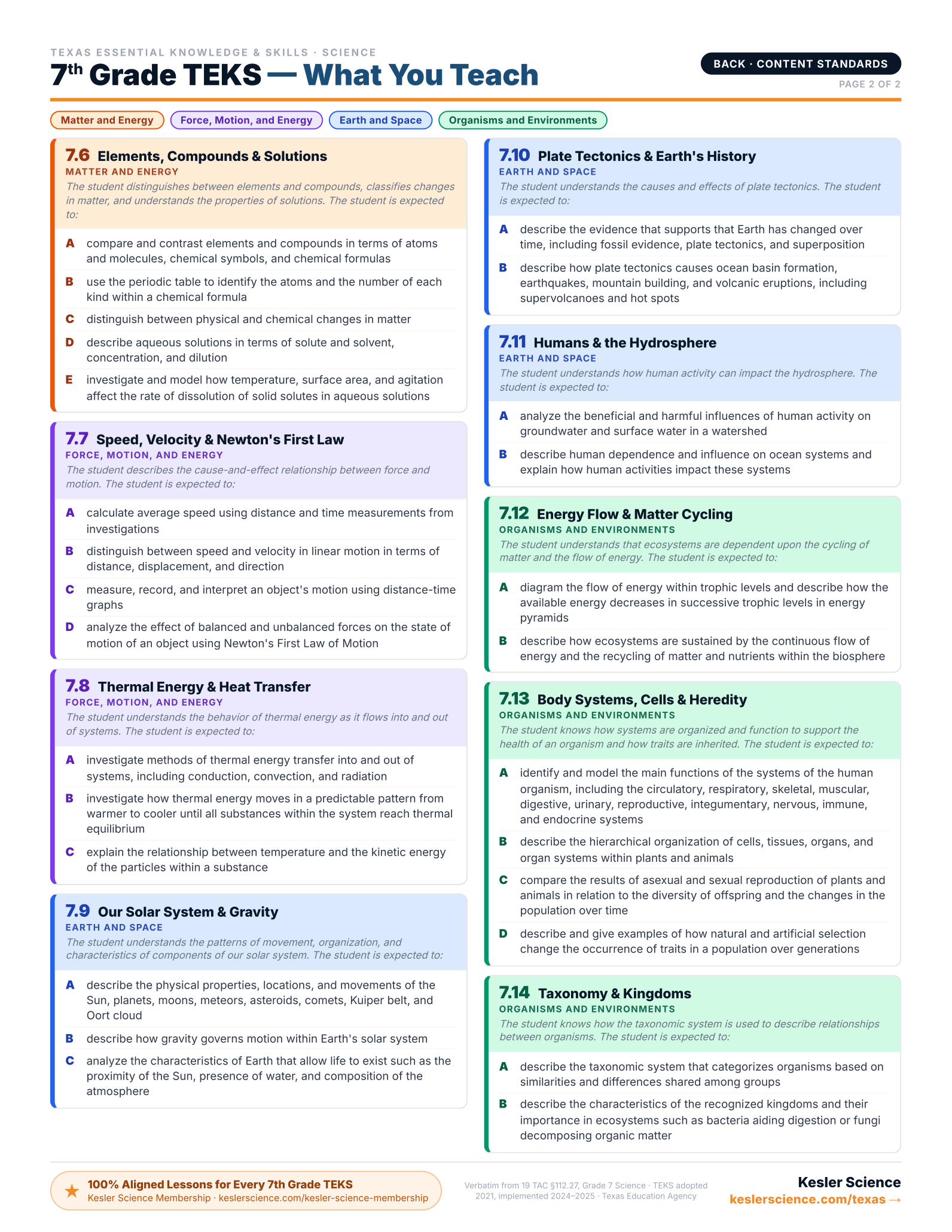
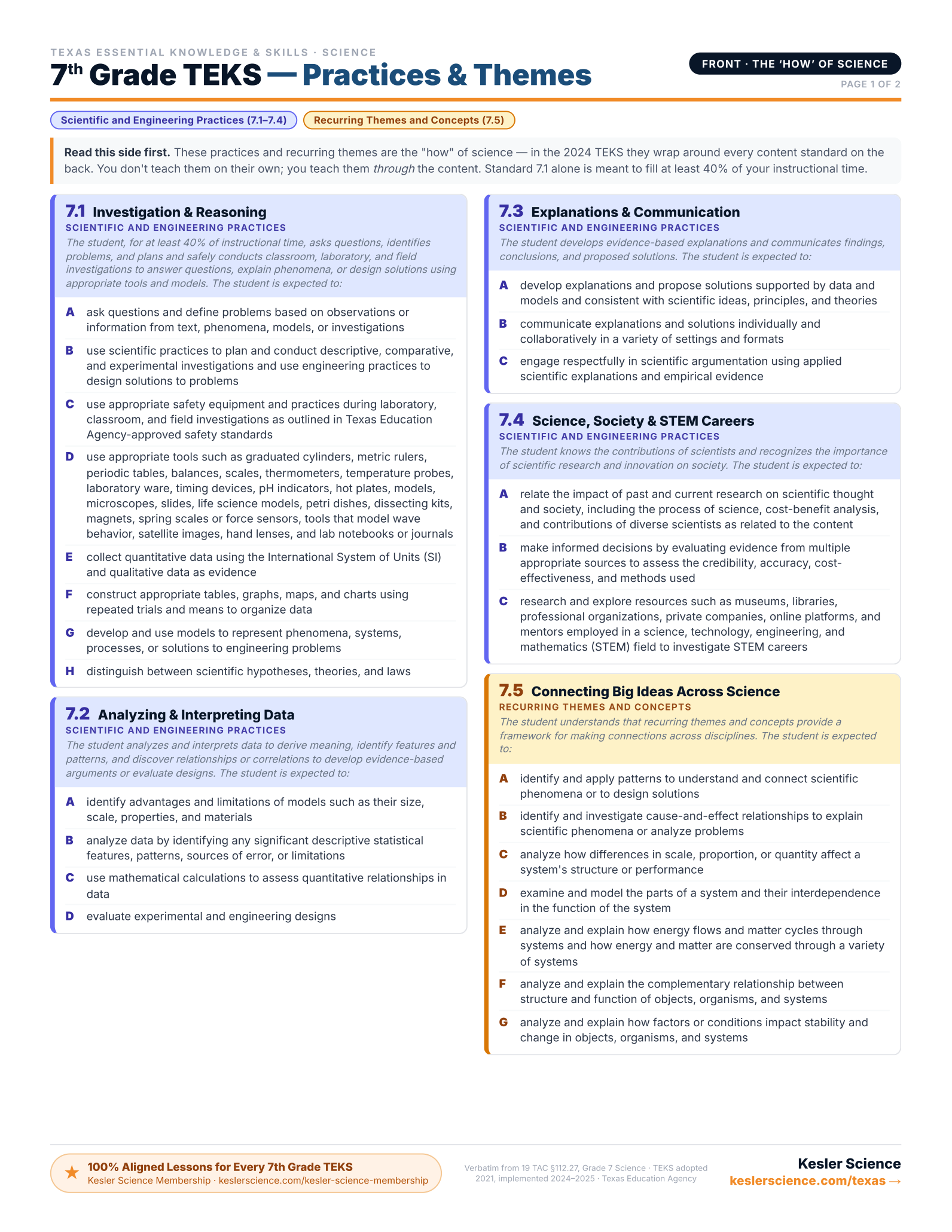
Every 7th-Grade Science TEKS on One Page
The color-coded, front-and-back cheat sheet I wish I'd had — every standard, organized by reporting category. Print it and reference it all year long. This will be your new favorite document!
Trusted Across Texas
From the Rio Grande Valley to the Panhandle, Texas science teachers are using Kesler Science to save time and engage students.
Texas Schools and Districts
Love Kesler Science

What Teachers Are Saying
Give Your Science Teachers Everything They Need
School and district licenses give your teachers access to every resource they need, including station labs, inquiry labs, anchoring phenomena, presentations, escape rooms, and much more. One purchase covers the grade levels you need.
- PO-friendly. We accept purchase orders
- Volume discounts for 11+ teachers
- Complimentary Kesler Science Plus orientation for 4+ teachers
- Three free implementation PD sessions for departments of 11+
- Aligned to the 2024 TEKS standards

See It in Action
Book a walkthrough and we'll show you how Kesler Science fits your campus.
Book Demo CallNo pressure, no hard sell