.png?width=375&height=100&name=WebPage%20logo%20with%20curves%202026%20(8).png)
Characteristics of Kingdoms
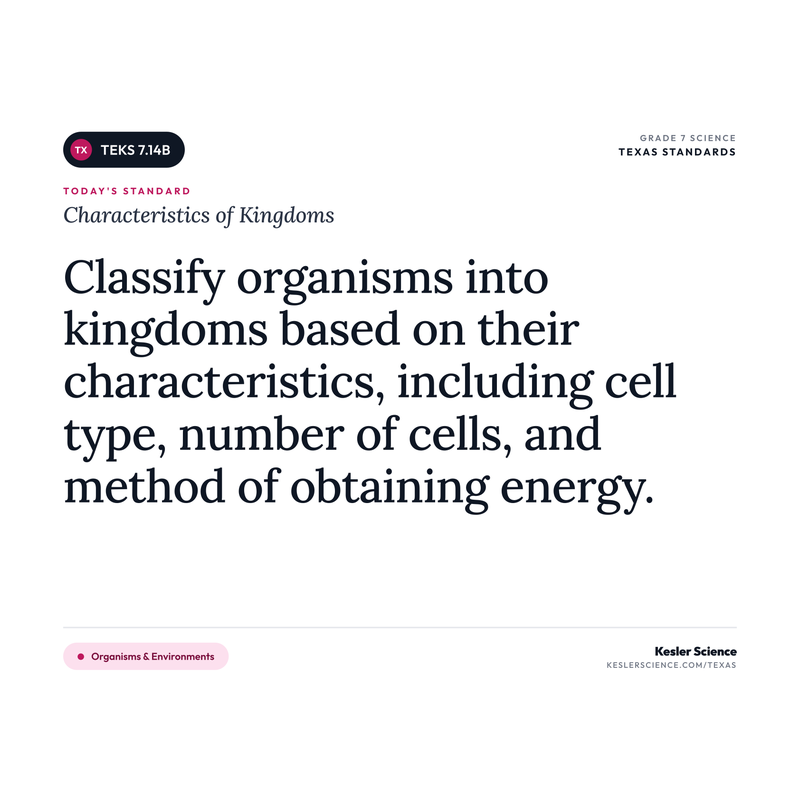
"Describe the characteristics of the recognized kingdoms and their importance in ecosystems such as bacteria aiding digestion or fungi decomposing organic matter."
💡 What This Standard Actually Means
"Describe". Students are describing the characteristics of the recognized kingdoms and their importance in ecosystems. The new wording adds an ecosystem-importance angle that wasn't in the old version, which was focused on classification by cell type, number of cells, and energy method. The TEKS gives examples to anchor the importance piece: bacteria aiding digestion and fungi decomposing organic matter. Instruction can take many forms, such as kingdom-traits comparison charts, ecosystem-role research projects, decomposer field observations, and short writing tasks tying each kingdom to a real ecological role.
A kingdom is one of the broadest groups in the classification of living things. Most middle school curricula teach six kingdoms: Animalia, Plantae, Fungi, Protista, Archaebacteria (Archaea), and Eubacteria (Bacteria). Each kingdom has a specific set of characteristics that students need to be able to describe.
The basic features come down to three big questions. Are the cells prokaryotic (no nucleus, simpler) or eukaryotic (nucleus, more complex)? Is the organism unicellular or multicellular? How does the organism get its energy? Animals are eukaryotic, multicellular, and ingest other organisms. Plants are eukaryotic, multicellular, and make their own food through photosynthesis. Fungi are eukaryotic, can be single-celled (like yeasts) or multicellular (like mushrooms), and absorb nutrients from dead or living matter. Protists are eukaryotic, mostly unicellular, and use a mix of feeding strategies. Archaea and Bacteria are both prokaryotic, mostly unicellular, and use a wide range of energy sources, including photosynthesis, chemical reactions, and absorbing nutrients from other organisms or their environment.
The newer focus in this 2024 standard is the importance of each kingdom in ecosystems. Bacteria break down organic matter, fix nitrogen in soil, and live in animal guts where they help digest food and produce vitamins. Fungi decompose dead plants and animals, returning nutrients to the soil so producers can use them again. Without fungi, leaves and dead organisms would pile up forever and ecosystems would stall. Plants are the producers that capture solar energy and feed almost every food web on Earth. Animals are consumers that move energy through ecosystems and help with seed dispersal and pollination. Protists include marine algae such as diatoms, which along with photosynthetic bacteria called cyanobacteria produce roughly half of Earth's oxygen. Students should walk away able to describe each kingdom's defining characteristics and explain at least one critical role each one plays in keeping ecosystems running.
The trick I kept coming back to was a three-question flowchart. "Does it have a nucleus? Yes or no." If no, it's Bacteria or Archaea. If yes, ask "Is it made of one cell or many?" If one, usually Protista. If many, ask "How does it eat?" Makes its own food = Plantae. Absorbs = Fungi. Eats other organisms = Animalia. Students who could run through that flowchart in their heads could classify almost any organism I threw at them. I had it posted on the wall for the whole unit and referenced it every lesson.
⚠️ Misconceptions Your Students May Have
These are some of the most common misconceptions. Knowing what to look for can help you get ahead of them.
"Mushrooms and other fungi are plants"
Fungi grow out of the ground like plants and often look leafy or stalk-like, so students assume they belong in the plant kingdom. They do not. Fungi do not photosynthesize, they do not have chlorophyll, and their cell walls are made of chitin (not cellulose like plants). Fungi have their own kingdom and are actually more closely related to animals than to plants in the eukaryote tree (both fungi and animals belong to a group called the Opisthokonta).
"All bacteria are harmful germs"
Bacteria get a bad reputation from disease-causing species, but the vast majority are helpful or neutral. Bacteria in the human gut help digest food. Bacteria in soil cycle nitrogen that plants need. Bacteria in yogurt, cheese, and sourdough are part of how those foods are made. Frame bacteria as a diverse kingdom where a small percentage cause disease and most do useful work.
"Plants are the only kingdom that really matters in an ecosystem"
Plants get the spotlight because they're the producers, but every kingdom is doing essential work. Bacteria fix nitrogen in the soil and help animals digest food. Fungi break down dead trees and recycle nutrients back into the soil so plants can grow. Protists like algae produce a huge chunk of the oxygen in our atmosphere. Animals spread seeds, pollinate flowers, and move energy up the food chain. Pull any one kingdom out and the ecosystem stalls.
"Decomposers are gross and don't really matter"
Decomposers, mostly fungi and bacteria, are quietly running the most important recycling system on Earth. When a leaf falls or an animal dies, decomposers break it down and return the nutrients to the soil where plants can use them again. Without that work, dead matter would pile up forever and producers would run out of the raw materials they need. Decomposers aren't a side note. They're the reason ecosystems can keep going.
📓 Teaching Resources for 7.14B
These resources are aligned to this standard.


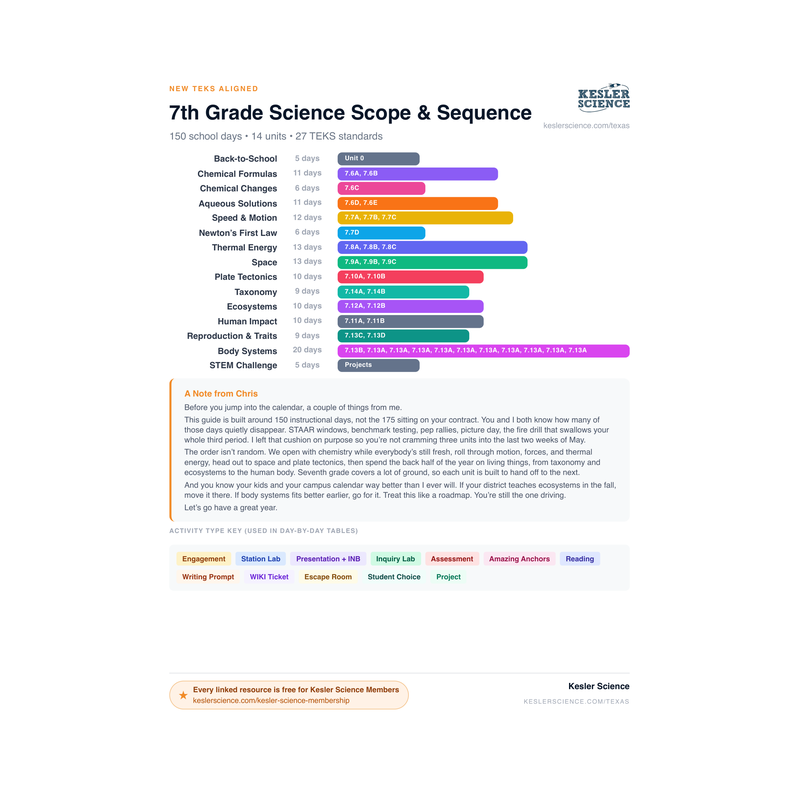
100% Aligned Lessons for Every TEKS You Teach
Kesler Science Plus puts thousands of ready-to-teach lessons and activities in your hands, so you can boost engagement and get your planning time back. Trusted by schools and districts all over the great state of Texas.
🌎 Phenomenon Ideas for 7.14B
Use these real-world phenomena to anchor your lesson. Show students the phenomenon first, let them wonder, then build toward Characteristics of Kingdoms as the explanation.
A Mushroom Grows on a Rotting Log Overnight
A fallen log sits in the forest. In the morning, a cluster of mushrooms appears along its side. They look almost like small plants, sprouting up from the wood. But these mushrooms are not plants. They are fungi, and they are breaking down the log to feed themselves by absorbing nutrients.
"Why would scientists put fungi in a separate kingdom from plants if they often grow in similar places? What's different about how a mushroom gets its energy compared to a plant?"
The Bacteria Living in Your Gut
Right now, trillions of bacteria are living inside your digestive tract, especially in your large intestine. They aren't making you sick. They're helping you digest food you couldn't break down on your own, like the fiber in fruits and vegetables. They produce vitamins your body needs. They train your immune system. Doctors are realizing more every year that gut bacteria affect everything from digestion to mood. You and your bacteria are basically partners.
"Most people think of bacteria as germs. So why does the human body let trillions of them live inside it on purpose? What does this tell us about how the bacteria kingdom helps the rest of an ecosystem?"
Half the Air You Breathe Comes From the Ocean
Most students grow up hearing that trees produce the world's oxygen. The trees do help, but a huge share of our planet's oxygen comes from microscopic photosynthetic organisms called phytoplankton drifting in the ocean. Phytoplankton include both single-celled protists (like diatoms) and tiny bacteria called cyanobacteria. Together they produce roughly 50 percent of all the oxygen on Earth. Every other breath you take came from two kingdoms most students barely think about.
"If half the oxygen on Earth comes from microscopic protists in the ocean, what would happen to ecosystems if those tiny organisms started disappearing? Why is it important to recognize the role of every kingdom, not just the big ones?"
💡 Free Engagement Ideas for 7.14B
Ready-to-run activities you can drop straight into a lesson. Where one of these looks like a phenomenon from the section above, that is on purpose: show it first as the hook, then let students run it themselves.
Match the Kingdom to the Job
Set out six labeled trays around the room, one per kingdom. On each tray, place six "ecosystem job" cards (decomposing leaves, fixing nitrogen, photosynthesizing in the ocean, helping digestion, pollinating, producing oxygen on land, eating insects, breaking down a dead log, etc.). Students walk around with an answer sheet and write down which kingdom does each job. Some jobs fit more than one kingdom (multiple kingdoms photosynthesize, for example), and that's where great discussion happens. Wrap up by asking students which jobs would stop happening if any one kingdom disappeared overnight.
Yeast as Decomposers in a Bottle
Mix warm water, sugar, and a packet of yeast in a bottle. Stretch a balloon over the top. As the yeast feeds on the sugar and releases CO2, the balloon inflates. Now bring it home: yeast is a fungus, and what it's doing in the bottle is exactly what fungi do in the wild. They break down sugars and other organic material to feed themselves and release gas back into the environment. Have students sketch the bottle, label it with the kingdom (Fungi), and write one sentence explaining how the same activity, scaled up to a forest floor, recycles dead leaves and logs back into useful nutrients.
Six Kingdoms, Six Jobs Gallery Walk
Post six large posters around the room, one per kingdom (Eubacteria, Archaebacteria, Protist, Fungi, Plant, Animal). Each poster has a title and four blank columns: cell type, number of cells, energy method, AND "what this kingdom does for ecosystems." Students rotate through and fill in the traits AND the ecosystem role for each kingdom. The fourth column is the new TEKS-aligned piece. Close with a whole-class review where each group reads off the most surprising ecosystem role they found.
"What If This Kingdom Disappeared?" Scenario
Assign each group one kingdom: Eubacteria, Archaebacteria, Protists, Fungi, Plants, or Animals. Their job is to write a one-page "What if" scenario describing what would happen on Earth if their kingdom disappeared overnight. They need to cover at least three specific consequences and explain which characteristics of their kingdom made those consequences happen. Wrap up by sharing out and ranking which kingdom's disappearance would cause the fastest collapse. Spoiler: the bacteria and fungi groups usually win.
🎯 What Approaches, Meets, and Masters Thinking Look Like
Here is what student thinking at each level looks like on this one task, so you know what to look for and how to move a student up.
A mushroom is growing on a dead, fallen log in the forest. Describe two characteristics of the kingdom this mushroom belongs to. Then explain one important job this kingdom does in the ecosystem.
- The mushroom is placed in the correct kingdom: Fungi (not Plantae).
- Two real characteristics of fungi, such as: it does not make its own food, it absorbs nutrients from dead or living matter, and its cells are eukaryotic (they have a nucleus).
- A clear statement that fungi do not photosynthesize, since this is what separates them from plants.
- One important ecosystem job named correctly: fungi are decomposers that break down dead matter.
- An explanation of why that job matters, not just the word "decomposer" by itself.
- A connection that the broken-down nutrients go back into the soil so other living things can use them again.
- Reasoning that fungi belong in their own kingdom because of their traits, not their looks. Looking leafy or growing from the ground is the easiest place to slip.
The mushroom is in the plant kingdom because it grows out of the ground like other plants. Two characteristics are that it has many cells and it grows in the dirt. Its important job is that it breaks down the dead log and helps clean up the forest.
The mushroom is in the Fungi kingdom, not the plant kingdom. Two characteristics of fungi are that they do not make their own food, and they absorb nutrients from dead or living things instead. They also are not green and they do not photosynthesize like plants do.
An important job fungi do is decomposing. This mushroom is breaking down the dead log. That returns nutrients to the soil so plants can use them again.
The mushroom belongs to the Fungi kingdom. Two characteristics are that fungi are eukaryotic, meaning their cells have a nucleus, and they cannot make their own food, so they absorb nutrients from dead or living matter. They are not plants because they have no chlorophyll and never photosynthesize.
The important job fungi do is decomposing. When this mushroom breaks down the dead log, the nutrients that were trapped in the wood get returned to the soil. Plants take those nutrients back in and grow, so the nutrients keep getting recycled instead of being lost. If there were no decomposers, dead logs and leaves would just pile up and plants would run out of nutrients.
Bacteria do this same recycling job in the soil too. So even though bacteria are in a different kingdom and are way smaller, they are important for the same reason fungi are: both kingdoms break down dead matter and keep the ecosystem running.
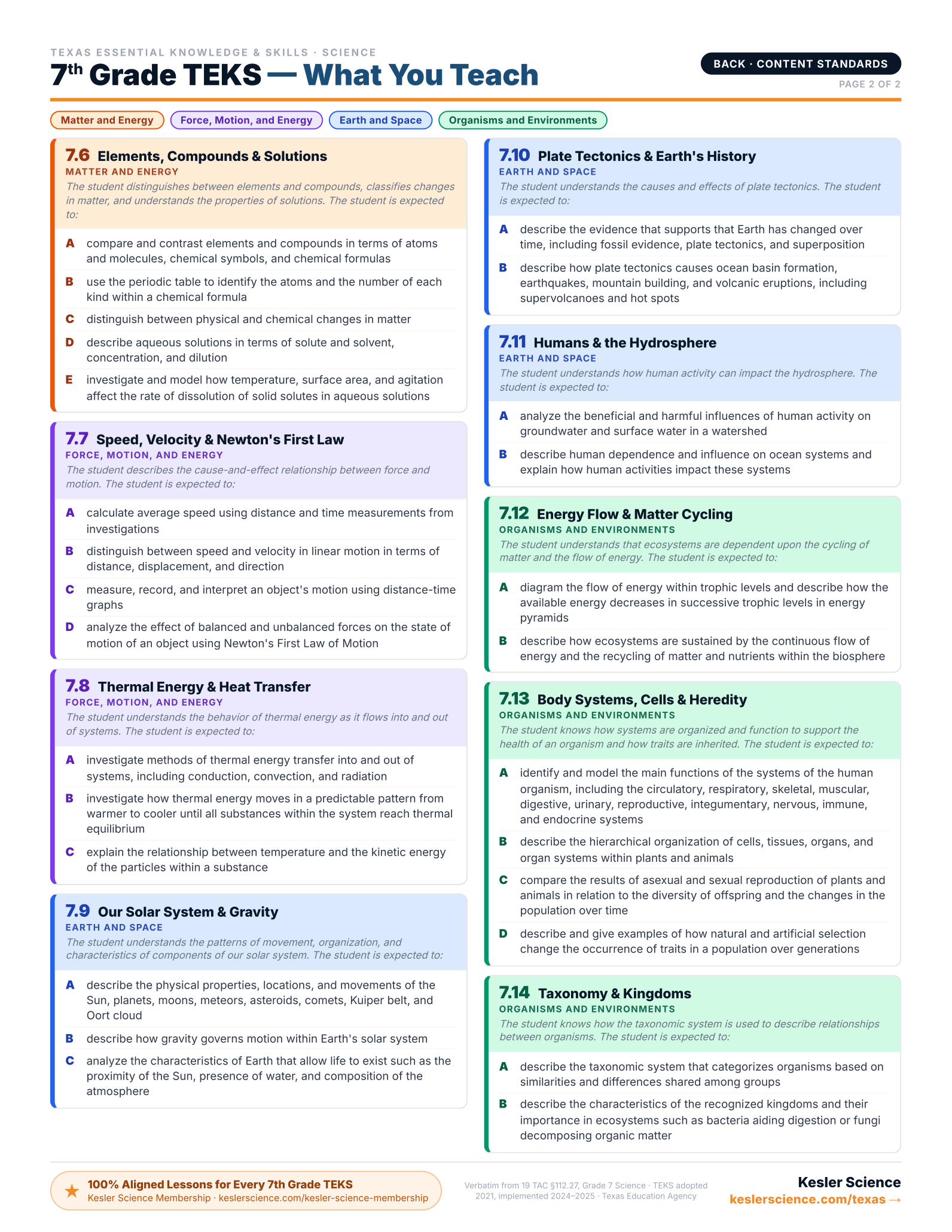
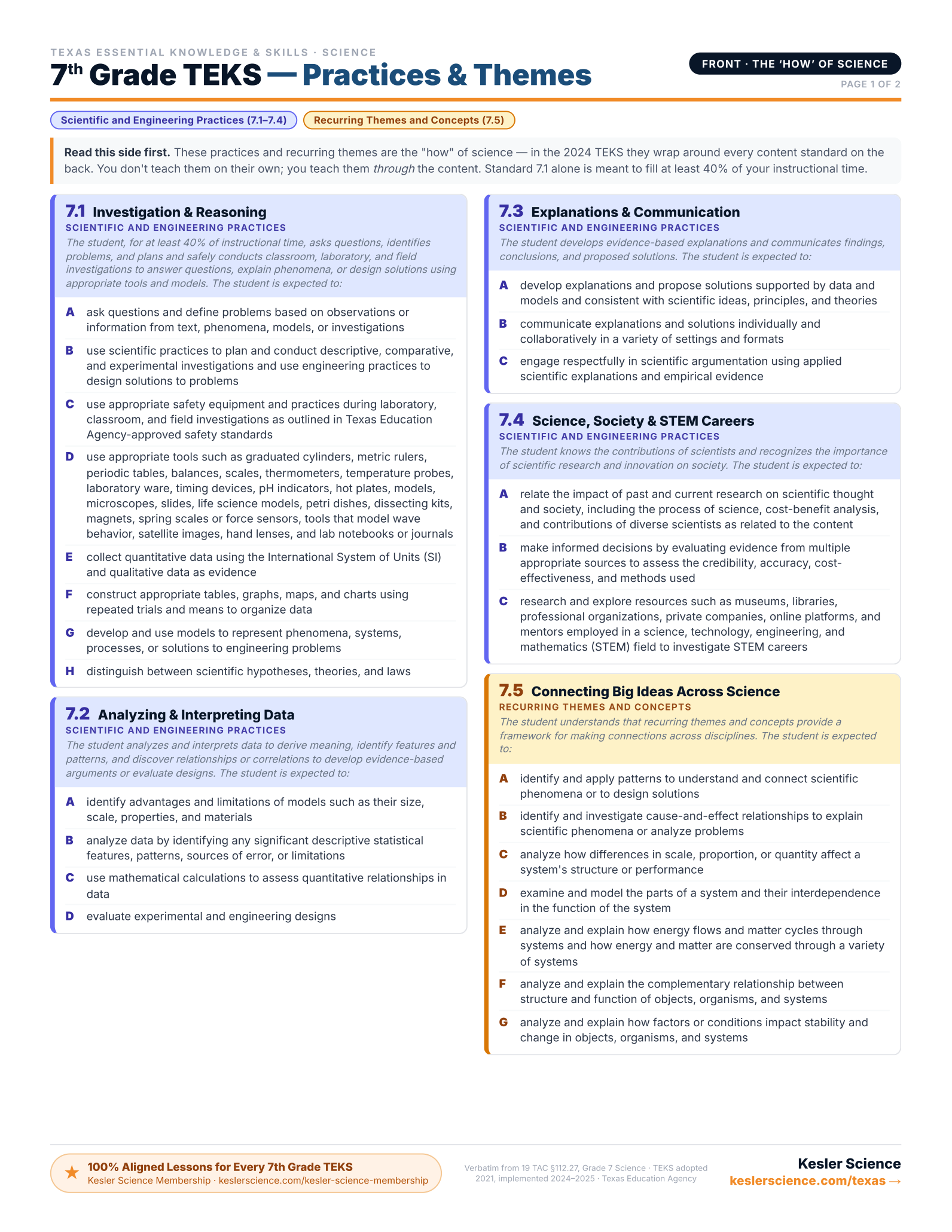
Every 7th-Grade Science TEKS on One Page
The color-coded, front-and-back cheat sheet I wish I'd had — every standard, organized by reporting category. Print it and reference it all year long. This will be your new favorite document!
Trusted Across Texas
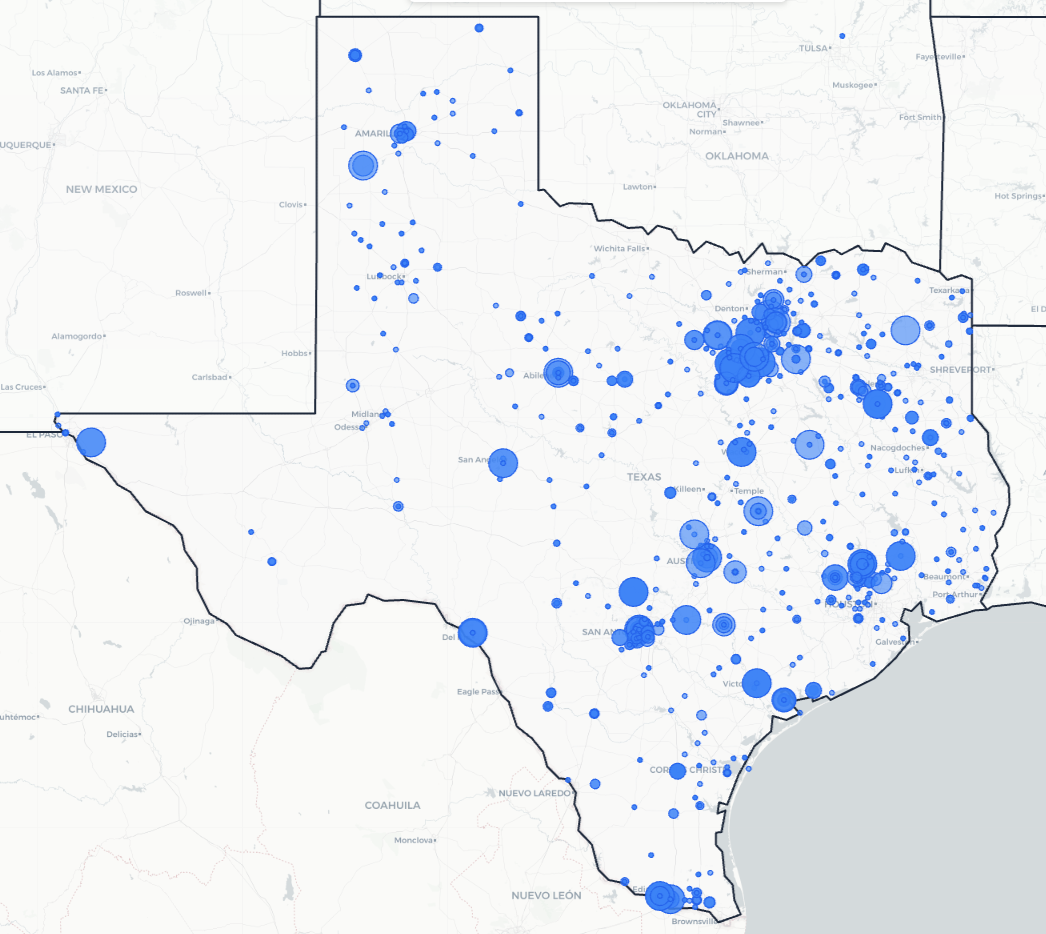
From the Rio Grande Valley to the Panhandle, Texas science teachers are using Kesler Science to save time and engage students.
Texas Schools and Districts
Love Kesler Science
What Teachers Are Saying
Give Your Science Teachers Everything They Need
School and district licenses give your teachers access to every resource they need, including station labs, inquiry labs, anchoring phenomena, presentations, escape rooms, and much more. One purchase covers the grade levels you need.
- PO-friendly. We accept purchase orders
- Volume discounts for 11+ teachers
- Complimentary Kesler Science Plus orientation for 4+ teachers
- Three free implementation PD sessions for departments of 11+
- Aligned to the 2024 TEKS standards
See It in Action
Book a walkthrough and we'll show you how Kesler Science fits your campus.
Book Demo CallNo pressure, no hard sell