.png?width=375&height=100&name=WebPage%20logo%20with%20curves%202026%20(8).png)
Atoms & Chemical Formulas
"Use the periodic table to identify the atoms and the number of each kind within a chemical formula."
💡 What This Standard Actually Means
"Use". Students are using the periodic table as a tool to identify the atoms in a chemical formula and count how many of each kind are present. The shift in this standard is that the focus is on reading formulas with the periodic table in hand, not on the structure of atoms (protons, neutrons, electrons) like the old version covered. Instruction can take many forms, such as periodic table scavenger hunts, formula-decoding worksheets, atom-counting card sorts, and quick draw activities where students sketch the atoms in a formula.
The periodic table is the cheat sheet for chemistry. Every element has its own square with a one or two-letter chemical symbol. Hydrogen is H, oxygen is O, sodium is Na, carbon is C, chlorine is Cl. When students see a chemical formula, the first job is to look up each symbol on the periodic table and figure out which element it represents.
The second job is counting. A chemical formula uses element symbols and small numbers to tell you what's inside a compound. The small number written after an element symbol is called a subscript, and it tells you how many atoms of that element are present. In H2O, the 2 means two hydrogen atoms. The oxygen has no subscript, which means one oxygen atom. So one water molecule has two hydrogen atoms and one oxygen atom for three atoms total. In CO2, one carbon bonds with two oxygens. In C6H12O6 (glucose), there are six carbons, twelve hydrogens, and six oxygens.
One detail that trips students up: the difference between a subscript and a coefficient. A subscript (small number after an element) tells you how many atoms of that element are inside one molecule. A coefficient (the bigger number written in front of the whole formula, like the 2 in 2H2O) tells you how many whole molecules are present. So 2H2O means two water molecules, for a total of 4 hydrogen atoms and 2 oxygen atoms. The core skill students should walk away with is the ability to grab a chemical formula, use the periodic table to identify each element, and accurately count how many atoms of each are present.
Reading formulas trips up way more kids than it should. What worked for me was treating every formula like a grocery list. If the formula says H2O, tell the class "your list has 2 hydrogens and 1 oxygen." Have them shop for it by circling that many atoms on a chart. Then throw in a coefficient, like 3H2O, and ask "now how big is your list?" Kids who can say "6 hydrogens and 3 oxygens" have locked in the difference between the subscript and the coefficient. That one move saves you so much pain later.
⚠️ Misconceptions Your Students May Have
These are some of the most common misconceptions. Knowing what to look for can help you get ahead of them.
"The subscript in H2O means the molecule is two atoms of water"
The subscript 2 tells you how many hydrogen atoms are in one molecule of water. One water molecule has 2 hydrogen atoms and 1 oxygen atom. The subscript never refers to the whole compound, only the element directly in front of it.
"All the symbols in a chemical formula are elements I'll have to memorize"
You don't have to memorize every element. Every formula uses symbols that come straight from the periodic table. If a student sees Fe in a formula, they look up Fe on the periodic table and find iron. Na is sodium, K is potassium, Au is gold. The periodic table is the answer key. Once students treat it as a tool to look things up instead of a wall of memorization, formulas get a lot less intimidating.
"A coefficient and a subscript mean the same thing"
Not the same. A subscript (small number after a symbol) tells you the number of atoms of that element inside one molecule. A coefficient (big number in front of the whole formula) tells you how many of those molecules you have. So 2H2O is 2 water molecules, which is 4 hydrogen atoms and 2 oxygen atoms in total.
"If an element has no subscript, there are zero atoms of it"
When an element symbol has no subscript, it means there is one atom of that element. We don't write the number 1. The oxygen in H2O shows up once, no subscript needed. This is a pattern students often need to see spelled out.
📓 Teaching Resources for 7.6B
These resources are aligned to this standard.


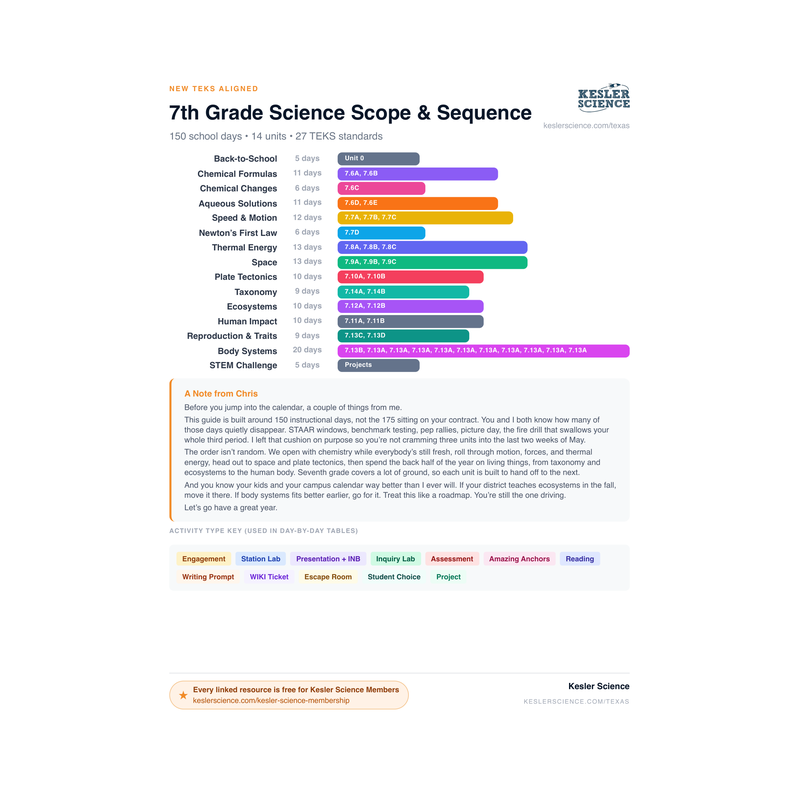
100% Aligned Lessons for Every TEKS You Teach
Kesler Science Plus puts thousands of ready-to-teach lessons and activities in your hands, so you can boost engagement and get your planning time back. Trusted by schools and districts all over the great state of Texas.
🌎 Phenomenon Ideas for 7.6B
Use these real-world phenomena to anchor your lesson. Show students the phenomenon first, let them wonder, then build toward Atoms & Chemical Formulas as the explanation.
Hydrogen Peroxide vs. Water
Water (H2O) is safe to drink. Hydrogen peroxide (H2O2) is used to disinfect cuts and bleach hair, and the stronger versions can be dangerous. The only difference in the formula is one extra oxygen atom. Same two elements, different subscripts, very different behavior.
"Both formulas use hydrogen and oxygen. Why would adding just one more oxygen atom change the properties so drastically? What does this tell us about why subscripts matter?"
Carbon Dioxide vs. Carbon Monoxide
Carbon dioxide (CO2) is what you exhale every minute of your life. Carbon monoxide (CO) is a silent killer that homes use detectors to warn against. Both contain only carbon and oxygen. The subscript is the only thing that changes on paper, but it changes everything about how the molecule behaves.
"Read each formula carefully. How many atoms of each element are in one CO2 molecule? How many in one CO molecule? Why is it important to read the subscripts carefully?"
Reading a Food Nutrition Label
Pull up a nutrition label and ingredient list. You'll see things like sodium chloride (NaCl), sucrose (C12H22O11), and citric acid (C6H8O7). Every one of these is a compound with a specific formula that tells you exactly which atoms are involved and how many of each. The whole food industry is built on reading these formulas accurately.
"Pick one compound from an ingredient list. How many atoms of each element does it contain? Why do scientists use formulas instead of just names?"
💡 Free Engagement Ideas for 7.6B
Ready-to-run activities you can drop straight into a lesson. Where one of these looks like a phenomenon from the section above, that is on purpose: show it first as the hook, then let students run it themselves.
Periodic Table Scavenger Hunt
Hand each student a periodic table and a list of formulas (NaCl, H2O, CO2, FeO, CaCO3, MgCl2, NaHCO3, etc.). Their job is to use the periodic table to identify each element symbol in the formula and write out the full element name plus the count. So NaCl becomes "1 sodium, 1 chlorine." CaCO3 becomes "1 calcium, 1 carbon, 3 oxygen." Trains them to use the periodic table as the lookup tool the new TEKS expects them to lean on.
Formula Decoder Stations
Set up stations with formulas on cards (H2O, CO2, NaCl, CH4, C6H12O6, 2H2O, 3CO2). At each station, students write the number of atoms of each element. Include formulas with coefficients to practice the coefficient vs. subscript distinction.
Build It With Marshmallows
Use marshmallows and toothpicks. Assign each color of marshmallow to an element (pink = hydrogen, white = oxygen, brown = carbon). Give students a formula and have them build the molecule. H2O becomes 2 pinks and 1 white connected by toothpicks. CH4 becomes 4 pinks around 1 brown.
Subscript vs. Coefficient Sort
Write formulas on cards: some with only subscripts (H2O, CO2), some with coefficients (2H2O, 3NaCl), some with both (4CH4). Students count total atoms in each and sort the cards by how many total atoms of each element are present. Catches the confusion between the two numbers before it turns into a habit.
🎯 What Approaches, Meets, and Masters Thinking Look Like
Here is what student thinking at each level looks like on this one task, so you know what to look for and how to move a student up.
Look at the chemical formula for glucose (a sugar): C6H12O6. Use the periodic table to name each element in the formula. Then count how many atoms of each element are in one molecule, and give the total number of atoms. Explain how you used the formula to get your counts.
- Each symbol named correctly from the periodic table: C is carbon, H is hydrogen, O is oxygen.
- The student treats the periodic table as a tool to look up symbols, not a list to memorize.
- Carbon counted as 6 atoms, from the subscript right after the C.
- Hydrogen counted as 12 atoms and oxygen counted as 6 atoms, each from the subscript right after its own symbol.
- The total added correctly: 6 plus 12 plus 6 is 24 atoms in one molecule.
- An explanation that says the small number (the subscript) tells how many atoms of the element right in front of it.
- The student keeps each subscript tied to its own element and does not let one number stand for the whole molecule. That is the easiest place to slip.
The elements are carbon (C), hydrogen (H), and oxygen (O). I found all three on the periodic table. The formula is C6H12O6, so there are 6 molecules of glucose. The big number 6 at the start tells you how many there are.
The elements are carbon (C), hydrogen (H), and oxygen (O). I looked up each symbol on the periodic table. The formula C6H12O6 has 6 carbon atoms, 12 hydrogen atoms, and 6 oxygen atoms. The small number after each symbol tells how many atoms of that element there are. I added them up: 6 plus 12 plus 6 equals 24 atoms in one molecule.
The elements are carbon (C), hydrogen (H), and oxygen (O), all found on the periodic table. C6H12O6 has 6 carbon atoms, 12 hydrogen atoms, and 6 oxygen atoms, for 24 atoms total. The trick is that each small number (the subscript) only counts the atoms of the element right before it. If a symbol has no number, that means just 1 atom, like the oxygen in H2O.
I can use the same rule on a formula I have never seen. Take baking soda, NaHCO3. I look up the symbols on the periodic table: Na is sodium, H is hydrogen, C is carbon, O is oxygen. Na, H, and C each have no number, so that is 1 atom each. The 3 belongs only to the oxygen, so 3 oxygen atoms. That is 1 plus 1 plus 1 plus 3, which is 6 atoms total.
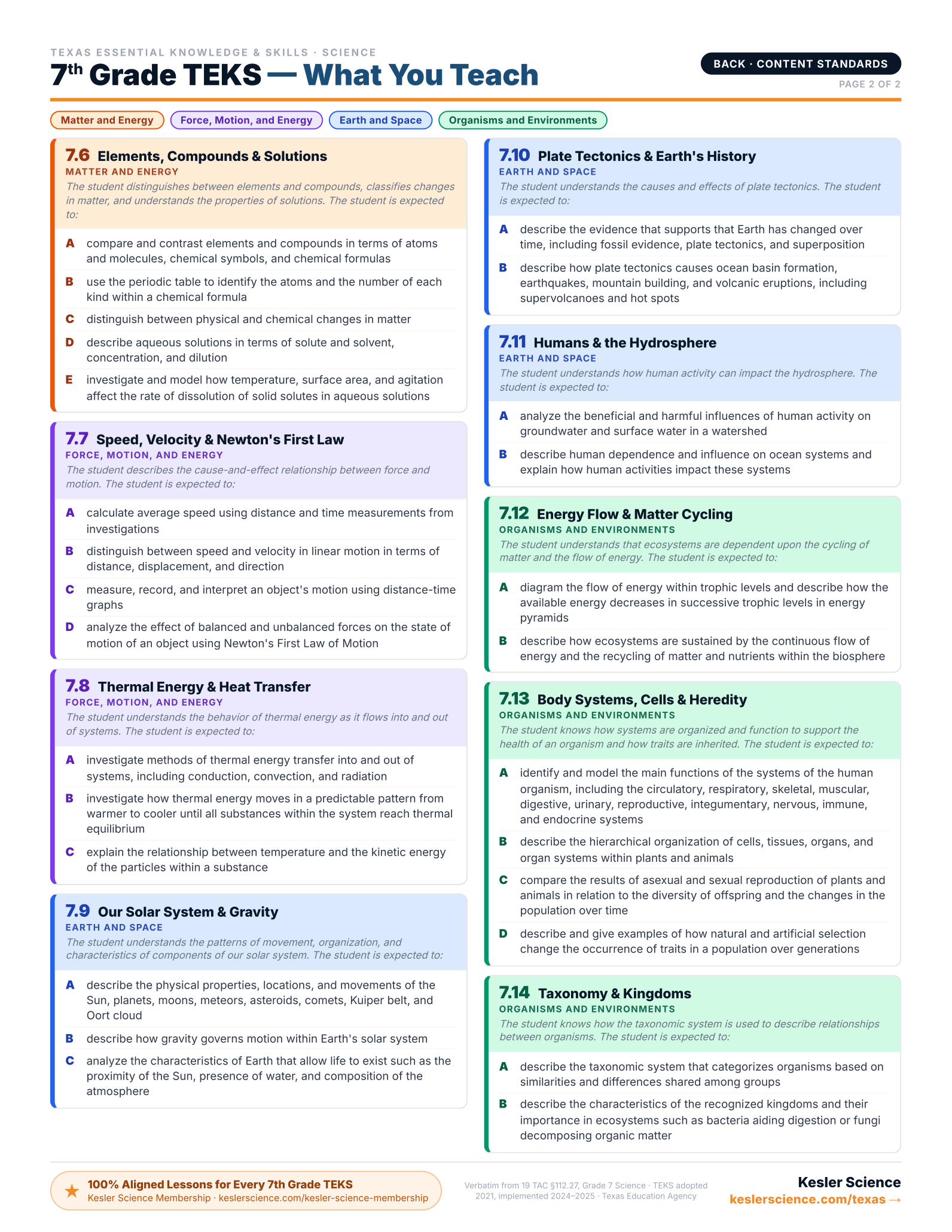
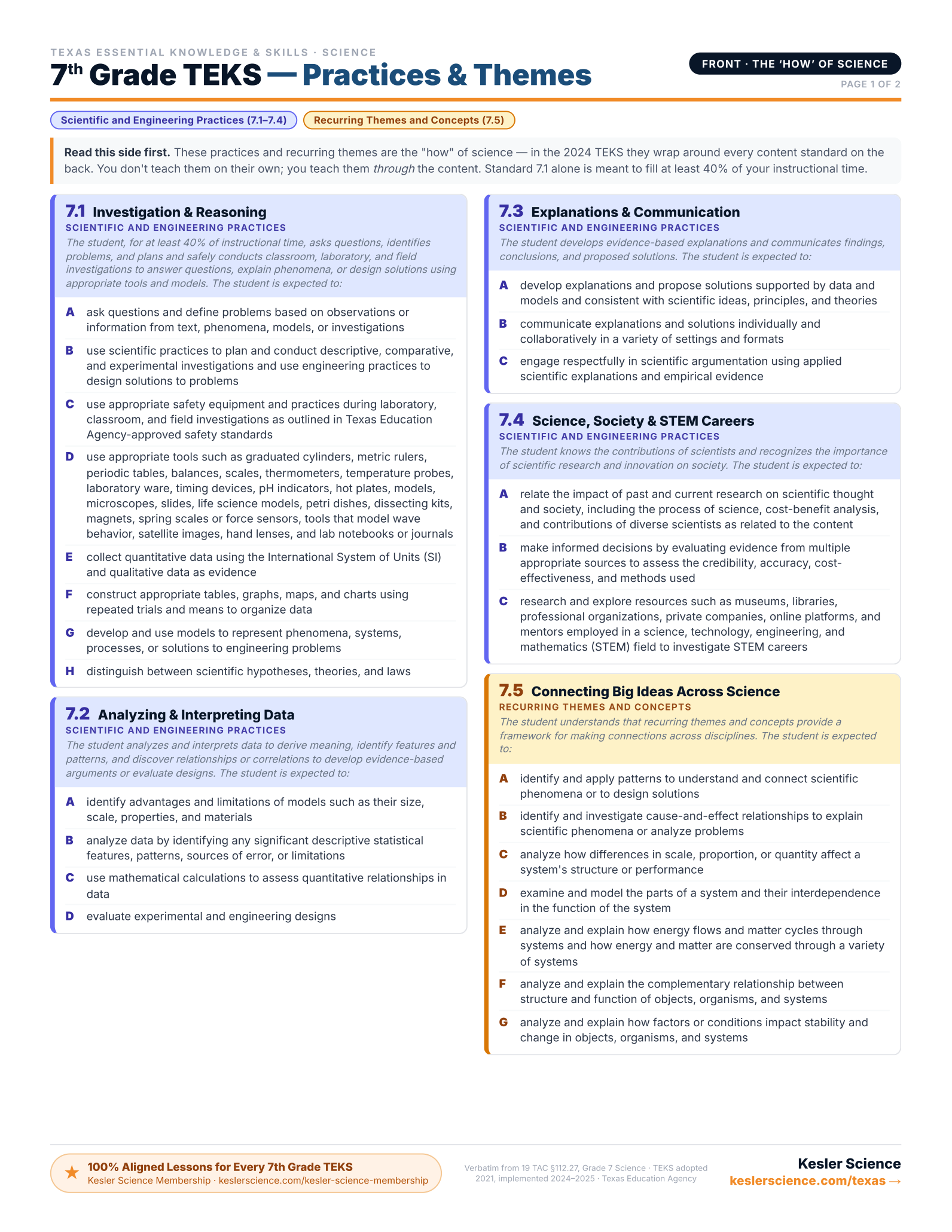
Every 7th-Grade Science TEKS on One Page
The color-coded, front-and-back cheat sheet I wish I'd had — every standard, organized by reporting category. Print it and reference it all year long. This will be your new favorite document!
Trusted Across Texas
From the Rio Grande Valley to the Panhandle, Texas science teachers are using Kesler Science to save time and engage students.
Texas Schools and Districts
Love Kesler Science

What Teachers Are Saying
Give Your Science Teachers Everything They Need
School and district licenses give your teachers access to every resource they need, including station labs, inquiry labs, anchoring phenomena, presentations, escape rooms, and much more. One purchase covers the grade levels you need.
- PO-friendly. We accept purchase orders
- Volume discounts for 11+ teachers
- Complimentary Kesler Science Plus orientation for 4+ teachers
- Three free implementation PD sessions for departments of 11+
- Aligned to the 2024 TEKS standards

See It in Action
Book a walkthrough and we'll show you how Kesler Science fits your campus.
Book Demo CallNo pressure, no hard sell