NGSS Resource Hub
Three-dimensional breakdowns, phenomena, and classroom-ready activities for every NGSS standard, grades 4-8.

🚀 Jump to Your Discipline
Middle School NGSS Standards
Pick any standard. Each page is your full lesson-planning workspace for that standard.
Patterns of Interaction Across Ecosystems: Why the Same Relationships Show Up Everywhere
"Construct an explanation that predicts patterns of interactions among organisms across multiple ecosystems."
"Emphasis is on predicting consistent patterns of interactions in different ecosystems in terms of the relationships among and between organisms and abiotic components of ecosystems. Examples of types of interactions could include competitive, predatory, and mutually beneficial."
NGSS does not list an explicit assessment boundary for this standard.
The three dimensions packed into this standard
Every standard bundles a DCI (the content), a SEP (the science practice), and a CCC (the crosscutting lens). They run in the same task, not in sequence.
"Although the species involved in these competitive, predatory, and mutually beneficial interactions vary across ecosystems, the patterns of interactions of organisms with their environments, both living and nonliving, are shared."
Organisms interact in a small number of repeating ways. They compete for the same resource. They eat each other. They help each other. One uses another without affecting it. One uses another and harms it. The species change from ecosystem to ecosystem, but the categories don't. A predator-prey relationship in the Serengeti works the same way as a predator-prey relationship in the Pacific.
"Construct an explanation that includes qualitative or quantitative relationships between variables that predict phenomena."
Students aren't just naming relationships. They're building an explanation that uses what they've seen in one ecosystem to predict what they'll see in another. If they understand the pattern, they can look at a new ecosystem they've never studied and call the shot: "this is competition," "this is mutualism." That's the work.
"Patterns can be used to identify cause and effect relationships."
Patterns are the lens. Once students can spot a category of interaction in one place, they recognize it everywhere. The same five relationship types appear in deserts, oceans, forests, and savannas. Different cast, same script. That repeating structure is what makes prediction possible.
📍 Where This Standard Fits in the K-12 Progression
Use this to plan the year. Knowing what students should already know and what they're heading toward keeps the lesson focused.
""
Patterns of Interaction Across Ecosystems: Why the Same Relationships Show Up Everywhere
""
🌎 Phenomena for MS-LS2-2
Anchor the lesson in one puzzling phenomenon kids keep coming back to. Use the two investigative phenomena to sharpen specific facets.
The Shark and the Cleaner Fish
A shark, the apex predator of the reef, holds completely still while a tiny cleaner fish swims into its open mouth and picks parasites off its teeth and gills. The shark could eat the cleaner fish in a single snap. It never does. Students will keep circling back to this all week: why doesn't the shark just eat the helper?
"Why do two organisms that should be predator and prey work together instead?"
- "What does the cleaner fish get out of it?"
- "Are there other relationships like this in different ecosystems?"
- "How does each organism know to stop being enemies?"
Lions and Hyenas Over a Kill
A pride of lions has taken down a wildebeest. Within minutes, a pack of hyenas shows up, hoping to steal the kill. The two groups face off, snarl, sometimes fight, and one side eventually walks away. Both species hunt, both eat the same animals, both want the same food. Use this one to sharpen the competition lens the anchor is pushing on: not every cross-species relationship is cooperative.
"When two predators want the same meal, what determines who wins and who walks?"
- "Is this still competition if they don't kill each other?"
- "Do lions and hyenas always fight, or do they sometimes share?"
- "What other pairs of animals compete this hard?"
The Tick on the Deer
A deer walks through tall grass and picks up a tick. The tick burrows in, drinks blood for several days, and falls off bloated. The deer scratches but mostly carries on. Same kind of "one organism using another" the anchor showed, only this time one of them gets hurt. Use this to push the parasitism vs. mutualism distinction the anchor opens up.
"Why is this relationship different from the shark and cleaner fish, even though both involve one organism feeding off another?"
- "Why doesn't the tick just kill the deer?"
- "Is the deer giving anything up that matters?"
- "Are there ticks on every kind of animal?"
100% Aligned Lessons for Every NGSS Standard You Teach
The membership gives you access to thousands of lessons and activities designed to boost student engagement and reclaim valuable teaching time. Trusted by schools and districts from every NGSS state.
⚠️ Misconceptions Your Students Will Walk In With
These come up almost every year. Knowing them in advance lets you head them off in the first lesson.
"Predators are evil or bad for the ecosystem"
Predators stabilize prey populations. Without predators, prey species often grow out of control, overgraze their food source, and crash. Wolves in Yellowstone, sea otters in kelp forests, sharks on reefs. All of them keep their ecosystems balanced. Predation isn't villainy. It's regulation.
"Competition only happens between members of the same species"
Competition happens any time two organisms need the same resource. That includes the same species (two squirrels over an acorn) and different species (a squirrel and a chipmunk over the same acorn). Lions and hyenas compete over a kill. Trees compete for sunlight in the canopy. Interspecies competition is everywhere.
"All symbiotic relationships help both organisms"
Symbiosis just means two organisms living in close contact. Mutualism is the type where both benefit. Commensalism is where one benefits and the other is unaffected. Parasitism is where one benefits and the other is harmed. All three are symbiotic. Only one of the three is win-win.
"Ecosystems are about animals"
Plants and microorganisms run most of the action. Plants produce the food and oxygen that animal life depends on. Fungi and bacteria break down dead material and recycle nutrients. A forest "ecosystem" without its fungi and bacteria would collapse in weeks. Animals are the visible layer, not the whole system.
🙋 Common Student Questions and How to Respond
These come up almost every time this standard gets taught. Plan a response and you'll keep the lesson focused.
In mutualism, both organisms get something out of the deal. Bees get nectar, flowers get pollinated. In commensalism, only one benefits and the other gets nothing, good or bad. Barnacles ride on a whale and reach more food. The whale doesn't notice. If you can't find a benefit for the second organism, it's commensalism, not mutualism.
Close, but no. Predators kill their prey and eat them, usually fast. Parasites live on or in their host and take resources from it over time, usually without killing it (because a dead host is no good to a long-term parasite). A wolf eating a rabbit is predation. A tick draining blood from a deer for a week is parasitism. Different time scale, different outcome.
The categories repeat. The details don't. A predator in the ocean has to chase prey through water, often using stealth and speed. A predator on the savanna has to deal with wide-open sightlines, prey that can outrun it for distance, and pack hunting. Same category, very different strategy. The pattern is the shared frame. The biome fills in the rest.
That happens. Oxpecker birds eat ticks off rhinos, which is mutualism (the bird gets food, the rhino gets cleaned). But oxpeckers also keep wounds on the rhino open to drink blood, which is parasitism. Real ecosystems are messy. Label the dominant interaction in the situation you're describing, and note that the same pair can shift categories depending on context.
📓 Teaching Resources for MS-LS2-2
These resources are aligned to this standard.
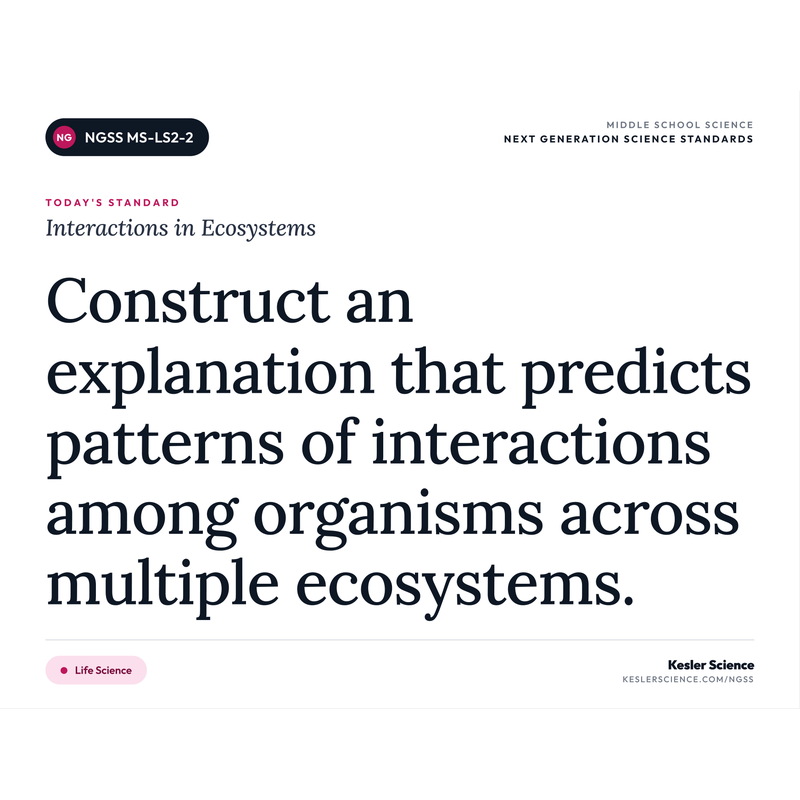
Print-ready classroom poster pack for MS-LS2-2. Includes the verbatim NGSS standard plus student-language "I Can" statements broken into daily learning goals. Landscape letter, ready to print and post on your wall.
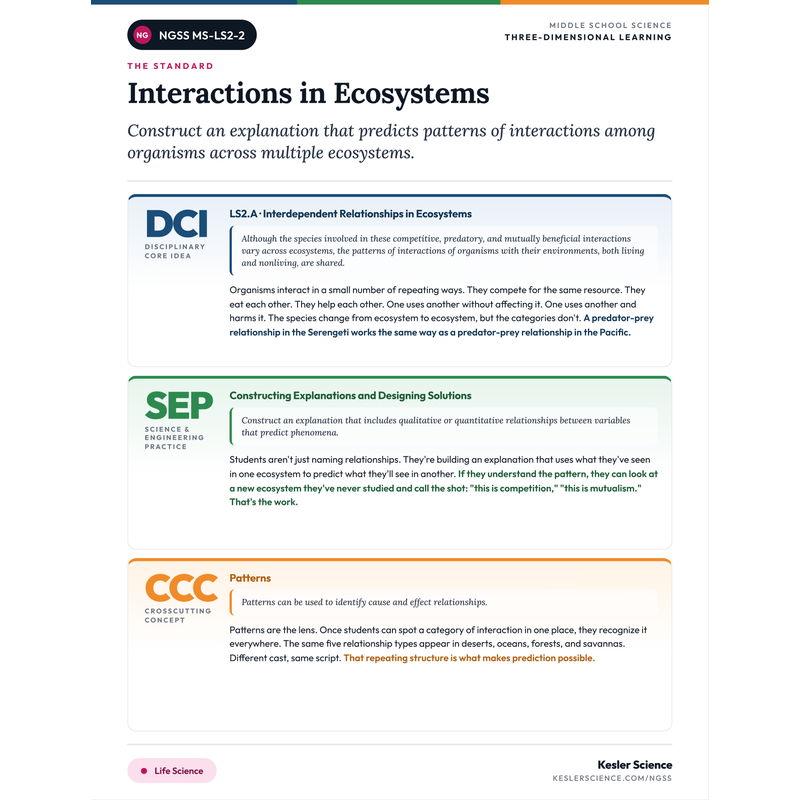
Teacher-facing PDF that breaks down the DCI, SEP, and CCC for MS-LS2-2 in plain English. Color-coded by dimension so you can read the whole standard at a glance. Perfect for lesson planning or a sub folder.
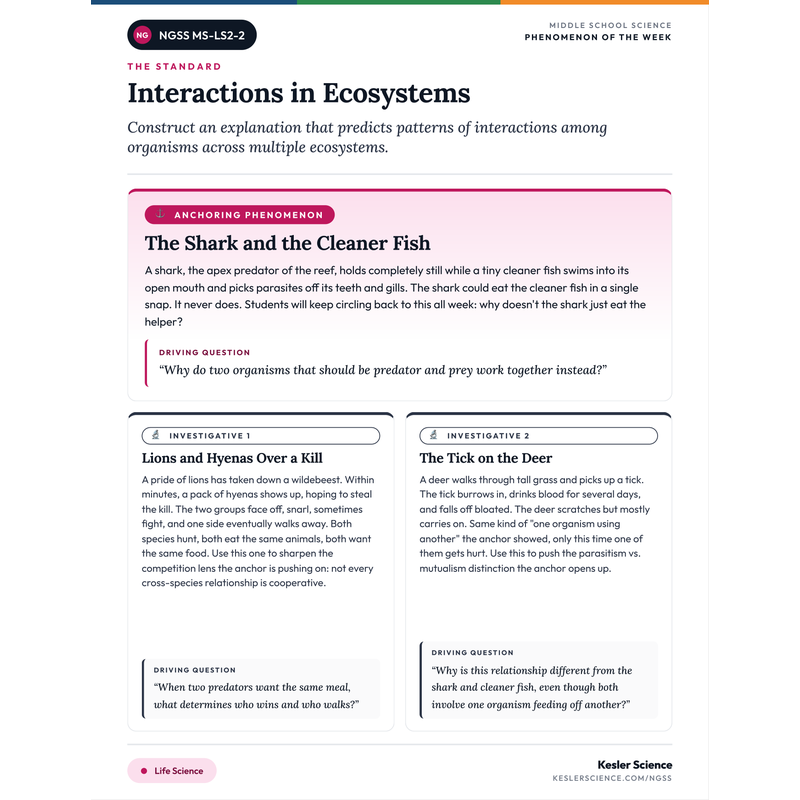
One-page printable with the anchoring phenomenon plus two investigative phenomena for MS-LS2-2. Each one comes with the driving question students will keep asking. Pin it above your desk for the week. One piece of paper, one week of hooks.

A hands-on inquiry investigation where students gather evidence for the patterns of interaction such as competition, predation, and cooperation among organisms across ecosystems. Includes student handouts, teacher guide, and materials list. 3 versions for differentiation. Both print and digital version included.

An anchoring phenomenon—Antibiotic Side Effects—that bookends your organism relationships lesson with an intro reading and an explanatory reading, each with comprehension and extension questions. Includes teacher directions with answer keys, projection slides, editable digital PPTs, and print handouts for INBs.

A leveled nonfiction reading passage that builds science literacy while reinforcing ecosystem interactions. Students read an engaging article—Ecosystem Interactions—then answer comprehension questions. Two reading levels for differentiation. Includes the passage, comprehension questions, answer key, and both print and digital versions.

A print-and-digital science writing activity where students reason and write about ecosystem interactions through an engaging real-world prompt. Includes teacher directions with an answer guide and project ideas. Great for constructed response, bell-ringers, or science journals.
📚 Vocabulary Students Need for MS-LS2-2
Twelve terms students need to access this standard. Definitions in plain-English, classroom-ready language.
Two organisms needing the same resource (food, water, space, mates). Can be within a species or between species.
One organism (the predator) hunts, kills, and eats another (the prey).
Both organisms benefit from the relationship. Bees and flowers, cleaner fish and sharks.
One organism benefits, the other is unaffected. Barnacles on a whale.
One organism (the parasite) benefits at the host's expense. Ticks on deer, tapeworms in intestines.
An individual living thing, plant, animal, fungus, or microbe.
All the organisms of one species living in one area.
All the populations living and interacting in one area.
A community plus the nonliving (abiotic) parts of its environment: water, soil, sunlight, temperature.
Any close, long-term relationship between two organisms. Includes mutualism, commensalism, and parasitism.
The role an organism plays in its ecosystem. What it eats, where it lives, what eats it, what it competes with.
💡 Free Engagement Ideas for MS-LS2-2
Five-Category Card Sort
Teams get a deck of 30 interaction cards drawn from four ecosystems (desert, ocean, forest, savanna). Each card describes one interaction in a sentence ("a coyote chases a roadrunner," "a clownfish lives in the tentacles of a sea anemone," etc.). Teams sort all 30 into the five categories: competition, predation, mutualism, commensalism, parasitism. The trickiest cards are the commensalism ones because they look like mutualism at first glance.
Two-Ecosystem Web Comparison
Students build a food web for a forest using a list of 12 organisms (oak tree, deer, tick, mushroom, owl, mouse, etc.). Then they build a coral reef web with 12 different organisms. They label every connection with one of the five interaction types and circle the matches between the two webs (predation in both, mutualism in both, etc.). The webs look totally different. The interaction types repeat.
Mystery Ecosystem Prediction
Teams pick a mystery biome from an envelope (tundra, mangrove swamp, deep-sea vent, prairie). Without researching the specific organisms, they predict what kinds of interactions they'd expect to see and why, based on the patterns they've learned. Then they look up the actual organisms and check their predictions against reality. Most predictions hit, even for biomes students have never studied.
Phenomenon Video Round
Short clips (under 90 seconds each) of 6 interactions: cleaner fish on a shark, bees on a flower, lions vs. hyenas, ticks on a deer, oxpecker on a rhino, barnacle on a whale. After each clip, students vote with whiteboards on the interaction type and defend their answer in a 30-second turn-and-talk. The oxpecker clip is the disagreement starter because it's actually both mutualism and parasitism.
📝 Assessment Ideas for MS-LS2-2
Three short tasks that hit all three dimensions. Doable in one class period each.
Students get 20 interaction descriptions from at least 3 different ecosystems. They sort each into the correct category (competition, predation, mutualism, commensalism, parasitism) and write one sentence per card explaining who benefits, who is harmed, and who is unaffected.
Students are given a brief description of an ecosystem they haven't studied (a kelp forest, a hot spring community, a city park). They have to predict what kinds of interactions they'd expect to find, name at least one example of each of the five categories, and explain how they know without having studied that ecosystem specifically.
Students get two organism pairs from different ecosystems (bees and flowers, cleaner fish and sharks). They write an explanation that identifies the interaction type, names the benefit on each side, and argues why the two pairs represent the same pattern despite being completely different species in completely different biomes.
🎯 What Proficient Student Work Looks Like
Same prompt, three student responses at different proficiency levels. Use as anchor papers when scoring.
"Use evidence from at least two ecosystems to construct an explanation that predicts what kinds of interactions you would expect to find in a third ecosystem you have not studied."
- A specific claim backed by data, observation, or model
- Use of standard-specific vocabulary in context
- Connection between the visible and the underlying explanation
- A question they're still wondering about (curiosity stays alive)
In the ocean there are sharks that eat fish. In the forest there are owls that eat mice. So in the desert there will probably be predators that eat other animals too.
Names one pattern (predation) and applies it to a new ecosystem. Doesn't address the other four interaction types. Doesn't explain why the pattern repeats. Stops at one example.
In the ocean, cleaner fish and sharks have a mutualism relationship because both organisms benefit. In a forest, bees and flowers also have a mutualism relationship because the bees get nectar and the flowers get pollinated. Even though the species are completely different, the same kind of relationship shows up in both ecosystems. Based on this pattern, I predict that in a desert ecosystem, I would find mutualism (maybe between a cactus and a pollinator), predation (a coyote eating a rabbit), competition (two coyotes wanting the same rabbit), parasitism (ticks on a coyote), and commensalism (a bird nesting in a saguaro without affecting the cactus). The species change, but the five interaction types should all be there.
Uses evidence from two ecosystems. Names all five interaction types in the prediction. Connects the pattern to the prediction explicitly. Hits exactly what the standard is targeting.
Across multiple ecosystems, the same five interaction types keep appearing: competition, predation, mutualism, commensalism, and parasitism. In the ocean, sharks and cleaner fish show mutualism (the fish gets food, the shark gets cleaned), and parrotfish compete with each other over algae patches. In a forest, oak trees and squirrels show a complex relationship (the squirrel gets food from acorns, the tree benefits when squirrels bury and forget acorns), and ticks on deer show parasitism. Based on these patterns, I predict that in a savanna ecosystem I would find: competition between lions and hyenas over kills, predation between lions and zebras, a complex bird-mammal relationship between oxpecker birds and rhinos (often called mutualism because the bird eats ticks off the rhino, but recent research suggests it tips into parasitism when the bird drinks blood from open wounds), commensalism between cattle egrets and grazing herds (the bird catches insects stirred up by the herd, the herd is unaffected), and parasitism by ticks or tapeworms. The pattern works because organisms everywhere need food, water, and space, and they only have a small number of ways to get those things from each other.
Cites evidence from two ecosystems with specific organisms and benefits. Predicts all five categories in the third ecosystem with named examples. Articulates the underlying reason the pattern repeats (limited number of ways to obtain resources). This is exactly the cross-ecosystem reasoning the standard targets.
Trusted Across NGSS States
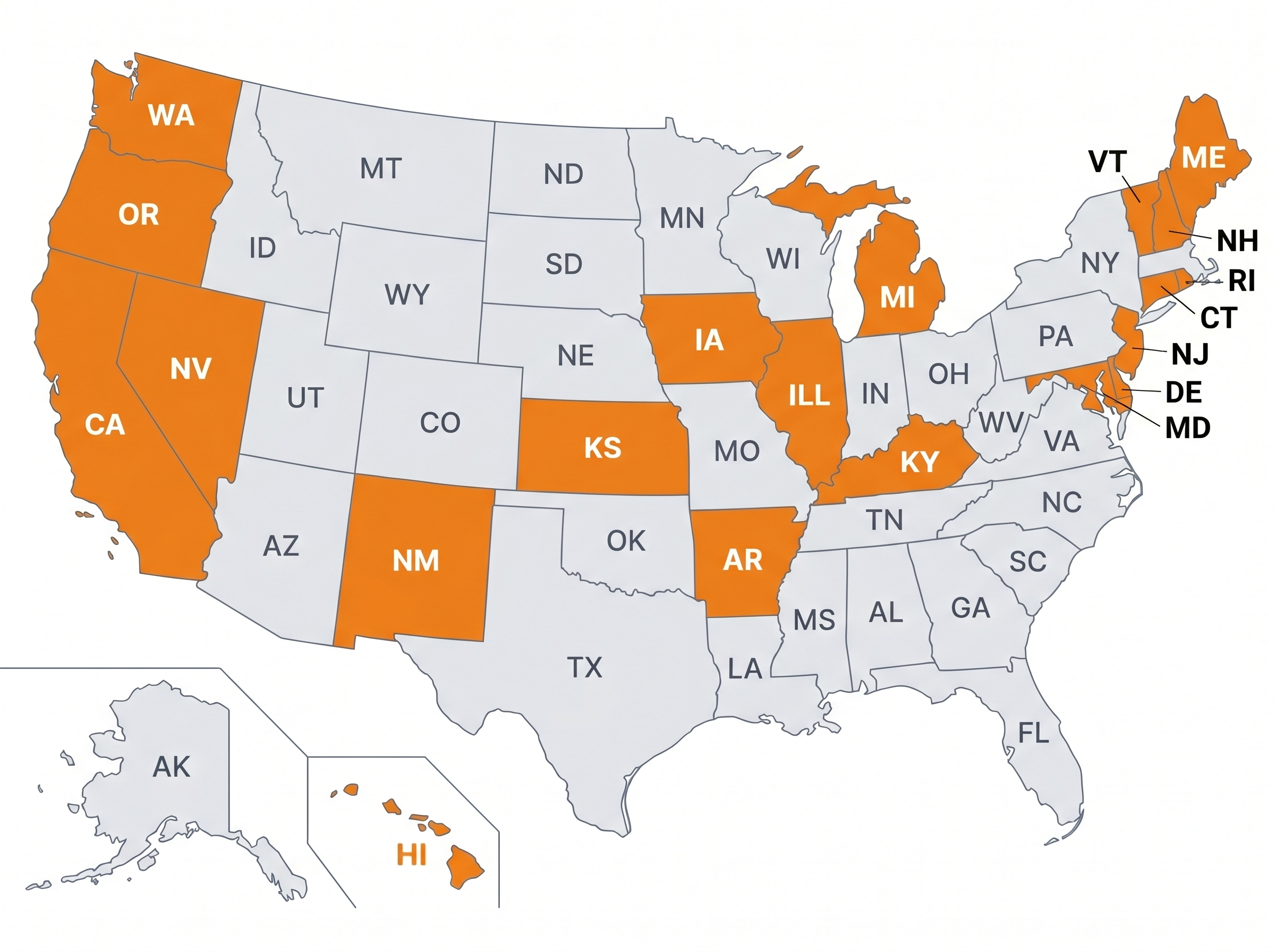
From California to Connecticut, science teachers in the 20 states that adopted NGSS are using Kesler Science to save time and engage students.
Teachers in NGSS States
Love Kesler Science
What Teachers Are Saying
"Complete, concise, time saving treasure chest of ready-made lessons that fit my standards. Cuts my prep time, increases student engagement, and makes it easier to have a student-led classroom."
"It is easy to access, updated frequently, well-supported when I have questions, and everything I need is provided. No surprises."
"Kesler has helped me differentiate instruction for students, move toward more inquiry-based labs, and kept me from losing my mind!"
Give Your Science Teachers Everything They Need
School and district licenses give your teachers access to every resource they need, including station labs, inquiry labs, anchoring phenomena, presentations, escape rooms, and much more. One purchase covers the grade levels you need.
- PO-friendly. We accept purchase orders
- Volume discounts for 11+ teachers
- Complimentary membership orientation for 4+ teachers
- Three free implementation PD sessions for departments of 11+
- Aligned to the NGSS standards
See It in Action
Book a walkthrough and we'll show you how Kesler Science fits your campus.
Book Demo CallNo pressure, no hard sell
"My assistant principal stopped in my room and immediately noticed how the students were engrossed in their centers and how they moved seamlessly from center to center. Also the built-in modifications really impressed!"
"It provides differentiated instruction for all types of learners, allowing them to become more engaged."
"I love it all!! I have become a facilitator in my class and I love the excitement it brings to my class. The kids love all that we do with the Kesler products."