.png?width=375&height=100&name=WebPage%20logo%20with%20curves%202026%20(8).png)
NGSS Resource Hub
Three-dimensional breakdowns, phenomena, and classroom-ready activities for every NGSS standard, grades 4-8.

🚀 Jump to Your Discipline
Middle School NGSS Standards
Pick any standard. Each page is your full lesson-planning workspace for that standard.
Evaluating Design Solutions: Picking the Best One on Purpose, Not by Gut
"Evaluate competing design solutions using a systematic process to determine how well they meet the criteria and constraints of the problem."
NGSS Lead States. (2013). Next Generation Science Standards: For states, by states (MS-ETS1-2). The National Academies Press. https://www.nextgenscience.org/dci-arrangement/ms-ets1-engineering-design
The focus is on using an organized method to weigh the strengths and weaknesses of each design idea against the stated criteria and constraints.
Summarized in our own words from the MS-ETS1-2 clarification statement (NGSS Lead States, 2013). Not a verbatim quote.
NGSS does not list an explicit assessment boundary for this standard.
The three dimensions packed into this standard
Every standard bundles a DCI (the content), a SEP (the science practice), and a CCC (the crosscutting lens). They run in the same task, not in sequence.
"There are systematic processes for evaluating solutions with respect to how well they meet the criteria and constraints of a problem."
National Research Council. (2012). A framework for K-12 science education: Practices, crosscutting concepts, and core ideas. The National Academies Press. https://doi.org/10.17226/13165
Once you've nailed down the criteria and constraints, you almost always end up with more than one possible design. Evaluation is how you decide which one actually wins. It's not a vibe check. It's a systematic process: score each design against each criterion, line up the trade-offs, and let the data point at the best fit.
"Evaluate competing design solutions based on jointly developed and agreed-upon design criteria."
National Research Council. (2012). A framework for K-12 science education. The National Academies Press.
Students aren't picking the design they personally like. They're arguing from evidence. Each design gets rated against agreed-upon criteria, the scores get compared, and students defend a choice using the numbers and the trade-offs. The argument is the whole point. If they can't justify it, they haven't done the work.
"All human activity draws on natural resources and has both short and long-term consequences, positive as well as negative, for the health of people and the natural environment."
National Research Council. (2012). A framework for K-12 science education. The National Academies Press.
Every design decision sends ripples outward. The lunchbox a company picks affects what gets bought, what materials get used, what ends up in a landfill. Students see that "best design" isn't just a classroom call. It shapes what people use, what the environment absorbs, and what gets made next.
📍 Where This Standard Fits in the K-12 Progression
Use this to plan the year. Knowing what students should already know and what they're heading toward keeps the lesson focused.
Students compare multiple possible solutions to a problem and identify which one best meets the criteria and constraints. They use fair tests to figure out which solution works better and why.
Evaluating Design Solutions: Picking the Best One on Purpose, Not by Gut
Students use quantitative methods (weighted decision matrices, cost-benefit analysis, computer modeling) to evaluate complex solutions with competing trade-offs across social, environmental, and economic criteria.
🌎 Phenomena for MS-ETS1-2
Anchor the lesson in one puzzling phenomenon kids keep coming back to. Use the two investigative phenomena to sharpen specific facets.
Three Lunchboxes, One Lunch
Same sandwich, same ice pack, same gym class day. Three different lunchboxes. A plain insulated lunchbox, a regular cloth bag, and an insulated lunchbox with a built-in cooling gel pack. By lunch, the sandwich in the cloth bag is room temperature. The other two are still cold, but one is heavier and cost three times as much. Which one is "best"? Students will argue about that all week.
"How do you decide which design is best when each one wins on different things?"
- "What if my family can't afford the most expensive one?"
- "Is heavier always worse, or only if you have to carry it far?"
- "Could you make a fourth lunchbox that beats all three?"
The Bridge Bid
A city needs a new bridge across a river. Three construction companies submit proposals. Company A: cheapest, finishes fast, expected lifespan 30 years. Company B: most expensive, beautiful, lifespan 80 years. Company C: mid-range cost, 50-year lifespan, lowest expected traffic disruption during construction. The city council has to pick one. Use this to sharpen the trade-off lens the anchor is pushing on: the cheapest option isn't automatically the best, and "best" depends on the criteria the council weighs heaviest.
"If the council picks the cheapest bridge to save tax money, what could that cost the city over 30 years?"
- "Who actually pays the price if the bridge wears out faster?"
- "Should beauty even be a criterion for a bridge?"
- "How do they decide which criterion matters most?"
Two Product Reviews, Same Product
Two online reviews of the exact same wireless earbuds. Reviewer A gives them 5 stars, focusing on sound quality and battery life. Reviewer B gives them 2 stars, focusing on price, comfort during long use, and microphone clarity for calls. Same product, opposite verdicts. The difference isn't the product. It's the criteria each reviewer used. Same idea as the anchor, only smaller: change the criteria, change the winner.
"How can two people evaluating the exact same product reach opposite conclusions?"
- "Which reviewer is right?"
- "Could you write criteria so specific that everyone would agree on the rating?"
- "When you read a product review, how do you know what the reviewer cared about?"
100% Aligned Lessons for Every NGSS Standard You Teach
The membership gives you access to thousands of lessons and activities designed to boost student engagement and reclaim valuable teaching time. Trusted by schools and districts from every NGSS state.
⚠️ Misconceptions Your Students Will Walk In With
These come up almost every year. Knowing them in advance lets you head them off in the first lesson.
"The best design is the cheapest one"
Cheapest only wins if cost is the only criterion. A $2 lunchbox that falls apart in a week loses against a $15 one that lasts the year. "Best" depends on the full set of criteria, weighted against each other. Cost is usually one of several factors, not the whole thing.
"More features means a better design"
Usually the opposite. Extra features add cost, weight, complexity, and points of failure. A lunchbox with a built-in fan, USB charger, and bottle opener isn't better than a plain insulated one if the criterion is "keep food cold for 4 hours." Simplicity often wins when the criteria are clear.
"Evaluating designs is just an opinion"
With criteria and data, it's a systematic process. Students score designs against the same yardstick, the totals come out where they come out, and the winner is defendable. Two teams using the same criteria and same evidence should land in roughly the same place. That's not opinion. That's argument from evidence.
"The first design idea is the one to go with"
Engineers almost never pick the first idea. They generate multiple designs on purpose so they have something to compare. Without competing solutions to evaluate, there's no way to know if the first one was any good. The whole point of "competing designs" in the standard is that you need more than one to make a real choice.
🙋 Common Student Questions and How to Respond
These come up almost every time this standard gets taught. Plan a response and you'll keep the lesson focused.
Great problem to hit. It means the criteria need more weight or a tiebreaker. You can do that two ways. Pick the most important criterion and let the higher score on that one win. Or add a new criterion that distinguishes them. Real engineers do this constantly when designs are close.
The team, working with whoever the design is for. In our classroom that's us. In real engineering it's a mix of the customer, the engineers, safety regulators, and sometimes the public. Different criteria produce different winners, which is why agreeing on the criteria before you start scoring is the most important step.
Yes, but only if you have new evidence. "I thought design B was a 3, but after testing I see it's actually a 5" is fine. "I changed it because I want design B to win" isn't. The score has to track the evidence, not the answer you want.
Common in real engineering. Two moves. Pick the design that misses the fewest criteria and propose changes to fix the gap. Or go back, generate a new design that combines the strongest parts of each, and score that one too. Sometimes evaluation tells you the designs aren't good enough yet.
📓 Teaching Resources for MS-ETS1-2
These resources are aligned to this standard.
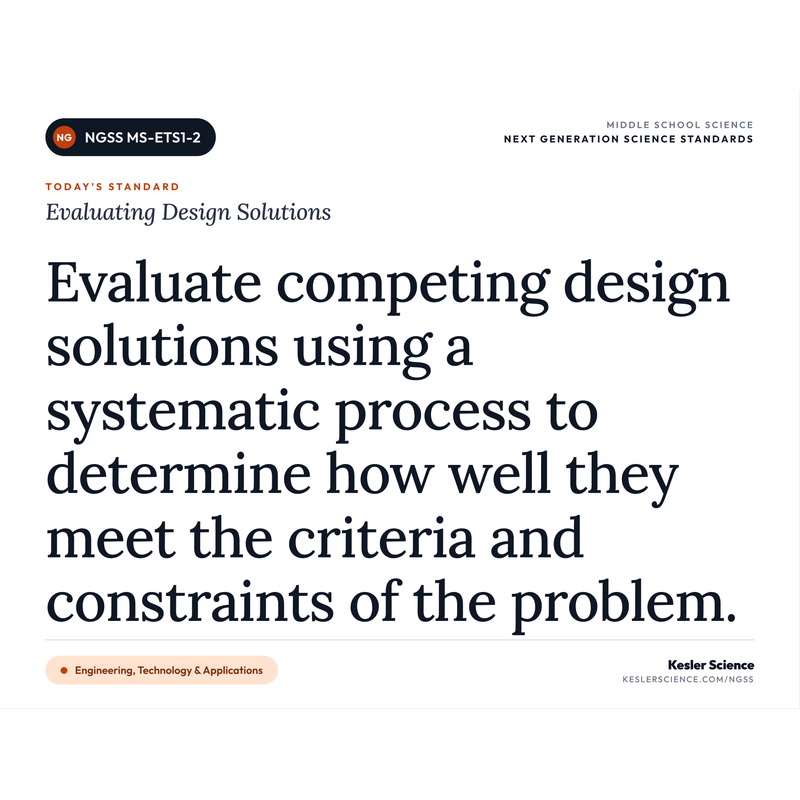
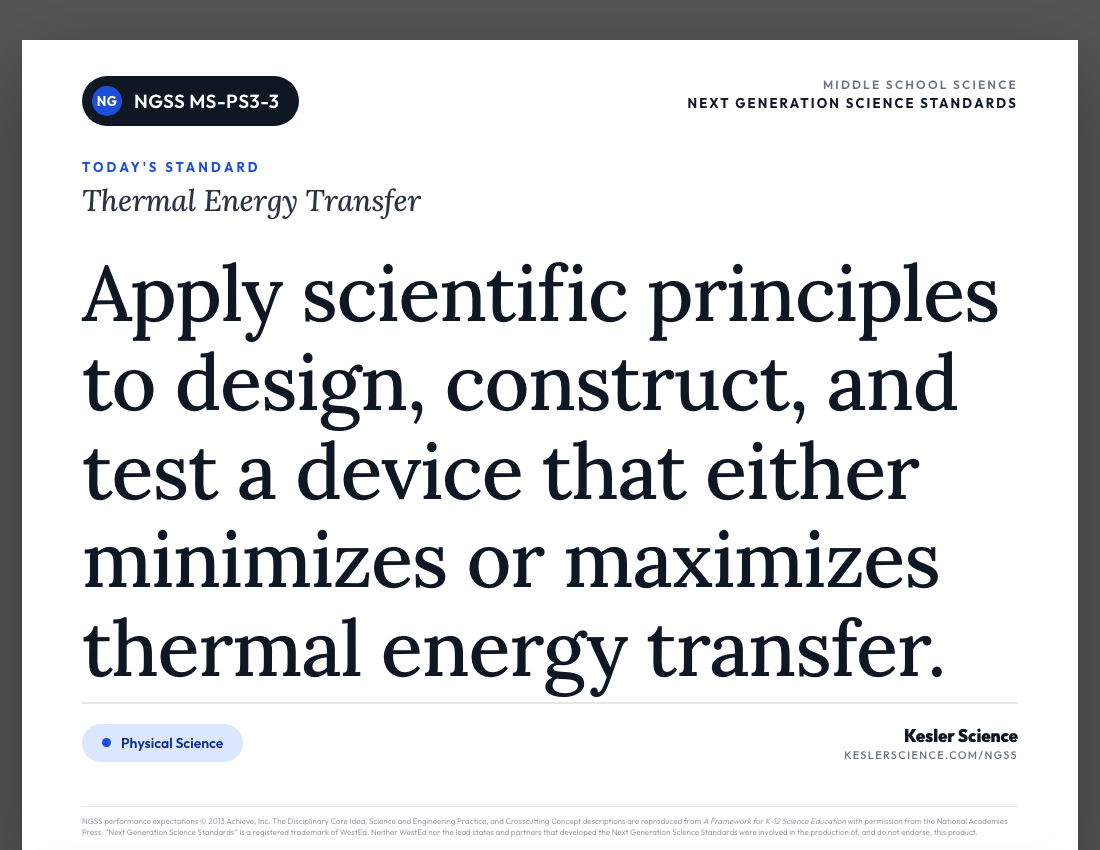
Print-ready classroom poster pack for MS-ETS1-2. Includes the verbatim NGSS performance expectation plus student-language "I Can" statements broken into daily learning goals. Landscape orientation, letter size, ready to print and post on your wall.
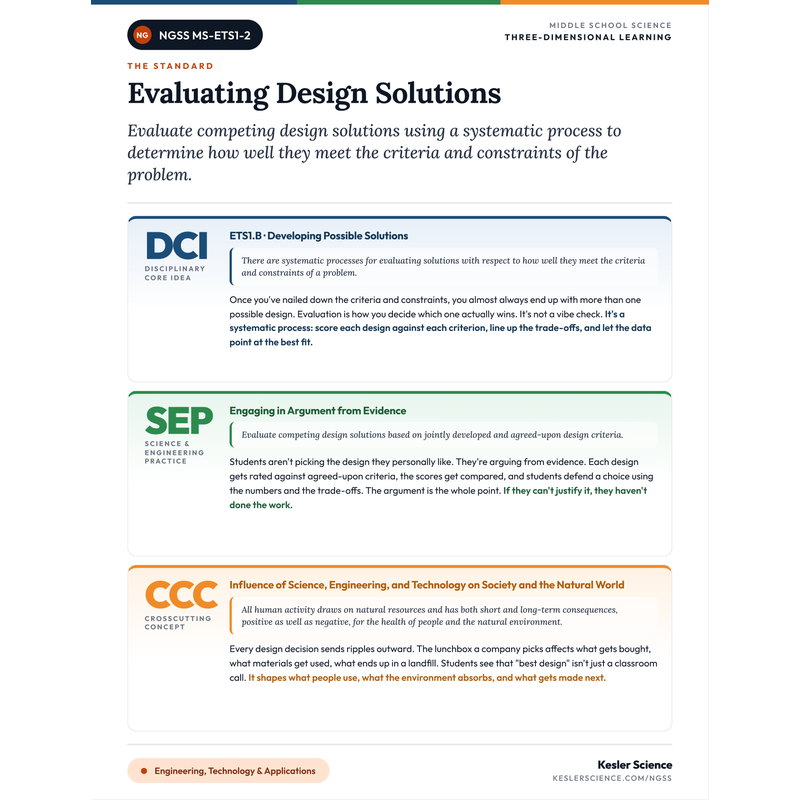
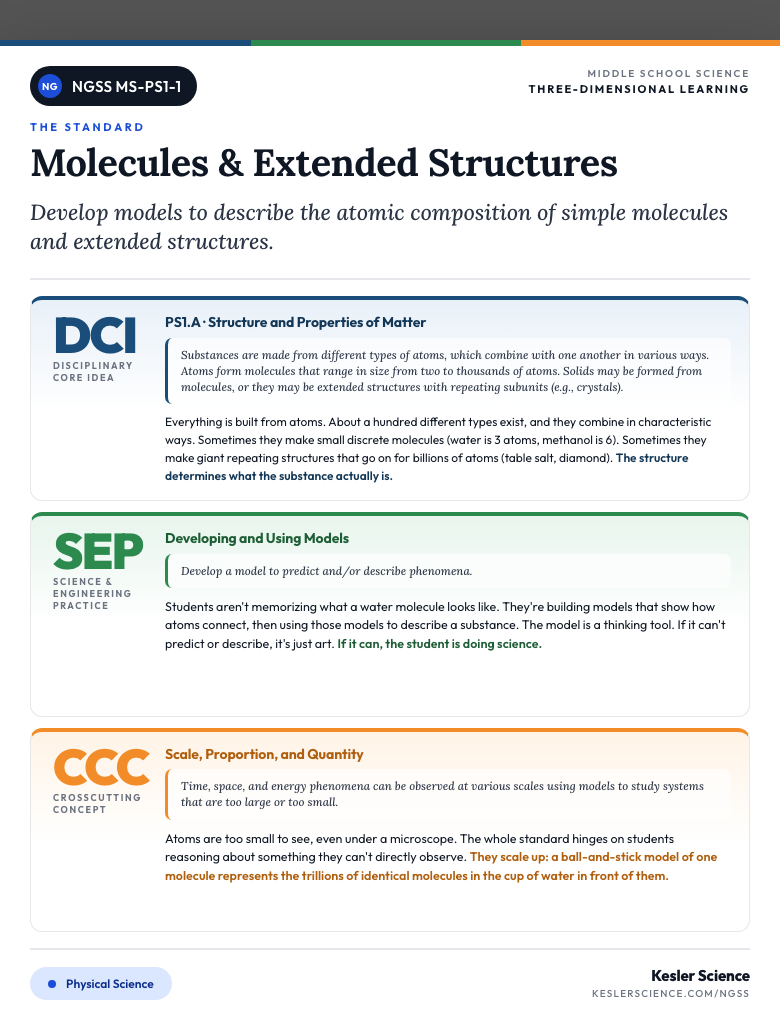
Teacher-facing PDF that breaks down the DCI, SEP, and CCC for MS-ETS1-2 in plain English. Color-coded by dimension so you can read the whole standard at a glance. Perfect for lesson planning or a sub folder.
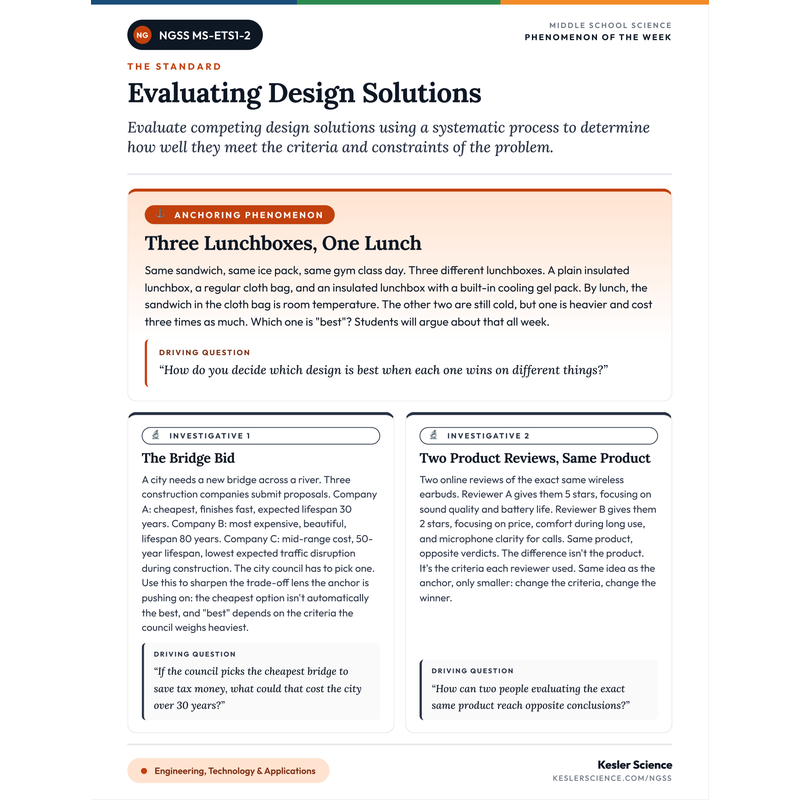
One-page printable with the anchoring phenomenon plus two investigative phenomena for MS-ETS1-2. Each one comes with the driving question students will keep asking. Pin it above your desk for the week. One piece of paper, one week of hooks.
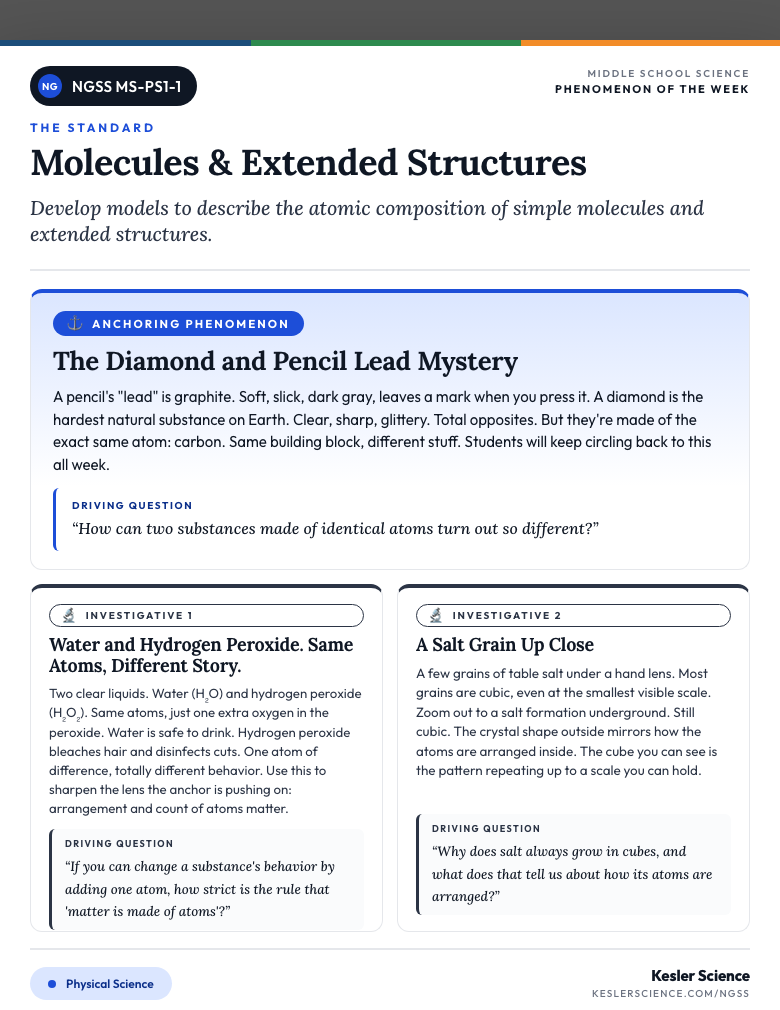
Teaching more than this one standard?
Get every I Can poster, phenomenon hook, and 3-dimension sheet for all 59 Middle School standards, in one download. The whole year, ready to print.
📚 Vocabulary Students Need for MS-ETS1-2
Twelve terms students need to access this standard. Definitions in plain-English, classroom-ready language.
To judge how well something meets a set of criteria, using evidence rather than personal preference.
A repeatable, step-by-step method. Same yardstick used the same way every time, so the results are defensible.
A table that lists designs in rows and criteria in columns. Each cell holds a score (often 1-5). Totals reveal which design fits best.
A number assigned to one design's performance against one criterion. Backed by evidence, not opinion.
A multiplier applied to a more important criterion so it counts for more in the final total. "Safety" might be weighted twice as much as "appearance."
Two or more solutions to the same problem, evaluated against the same criteria.
What a successful design must do. Carried over from MS-ETS1-1.
What a design cannot exceed. Cost ceilings, size limits, time, materials. Also carried over from MS-ETS1-1.
What you give up to gain something else. A lighter lunchbox might insulate worse. A cheaper one might break sooner.
A claim about which design is best, supported by criteria, scores, and trade-offs. Not a personal opinion.
💡 Free Engagement Ideas for MS-ETS1-2
Lunchbox Decision Matrix
Teams of 3 score three lunchbox designs (insulated, regular bag, insulated with cooling pack) against four criteria (cold retention, cost, weight, durability). Scores 1-5 per cell, totals at the bottom. Then each team writes a paragraph naming the winner and the trade-off they accepted. The teaching moment: different teams often land on different winners depending on small judgment calls in scoring.
Bridge Bid Debate
Class is split into three groups, each assigned one bridge bid (cheapest, longest-lasting, mid-range). Each group spends 15 minutes building the argument for their bridge using the same set of criteria (cost, lifespan, traffic disruption, environmental impact). Then a 20-minute structured debate. The teacher plays city council and asks follow-up questions that force students to weigh trade-offs in real time.
Product Review Forensics
Students get 2 reviews of the same product (any consumer item works: earbuds, water bottles, video games). They highlight the criteria each reviewer cared about, then build a side-by-side comparison showing where the criteria differed. Final task: write a third review using a set of criteria the class agrees on, so the verdict can be defended by anyone using the same rubric.
Pick Your Own Criteria
Teams design three competing solutions for a class-chosen problem (best paper airplane, best classroom pencil sharpener, best backpack). Before evaluating, each team writes its own criteria. Then teams swap designs and evaluate each other's using the original team's criteria. Discussion: did the criteria favor the team that wrote them? Could you write fairer criteria? Connects scoring to the agreement step.
📝 Assessment Ideas for MS-ETS1-2
Three short tasks that hit all three dimensions. Doable in one class period each.
Students are given 3 competing designs for an insulated lunchbox (described in data cards: cold retention in hours, cost in dollars, weight in pounds, durability rating). They build a decision matrix scoring each design against the criteria, total the scores, and write a 3-4 sentence argument naming the winner. The argument must reference at least one trade-off accepted.
Students are shown a decision matrix that's already been filled out, with a final winner declared. They identify three problems with the evaluation (different criteria applied to different designs, scores not backed by evidence, a missing criterion, biased weighting, etc.) and propose a corrected version of the analysis.
Students start with a completed decision matrix where Design A wins. They're asked: change ONE criterion (or its weight) so Design B becomes the winner instead. Then they explain in 2-3 sentences why the change flipped the result, and what that says about how criteria shape the verdict.
🎯 What Proficient Student Work Looks Like
Same prompt, three student responses at different proficiency levels. Use as anchor papers when scoring.
"Use a decision matrix to evaluate three lunchbox designs against the criteria (cold retention, cost, weight, durability). Decide which design is best and defend your choice."
- A specific claim backed by data, observation, or model
- Use of standard-specific vocabulary in context
- Connection between the visible and the underlying explanation
- A question they're still wondering about (curiosity stays alive)
I picked the insulated lunchbox with the cooling pack because it keeps food the coldest. It's the most expensive but cold food is the most important thing. The other two aren't as good.
Names a winner and one criterion. Doesn't use a matrix. Doesn't compare across all criteria. Doesn't name a trade-off. Stops at "this one's best because of one thing I care about."
I built a decision matrix scoring each lunchbox 1-5 on cold retention, cost, weight, and durability. The plain insulated lunchbox scored 16 total. The cloth bag scored 9. The insulated lunchbox with the cooling pack scored 17. The cooling-pack one won by 1 point. The trade-off: it costs $5 more and weighs half a pound more than the plain insulated one. I picked it because cold retention scored 5 (vs. 4 for the plain insulated), and that was the most important criterion in our group.
Uses a decision matrix. Compares all designs against all criteria. Cites totals. Names a specific trade-off. Justifies the winner using the data, not preference. This is exactly the systematic process the standard is asking for.
Decision matrix below. The cooling-pack lunchbox won 17-16 against the plain insulated. The cloth bag scored 9 and was never close. But the win is fragile. If we'd weighted cost twice as much (which would make sense for a family on a tight budget), the plain insulated wins 32-29. So the answer depends on whose criteria we use. My recommendation: the plain insulated lunchbox is the better all-around choice because it scored within 1 point on cold retention and beats the cooling-pack version on cost and weight. Trade-off accepted: slightly warmer lunches by the end of the day. For a family that can't afford the cooling pack, this matters.
Uses the matrix, cites the totals, and then goes further by testing how the answer changes when criteria weights shift. Names the human impact (family budget) as a reason to weight cost higher. This is the macro-to-micro reasoning the standard targets, with the CCC (impact on people) showing up inside the argument itself.
“Next Generation Science Standards” is a registered trademark of WestEd. Neither WestEd nor the lead states and partners that developed the Next Generation Science Standards were involved in the production of, and do not endorse, this product.
NGSS performance expectations © 2013 Achieve, Inc. The Disciplinary Core Idea, Science and Engineering Practice, and Crosscutting Concept descriptions are reproduced from A Framework for K-12 Science Education with permission from the National Academies Press.
Trusted Across NGSS States
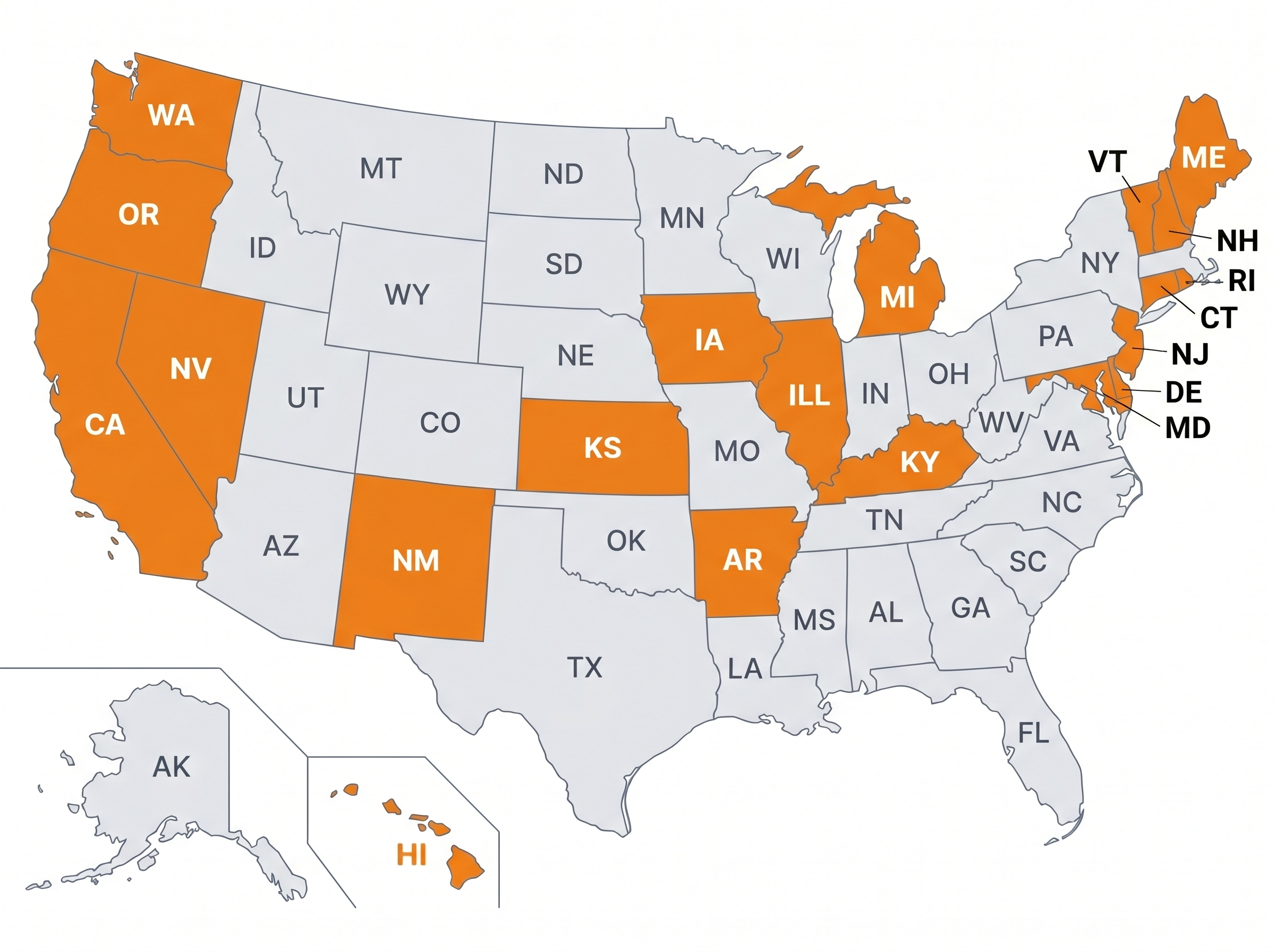
From California to Connecticut, science teachers in the 20 states that adopted NGSS are using Kesler Science to save time and engage students.
Teachers in NGSS States
Love Kesler Science
What Teachers Are Saying
"I'm able to access rigorous NGSS-aligned lessons and labs that are ready to use, so I spend more time helping students directly and less time searching for quality material."
"There's a lesson for each of the NGSS, so I don't have to search for hours to find a good quality lesson. I can spend more time actually teaching."
"The resources help me cover NGSS in a meaningful way, and my students gain a deeper knowledge of the concepts, with learning that's more self-driven."
Give Your Science Teachers Everything They Need
School and district licenses give your teachers access to every resource they need, including station labs, inquiry labs, anchoring phenomena, presentations, escape rooms, and much more. One purchase covers the grade levels you need.
- PO-friendly. We accept purchase orders
- Volume discounts for 11+ teachers
- Complimentary membership orientation for 4+ teachers
- Three free implementation PD sessions for departments of 11+
- Aligned to the NGSS standards

See It in Action
Book a walkthrough and we'll show you how Kesler Science fits your campus.
Book Demo CallNo pressure, no hard sell
"My assistant principal stopped in my room and immediately noticed how the students were engrossed in their centers and how they moved seamlessly from center to center. Also the built-in modifications really impressed!"
"It provides differentiated instruction for all types of learners, allowing them to become more engaged."
"I love it all!! I have become a facilitator in my class and I love the excitement it brings to my class. The kids love all that we do with the Kesler products."