.png?width=375&height=100&name=WebPage%20logo%20with%20curves%202026%20(8).png)
NGSS Resource Hub
Three-dimensional breakdowns, phenomena, and classroom-ready activities for every NGSS standard, grades 4-8.

🚀 Jump to Your Discipline
Middle School NGSS Standards
Pick any standard. Each page is your full lesson-planning workspace for that standard.
Digital vs. Analog Signals: Why the World Switched to Ones and Zeros
"Integrate qualitative scientific and technical information to support the claim that digitized signals are a more reliable way to encode and transmit information than analog signals."
NGSS Lead States. (2013). Next Generation Science Standards: For states, by states (MS-PS4-3). The National Academies Press. https://www.nextgenscience.org/dci-arrangement/ms-ps4-waves-and-their-applications-technologies-information-transfer
The focus is on a general grasp of how waves can carry communication. Examples might include sending light pulses through fiber optic cable, radio wave pulses in wifi devices, or turning stored binary patterns into sound or text on a computer screen.
Summarized in our own words from the MS-PS4-3 clarification statement (NGSS Lead States, 2013). Not a verbatim quote.
Students are not expected to do binary counting or to explain how any particular device works internally.
Summarized in our own words from the MS-PS4-3 assessment boundary (NGSS Lead States, 2013). Not a verbatim quote.
The three dimensions packed into this standard
Every standard bundles a DCI (the content), a SEP (the science practice), and a CCC (the crosscutting lens). They run in the same task, not in sequence.
"Digitized signals (sent as wave pulses) are a more reliable way to encode and transmit information."
National Research Council. (2012). A framework for K-12 science education: Practices, crosscutting concepts, and core ideas. The National Academies Press. https://doi.org/10.17226/13165
Signals carry information. Analog signals carry it as a smooth wave that can take any value, like a needle wiggling in a groove on a record. Digital signals carry it as a string of discrete pulses, usually just two values (on or off, 1 or 0). When a signal travels, noise gets added. Digital signals can be cleaned up by snapping each pulse back to its nearest value. Analog signals can't. The noise stays.
"Integrate qualitative scientific and technical information in written text with that contained in media and visual displays to clarify claims and findings."
National Research Council. (2012). A framework for K-12 science education. The National Academies Press.
Students aren't building a phone. They're pulling information from a few different places (a short reading, a diagram, a video clip, a side-by-side audio sample) and stitching it into one clear argument. The claim is already given: digital is more reliable. Their job is to back it up with evidence from multiple sources and explain it in their own words.
"Structures can be designed to serve particular functions."
National Research Council. (2012). A framework for K-12 science education. The National Academies Press.
A signal's structure (continuous wave vs. discrete pulses) is what determines its function (degrades over distance vs. regenerates cleanly). Engineers picked digital for most modern communication because the structure was designed for the job. The "shape" of the signal is the whole reason it works.
📍 Where This Standard Fits in the K-12 Progression
Use this to plan the year. Knowing what students should already know and what they're heading toward keeps the lesson focused.
""
Digital vs. Analog Signals: Why the World Switched to Ones and Zeros
""
🌎 Phenomena for MS-PS4-3
Anchor the lesson in one puzzling phenomenon kids keep coming back to. Use the two investigative phenomena to sharpen specific facets.
The Same Song, Two Ways
Play the same song twice in a row. First through a static-filled AM radio station, the kind you have to hold the antenna just right to hear. Then through a digital streaming service on a phone speaker. The song is identical. The signal carrying it is not. One is full of pops and fuzz. The other is crystal clear. Both traveled a similar distance to get to the room. Something in how each signal was built made all the difference.
"Why does the same information sound completely different depending on which kind of signal carries it?"
- "Why does the static stay no matter how much you turn it up?"
- "What's actually different about the way the digital version was sent?"
- "Could you fix the AM version after it gets to the radio, or is it too late?"
Photocopy of a Photocopy
Show a clear printed photograph. Make a photocopy of it. Then a photocopy of that copy. Keep going for five generations. By copy five, the photo is muddy and unreadable. Then show the same image as a digital file, copied five times. Bit-for-bit identical to the original. Use this to sharpen the "analog noise builds up, digital noise gets cleaned out" lens the anchor is pushing on. Same kind of degradation, but in a way students can see instead of only hear.
"Why does information fall apart when you copy it as a picture, but stay perfect when you copy it as a file?"
- "If digital copies are perfect, why do videos sometimes look pixelated online?"
- "What's actually getting added to the photo each time it gets copied?"
- "Is there a way to fix a blurry analog copy, or is the original gone for good?"
The Whisper Chain
Line up six volunteers. Whisper a one-sentence message to the first. They whisper to the next, who whispers to the next, all the way down. The message at the end almost always comes out garbled. Then run it again, but each student passes a card labeled either "0" or "1" instead. Each card gets passed down the line, copied if needed, and read at the end. The pattern arrives intact. Same kind of "noise piling up" the anchor is showing, but built from students instead of speakers.
"Why does a whispered message scramble down a line, but a pattern of 0s and 1s makes it through clean?"
- "What if one student gets a card wrong on purpose? Does the whole message break?"
- "Could you build a way to whisper that doesn't get garbled?"
- "Is this how phones actually work, or is it just a comparison?"
100% Aligned Lessons for Every NGSS Standard You Teach
The membership gives you access to thousands of lessons and activities designed to boost student engagement and reclaim valuable teaching time. Trusted by schools and districts from every NGSS state.
⚠️ Misconceptions Your Students Will Walk In With
These come up almost every year. Knowing them in advance lets you head them off in the first lesson.
"Digital signals don't pick up any noise at all"
Digital signals pick up noise just like analog signals do. The difference is what happens next. A receiver looks at each pulse and decides whether it's closer to a 1 or a 0, then sends a clean version onward. The noise gets erased at each step. Analog signals don't get that cleanup pass, so the noise builds up.
"Digital means electronic, and analog means non-electronic"
Digital and analog describe the type of signal, not whether electricity is involved. Morse code is digital (it's just dots and dashes, two discrete values). Drum signals across a valley are digital. A vinyl record is analog because the groove carries a continuous wave, even though playing it back uses electricity. The question is whether the signal takes any value (analog) or only discrete values (digital).
"Digital is always better than analog"
For sending information accurately across distance, digital usually wins. But analog signals still get used. Some high-end audio engineers prefer the texture of analog recordings. Some scientific instruments measure continuous quantities directly. The standard makes a specific claim about reliability of transmission, not about which is "better" in every situation.
"Digital signals are made of light or radio waves, but analog signals are sounds"
Both digital and analog signals can ride on light, radio waves, electrical current, or sound. A flashlight blinking SOS is a digital optical signal. A flashlight slowly dimmed up and down is an analog optical signal. Same medium, different signal type. The structure of the signal is what matters, not what's carrying it.
🙋 Common Student Questions and How to Respond
These come up almost every time this standard gets taught. Plan a response and you'll keep the lesson focused.
Reliability isn't the only reason people pick a signal type. Some listeners like the way vinyl sounds, including the small imperfections. The standard makes a specific claim: digital is more reliable for encoding and transmitting information. That doesn't mean every situation calls for the most reliable option. People still write letters by hand too.
It looks at the signal at a specific moment and asks: is this closer to "on" or "off?" The signal might come in fuzzy because of noise, but as long as it's clearly closer to one value or the other, the receiver makes a clean call. Then it passes that clean value along. The standard doesn't ask you to know the circuitry that does this, just the idea that it happens.
Yes to both. The internet sends everything as digital pulses, mostly through fiber optic cables that flash light on and off. Wi-Fi uses radio waves, but the waves get encoded with digital pulses too. Even the call you make on a phone gets converted from your voice (analog) into digital pulses before it travels, then back to analog at the other end.
A digital file copied correctly is bit-for-bit identical to the original, even after a hundred copies. Each 1 stays a 1 and each 0 stays a 0. Compare that to a photocopy of a photocopy of a photocopy. That's analog copying, and the image gets blurrier every time. The digital reliability claim shows up in storage too, not only transmission.
📓 Teaching Resources for MS-PS4-3
These resources are aligned to this standard.
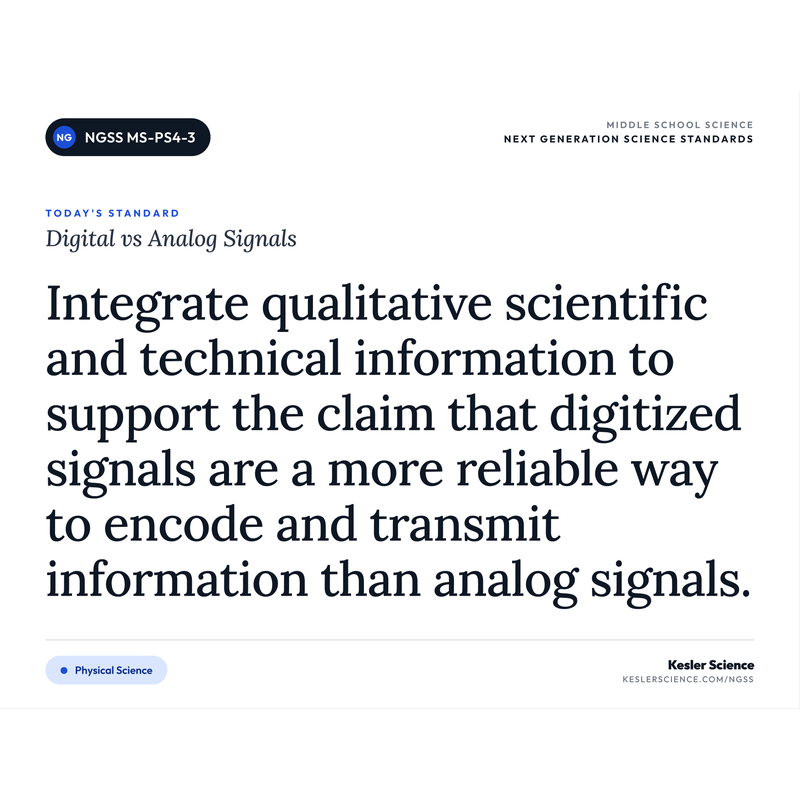
Print-ready classroom poster pack for MS-PS4-3. Includes the verbatim NGSS performance expectation plus student-language "I Can" statements broken into daily learning goals. Landscape orientation, letter size, ready to print and post on your wall.
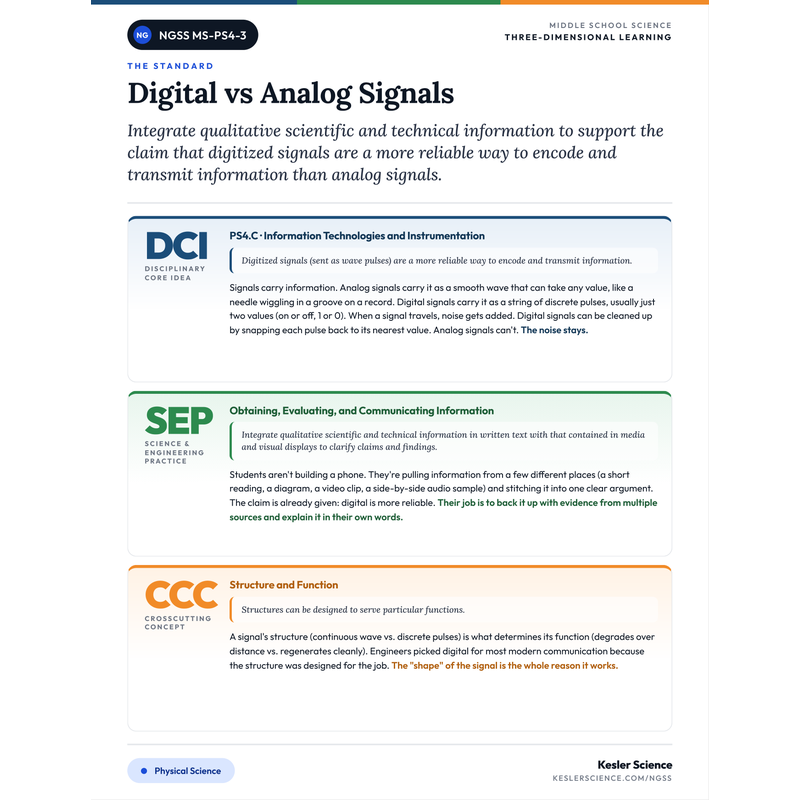
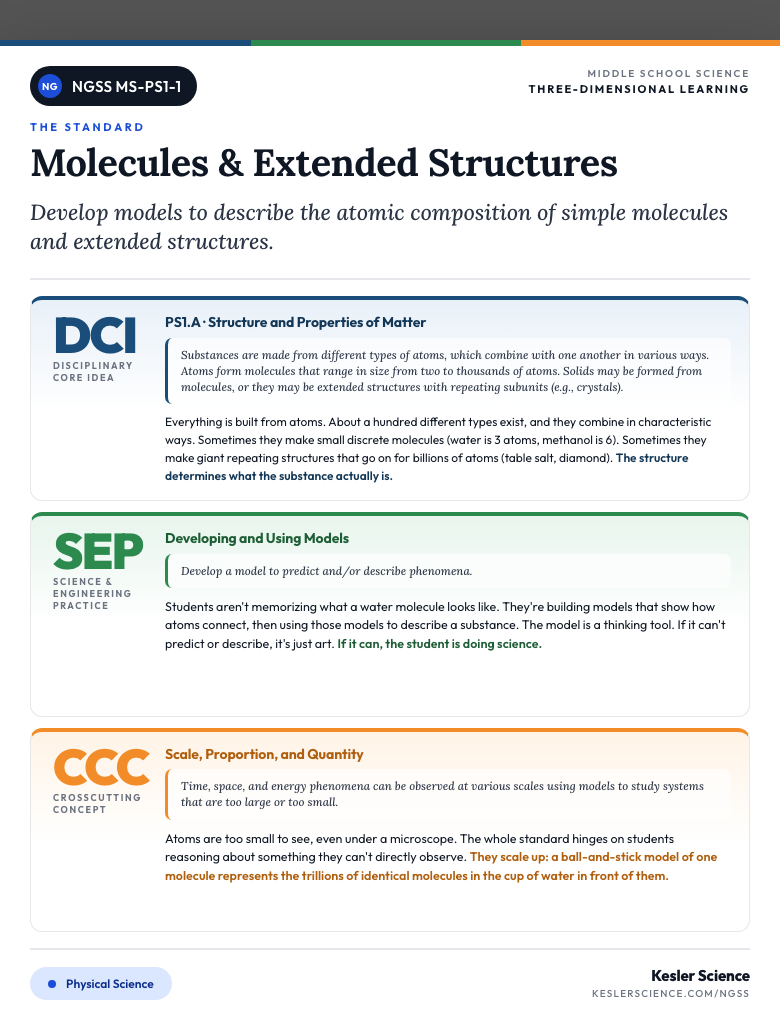
Teacher-facing PDF that breaks down the DCI, SEP, and CCC for MS-PS4-3 in plain English. Color-coded by dimension so you can read the whole standard at a glance. Perfect for lesson planning or a sub folder.
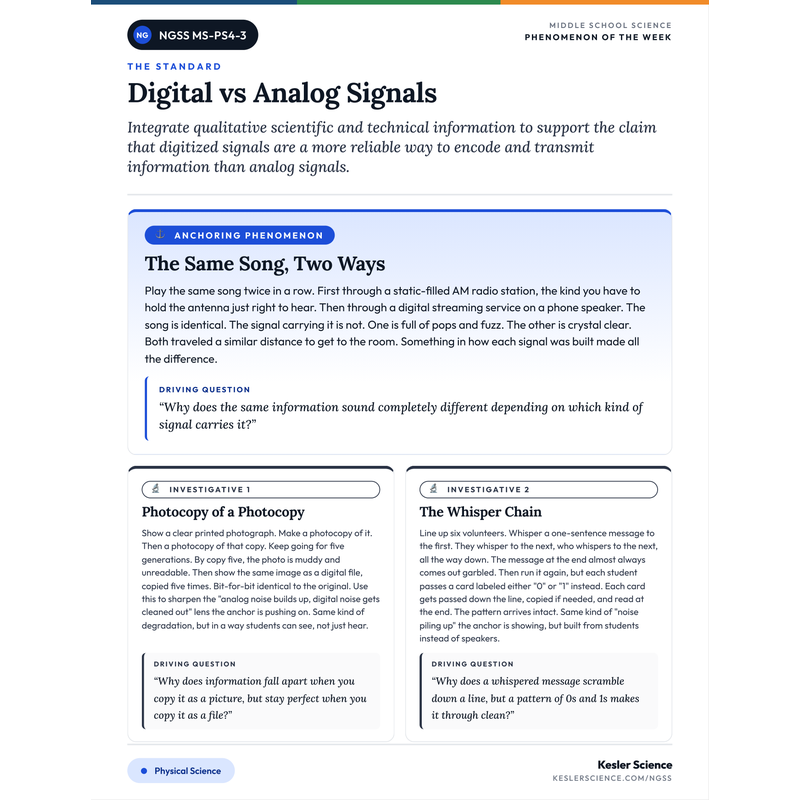
One-page printable with the anchoring phenomenon plus two investigative phenomena for MS-PS4-3. Each one comes with the driving question students will keep asking. Pin it above your desk for the week. One piece of paper, one week of hooks.

A hands-on inquiry investigation where students investigate why digitized signals are a more reliable way to encode and transmit information than analog signals. Includes student handouts, teacher guide, and materials list. 3 versions for differentiation. Both print and digital version included.

An anchoring phenomenon that bookends your digital vs analog signals lesson with an intro reading and an explanatory reading, each with comprehension and extension questions. Includes teacher directions with answer keys, projection slides, editable digital PPTs, and print handouts for INBs.

A leveled nonfiction reading passage that builds science literacy while reinforcing digital vs. analog signals. Students read an engaging article—Advantages to Digital Technology—then answer comprehension questions. Two reading levels for differentiation. Includes the passage, comprehension questions, answer key, and both print and digital versions.

A print-and-digital science writing activity where students reason and write about digital vs. analog signals through an engaging real-world prompt. Includes teacher directions with an answer guide and project ideas. Great for constructed response, bell-ringers, or science journals.
Teaching more than this one standard?
Get every I Can poster, phenomenon hook, and 3-dimension sheet for all 59 Middle School standards, in one download. The whole year, ready to print.
📚 Vocabulary Students Need for MS-PS4-3
Twelve terms students need to access this standard. Definitions in plain-English, classroom-ready language.
Anything that carries information from one place to another. Sounds, light flashes, radio waves, and electric currents can all be signals.
A signal that carries information as a continuous wave. The wave can take any value at any moment. Vinyl records and old AM/FM radio are analog.
A signal that carries information as a string of discrete values, usually just two (on or off, 1 or 0). CDs, streaming audio, and the internet are digital.
A short burst of a signal, like a quick flash of light or a momentary jump in current. Digital signals are built from streams of pulses.
A system that uses only two values, typically written as 1 and 0. Digital signals are usually binary.
To turn information into a signal that can be sent. A song gets encoded into a stream of pulses before it's transmitted.
To send a signal from one place to another. Phones, radios, and fiber optic cables all transmit signals.
Unwanted disruption added to a signal during transmission. Static on a radio, fuzzy phone audio, and snowy old TVs are all examples of noise.
To rebuild a clean version of a signal from a noisy one. Digital signals can be regenerated at each step. Analog signals can't.
A thin glass cable that carries digital signals as flashes of light. Most long-distance internet traffic moves through fiber optics.
An electromagnetic wave used to carry signals through the air. Can carry either analog or digital information depending on how it's encoded.
The chance that a signal arrives at the receiver matching what the sender sent. Digital signals are more reliable because noise can be cleaned out.
💡 Free Engagement Ideas for MS-PS4-3
AM vs. Digital Side-by-Side Listen
Pull up a free streaming version of a public radio station. Play the same content side-by-side: once on an AM radio in the room (or on a recorded AM clip), once on the streaming version. Students write a half-page comparison covering what they hear, where the noise lives, and which one sounds closer to the original studio recording. Pure listening evidence for the reliability claim.
The 0/1 Card Pass
Pre-make a stack of "0" and "1" cards. Encode a short message (a single word, four to six letters) into a binary pattern of about 35 cards using a printed key. Pass the stack down a line of students who copy each card onto a fresh card and pass it on. At the end, decode using the same key. Compare to a whisper line of the same word. Discuss what survived and what didn't.
Source-Stitch Argument Builder
Give each pair a packet with three short sources: a one-paragraph reading on how digital signals get regenerated, a labeled diagram showing a noisy wave vs. a clean pulse train, and a short audio file pairing a static-filled signal with a clean version. Pairs build a one-paragraph argument supporting the claim that digital is more reliable. Every sentence has to cite which source it came from.
Signal Spot Check Sort
Card-sort with 12 example signals (smoke signals, vinyl record, CD, Morse code, Wi-Fi, AM radio, fiber optic internet, dimmer switch, digital thermometer, old film projector, hand-held flag semaphore, traditional sundial). Pairs sort each card into digital or analog and justify each one in a single sentence. Some cards are tricky on purpose (semaphore is digital because each flag position is discrete; a dimmer switch is analog because brightness changes continuously).
📝 Assessment Ideas for MS-PS4-3
Three short tasks that hit all three dimensions. Doable in one class period each.
Students get three pre-screened sources about digital vs. analog signals: a short article, a labeled diagram of noise being added and cleaned out, and a short audio comparison. They write a one-page argument supporting the claim that digital signals are more reliable. The response has to pull from all three sources and identify each one. Mirrors the SEP wording about integrating multiple sources.
Show students a short transcript of a whisper-line game in which the original message got mangled, paired with a record of a 0/1 card-pass game in which the message arrived intact. Students write a half-page explanation of why the digital version held up. They need to use the words "noise" and "regenerate" or describe regeneration in their own terms.
Students get a list of four pairs of devices doing the same job: AM radio vs. digital radio, vinyl record vs. CD, film camera vs. digital camera, dimmer switch vs. on/off switch. For each pair, they identify which is analog, which is digital, and write one sentence about why the digital version is more reliable for transmitting or storing information. The dimmer pair is the trick (a dimmer is analog because brightness is continuous).
🎯 What Proficient Student Work Looks Like
Same prompt, three student responses at different proficiency levels. Use as anchor papers when scoring.
"Use the sources in your packet to write an argument supporting the claim that digitized signals are a more reliable way to encode and transmit information than analog signals."
- A specific claim backed by data, observation, or model
- Use of standard-specific vocabulary in context
- Connection between the visible and the underlying explanation
- A question they're still wondering about (curiosity stays alive)
Digital signals are more reliable than analog signals because they don't have static. The article said digital is better. The diagram showed a clean signal on the digital side. So digital wins.
Restates the claim and references the sources in a general way, but doesn't explain why digital is more reliable. Doesn't mention noise, regeneration, or the difference between continuous and discrete signals. Stops at the surface.
Digital signals are a more reliable way to encode and transmit information than analog signals. According to the article, both kinds of signals pick up noise when they travel, but digital signals can be cleaned up at each step because they only have two values, 0 and 1. The receiver looks at each pulse and decides whether it's closer to a 0 or a 1, then passes a clean version on. The diagram showed an analog wave getting messier and messier as it traveled, while the digital pulses got snapped back to their clean shape. In the audio clip, the AM version had a lot of static, but the digital version of the same song sounded clean. The reason digital is more reliable is that the noise can be removed at every step instead of building up the whole way.
Pulls from all three sources. Names noise, identifies regeneration in plain language, and connects the discrete structure of digital signals to the reliability function. Hits exactly what the standard is targeting.
Digital signals are a more reliable way to encode and transmit information than analog signals because of how they're structured. The article in the packet explained that analog signals carry information as a continuous wave, which means any small wiggle added by noise becomes part of the signal forever. Digital signals carry the same information as a string of pulses with just two values, like 0 and 1. The diagram showed both signal types after they pick up noise. The analog signal looked fuzzy and messy. The digital signal looked fuzzy too, but the receiver could snap each pulse back to the nearest value, so the cleaned-up version matched the original. The audio clip backed this up. The same song sounded full of static on AM but sounded clean over the streaming version. The design choice matters. Pulses with only two possible values can be regenerated. A continuous wave can't. That's why phones, fiber optic internet, CDs, and digital cameras all use digital signals instead of analog ones. The structure of the signal was designed to handle noise, and that design is the whole reason digital is more reliable.
Restates the claim in the student's own words. Pulls from all three sources by name. Distinguishes continuous from discrete signals. Names regeneration as the key mechanism. Connects structure (two-value pulses) directly to function (resists noise). Names real-world examples that match the standard's clarification statement. This is exactly the source-integration argument the SEP is asking for, applied to the reliability claim the DCI lays out.
“Next Generation Science Standards” is a registered trademark of WestEd. Neither WestEd nor the lead states and partners that developed the Next Generation Science Standards were involved in the production of, and do not endorse, this product.
NGSS performance expectations © 2013 Achieve, Inc. The Disciplinary Core Idea, Science and Engineering Practice, and Crosscutting Concept descriptions are reproduced from A Framework for K-12 Science Education with permission from the National Academies Press.
Trusted Across NGSS States
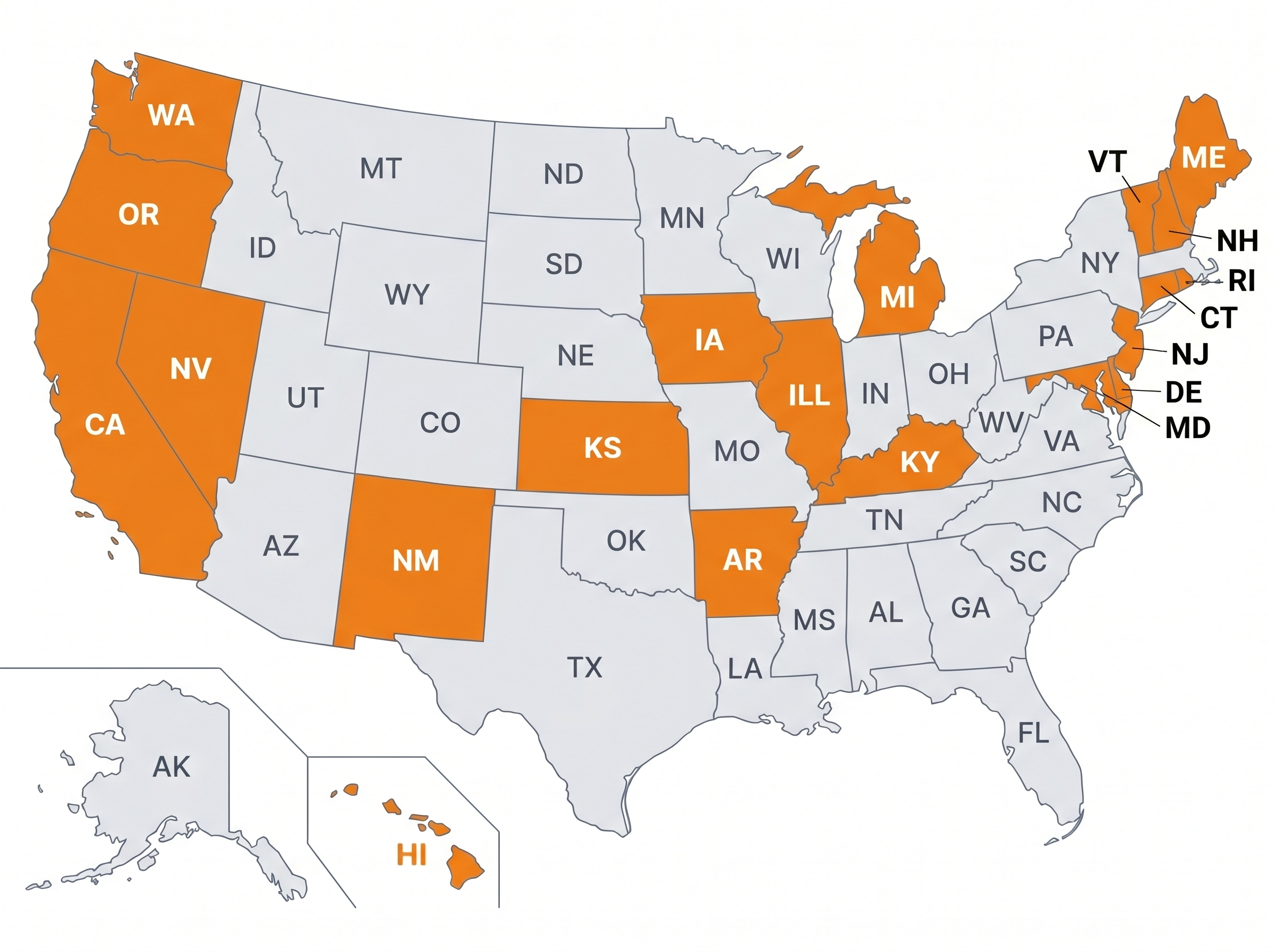
From California to Connecticut, science teachers in the 20 states that adopted NGSS are using Kesler Science to save time and engage students.
Teachers in NGSS States
Love Kesler Science
What Teachers Are Saying
"I'm able to access rigorous NGSS-aligned lessons and labs that are ready to use, so I spend more time helping students directly and less time searching for quality material."
"There's a lesson for each of the NGSS, so I don't have to search for hours to find a good quality lesson. I can spend more time actually teaching."
"The resources help me cover NGSS in a meaningful way, and my students gain a deeper knowledge of the concepts, with learning that's more self-driven."
Give Your Science Teachers Everything They Need
School and district licenses give your teachers access to every resource they need, including station labs, inquiry labs, anchoring phenomena, presentations, escape rooms, and much more. One purchase covers the grade levels you need.
- PO-friendly. We accept purchase orders
- Volume discounts for 11+ teachers
- Complimentary membership orientation for 4+ teachers
- Three free implementation PD sessions for departments of 11+
- Aligned to the NGSS standards

See It in Action
Book a walkthrough and we'll show you how Kesler Science fits your campus.
Book Demo CallNo pressure, no hard sell
"My assistant principal stopped in my room and immediately noticed how the students were engrossed in their centers and how they moved seamlessly from center to center. Also the built-in modifications really impressed!"
"It provides differentiated instruction for all types of learners, allowing them to become more engaged."
"I love it all!! I have become a facilitator in my class and I love the excitement it brings to my class. The kids love all that we do with the Kesler products."