.png?width=375&height=100&name=WebPage%20logo%20with%20curves%202026%20(8).png)
NGSS Resource Hub
Three-dimensional breakdowns, phenomena, and classroom-ready activities for every NGSS standard, grades 4-8.

🚀 Jump to Your Discipline
Middle School NGSS Standards
Pick any standard. Each page is your full lesson-planning workspace for that standard.
Synthetic Materials From Natural Resources: Tracing Stuff Back to the Source
"Gather and make sense of information to describe that synthetic materials come from natural resources and impact society."
NGSS Lead States. (2013). Next Generation Science Standards: For states, by states (MS-PS1-3). The National Academies Press. https://www.nextgenscience.org/dci-arrangement/ms-ps1-matter-and-its-interactions
The focus is on natural resources that go through a chemical process to produce synthetic materials. New materials might include things like medicines, foods, and alternative fuels.
Summarized in our own words from the MS-PS1-3 clarification statement (NGSS Lead States, 2013). Not a verbatim quote.
Students only need to work with qualitative information.
Summarized in our own words from the MS-PS1-3 assessment boundary (NGSS Lead States, 2013). Not a verbatim quote.
The three dimensions packed into this standard
Every standard bundles a DCI (the content), a SEP (the science practice), and a CCC (the crosscutting lens). They run in the same task, not in sequence.
"Each pure substance has characteristic physical and chemical properties (for any bulk quantity under given conditions) that can be used to identify it."
National Research Council. (2012). A framework for K-12 science education: Practices, crosscutting concepts, and core ideas. The National Academies Press. https://doi.org/10.17226/13165
"Substances react chemically in characteristic ways. In a chemical process, the atoms that make up the original substances are regrouped into different molecules, and these new substances have different properties from those of the reactants."
National Research Council. (2012). A framework for K-12 science education. The National Academies Press.
Synthetic materials don't appear out of nowhere. Every plastic bottle, every pill, every polyester shirt started as something natural: oil pumped from the ground, natural gas, plant compounds, ore. A chemical process rearranges those atoms into a new substance with different properties. The new substance can do something the original couldn't. Strength, flexibility, waterproofness, healing.
"Gather, read, and synthesize information from multiple appropriate sources and assess the credibility, accuracy, and possible bias of each publication and methods used, and describe how they are supported or not supported by evidence."
National Research Council. (2012). A framework for K-12 science education. The National Academies Press.
Students aren't running a reaction in a beaker. They're reading. Articles, infographics, product labels, news pieces. The work is picking through information, deciding what's credible, and pulling out the through-line: natural resource in, chemical process happens, synthetic material out, society changes because of it. Information literacy is the lab.
"Structures can be designed to serve particular functions by taking into account properties of different materials, and how materials can be shaped and used."
National Research Council. (2012). A framework for K-12 science education. The National Academies Press.
Synthetic materials are designed on purpose. Someone needed a fabric that wouldn't tear, so nylon got engineered. Someone needed a painkiller you could swallow, so aspirin got made. The properties of the material match the job it has to do. Structure and function, but at the level of "why does this stuff exist at all?"
📍 Where This Standard Fits in the K-12 Progression
Use this to plan the year. Knowing what students should already know and what they're heading toward keeps the lesson focused.
NGSS doesn't list a direct elementary lead-in for this standard. The closest prior knowledge students bring is 5.PS1.A (matter is made of small particles) and 5-ESS3-1 (humans use Earth's resources and that use has impacts). Most students arrive having never thought about where everyday materials actually come from.
Synthetic Materials From Natural Resources: Tracing Stuff Back to the Source
Students dig into the chemistry of how synthetic materials are designed at the molecular level, the resource and energy costs of making them, and the long-term impact of producing and disposing of them at scale. Trade-offs become quantitative rather than qualitative.
🌎 Phenomena for MS-PS1-3
Anchor the lesson in one puzzling phenomenon kids keep coming back to. Use the two investigative phenomena to sharpen specific facets.
The Pill That Came From a Tree
Hold up an aspirin tablet next to a piece of willow bark. The pill is small, white, identical to every other one in the bottle. The bark is rough, brown, full of fibers, smells like wood. The pill works the same every time. The bark works sometimes, sort of, depending on which piece you chew. People used the bark for thousands of years before chemists figured out how to make the pill.
"How did people turn a tree into a reliable medicine, and what did that change about how the world works?"
- "What's actually inside the bark that makes it work?"
- "If aspirin and willow bark do the same thing, why is one way better?"
- "Are there other natural things we've turned into medicine? How did chemists figure those out too?"
A Plastic Bottle's Backstory
A clear plastic water bottle on the desk. Then a photo of an oil pump in West Texas. The bottle and the oil look nothing alike. But every plastic bottle in the room started as crude oil somewhere underground. The chemical process in the middle is what changed everything. Use this to sharpen the "natural resource to synthetic product" lens the anchor is pushing on.
"How does black goopy oil become a clear, lightweight, leak-proof water bottle, and what does that transformation cost us?"
- "What part of the oil actually becomes the plastic?"
- "If plastic comes from oil, will we run out of plastic when we run out of oil?"
- "Why is plastic so hard to break down if it came from something that was once alive?"
The Fertilizer That Fed the World
A bag of synthetic lawn fertilizer next to a picture of clear blue sky. Most of the nitrogen in that bag came from the air. About a hundred years ago, chemists figured out how to pull nitrogen out of the atmosphere and turn it into fertilizer. That single invention changed how much food the planet could grow. It also changed what runs off into rivers. Same kind of source-to-product chain as the anchor, with bigger stakes.
"If fertilizer comes from the air, why does it sometimes cause so much damage to lakes and rivers?"
- "How do you turn a gas into a solid you can sprinkle on a lawn?"
- "What happens to the fertilizer that doesn't get used by the plants?"
- "Could we feed everyone without synthetic fertilizer? What would change?"
100% Aligned Lessons for Every NGSS Standard You Teach
The membership gives you access to thousands of lessons and activities designed to boost student engagement and reclaim valuable teaching time. Trusted by schools and districts from every NGSS state.
⚠️ Misconceptions Your Students Will Walk In With
These come up almost every year. Knowing them in advance lets you head them off in the first lesson.
"Synthetic means fake or unnatural in a bad way"
Synthetic just means made by humans through a chemical process, usually from natural starting materials. Aspirin is synthetic. So is insulin used by diabetics. So are most modern medicines. "Synthetic" describes how something was made, not whether it's good or bad. The judgment about impact comes from evidence, not from the word itself.
"Plastic and other synthetic stuff just gets manufactured. It doesn't really come from nature."
Every synthetic material starts with a natural resource. Most plastics come from petroleum, which is the remains of ancient organisms that got pressurized underground for millions of years. Synthetic fertilizers come partly from atmospheric nitrogen. Even completely lab-made medicines start with carbon and other atoms pulled from natural sources. There's no "manufactured from scratch." It's always rearranged from something.
"Natural materials are always better than synthetic ones"
Not always. Natural rubber cracks in extreme cold. Synthetic rubber doesn't. Cotton ropes rot. Nylon ropes don't. Willow bark tea can ease pain but doses are wildly inconsistent. Aspirin tablets are predictable to the milligram. The honest answer is that each has trade-offs. "Better" depends on what job the material has to do.
"If a material is synthetic, it must be more harmful to the environment"
Some synthetic materials cause serious environmental damage (single-use plastics, certain fertilizers running off into waterways). Some reduce harm compared to natural alternatives (synthetic fabrics that don't require farmland, synthetic medicines that don't require harvesting endangered plants). Impact has to be evaluated case by case using actual evidence, not assumed from the word "synthetic."
🙋 Common Student Questions and How to Respond
These come up almost every time this standard gets taught. Plan a response and you'll keep the lesson focused.
Oil is a mix of long chains of carbon and hydrogen atoms. Refineries heat it up and split those chains apart into smaller pieces. Then chemists hook the pieces back together in long repeating chains called polymers. Different chains give you different plastics. The atoms are mostly the same. The arrangement is what makes oil into a milk jug.
People did for thousands of years. The active compound in willow bark eases pain, but the amount in any piece of bark is unpredictable. Chemists figured out how to make a similar molecule in a lab at a precise dose. Same effect, way more reliable. That's the trade-off the chemical process bought us: consistency you can't get from chewing on a tree.
Testing, regulation, and time. New medicines go through years of trials before they're approved. Materials that touch food or skin get reviewed by agencies like the FDA. But "safe" isn't permanent. Some materials we used widely (lead in paint, certain pesticides) turned out to be harmful after decades. That's why source-checking and updating what we know matters.
Probably not any that hurt zero. Making any new material takes energy and produces waste. But some are designed to do less harm. Biodegradable plastics break down faster than regular plastic. Some new materials get made from corn or sugar instead of petroleum. The honest framing is "less harmful," not "no harm." Track the trade-offs.
📓 Teaching Resources for MS-PS1-3
These resources are aligned to this standard.
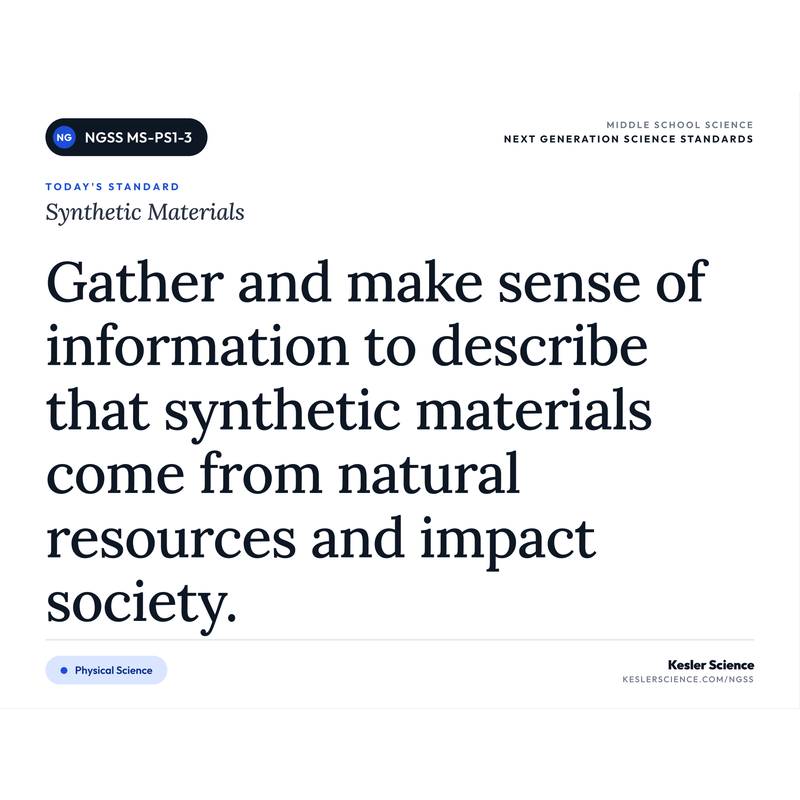
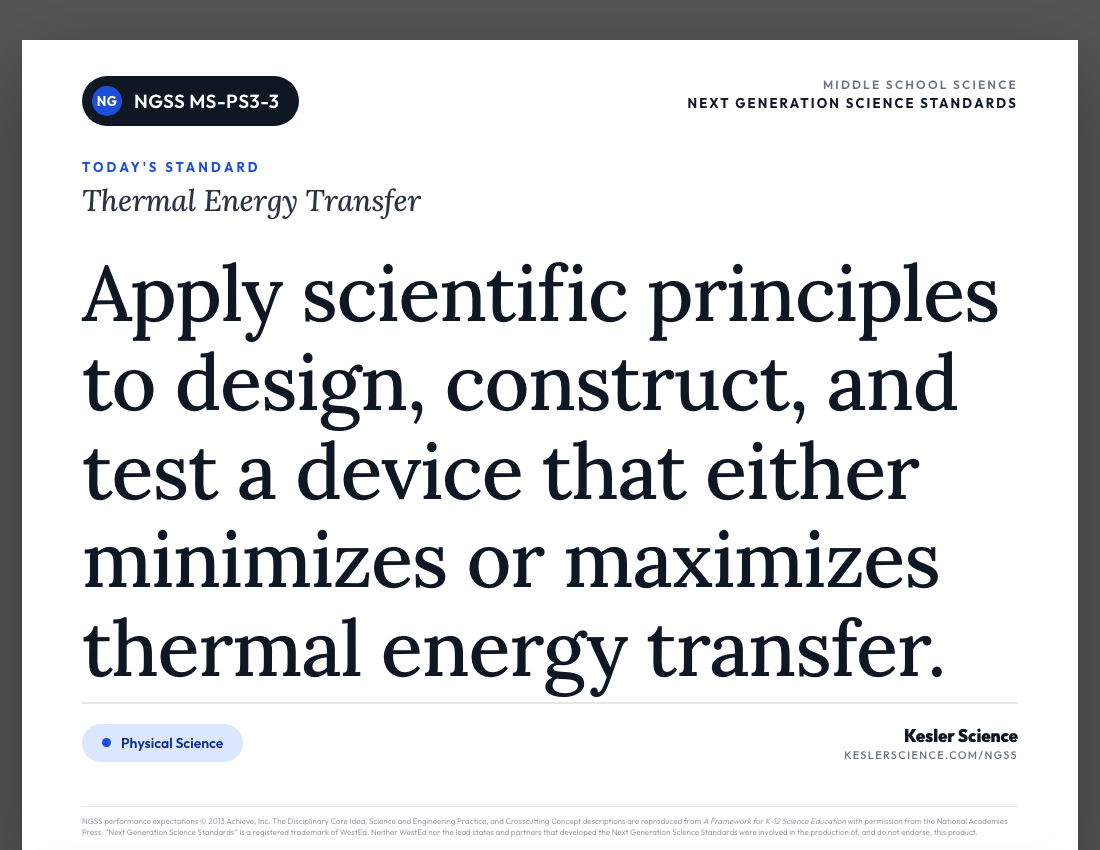
Print-ready classroom poster pack for MS-PS1-3. Includes the verbatim NGSS performance expectation plus student-language "I Can" statements broken into daily learning goals. Landscape orientation, letter size, ready to print and post on your wall.
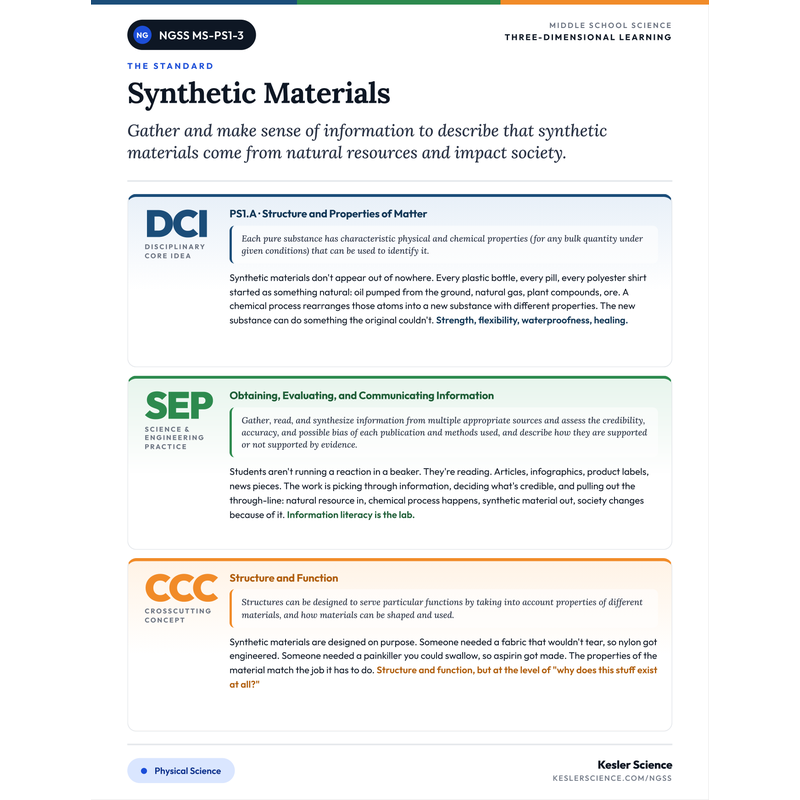
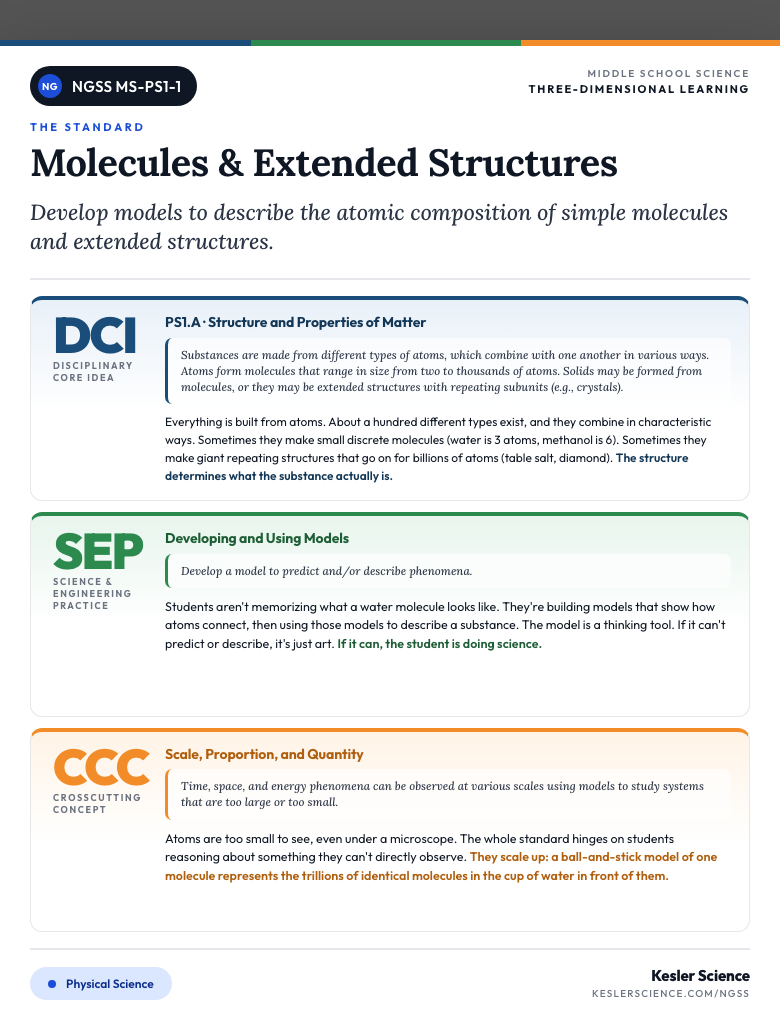
Teacher-facing PDF that breaks down the DCI, SEP, and CCC for MS-PS1-3 in plain English. Color-coded by dimension so you can read the whole standard at a glance. Perfect for lesson planning or a sub folder.
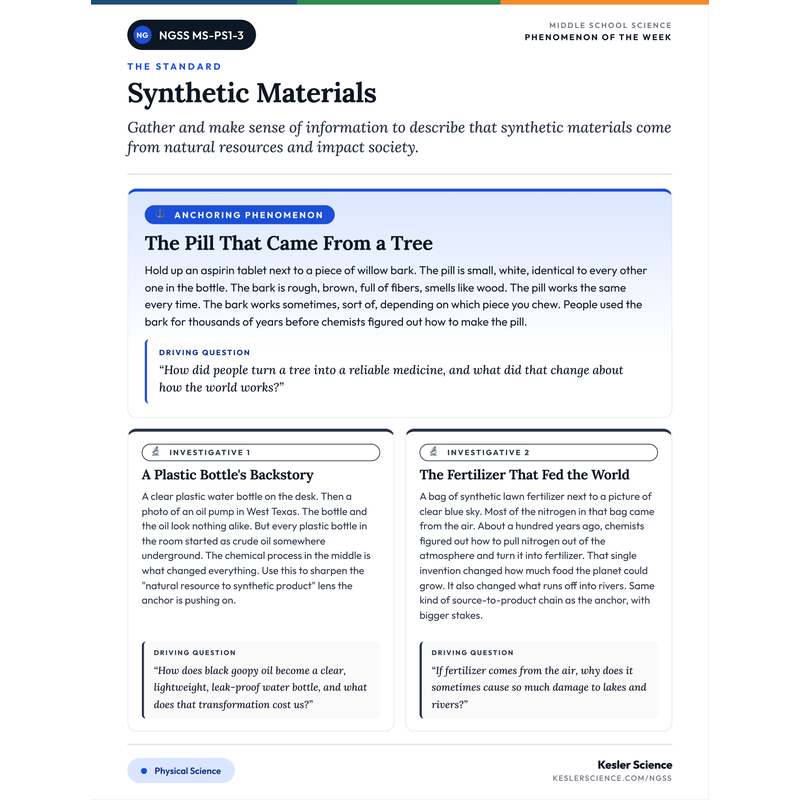
One-page printable with the anchoring phenomenon plus two investigative phenomena for MS-PS1-3. Each one comes with the driving question students will keep asking. Pin it above your desk for the week. One piece of paper, one week of hooks.

A hands-on inquiry investigation where students investigate how synthetic materials are made from natural resources and how they affect society. Includes student handouts, teacher guide, and materials list. 3 versions for differentiation. Both print and digital version included.

An anchoring phenomenon—Solar Panels—that bookends your synthetic materials lesson with an intro reading and an explanatory reading, each with comprehension and extension questions. Includes teacher directions with answer keys, projection slides, editable digital PPTs, and print handouts for INBs.

A leveled nonfiction reading passage that builds science literacy while reinforcing synthetic materials. Students read an engaging article—Impacts of Synthetic Materials—then answer comprehension questions. Two reading levels for differentiation. Includes the passage, comprehension questions, answer key, and both print and digital versions.

A print-and-digital science writing activity where students reason and write about synthetic materials through an engaging real-world prompt. Includes teacher directions with an answer guide and project ideas. Great for constructed response, bell-ringers, or science journals.
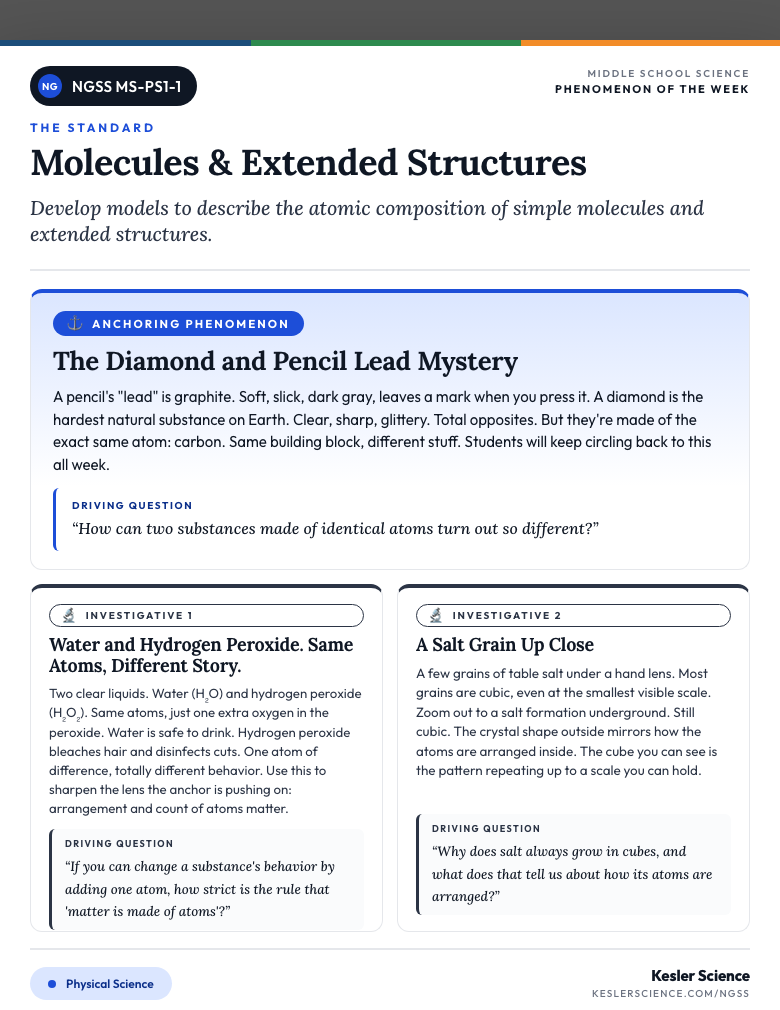
Teaching more than this one standard?
Get every I Can poster, phenomenon hook, and 3-dimension sheet for all 59 Middle School standards, in one download. The whole year, ready to print.
📚 Vocabulary Students Need for MS-PS1-3
Twelve terms students need to access this standard. Definitions in plain-English, classroom-ready language.
A material that comes from the Earth and isn't made by humans. Oil, natural gas, ore, wood, water, and atmospheric nitrogen are all natural resources.
Crude oil pumped from underground. Made of long chains of carbon and hydrogen atoms. The raw material for most plastics, synthetic fabrics, and many medicines.
Methane and other gases pumped from underground. Used as a fuel and as a starting material for fertilizers and some plastics.
Rock containing useful metal compounds. Iron ore, bauxite (aluminum), and copper ore are all sources for metals.
A natural resource that replenishes on a human timescale. Wood, water, and solar energy are renewable.
A natural resource that doesn't replenish on a human timescale. Petroleum, natural gas, and most ores are nonrenewable.
A substance made by humans through a chemical process, usually starting from a natural resource. Plastic, nylon, aspirin, and synthetic rubber are synthetic.
A series of chemical reactions that rearrange the atoms in a starting material into a new substance with different properties.
A material made of long, repeating chains of smaller molecules. Most plastics are polymers. So are natural materials like cellulose in wood.
A synthetic or semi-synthetic medicine. Aspirin, antibiotics, and insulin are all pharmaceuticals.
A consequence (positive, negative, or both) that a material has on how people live. Cheap plastic packaging changed food storage. Synthetic fertilizer changed farming yields.
A gain in one area that comes with a loss in another. Synthetic materials usually come with trade-offs. Cheaper but more pollution. Stronger but less biodegradable.
💡 Free Engagement Ideas for MS-PS1-3
Trace the Object Source Hunt
Each pair gets an everyday classroom object: a plastic ruler, a polyester backpack strap, a vitamin tablet, a sticky note, a rubber band. They have 20 minutes and three pre-screened sources to find: the natural resource it came from, the chemical process that made it, one property it has that its source didn't, and one society impact. Posters get displayed for a gallery walk.
Source Credibility Sort
Students get 6 short readings about plastic in the ocean from different sources: a news article, a plastic-industry FAQ, an environmental nonprofit page, a personal blog, a peer-reviewed summary, a TikTok transcript. They sort by credibility and explain their ranking using specific reasons (who wrote it, what's the agenda, what evidence is cited). The point is the sort, not the topic.
Property Match: Synthetic vs. Source
Card-matching activity. One pile of cards lists synthetic materials (nylon, aspirin, polyester, kevlar). Another lists natural sources (petroleum, willow compounds, etc.). A third lists properties the synthetic has that the source didn't (predictable dose, stretches without tearing, waterproof, stops bullets). Pairs match all three. Pure information-processing with no chemicals.
Society Impact Debate Cards
Pairs each get one synthetic material and 5 minutes to read a short briefing. They have to argue both sides: "this material is great for society" and "this material is hard on society." Whichever side they argue first depends on a coin flip. The point is forcing them to see both sides of the trade-off, then writing a 3-sentence honest assessment after.
📝 Assessment Ideas for MS-PS1-3
Three short tasks that hit all three dimensions. Doable in one class period each.
Students get a synthetic material they haven't seen yet (semi-synthetic rubber, biodegradable plastic, a specific synthetic vitamin). Using two short articles you provide, they write a one-page response that names the natural resource, describes the chemical process in plain language, identifies the key property of the synthetic, and names one society impact backed by the readings.
Give students two articles about the same synthetic material that disagree about its environmental impact (one industry source, one watchdog source). Students write a half-page comparison: where do the two sources agree, where do they disagree, which one would you trust more for this question and why? Mirrors the SEP wording about credibility and bias.
Students get a list of 4 jobs a material has to do: stop a bullet, dissolve in water and ease a headache, hold a soccer ball's shape, fertilize a cornfield. For each, they pick one synthetic material (kevlar, aspirin, synthetic rubber, ammonium nitrate) and explain in 2-3 sentences why that material's properties match that job. Then they name the natural resource each one came from.
🎯 What Proficient Student Work Looks Like
Same prompt, three student responses at different proficiency levels. Use as anchor papers when scoring.
"Pick one synthetic material we studied this week. Use the articles you read to describe where it came from, how it was made, and one way it has changed society."
- A specific claim backed by data, observation, or model
- Use of standard-specific vocabulary in context
- Connection between the visible and the underlying explanation
- A question they're still wondering about (curiosity stays alive)
I picked plastic. Plastic comes from oil. People make it into bottles and bags and lots of other stuff. Plastic is bad for the environment because it doesn't break down.
Names the source ("oil") and a general impact ("doesn't break down") but doesn't describe the chemical process or cite anything from the readings. The property of plastic that matters (its durability is also why it lingers) isn't connected. Stops at the surface level.
I picked polyester. Polyester comes from petroleum, which is the same thing as crude oil. The oil gets split apart into smaller molecules in a refinery, then those molecules get linked together into long chains called polymers. Polyester is the result. According to the article from the textile industry source, polyester clothing doesn't wrinkle and dries fast, which is why it's used in workout clothes. According to the environmental article, polyester sheds tiny plastic fibers when it's washed, and those fibers end up in waterways. So polyester changed how clothes work and how they hold up, but it also added a new kind of pollution we didn't have before.
Names the source, describes the chemical process in middle school terms, cites both readings, and identifies a property (no wrinkles, fast-drying) that's tied to a function (workout clothes). Connects the property to a society impact (microplastic pollution). Hits exactly what the standard is targeting.
I picked synthetic fertilizer. The nitrogen in fertilizer mostly comes from the air, which is about 78 percent nitrogen gas. The chemical process that pulls it out is called the Haber process, and it combines nitrogen from the air with hydrogen from natural gas to make ammonia. Ammonia is the building block for fertilizers like ammonium nitrate. According to the agriculture article, this invention is one of the main reasons the world can feed as many people as it does today. Without it, we'd have to grow most of our nitrogen using plants like beans, which takes more land and time. According to the environmental article, the same fertilizer that helps crops also runs off into rivers when it rains, and that runoff feeds algae blooms that suffocate fish. The property that makes fertilizer useful (it dissolves in water and plants can absorb it) is the same property that makes it a problem (it dissolves in water and washes away). I trusted the agriculture source for the history but I trusted the environmental source more on the runoff because the agriculture source didn't mention runoff at all, which felt like a gap.
Names the source (atmospheric nitrogen + natural gas), names the chemical process (Haber process, though by name not mechanism), cites multiple sources, identifies a key property (dissolves in water) and connects it to BOTH the benefit and the harm, and evaluates source credibility by name. Catches an omission in one source. This is exactly the source-evaluation thinking the SEP is asking for, applied to real trade-offs.
“Next Generation Science Standards” is a registered trademark of WestEd. Neither WestEd nor the lead states and partners that developed the Next Generation Science Standards were involved in the production of, and do not endorse, this product.
NGSS performance expectations © 2013 Achieve, Inc. The Disciplinary Core Idea, Science and Engineering Practice, and Crosscutting Concept descriptions are reproduced from A Framework for K-12 Science Education with permission from the National Academies Press.
Trusted Across NGSS States
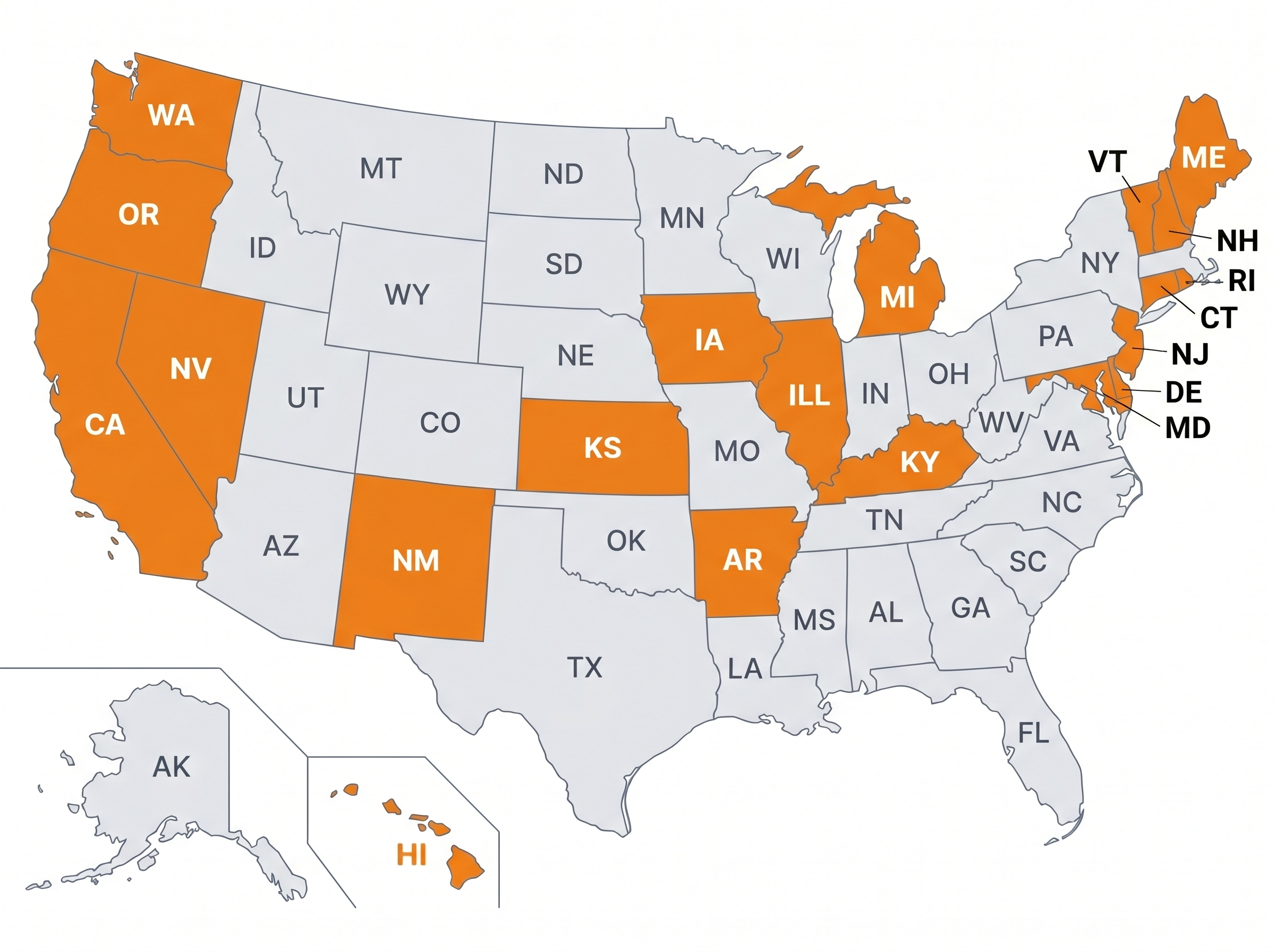
From California to Connecticut, science teachers in the 20 states that adopted NGSS are using Kesler Science to save time and engage students.
Teachers in NGSS States
Love Kesler Science
What Teachers Are Saying
"I'm able to access rigorous NGSS-aligned lessons and labs that are ready to use, so I spend more time helping students directly and less time searching for quality material."
"There's a lesson for each of the NGSS, so I don't have to search for hours to find a good quality lesson. I can spend more time actually teaching."
"The resources help me cover NGSS in a meaningful way, and my students gain a deeper knowledge of the concepts, with learning that's more self-driven."
Give Your Science Teachers Everything They Need
School and district licenses give your teachers access to every resource they need, including station labs, inquiry labs, anchoring phenomena, presentations, escape rooms, and much more. One purchase covers the grade levels you need.
- PO-friendly. We accept purchase orders
- Volume discounts for 11+ teachers
- Complimentary membership orientation for 4+ teachers
- Three free implementation PD sessions for departments of 11+
- Aligned to the NGSS standards
See It in Action
Book a walkthrough and we'll show you how Kesler Science fits your campus.
Book Demo CallNo pressure, no hard sell
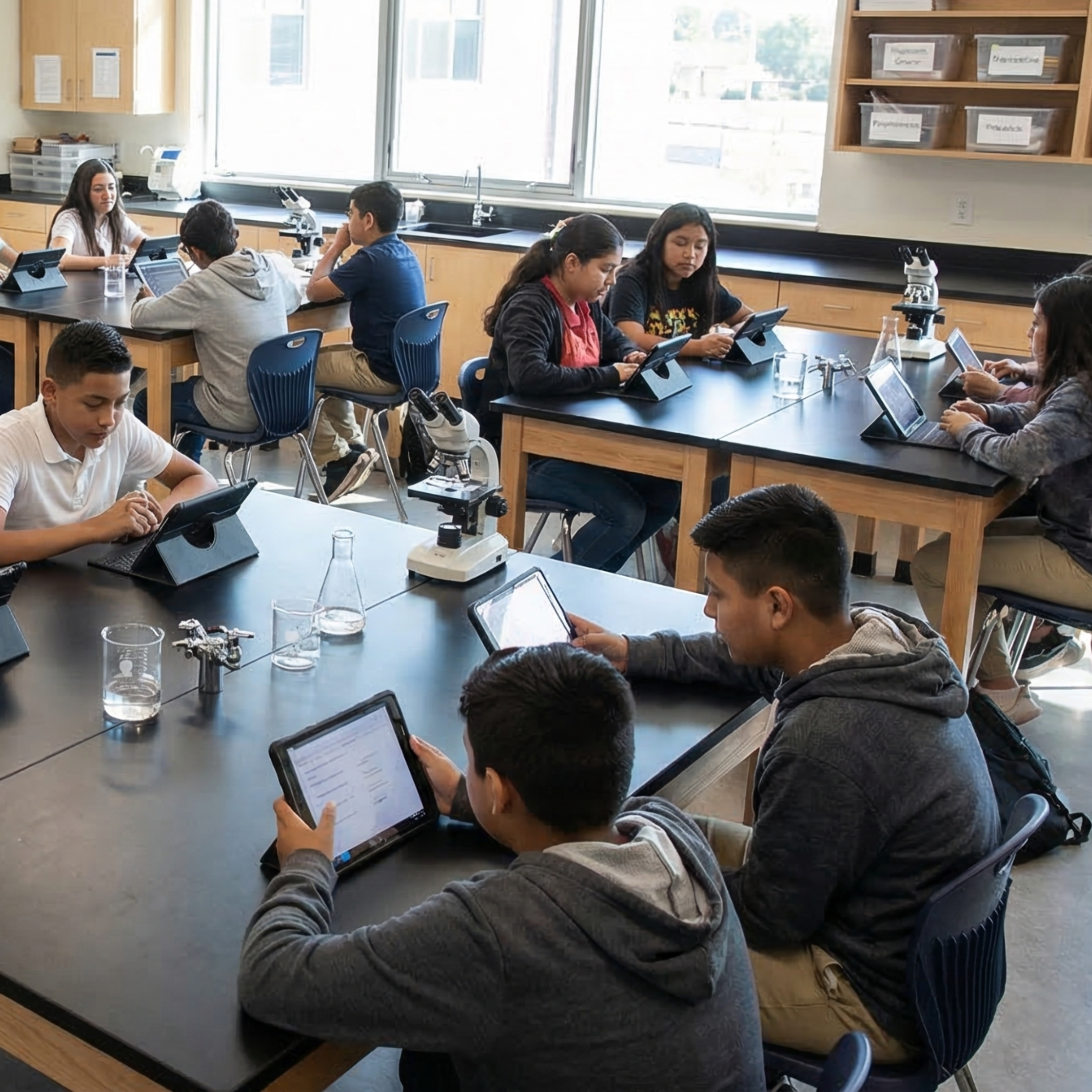
"My assistant principal stopped in my room and immediately noticed how the students were engrossed in their centers and how they moved seamlessly from center to center. Also the built-in modifications really impressed!"
"It provides differentiated instruction for all types of learners, allowing them to become more engaged."
"I love it all!! I have become a facilitator in my class and I love the excitement it brings to my class. The kids love all that we do with the Kesler products."