.png?width=375&height=100&name=WebPage%20logo%20with%20curves%202026%20(8).png)
NGSS Resource Hub
Three-dimensional breakdowns, phenomena, and classroom-ready activities for every NGSS standard, grades 4-8.

🚀 Jump to Your Discipline
Middle School NGSS Standards
Pick any standard. Each page is your full lesson-planning workspace for that standard.
Gravitational Interactions: Arguing From Evidence That Mass Matters
"Construct and present arguments using evidence to support the claim that gravitational interactions are attractive and depend on the masses of interacting objects."
NGSS Lead States. (2013). Next Generation Science Standards: For states, by states (MS-PS2-4). The National Academies Press. https://www.nextgenscience.org/dci-arrangement/ms-ps2-motion-and-stability-forces-and-interactions
Evidence supporting arguments might include data from simulations or digital tools, along with charts showing mass, the strength of the interaction, distance from the Sun, and the orbital periods of objects in the solar system.
Summarized in our own words from the MS-PS2-4 clarification statement (NGSS Lead States, 2013). Not a verbatim quote.
Students are not expected to use Newton's Law of Gravitation or Kepler's Laws.
Summarized in our own words from the MS-PS2-4 assessment boundary (NGSS Lead States, 2013). Not a verbatim quote.
The three dimensions packed into this standard
Every standard bundles a DCI (the content), a SEP (the science practice), and a CCC (the crosscutting lens). They run in the same task, not in sequence.
"Gravitational forces are always attractive. There is a gravitational force between any two masses, but it is very small except when one or both of the objects have large mass (e.g., Earth and the sun)."
National Research Council. (2012). A framework for K-12 science education: Practices, crosscutting concepts, and core ideas. The National Academies Press. https://doi.org/10.17226/13165
Gravity isn't an Earth-only thing. Every object with mass pulls on every other object with mass. We just don't notice most of those pulls because the masses involved are too small. When one object is huge (Earth, the Sun, Jupiter), the pull is obvious. Two pencils on a desk pull on each other too. The effect is just way too tiny to see.
"Construct and present oral and written arguments supported by empirical evidence and scientific reasoning to support or refute an explanation or a model for a phenomenon or a solution to a problem."
National Research Council. (2012). A framework for K-12 science education. The National Academies Press.
Students aren't memorizing that "gravity depends on mass." They're being handed evidence sets (orbital data, falling-object data, tidal patterns) and asked to build a claim, back it with the data, and present it so a peer can push back. The argument is the science. A claim without evidence isn't an argument, it's a guess.
"Models can be used to represent systems and their interactions, such as inputs, processes and outputs, and energy and matter flows within systems."
National Research Council. (2012). A framework for K-12 science education. The National Academies Press.
A gravitational system is the Sun and its planets. Or Earth and the Moon. Or Earth and a dropped apple. Students treat each as a system: which objects are interacting, which masses are involved, and what the pull does to the motion. The system model is the frame that makes the evidence add up.
📍 Where This Standard Fits in the K-12 Progression
Use this to plan the year. Knowing what students should already know and what they're heading toward keeps the lesson focused.
The gravitational force of Earth pulls objects toward the planet's center. That's why dropped things fall down. Students treat gravity as a single Earth-only pull, not yet as something every mass does.
Gravitational Interactions: Arguing From Evidence That Mass Matters
Students quantify gravity with Newton's Law of Gravitation, work with inverse-square distance effects, and use Kepler's Laws to explain orbital motion in the solar system and beyond.
🌎 Phenomena for MS-PS2-4
Anchor the lesson in one puzzling phenomenon kids keep coming back to. Use the two investigative phenomena to sharpen specific facets.
The Moon Has Been Up There the Whole Time
Show a time-lapse of the Moon crossing the night sky, or a series of photos from the same window at the same time of night across a month. The Moon keeps showing up. It hasn't drifted off into space, and it hasn't crashed into Earth. Something invisible is keeping it on the same path for billions of years. Students will keep circling back to this all week.
"What's holding the Moon in place if there's nothing physical connecting it to Earth?"
High Tide, Low Tide, Same Beach
Two photos of the same coastline six hours apart. Water level dramatically different. Ask students what could move that much water across a whole ocean twice a day, every day, on a perfect schedule. Then drop the hint: the Moon. Use this to sharpen the "gravity works at a distance" lens the anchor is pushing on. The Moon is hundreds of thousands of miles away and still moving oceans.
"How can the Moon move that much water from that far away?"
Drop Two Different Objects At Once
Drop a textbook and a small rubber ball from the same height at the same time. They hit the ground at the same moment. Then watch a clip of the famous hammer-and-feather drop from the Apollo 15 mission on the Moon. No air, same result. Use this to sharpen the "mass and acceleration" facet. Heavier doesn't mean faster falling. Mass matters for gravitational pull, but acceleration near a planet is the same for everything.
"If gravity depends on mass, why don't heavier objects fall faster?"
100% Aligned Lessons for Every NGSS Standard You Teach
The membership gives you access to thousands of lessons and activities designed to boost student engagement and reclaim valuable teaching time. Trusted by schools and districts from every NGSS state.
⚠️ Misconceptions Your Students Will Walk In With
These come up almost every year. Knowing them in advance lets you head them off in the first lesson.
"There's no gravity in space"
Gravity is everywhere. Astronauts on the ISS aren't gravity-free; they're in free fall around Earth. They're falling toward Earth and moving sideways fast enough that they keep missing it. That's what orbit is. Earth's gravity is still pulling on them at almost the same strength as on the ground.
"Gravity only works one way. Earth pulls things down; the things don't pull back."
Gravity is mutual. The apple pulls on Earth with the same force Earth pulls on the apple. We don't see Earth move toward the apple because Earth is so much more massive. Same force, very different effect on the motion of each object.
"Heavier objects fall faster"
In a vacuum, a feather and a bowling ball fall at the same rate. On Earth, air resistance makes light things fall slower, but that's air pushing back, not gravity being weaker. Gravity gives every object the same acceleration near Earth's surface, regardless of mass.
"Gravity is just an Earth thing"
Every object with mass exerts gravity. The Sun holds the whole solar system together because of its enormous mass. The Moon pulls on Earth's oceans, which is why we have tides. Two coins on a desk pull on each other too; the effect is just too tiny to measure without special equipment.
🙋 Common Student Questions and How to Respond
These come up almost every time this standard gets taught. Plan a response and you'll keep the lesson focused.
You actually do. You and that building pull on each other right now. The pull is real, but the masses involved (you and a building) are tiny compared to Earth's mass. Earth's pull is so much stronger that it drowns out every other gravitational pull around you. Real effect, just way too small to feel.
The Moon is falling toward Earth. Constantly. But the Moon is also moving sideways, fast. It falls toward Earth and moves sideways at the same time, so it keeps curving around Earth instead of hitting it. That's orbit. If the Moon slowed down enough, it would spiral in. If it sped up enough, it would fly away.
That's a great question physicists are still working on at the deepest level. At the middle-school level, gravity acts across distance without anything in between, the same way magnetism does. You can feel a magnet's pull on a paperclip through air. Gravity works similarly across the empty space between Earth and the Sun.
Yes, but not by much over distances you'd notice. At the top of Mount Everest, gravity is about 0.3% weaker than at sea level. On the ISS, gravity is still about 90% as strong as on the ground. Astronauts float because they're in free fall, not because gravity is gone. The further you get from a mass, the weaker its pull, but the change is gradual.
📓 Teaching Resources for MS-PS2-4
These resources are aligned to this standard.
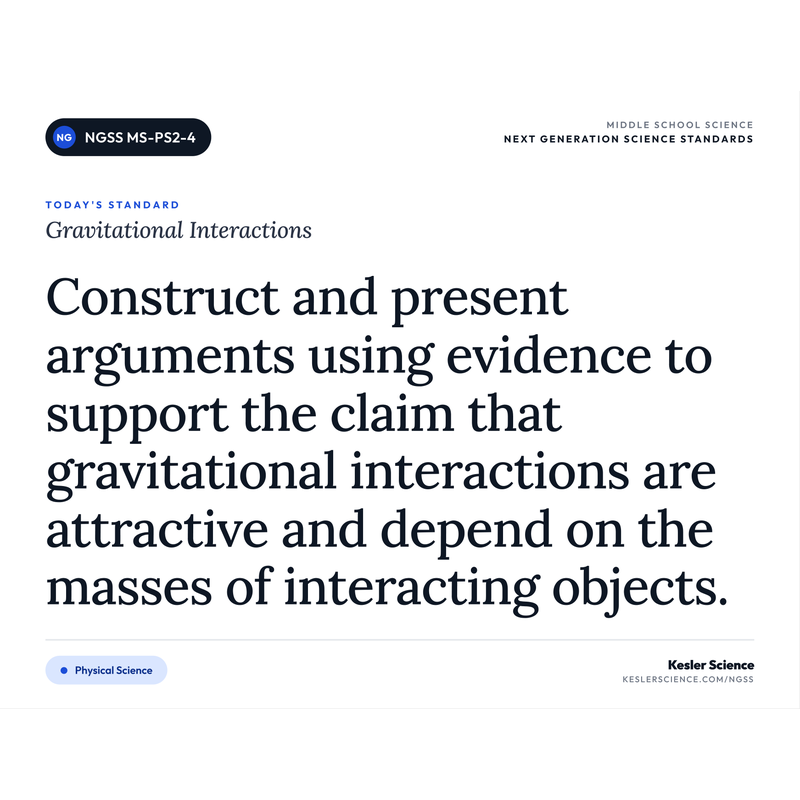
Print-ready classroom poster pack for MS-PS2-4. Includes the verbatim NGSS performance expectation plus student-language "I Can" statements broken into daily learning goals. Landscape orientation, letter size, ready to print and post on your wall.
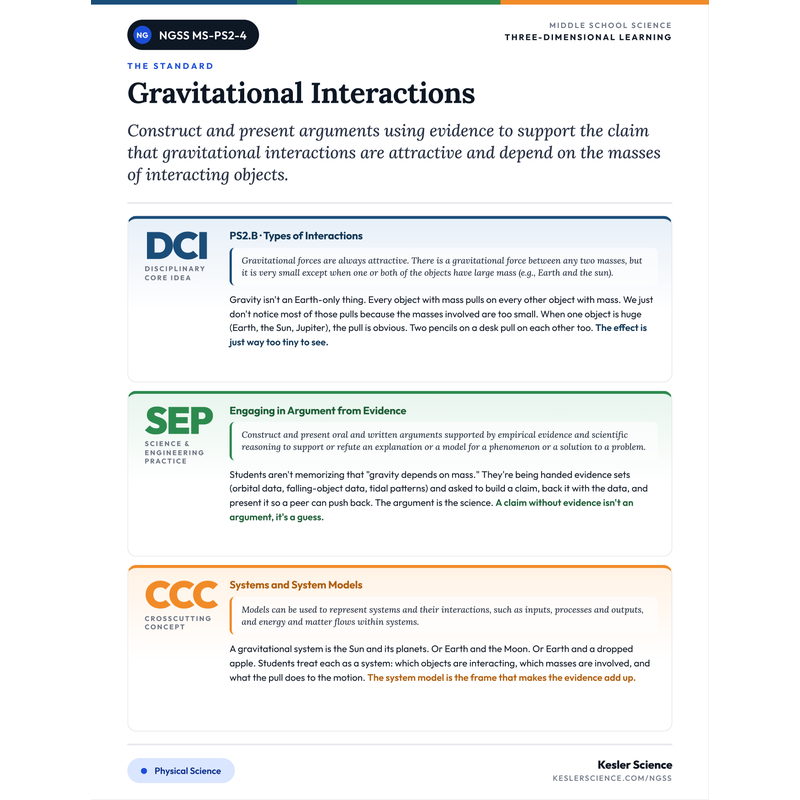
Teacher-facing PDF that breaks down the DCI, SEP, and CCC for MS-PS2-4 in plain English. Color-coded by dimension so you can read the whole standard at a glance. Perfect for lesson planning or a sub folder.
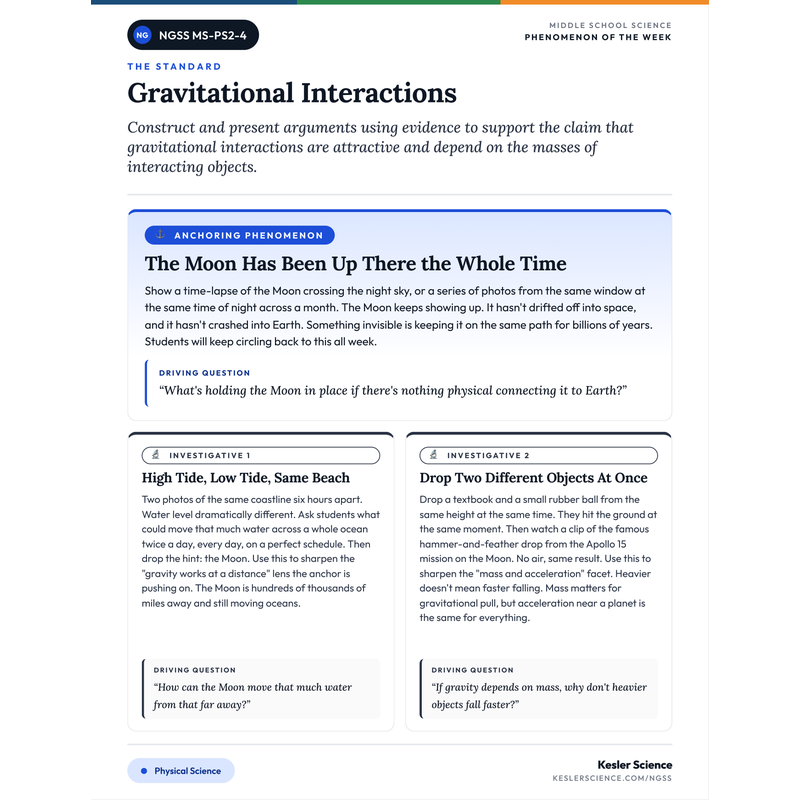
One-page printable with the anchoring phenomenon plus two investigative phenomena for MS-PS2-4. Each one comes with the driving question students will keep asking. Pin it above your desk for the week. One piece of paper, one week of hooks.

A hands-on inquiry investigation where students gather evidence that gravitational forces depend on the masses of objects and are always attractive. Includes student handouts, teacher guide, and materials list. 3 versions for differentiation. Both print and digital version included.

An anchoring phenomenon that bookends your gravitational interactions lesson with an intro reading and an explanatory reading, each with comprehension and extension questions. Includes teacher directions with answer keys, projection slides, editable digital PPTs, and print handouts for INBs.

A leveled nonfiction reading passage that builds science literacy while reinforcing gravity. Students read an engaging article—Gravity Attracts—then answer comprehension questions. Two reading levels for differentiation. Includes the passage, comprehension questions, answer key, and both print and digital versions.

A print-and-digital science writing activity where students reason and write about gravity through an engaging real-world prompt. Includes teacher directions with an answer guide and project ideas. Great for constructed response, bell-ringers, or science journals.
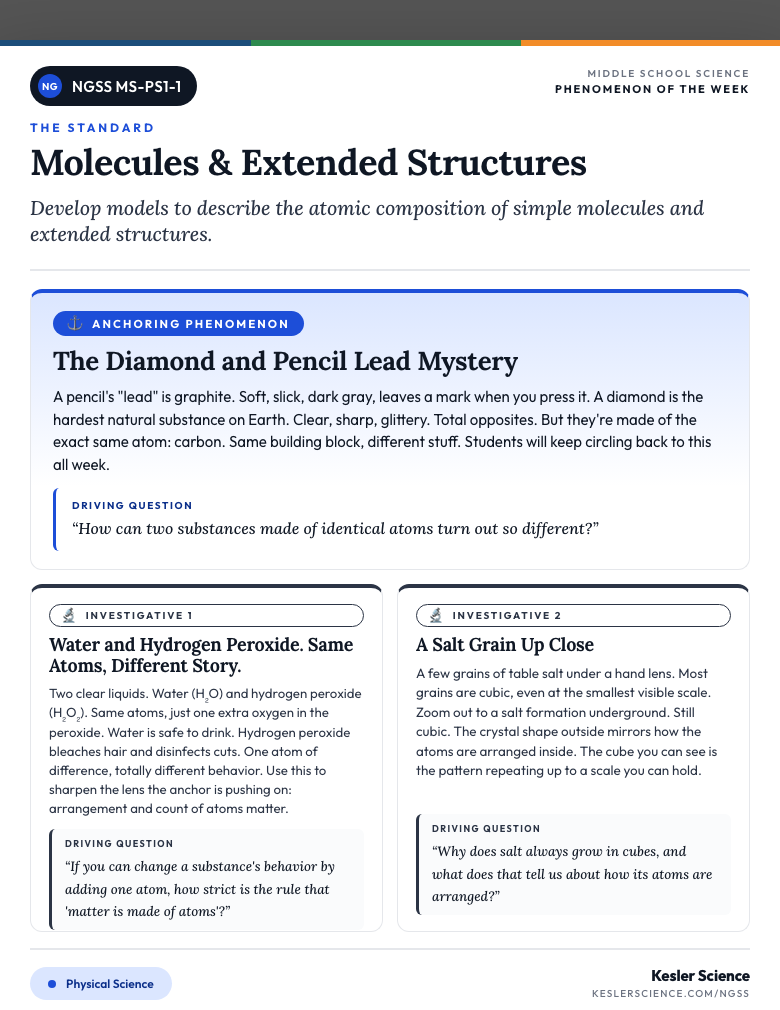
Teaching more than this one standard?
Get every I Can poster, phenomenon hook, and 3-dimension sheet for all 59 Middle School standards, in one download. The whole year, ready to print.
📚 Vocabulary Students Need for MS-PS2-4
Twelve terms students need to access this standard. Definitions in plain-English, classroom-ready language.
The attractive pull between any two objects that have mass. Always pulls, never pushes.
The amount of matter in an object. More mass means more gravitational pull. Mass is the same on Earth, on the Moon, or in space.
The pull of gravity on an object's mass. Weight changes depending on where you are (less on the Moon, more on Jupiter), but mass stays the same.
A force that pulls two objects together. Gravity is always attractive.
Falling under the influence of gravity alone, with nothing else slowing or pushing you. Astronauts on the ISS are in free fall.
A repeating curved path one object takes around another because of gravity. The Moon orbits Earth, Earth orbits the Sun.
A statement of what you believe to be true based on evidence. The claim in this standard is "gravity is attractive and depends on mass."
Data, observations, or measurements that support a claim. Orbital data, tidal photos, and falling-object times are all evidence here.
The thinking that connects your evidence to your claim. The "why does this evidence support this claim?" part.
A claim plus the evidence and reasoning that back it up. In science, an argument is presented and defended, not only stated.
A group of objects that interact with each other. Earth and the Moon form a system. The Sun and all the planets form a bigger system.
A representation of a system that shows what's interacting and how. A drawing of Earth with arrows for the Moon's pull is a system model.
💡 Free Engagement Ideas for MS-PS2-4
Planet Data Sort
Pairs get a printed card deck with 8 solar system objects (the Sun, Mercury, Venus, Earth, Mars, Jupiter, Saturn, the Moon). Each card lists mass and distance from the Sun. Students sort the cards by mass, then by distance, then talk about why the Sun being most massive matters for the whole system. They write a one-sentence claim about what mass has to do with gravity.
Free-Fall Drop Timing
Students use a phone stopwatch or a free-fall app to time how long different objects take to fall a fixed distance (about 2 meters). They drop a coin, a pencil, a small textbook, and a crumpled paper ball. They record times in a chart and graph the results. The takeaway: weight doesn't change the fall time, but air resistance on the paper does. Then a short clip of the Apollo hammer-and-feather seals it.
PhET Gravity and Orbits Sim
Use the free PhET "Gravity and Orbits" sim. Students change the mass of the Sun and watch what happens to Earth's orbit. They change the mass of Earth and watch what happens to the Moon. They record three predictions, run the sim, and write whether each prediction held up. The "turn gravity off" button is the favorite. Everything goes flying.
Argument Carousel
Six argument stations around the room. Each has one evidence card and one claim card. Examples: "Claim: The Sun pulls on Jupiter. Evidence: Jupiter orbits the Sun." Students rotate through, write whether the evidence supports the claim, and add one more piece of evidence that would strengthen it. After the carousel, the class votes on the strongest argument.
📝 Assessment Ideas for MS-PS2-4
Three short tasks that hit all three dimensions. Doable in one class period each.
Students get a data table of the 8 planets (mass and orbital period) and write a claim-evidence-reasoning paragraph arguing that the Sun's huge mass is what holds the solar system together. They must cite at least two specific pieces of data and explain how those data points support the claim.
Students get four statements about gravity and decide whether each is correct or a misconception. For each, they write one sentence of evidence or reasoning. Sample statements: "Astronauts float because there's no gravity in space." / "A bowling ball falls faster than a tennis ball." / "Earth pulls on the Moon, but the Moon doesn't pull on Earth." / "The Sun's mass is why the planets orbit it." They must distinguish accurate claims from misconceptions and justify each choice.
Students draw a system model showing the Earth-Moon system. Their model must label both masses, show the direction of the gravitational pull (with arrows on both objects, since gravity is mutual), and include a 2-3 sentence caption explaining what's happening in the system. They then add a second drawing showing what would change if the Moon's mass doubled.
🎯 What Proficient Student Work Looks Like
Same prompt, three student responses at different proficiency levels. Use as anchor papers when scoring.
"Use evidence to argue that gravitational interactions are attractive and depend on the masses of the interacting objects."
- A specific claim backed by data, observation, or model
- Use of standard-specific vocabulary in context
- Connection between the visible and the underlying explanation
- A question they're still wondering about (curiosity stays alive)
Gravity is the force that pulls things down. The Sun has lots of gravity because it is big. The planets go around the Sun because of gravity. Heavy things have more gravity than light things.
Names gravity and connects it to size, but doesn't cite specific evidence and doesn't distinguish mass from size. Calls the pull "down" instead of mutual. No system framing.
Gravitational interactions are attractive and depend on mass. Evidence: The Sun is the most massive object in the solar system, and every planet orbits it, which shows the Sun's mass is pulling on every planet. Evidence: The Moon orbits Earth because Earth has enough mass to hold it in orbit, but Earth doesn't have a moon orbiting Mars because the masses aren't right for that system. Reasoning: When one object has a lot of mass, its gravitational pull is strong enough to keep less-massive objects in orbit around it. Gravity is attractive because the planets are being pulled toward the Sun, not pushed away.
Clear claim, two specific evidence pieces, reasoning that ties evidence to claim. Uses system thinking (Sun-planets, Earth-Moon). Identifies gravity as attractive. Hits exactly what the standard targets.
Claim: Gravitational interactions are always attractive and depend on the masses of both objects involved. Evidence 1: The Sun has about 333,000 times the mass of Earth, and all 8 planets orbit the Sun. The most massive object is at the center of the system, and less-massive objects circle it. Evidence 2: Ocean tides on Earth follow the Moon's position. Twice a day, water bulges toward where the Moon is, which means the Moon's mass is pulling on Earth's oceans across about 240,000 miles of empty space. Reasoning: If gravity were one-directional, the Moon couldn't pull on Earth's oceans because only Earth would pull on the Moon. The fact that tides exist proves both masses pull on each other. The Sun-planet evidence shows that bigger mass means stronger pull, because the Sun's mass is what holds the whole system together. Counter-argument: A student might say astronauts on the ISS prove there's no gravity in space, but astronauts are in free fall around Earth, which actually proves gravity is still pulling on them strongly.
Stated claim, multiple specific pieces of evidence with quantitative detail (mass ratio, distance), reasoning that connects evidence to the mutual nature of gravity, and a handled counter-argument. Treats two systems (Sun-planets, Earth-Moon) as evidence for the same principle. This is the kind of argument the standard targets.
“Next Generation Science Standards” is a registered trademark of WestEd. Neither WestEd nor the lead states and partners that developed the Next Generation Science Standards were involved in the production of, and do not endorse, this product.
NGSS performance expectations © 2013 Achieve, Inc. The Disciplinary Core Idea, Science and Engineering Practice, and Crosscutting Concept descriptions are reproduced from A Framework for K-12 Science Education with permission from the National Academies Press.
Trusted Across NGSS States
From California to Connecticut, science teachers in the 20 states that adopted NGSS are using Kesler Science to save time and engage students.
Teachers in NGSS States
Love Kesler Science

What Teachers Are Saying
"I'm able to access rigorous NGSS-aligned lessons and labs that are ready to use, so I spend more time helping students directly and less time searching for quality material."
"There's a lesson for each of the NGSS, so I don't have to search for hours to find a good quality lesson. I can spend more time actually teaching."
"The resources help me cover NGSS in a meaningful way, and my students gain a deeper knowledge of the concepts, with learning that's more self-driven."
Give Your Science Teachers Everything They Need
School and district licenses give your teachers access to every resource they need, including station labs, inquiry labs, anchoring phenomena, presentations, escape rooms, and much more. One purchase covers the grade levels you need.
- PO-friendly. We accept purchase orders
- Volume discounts for 11+ teachers
- Complimentary membership orientation for 4+ teachers
- Three free implementation PD sessions for departments of 11+
- Aligned to the NGSS standards
See It in Action
Book a walkthrough and we'll show you how Kesler Science fits your campus.
Book Demo CallNo pressure, no hard sell
"My assistant principal stopped in my room and immediately noticed how the students were engrossed in their centers and how they moved seamlessly from center to center. Also the built-in modifications really impressed!"
"It provides differentiated instruction for all types of learners, allowing them to become more engaged."
"I love it all!! I have become a facilitator in my class and I love the excitement it brings to my class. The kids love all that we do with the Kesler products."