.png?width=375&height=100&name=WebPage%20logo%20with%20curves%202026%20(8).png)
NGSS Resource Hub
Three-dimensional breakdowns, phenomena, and classroom-ready activities for every NGSS standard, grades 4-8.

🚀 Jump to Your Discipline
Middle School NGSS Standards
Pick any standard. Each page is your full lesson-planning workspace for that standard.
Cycling of Earth's Materials: Modeling the Rock Cycle and the Energy That Drives It
"Develop a model to describe the cycling of Earth's materials and the flow of energy that drives this process."
NGSS Lead States. (2013). Next Generation Science Standards: For states, by states (MS-ESS2-1). The National Academies Press. https://www.nextgenscience.org/dci-arrangement/ms-ess2-earths-systems
The focus is on how processes such as melting, crystallization, weathering, deformation, and sedimentation work together to form minerals and rocks as Earth's materials cycle.
Summarized in our own words from the MS-ESS2-1 clarification statement (NGSS Lead States, 2013). Not a verbatim quote.
Students are not expected to identify and name minerals.
Summarized in our own words from the MS-ESS2-1 assessment boundary (NGSS Lead States, 2013). Not a verbatim quote.
The three dimensions packed into this standard
Every standard bundles a DCI (the content), a SEP (the science practice), and a CCC (the crosscutting lens). They run in the same task, not in sequence.
"All Earth processes are the result of energy flowing and matter cycling within and among the planet's systems. This energy is derived from the sun and Earth's hot interior. The energy that flows and matter that cycles produce chemical and physical changes in Earth's materials and living organisms."
National Research Council. (2012). A framework for K-12 science education: Practices, crosscutting concepts, and core ideas. The National Academies Press. https://doi.org/10.17226/13165
Rocks aren't permanent. They're just one stage in a cycle. A volcanic rock can break down into sand. Sand can get buried and packed into sandstone. Sandstone can get cooked and squeezed into a different rock entirely. Cooked deeper, it melts into magma and starts the loop over. Two energy sources drive the whole thing: the sun (weathering, water moving sediment) and Earth's internal heat (volcanoes, mountain-building, melting).
"Develop and use a model to describe phenomena."
National Research Council. (2012). A framework for K-12 science education. The National Academies Press.
Students aren't memorizing a chart of rock names. They're building a model that shows how matter moves between forms and where the energy comes from at each step. The model is the thinking. If a student can point at their diagram and trace one atom from a lava flow to a beach to a buried layer to magma again, they're doing the science.
"Explanations of stability and change in natural or designed systems can be constructed by examining the changes over time and processes at different scales, including the atomic scale."
National Research Council. (2012). A framework for K-12 science education. The National Academies Press.
A rock looks stable. On a human timescale it basically is. Stretch the timescale to millions of years and that same rock is in motion: breaking down, getting buried, melting, recrystallizing. The cycle is what changes. The material is what stays. Stability and change live in the same system, depending on how far back you zoom.
📍 Where This Standard Fits in the K-12 Progression
Use this to plan the year. Knowing what students should already know and what they're heading toward keeps the lesson focused.
Earth's surface is shaped by slow processes like weathering and erosion and fast events like volcanoes and earthquakes. Water plays a role in nearly all of it. Rocks, soil, water, and air interact as parts of larger Earth systems.
Cycling of Earth's Materials: Modeling the Rock Cycle and the Energy That Drives It
Earth's systems are dynamic and interacting, driven by energy from the sun and the planet's interior. Feedback loops among the geosphere, hydrosphere, atmosphere, and biosphere shape the surface over deep time. Plate tectonics provides the unifying mechanism for crustal change.
🌎 Phenomena for MS-ESS2-1
Anchor the lesson in one puzzling phenomenon kids keep coming back to. Use the two investigative phenomena to sharpen specific facets.
The Layered Highway Road Cut
A photo (or a field trip if you can swing it) of a highway road cut showing 20 distinct horizontal layers of rock, each a different color. The bottom layers are gray limestone full of tiny shell fragments. The middle layers are red sandstone. The top is dark shale. Students notice immediately that the layers look like a stack of pancakes and that each one used to be something at the surface. The question that sticks: how did all of this used to be loose stuff, and what's holding it together now?
"How did 30 meters of solid rock get built up in layers, and how long did it take?"
- "Why are the layers different colors and textures?"
- "What happened in between layers? Was something growing or living there?"
- "If we keep going down, do we eventually hit a rock that was never a layer?"
Marble Countertops, Limestone Floors
A piece of polished marble next to a piece of polished limestone. Same atoms (calcium carbonate). Almost identical chemistry. But marble has swirly veins and a crystalline shine. Limestone has fossils and a duller surface. Use this one to sharpen the heat-and-pressure lens the anchor is pushing on. The marble used to be limestone before it got cooked and squeezed deep underground.
"If marble and limestone are basically the same chemical, why do they look and feel so different?"
- "What had to happen to the limestone to turn it into marble?"
- "Could the marble turn back into limestone, or is it stuck this way?"
- "Where on Earth is limestone becoming marble right now?"
Yellowstone Hot Springs and the Grand Canyon
Two photos side by side. Yellowstone hot springs steaming and bubbling, fed by magma a few kilometers underground. The Grand Canyon, a mile deep, carved by the Colorado River over six million years. Same planet, two completely different energy sources making the landscape. Yellowstone is internal heat doing visible work. The Grand Canyon is solar energy (driving the water cycle, driving the river) doing visible work over deep time.
"These two places are reshaping themselves right now. Where is the energy coming from in each one, and how does it connect to the rock cycle?"
- "Why is one of them changing so fast and the other so slowly?"
- "Is the river in the Grand Canyon making new rock, or just exposing old rock?"
- "Will Yellowstone eventually become a canyon, or a mountain, or something else?"
100% Aligned Lessons for Every NGSS Standard You Teach
The membership gives you access to thousands of lessons and activities designed to boost student engagement and reclaim valuable teaching time. Trusted by schools and districts from every NGSS state.
⚠️ Misconceptions Your Students Will Walk In With
These come up almost every year. Knowing them in advance lets you head them off in the first lesson.
"Rocks never change"
Rocks change constantly. They just change slowly. A granite boulder weathering on a hillside is breaking down right now, one grain at a time. In a few thousand years it might be sand on a beach. In a few million it might be buried sandstone. The "rocks are permanent" feeling comes from comparing them to our lifespan, not their actual behavior.
"All rocks were always rocks"
A lot of rock used to be something else. Sandstone used to be loose sand. Limestone used to be shells and coral. Marble used to be limestone. Slate used to be shale. Coal used to be plants. The rock you're holding has a history of being a different rock, or sometimes not a rock at all.
"Lava and magma are the same thing"
Same molten rock, different location. When it's underground, it's magma. The moment it reaches the surface (out a volcano, out a crack), it's lava. The name changes when it crosses the surface. Lava cools fast and forms small crystals. Magma cools slow underground and forms big ones.
"If a rock is hard, it must be igneous"
Hardness doesn't tell you which type of rock you have. Diamond is the hardest natural mineral on Earth, and it forms under intense heat and pressure deep in the mantle (metamorphic conditions). Slate is metamorphic and hard. Quartzite is metamorphic and hard. Some sedimentary rocks like chert are very hard. Some igneous rocks like pumice are so light they float. The type comes from how it formed, not how it feels in your hand.
🙋 Common Student Questions and How to Respond
These come up almost every time this standard gets taught. Plan a response and you'll keep the lesson focused.
We catch it mid-cycle in lots of places. Volcanoes are igneous rock forming right now. Rivers are weathering rock and dropping sediment right now. Mountain ranges getting pushed up are deforming rock right now. Geologists also use radiometric dating to measure how old different rock layers are, and the ages line up with the cycle. We don't have to watch one rock complete the whole loop to know the loop is real.
Two places. The sun powers the surface part: it heats the air and oceans, drives the water cycle, and water doing its thing is what weathers and erodes rock. Earth's internal heat (left over from the planet forming, plus decay of radioactive elements deep inside) powers the deep stuff: melting, volcanoes, mountains rising. Every arrow on a good rock cycle diagram should be labeled with one of those two energy sources.
Yes. The cycle isn't a one-way line. An igneous rock can weather straight into sediment without ever being metamorphic. A sedimentary rock can melt and become igneous without going through metamorphic. A metamorphic rock can be uplifted, weather away, and become sediment again. The classic textbook diagram is a triangle with arrows everywhere because every rock type can become any other rock type, given the right conditions.
Constantly. Hawaii is making new igneous rock every time Kilauea erupts. The Mississippi River is depositing layers of new sediment in the Gulf of Mexico that will eventually become sedimentary rock. Anywhere a tectonic plate is colliding, metamorphic rock is being made deep underground. The Earth never stops being a rock factory. The cycle is running right now.
📓 Teaching Resources for MS-ESS2-1
These resources are aligned to this standard.
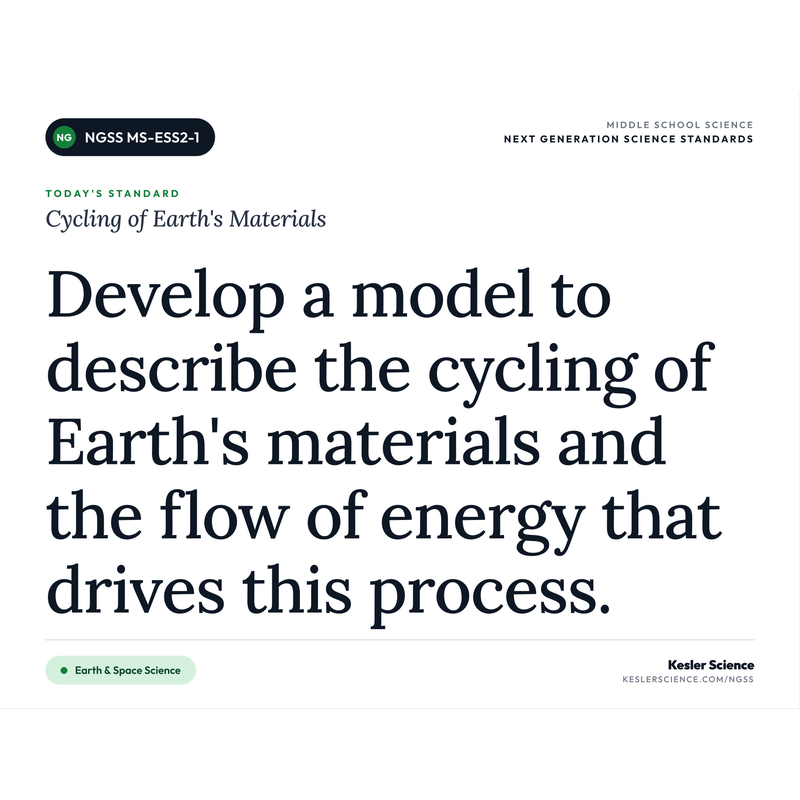
Print-ready classroom poster pack for MS-ESS2-1. Includes the verbatim NGSS performance expectation plus student-language "I Can" statements broken into daily learning goals. Landscape orientation, letter size, ready to print and post on your wall.
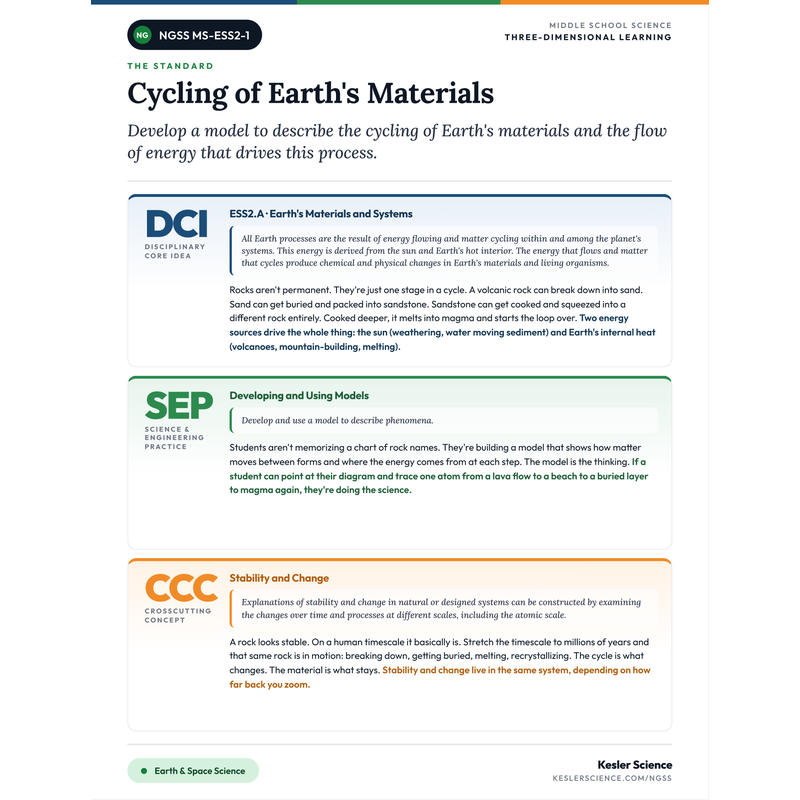
Teacher-facing PDF that breaks down the DCI, SEP, and CCC for MS-ESS2-1 in plain English. Color-coded by dimension so you can read the whole standard at a glance. Perfect for lesson planning or a sub folder.
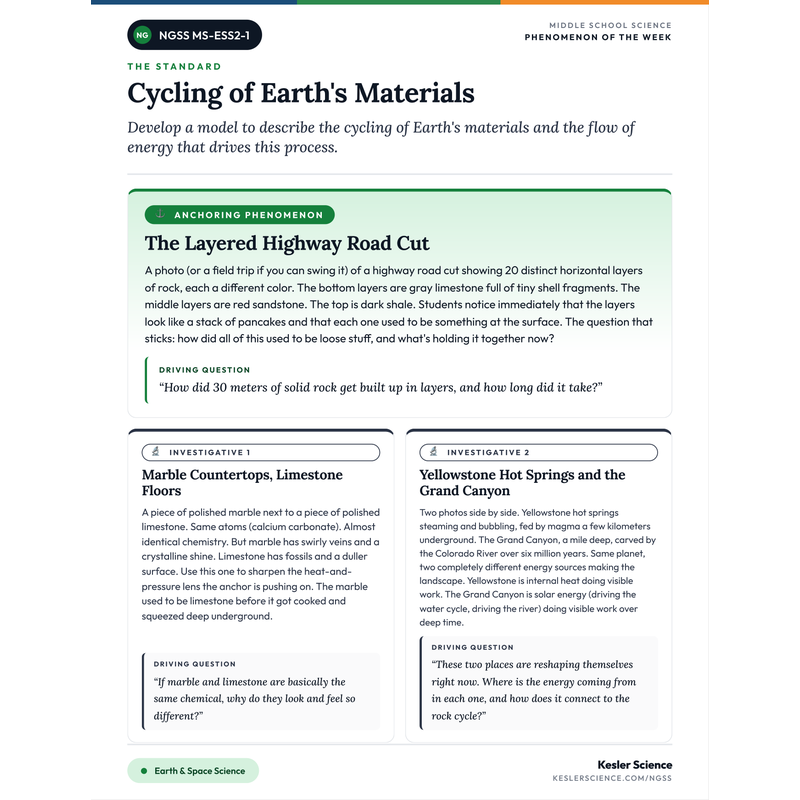
One-page printable with the anchoring phenomenon plus two investigative phenomena for MS-ESS2-1. Each one comes with the driving question students will keep asking. Pin it above your desk for the week. One piece of paper, one week of hooks.

A hands-on inquiry investigation where students model how energy and matter cycle rocks through their igneous, sedimentary, and metamorphic forms. Includes student handouts, teacher guide, and materials list. 3 versions for differentiation. Both print and digital version included.

An anchoring phenomenon—Geothermal Energy—that bookends your cycling of Earth's materials lesson with an intro reading and an explanatory reading, each with comprehension and extension questions. Includes teacher directions with answer keys, projection slides, editable digital PPTs, and print handouts for INBs.

A leveled nonfiction reading passage that builds science literacy while reinforcing cycling of Earth's materials. Students read an engaging article—Kilauea and the Rock Cycle—then answer comprehension questions. Two reading levels for differentiation. Includes the passage, comprehension questions, answer key, and both print and digital versions.

A print-and-digital science writing activity where students reason and write about cycling of Earth's materials through an engaging real-world prompt. Includes teacher directions with an answer guide and project ideas. Great for constructed response, bell-ringers, or science journals.
Teaching more than this one standard?
Get every I Can poster, phenomenon hook, and 3-dimension sheet for all 59 Middle School standards, in one download. The whole year, ready to print.
📚 Vocabulary Students Need for MS-ESS2-1
Twelve terms students need to access this standard. Definitions in plain-English, classroom-ready language.
A naturally occurring solid mixture of one or more minerals (or in some cases, organic material like coal). Granite, sandstone, and marble are all rocks.
A naturally occurring solid with a specific chemical makeup and crystal structure. Rocks are made of minerals, but a single mineral isn't a rock.
Rock formed when magma or lava cools and hardens. Granite (cooled slowly underground) and basalt (cooled quickly at the surface) are igneous.
Rock formed when sediment gets compacted and cemented together. Sandstone, shale, and limestone are sedimentary.
Rock that's been changed by heat and pressure without melting. Marble comes from limestone. Slate comes from shale. Gneiss comes from granite (or other rocks).
Molten rock underground.
Molten rock above the surface.
The breakdown of rock at or near the surface, by water, wind, ice, temperature changes, or living things.
The movement of weathered material from one place to another, usually by water, wind, or ice.
The settling out and piling up of sediment, usually at the bottom of an ocean, lake, or river.
The two steps that turn loose sediment into sedimentary rock. Compaction squeezes out water. Cementation glues grains together with minerals.
The process of magma or lava cooling and forming a solid igneous rock. Slow cooling makes big crystals. Fast cooling makes small ones.
Changes to a rock's shape, size, or arrangement caused by pressure (and often heat). The "squeeze and fold" half of metamorphism.
The continuous set of processes that move Earth's materials between igneous, sedimentary, and metamorphic forms.
The heat inside Earth, left over from the planet's formation plus heat from radioactive decay. The energy source for melting, volcanoes, and tectonic motion.
💡 Free Engagement Ideas for MS-ESS2-1
Crayon Shaving Rock Cycle Simulation
Pairs shave 3 colors of crayons onto squares of aluminum foil. They wrap and squeeze the foil to make "sedimentary" layers. Then press hard with a textbook to deform it (metamorphic). Then drop the foil packet briefly into hot tap water to melt the crayon and let it re-solidify (igneous). At each stage, they sketch what their "rock" looks like and label the process and energy source.
Rock Kit Sort by Type
Each group gets a tray of 12 unlabeled rock samples (mix of igneous, sedimentary, and metamorphic). Students sort them into 3 piles using a clue card listing the visual features of each type (crystals, layers, banding, fossils, glassy texture). They record which features they used to decide. Then they check answers with a key and revise.
Build a Rock Cycle Model
Students get a blank circular template with 3 nodes labeled IGNEOUS, SEDIMENTARY, and METAMORPHIC. They draw arrows connecting every node to every other node (6 arrows total). On each arrow they label the process (melting, weathering, heat and pressure, etc.) and the energy source (sun or internal heat). The final product is their personal rock cycle diagram, no two will look exactly alike.
Sand to Sandstone Demo
Teacher demo, students record observations. In a clear cup, layer sand, gravel, and small pebbles. Add a saturated salt water solution and let evaporate over several days. The salt crystals act as the cement. Students poke the cup each day and rate hardness on a 1-5 scale. By day 5 it should be a brittle "rock." Students connect this to how sandstone actually forms (minerals in groundwater cementing grains together over long timescales).
📝 Assessment Ideas for MS-ESS2-1
Three short tasks that hit all three dimensions. Doable in one class period each.
Students pick a starting rock (granite, limestone, or marble) and write a story tracing it through at least one full loop of the rock cycle. They must include at least 3 transitions, name the process at each step, and identify the energy source. They draw a small diagram alongside the story showing the path their rock takes.
Students get a partially-completed rock cycle diagram with intentional errors (an arrow pointing the wrong way, an energy source labeled incorrectly as "the sun" when it should be internal heat, a missing process label between sedimentary and metamorphic). They identify and correct each error, explaining their reasoning.
Students get a description of a setting they haven't studied (a desert canyon wall, a volcanic island, a metamorphic core complex). They predict what kind of rock dominates, what processes formed it, and what energy source drove the formation. Then they're shown the answer and revise their prediction with what surprised them.
🎯 What Proficient Student Work Looks Like
Same prompt, three student responses at different proficiency levels. Use as anchor papers when scoring.
"Use a model to explain how a piece of granite on a mountainside could eventually become a layer of sandstone, and identify the energy that drives each step."
- A specific claim backed by data, observation, or model
- Use of standard-specific vocabulary in context
- Connection between the visible and the underlying explanation
- A question they're still wondering about (curiosity stays alive)
The granite breaks down into sand and then the sand becomes sandstone. The sun melts the rock. So it goes from igneous to sedimentary.
Names the start and end points but misses the steps in between. The energy claim is wrong (the sun doesn't melt granite). No model. Misses what weathering, erosion, and sedimentation actually do.
Granite weathers when water freezes in its cracks and breaks pieces off. Rivers carry the pieces (erosion) until they settle at the bottom of a lake or ocean (sedimentation). Over millions of years, more layers pile on top and squeeze the sand. Minerals in groundwater cement the grains together. The sand becomes sandstone. [Includes a labeled arrow diagram: granite, weathering, sediment, transport, deposition, sandstone]. The sun drives this whole process because it powers the water cycle, which drives weathering and erosion.
Uses a model. Names the processes correctly and in order. Identifies the energy source. Connects the surface processes to solar energy through the water cycle. Hits the standard cleanly.
Granite on a mountainside breaks down through chemical and physical weathering. Water freezes in cracks and pries pieces off. Carbonic acid in rainwater slowly dissolves some minerals. The loose pieces get carried downhill by gravity, wind, and water (erosion). They settle into a low spot like a lake or sea floor (sedimentation). Over millions of years, more sediment piles on top, squeezing the bottom layers (compaction). Water moving through the layers leaves minerals behind that cement the grains together. The result is sandstone. [Includes labeled diagram with all six stages and arrows]. All the surface energy here traces back to the sun: it heats the air, drives the water cycle, and the moving water is the actual agent of weathering, erosion, and deposition. Gravity helps, but the sun started it. Internal heat doesn't show up until that sandstone gets buried deep enough to be cooked into something new.
Drawing is clear and accurate. Names all six steps correctly. Distinguishes between chemical and physical weathering. Tracks the energy back to its source through the water cycle. Recognizes that internal heat isn't part of this particular path but flags where it would enter. This is the kind of system-level thinking the standard targets.
“Next Generation Science Standards” is a registered trademark of WestEd. Neither WestEd nor the lead states and partners that developed the Next Generation Science Standards were involved in the production of, and do not endorse, this product.
NGSS performance expectations © 2013 Achieve, Inc. The Disciplinary Core Idea, Science and Engineering Practice, and Crosscutting Concept descriptions are reproduced from A Framework for K-12 Science Education with permission from the National Academies Press.
Trusted Across NGSS States
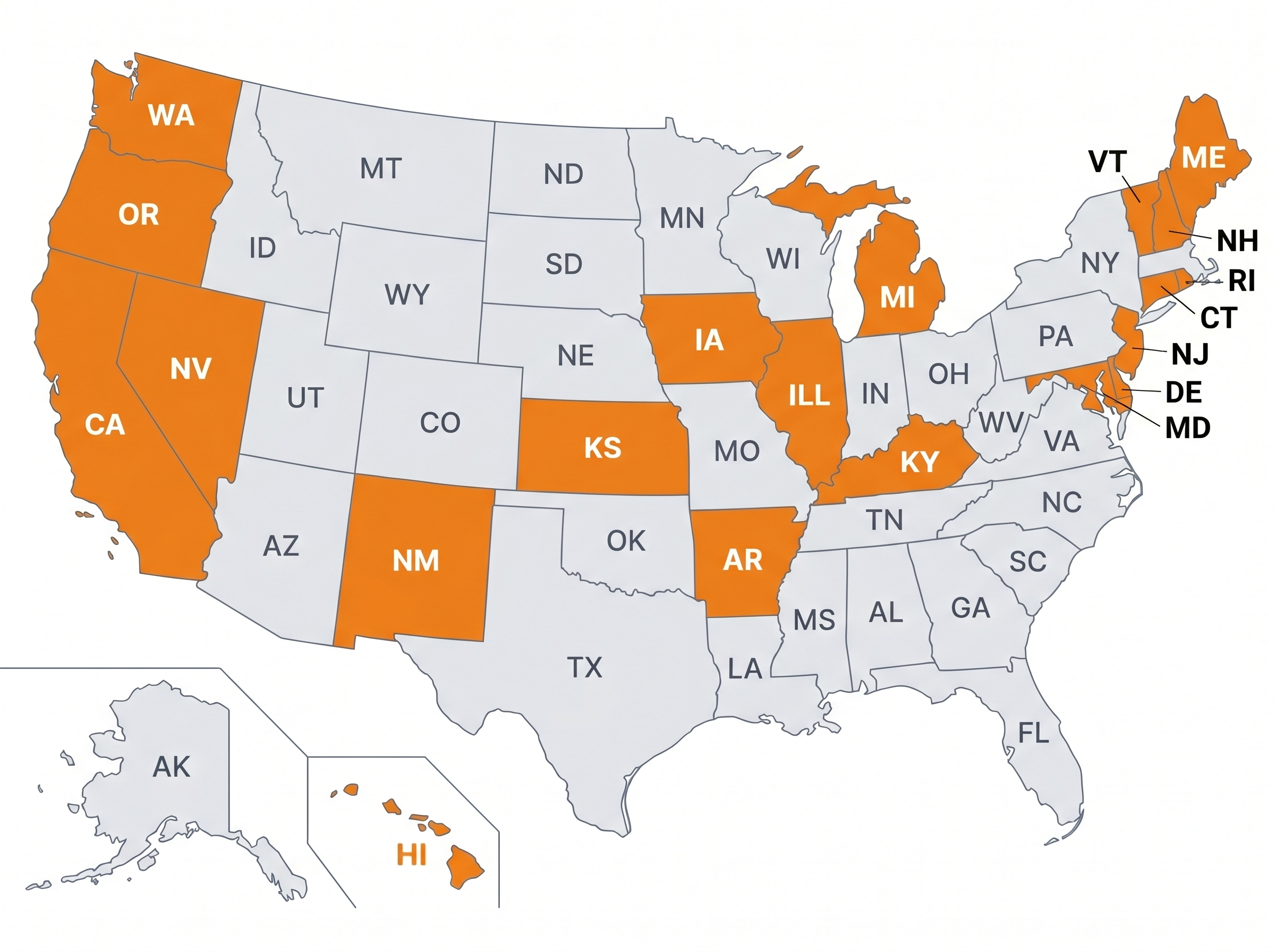
From California to Connecticut, science teachers in the 20 states that adopted NGSS are using Kesler Science to save time and engage students.
Teachers in NGSS States
Love Kesler Science
What Teachers Are Saying
"I'm able to access rigorous NGSS-aligned lessons and labs that are ready to use, so I spend more time helping students directly and less time searching for quality material."
"There's a lesson for each of the NGSS, so I don't have to search for hours to find a good quality lesson. I can spend more time actually teaching."
"The resources help me cover NGSS in a meaningful way, and my students gain a deeper knowledge of the concepts, with learning that's more self-driven."
Give Your Science Teachers Everything They Need
School and district licenses give your teachers access to every resource they need, including station labs, inquiry labs, anchoring phenomena, presentations, escape rooms, and much more. One purchase covers the grade levels you need.
- PO-friendly. We accept purchase orders
- Volume discounts for 11+ teachers
- Complimentary membership orientation for 4+ teachers
- Three free implementation PD sessions for departments of 11+
- Aligned to the NGSS standards
See It in Action
Book a walkthrough and we'll show you how Kesler Science fits your campus.
Book Demo CallNo pressure, no hard sell
"My assistant principal stopped in my room and immediately noticed how the students were engrossed in their centers and how they moved seamlessly from center to center. Also the built-in modifications really impressed!"
"It provides differentiated instruction for all types of learners, allowing them to become more engaged."
"I love it all!! I have become a facilitator in my class and I love the excitement it brings to my class. The kids love all that we do with the Kesler products."