NGSS Resource Hub
Three-dimensional breakdowns, phenomena, and classroom-ready activities for every NGSS standard, grades 4-8.

🚀 Jump to Your Discipline
Middle School NGSS Standards
Pick any standard. Each page is your full lesson-planning workspace for that standard.
Iterative Testing & Modification: Letting Data Drive the Next Version
"Develop a model to generate data for iterative testing and modification of a proposed object, tool, or process such that an optimal design can be achieved."
NGSS does not list an explicit clarification statement for this standard.
NGSS does not list an explicit assessment boundary for this standard.
The three dimensions packed into this standard
Every standard bundles a DCI (the content), a SEP (the science practice), and a CCC (the crosscutting lens). They run in the same task, not in sequence.
"A solution needs to be tested, and then modified on the basis of the test results, in order to improve it. Models of all kinds are important for testing solutions."
"The iterative process of testing the most promising solutions and modifying what is proposed on the basis of the test results leads to greater refinement and ultimately to an optimal solution."
Engineering doesn't happen in one shot. You build a version, test it, study what the data tells you, and change one thing. Then you test again. Each round (each iteration) makes the design a little better. The goal isn't a perfect solution. It's the best one you can land on inside the criteria, constraints, and time you've got.
"Develop a model to generate data to test ideas about designed systems, including those representing inputs and outputs."
Students aren't sketching a final design and calling it engineering. They're building a model (physical, drawn, or digital) for the purpose of generating data. The model exists to get tested. The data from that test points to the next change. The model is a question, not an answer.
"Engineering standards typically do not specify a single CCC."
NGSS doesn't list a single crosscutting concept for engineering standards. The one that fits best here is the Influence of Engineering, Technology, and Science on Society and the Natural World. Iterative design is how every tool, gadget, and process around students got refined: try, measure, change, retry, until it's good enough to ship.
📍 Where This Standard Fits in the K-12 Progression
Use this to plan the year. Knowing what students should already know and what they're heading toward keeps the lesson focused.
""
Iterative Testing & Modification: Letting Data Drive the Next Version
""
🌎 Phenomena for MS-ETS1-4
Anchor the lesson in one puzzling phenomenon kids keep coming back to. Use the two investigative phenomena to sharpen specific facets.
SpaceX, Year of the Exploding Rockets
Show students the Starship test footage from 2020 and 2021. Rocket after rocket. Some make it most of the way. Some explode on launch. Some explode on landing. By 2024 SpaceX is catching the rocket booster out of the sky. The whole journey is iteration in front of a camera. Engineers don't hide the failures. They use them.
"If their rockets keep blowing up, why do we still call SpaceX successful?"
- "Did they actually plan for the explosions, or were those accidents?"
- "How do you know when to stop iterating and ship something?"
- "What did they change between version 1 and version 10?"
The Paper Helicopter That Won't Quit
A single paper helicopter design, dropped from the same height ten times in a row, lands at slightly different spots each time. Same paper, same fold, same drop. The data isn't identical. Use this to sharpen the lens the anchor is pushing on: iteration isn't just about changes between versions. You have to know how much variation your test has before you can trust that a change to v2 actually mattered.
"How big does a change have to be before you can trust it actually made a difference?"
- "Why doesn't the same helicopter give the same result every time?"
- "How many drops should we do before we trust the average?"
- "If v2 is 0.1 seconds better than v1, is that a real improvement or just noise?"
The iPhone Lineup
Show the lineup of iPhones from 2007 to today. Side by side. Same product family, totally different machines. The first one has no app store, no front camera, no fingerprint reader. Each year added one or two new pieces. The change from year to year is small. The change from start to finish is enormous. Same loop as the anchor, only stretched across two decades instead of two years.
"Could Apple have built today's iPhone in 2007 if they'd just tried harder, or did each version have to come first?"
- "What did each new model change, and what stayed the same?"
- "Are there iterations that didn't work and got pulled?"
- "When does a new iPhone become a different product instead of an iteration?"
100% Aligned Lessons for Every NGSS Standard You Teach
The membership gives you access to thousands of lessons and activities designed to boost student engagement and reclaim valuable teaching time. Trusted by schools and districts from every NGSS state.
⚠️ Misconceptions Your Students Will Walk In With
These come up almost every year. Knowing them in advance lets you head them off in the first lesson.
"Iterating means starting over each time"
Iteration is the opposite of starting over. You keep what worked from the last version and change one thing. If v1 had a 1.2-second hang time and the blades looked unstable, v2 keeps everything except the blade length. The point is to build on, not erase.
"More iterations always means a better design"
Up to a point, yes. But every iteration costs time and materials, and improvements get smaller as you go. v2 might shave half a second off v1. v6 might shave a hundredth of a second off v5. Optimal means good enough within constraints, not endless improvement.
"Optimal means perfect"
Optimal means the best you can do given the criteria (what success looks like), the constraints (time, materials, money), and the tradeoffs between them. A perfect paper helicopter that takes 40 hours to build isn't optimal in a 45-minute class. Optimal is always inside a box.
"If v1 doesn't work, the design is bad"
v1 is supposed to give you data, not a finished product. A "failed" v1 is doing its job if it tells you what to change next. The design is bad only if you can't learn anything from the test. Real engineers expect v1 to fail and plan for it.
🙋 Common Student Questions and How to Respond
These come up almost every time this standard gets taught. Plan a response and you'll keep the lesson focused.
Because if you change two things and the result improves, you don't know which change did it. Maybe both helped. Maybe one helped and one hurt and you got lucky. Changing one variable per round gives you a clean signal: this change caused this difference. Engineers call it controlled iteration.
When it meets the criteria within the constraints, and the next change wouldn't improve it enough to be worth the time. If your hang time has to be at least 2 seconds and you're at 2.4, you're done. If you're at 1.9 and you've got one round left, you make the change with the biggest expected return.
A model is anything you build to learn about a design, even if it looks like the final product. Your paper helicopter is a model of how blade shape affects fall time. SpaceX flies actual rockets as models, because they're testing variables. A drawing, a Lego prototype, a digital simulation, a full-size build, all of those count. If you're using it to generate data, it's a model.
Then you learned something. The change you made hurt the design, which is just as useful as a change that helped. Go back to v1's setup for v3, and change a different variable instead. A worse iteration isn't a failure. It's evidence about what doesn't work, which narrows the search.
📓 Teaching Resources for MS-ETS1-4
These resources are aligned to this standard.
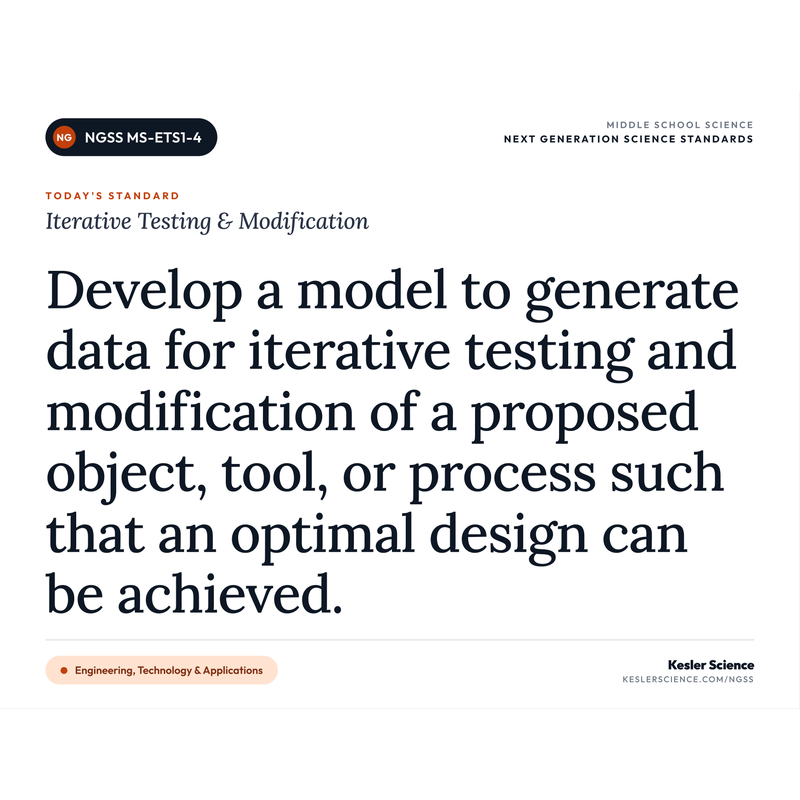
Print-ready classroom poster pack for MS-ETS1-4. Includes the verbatim NGSS performance expectation plus student-language "I Can" statements broken into daily learning goals. Landscape letter, ready to print and post on your wall.
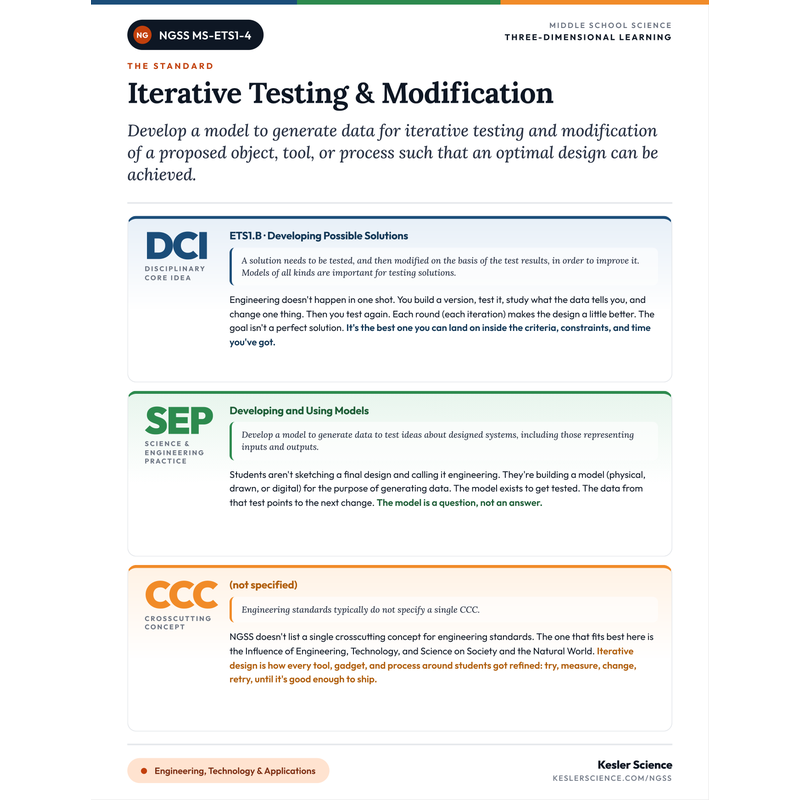
Teacher-facing PDF that breaks down the DCI, SEP, and CCC for MS-ETS1-4 in plain English. Color-coded by dimension so you can read the whole standard at a glance. Perfect for lesson planning or a sub folder.
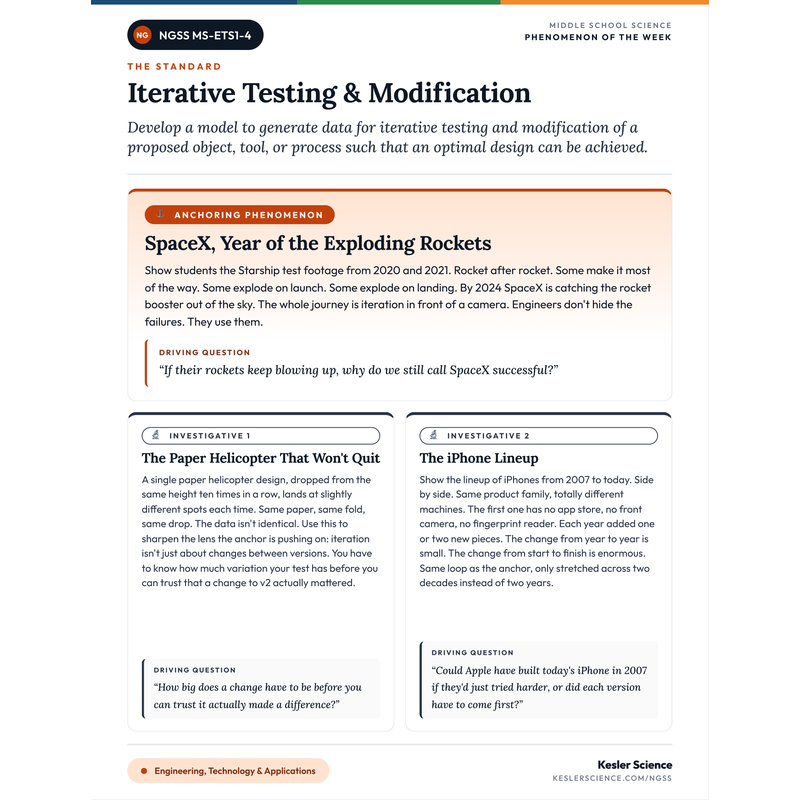
One-page printable with the anchoring phenomenon plus two investigative phenomena for MS-ETS1-4. Each one comes with the driving question students will keep asking. Pin it above your desk for the week. One piece of paper, one week of hooks.
📚 Vocabulary Students Need for MS-ETS1-4
Twelve terms students need to access this standard. Definitions in plain-English, classroom-ready language.
One round of building, testing, and modifying. v1 to v2 is one iteration. v2 to v3 is another.
A working version of a design built for testing. Doesn't have to be the final material or final size.
What the design has to do to count as successful. "Hang time at least 2 seconds" is a criterion.
The limits the design has to live within. Time, materials, cost, size. "One sheet of paper, 45 minutes" is a set of constraints.
The best design you can achieve given the criteria and constraints. Not perfect. Best within the box.
When improving one part of the design hurts another. Heavier paperclip might mean more stable flight but shorter hang time.
Anything built to generate data about a design. Physical prototype, drawing, or digital sim.
A feature of the design you can change between iterations. Blade length, weight, body height.
The measurements you record from running a test. Fall time, distance, force, count.
Changing one variable per round so the data clearly shows what that change did.
When each new iteration makes a smaller improvement than the one before. Signals you're close to optimal.
A change made between iterations, based on what the previous test data showed.
💡 Free Engagement Ideas for MS-ETS1-4
Paper Helicopter Optimization, 3 Rounds
Teams build a baseline paper helicopter from a shared template, drop it from a fixed height, and record 3 trial times. They average and log v1 data. Then they change ONE variable (blade length, body length, paperclip weight) and run v2. Same again for v3. The team with the longest average hang time wins, but every team has to show the data trail and the reasoning for each change.
Marble Run, Time Target
Teams build a cardboard marble run with the goal of getting a marble from top to bottom in exactly 4.0 seconds. Too fast or too slow both lose. They iterate: build, time 3 trials, adjust track angles or add curves, retest. The constraint forces real tradeoffs (steeper = faster but harder to control). Best team has the average closest to 4.0 across 3 final trials.
Cardboard Catapult, Hit the Zone
Teams build a small cardboard catapult and aim to land a mini marshmallow inside a target zone (a paper plate) at 2 meters. Three iterations. After each round, they measure how far short or long their shot was, and modify ONE thing (arm length, rubber band tension, launch angle). Goal: 3 of 5 shots inside the plate on round 3.
Insulating Sleeve Iteration
Each team gets a small water bottle of hot water (start at 60°C) and has 10 minutes to design an insulating sleeve using only the materials provided. They take a 5-minute temperature reading, then iterate: rebuild with one change, retest, change again. Winner has the smallest temperature drop over 5 minutes on the final iteration. Connects directly to the real-world design problem NGSS lists for this standard.
📝 Assessment Ideas for MS-ETS1-4
Three short tasks that hit all three dimensions. Doable in one class period each.
Students submit a 3-version design log from any iteration activity. For each version, they include the data (3 trials + average), the ONE change they made and why, and a one-sentence claim about whether the change helped. Final paragraph: which version was optimal and why, using the criteria and constraints they were given.
Students get 4 design logs from fictional teams. Three are clean (one variable changed per round, data tied to the next change). One is broken (two variables changed at once, or the change doesn't connect to the previous data). They identify which log is broken and explain why the data from that log can't be trusted to guide the next iteration.
Students get a partial design log: criteria, constraints, v1 data, v2 data. v2 was slightly worse than v1. Their job is to plan v3. They identify what change they'd make, why the v2 data justifies that change, and what they'd measure to know if it worked. No building required, just the reasoning.
🎯 What Proficient Student Work Looks Like
Same prompt, three student responses at different proficiency levels. Use as anchor papers when scoring.
"Use your three rounds of paper helicopter data to explain how iterative testing led you to an optimal design."
- A specific claim backed by data, observation, or model
- Use of standard-specific vocabulary in context
- Connection between the visible and the underlying explanation
- A question they're still wondering about (curiosity stays alive)
We tested our helicopter three times and it went better each time. v3 had the longest hang time of 2.1 seconds. We made it better by changing the blades and the paperclip. The design got optimal because we kept testing it.
Names the rounds but doesn't separate the changes. No data trail. No reasoning tied to specific results. Doesn't explain why v3 is optimal in any meaningful sense (within constraints, tradeoffs, etc.).
Our v1 hang time was 1.4 seconds (avg of 3 trials). The helicopter spun too fast. For v2 we made the blades longer, which got us 1.9 seconds. For v3 we added a second paperclip to slow the spin, and got 2.1 seconds. Each version changed ONE thing, so we knew which change helped. v3 was the optimal design for our constraints (one sheet of paper, 45 minutes), because the next change would have been a guess and we were out of time.
Clear data trail across 3 versions. One change per round. Reasoning ties each change to the previous data. Recognizes optimal as bounded by constraints, not as perfect. Hits exactly what the standard is targeting.
Our v1 averaged 1.4 seconds across 3 trials. The variation between trials was 0.2 seconds, so we knew any change smaller than that wouldn't count as real improvement. v2 added 2 cm of blade length and averaged 1.9 seconds, a 0.5-second gain (clearly beyond our noise floor). v3 added one paperclip to slow the spin and averaged 2.1 seconds. The gain dropped from 0.5 to 0.2, which is right at the variation level. That tells us we're hitting diminishing returns. v3 is our optimal design for these constraints because (a) it meets the criterion of 2.0+ second hang time, (b) the next change would likely fall inside our noise floor, and (c) we have no remaining materials within the one-sheet-of-paper constraint. If we had more iterations, I'd test a heavier paperclip alone next, because that variable hasn't been isolated yet.
Recognizes test variation as a constraint on what counts as improvement. Identifies diminishing returns explicitly. Justifies optimal using both the criteria and the constraints. Names a next test the iteration didn't get to. This is the kind of bounded-engineering reasoning the standard targets.
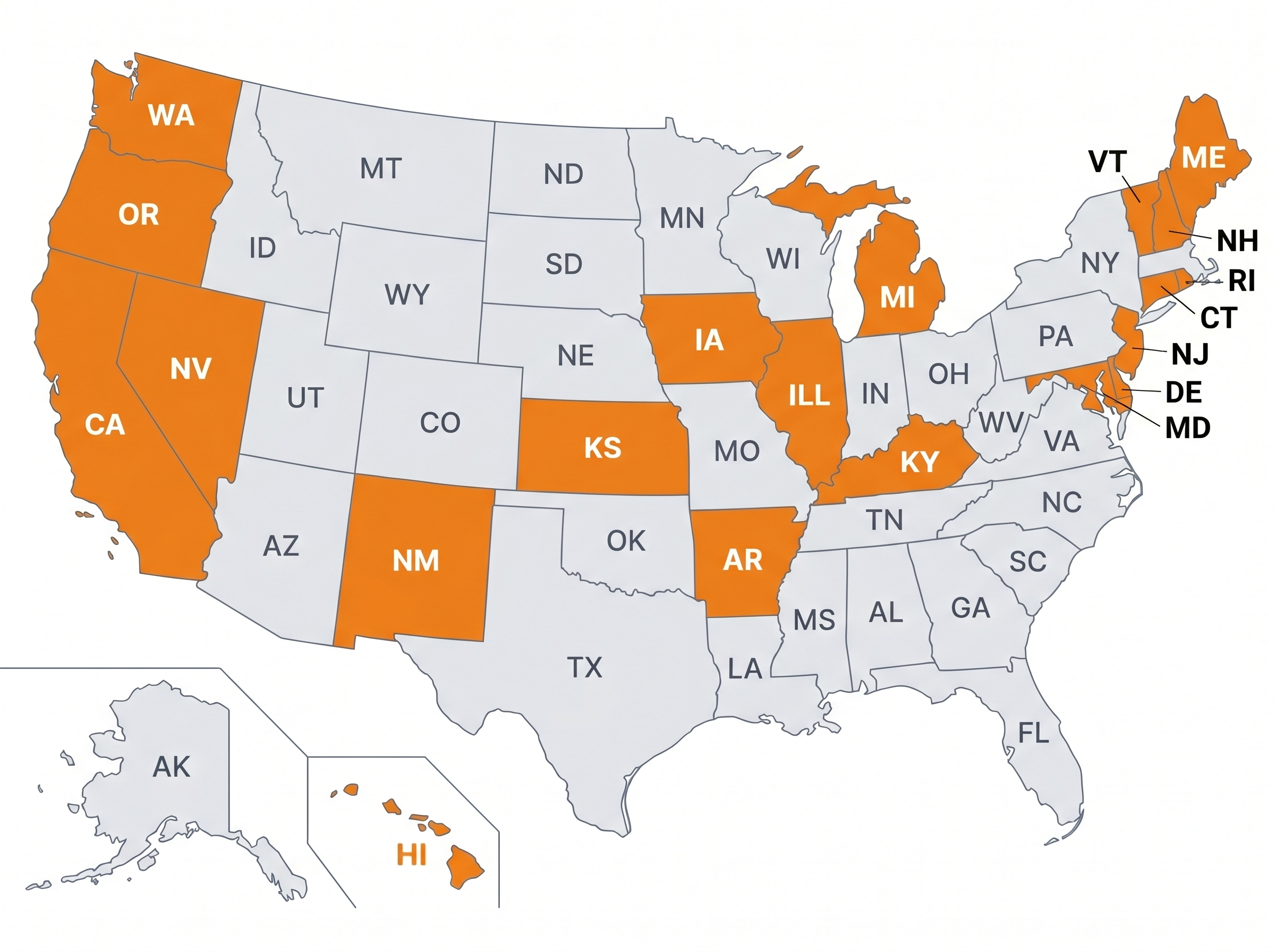
Trusted Across NGSS States
From California to Connecticut, science teachers in the 20 states that adopted NGSS are using Kesler Science to save time and engage students.
Teachers in NGSS States
Love Kesler Science
What Teachers Are Saying
"Complete, concise, time saving treasure chest of ready-made lessons that fit my standards. Cuts my prep time, increases student engagement, and makes it easier to have a student-led classroom."
"It is easy to access, updated frequently, well-supported when I have questions, and everything I need is provided. No surprises."
"Kesler has helped me differentiate instruction for students, move toward more inquiry-based labs, and kept me from losing my mind!"
Give Your Science Teachers Everything They Need
School and district licenses give your teachers access to every resource they need, including station labs, inquiry labs, anchoring phenomena, presentations, escape rooms, and much more. One purchase covers the grade levels you need.
- PO-friendly. We accept purchase orders
- Volume discounts for 11+ teachers
- Complimentary membership orientation for 4+ teachers
- Three free implementation PD sessions for departments of 11+
- Aligned to the NGSS standards
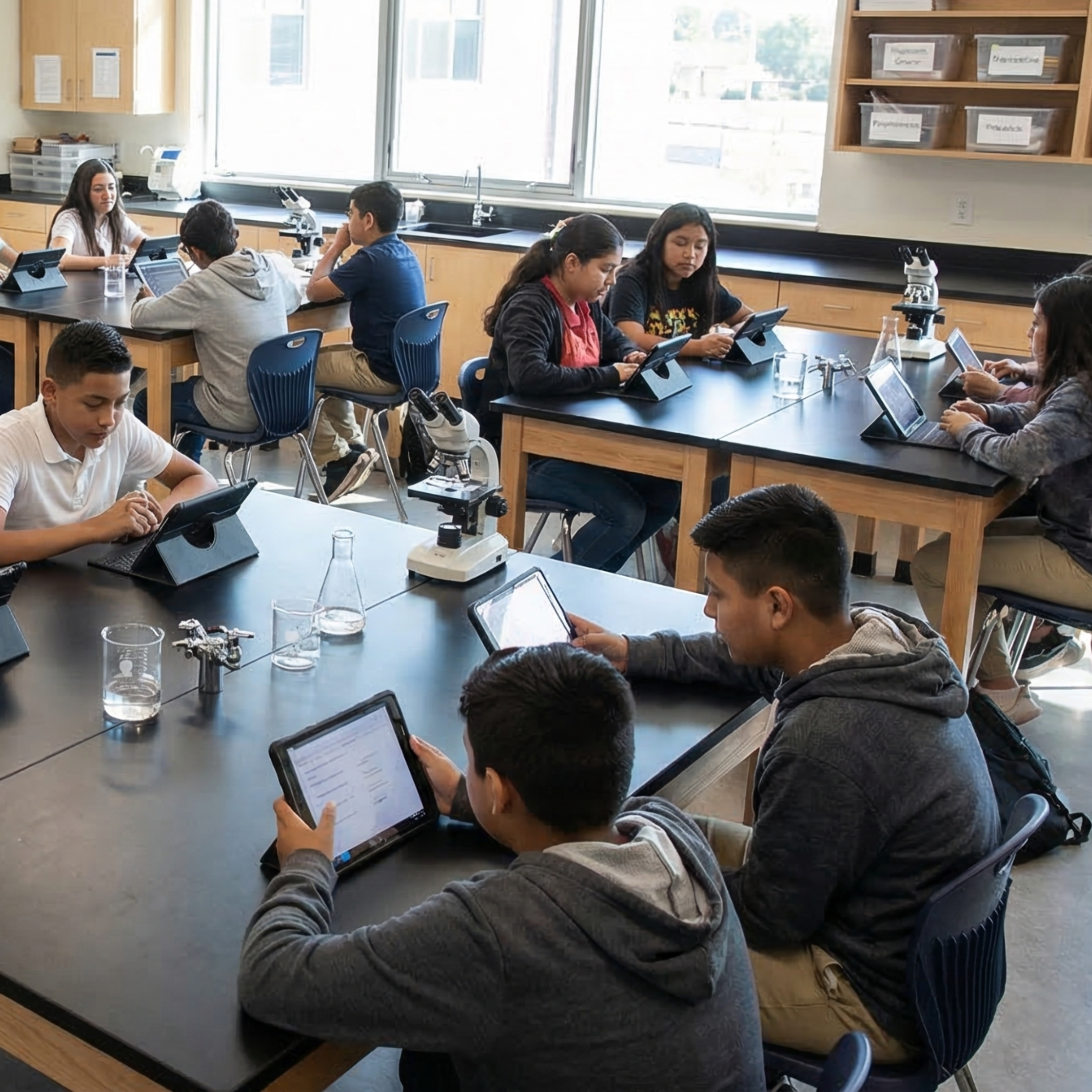
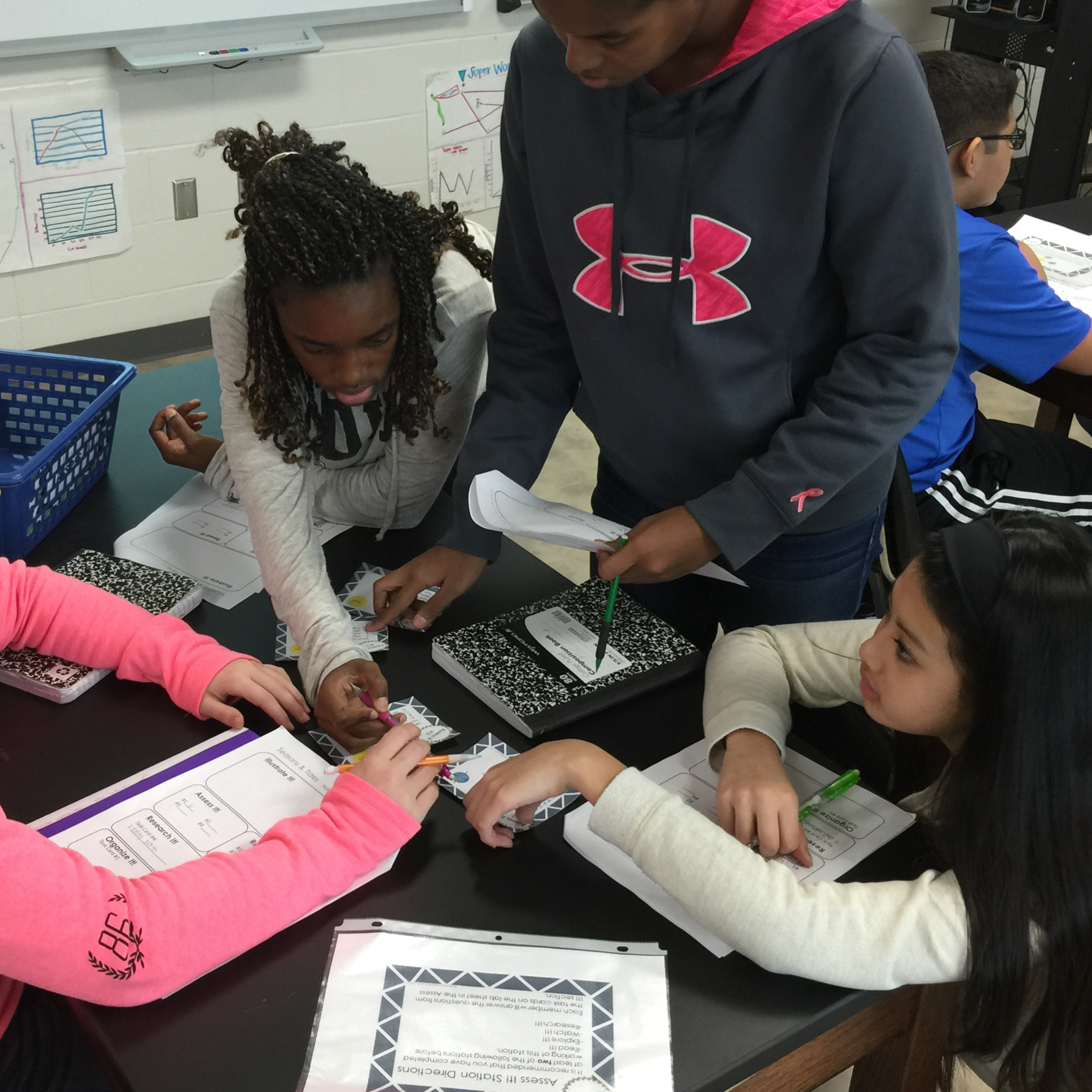
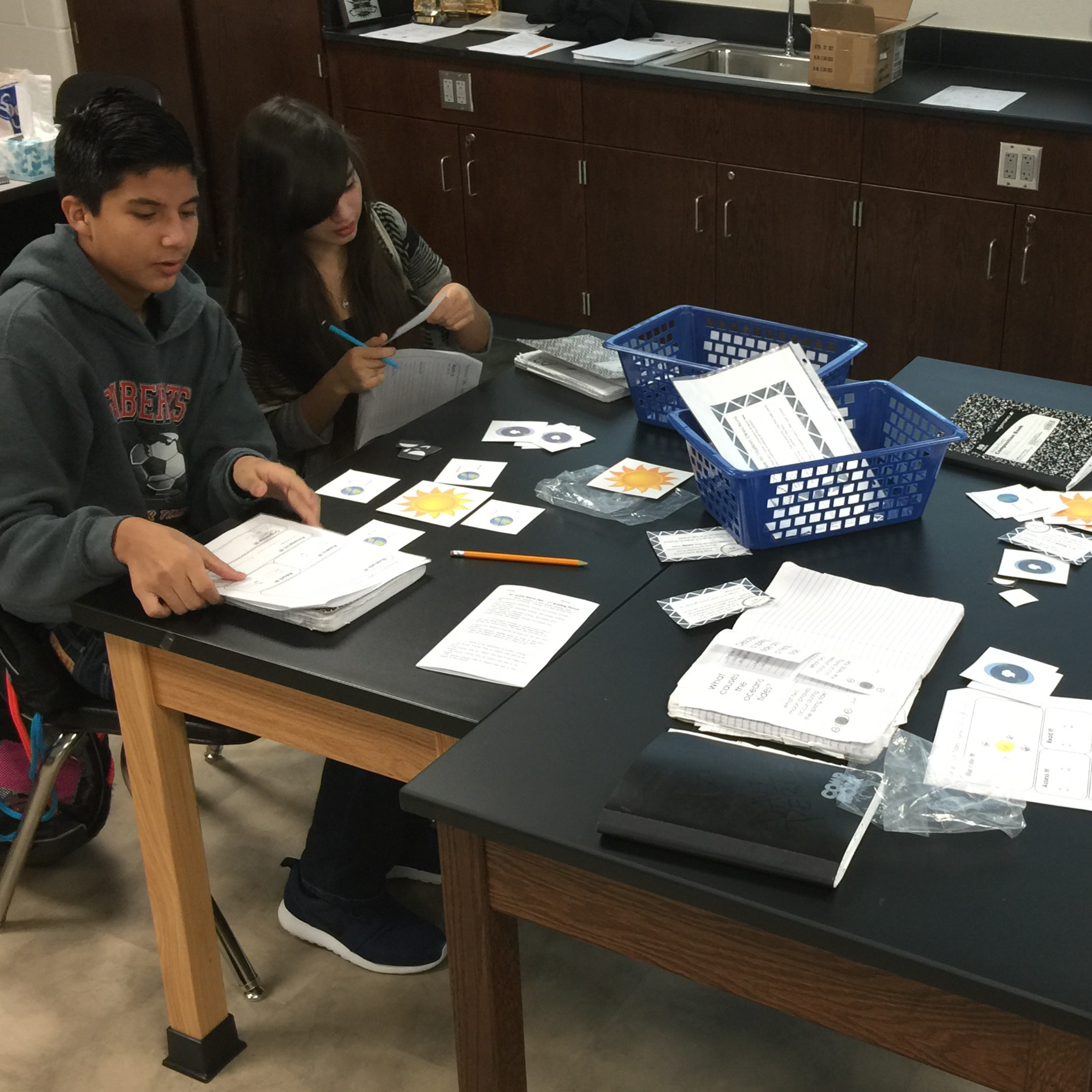
See It in Action
Book a walkthrough and we'll show you how Kesler Science fits your campus.
Book Demo CallNo pressure, no hard sell
"My assistant principal stopped in my room and immediately noticed how the students were engrossed in their centers and how they moved seamlessly from center to center. Also the built-in modifications really impressed!"
"It provides differentiated instruction for all types of learners, allowing them to become more engaged."
"I love it all!! I have become a facilitator in my class and I love the excitement it brings to my class. The kids love all that we do with the Kesler products."