.png?width=375&height=100&name=WebPage%20logo%20with%20curves%202026%20(8).png)
Energy Transformations in Systems
"Describe how energy is conserved through transfers and transformations in systems such as electrical circuits, food webs, amusement park rides, or photosynthesis."
💡 What This Standard Actually Means
"Describe". Students are explaining how energy is conserved as it transfers and transforms inside a system. The standard pushes kids to use real-world examples (electrical circuits, food webs, amusement park rides, photosynthesis) to show that energy isn't created or destroyed, it just moves and changes form. Notice this is a shift away from just listing forms of energy. The focus now is on the conservation idea inside a working system. Instruction can take many forms, such as energy-flow diagrams, roller-coaster animation analysis, simple circuit builds, and food-web tracing activities.
The big idea behind this standard is the law of conservation of energy. Energy isn't created or destroyed. It just moves from one place to another (a transfer) or changes from one form to another (a transformation). Tracking energy through a system is the whole point.
Energy comes in several forms students should know: mechanical, thermal, electrical, sound, light, and chemical. In a real system, these forms change into each other constantly. Take an electrical circuit with a battery and a light bulb. Chemical energy stored in the battery converts to electrical energy in the wire, then to light and thermal energy at the bulb. None of the energy disappears. Some becomes useful light, some becomes heat. In a food web, the sun's light energy is captured by plants and stored as chemical energy in food. A rabbit eats the plant, gaining chemical energy that powers movement (kinetic energy) and body heat (thermal energy). When a fox eats the rabbit, more energy transfers up the chain.
The same idea works in amusement park rides and in photosynthesis. A roller-coaster car at the top of a hill has gravitational potential energy. As it drops, PE converts to kinetic energy. Friction and air resistance turn some of that energy into thermal and sound energy along the way. In photosynthesis, plants use light energy from the sun to drive a chemical reaction that stores energy in the bonds of glucose. Different system, same rule. Students should walk away able to pick a system, trace where the energy comes from, where it goes, and how the total amount stays constant even as the form keeps shifting.
The tool that made this click for my kids was a simple three-column sheet: "Energy In", "What's Happening Inside", "Energy Out". I'd bring in a battery-powered fan, a wind-up toy, a flashlight, and a little music box from the dollar bin. Each group would pick one and fill out the chart. The middle column is the one that matters, and it's the one kids skip. That's where they say, in their own words, what the device is actually doing with the energy. The fan: electrical in, the motor spins the blades and warms up while it runs, mechanical and thermal and sound out. The flashlight: chemical in from the battery, the current runs through the bulb and heats it, light and thermal out. The wind-up toy: mechanical in when you twist the key, the spring holds onto it and then unwinds, mechanical out. Once they filled out three or four of these, they started seeing every device in the room as a tiny energy-conversion machine. That framing carries them through the rest of the unit.
⚠️ Misconceptions Your Students May Have
These are some of the most common misconceptions. Knowing what to look for can help you get ahead of them.
"Energy gets used up, and eventually it's gone"
Energy doesn't disappear. It changes form. When a phone battery "runs out," the chemical energy inside has been transformed into electrical energy, then light, sound, and thermal energy from the screen and speakers. The energy went somewhere, it didn't vanish. Conservation of energy says energy is not created or destroyed.
"Energy transformations are 100 percent efficient"
When energy changes form, some of it usually becomes thermal energy that spreads out into the surroundings. A light bulb gives off light, but also heat. A car engine uses chemical energy from fuel, but a lot of that energy leaves the engine as heat through the exhaust. Thermal energy often shows up as a side effect of every transformation.
"Heat and temperature are the same thing"
Thermal energy is the total energy of moving particles in a substance, distinct from heat, which is the transfer of thermal energy from one substance to another. Temperature measures the average kinetic energy of those particles. A bathtub of warm water has more thermal energy than a cup of boiling water, even though the cup has a higher temperature. Mixing these two up makes it hard for students to reason about energy transfer.
"Chemical energy is only in batteries"
Batteries store chemical energy, but so does food, gasoline, firewood, and even the student's own muscles and fat cells. Chemical energy is stored in the bonds between atoms. Anything that can burn, metabolize, or react to release energy has chemical energy. Expanding this list helps students see chemical energy as everywhere, not just in a AA.
📓 Teaching Resources for 6.8B
These resources are aligned to this standard.


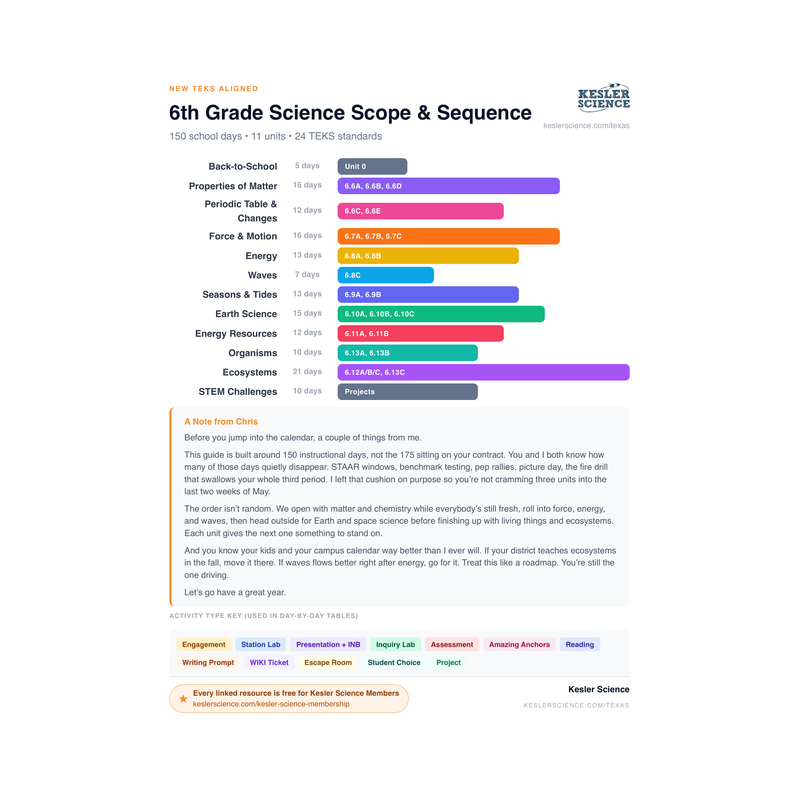
100% Aligned Lessons for Every TEKS You Teach
Kesler Science Plus puts thousands of ready-to-teach lessons and activities in your hands, so you can boost engagement and get your planning time back. Trusted by schools and districts all over the great state of Texas.
🌎 Phenomenon Ideas for 6.8B
Use these real-world phenomena to anchor your lesson. Show students the phenomenon first, let them wonder, then build toward Energy Transformations in Systems as the explanation.
A Campfire on a Cold Night
A group of campers sits around a fire. The logs came from a tree that grew for years using sunlight. Now the fire gives off a steady orange glow, crackling sounds, waves of warmth on their faces, and a little bit of smoke. The wood slowly gets smaller, and eventually the fire burns down to ash. Many forms of energy are flowing out at once.
"What forms of energy leave a campfire? Where did that energy come from originally? Follow the energy back as far as you can. Where does it start?"
A Warm Lamp After 10 Minutes
Flip on a desk lamp and put your hand near the bulb. After a few minutes, you can feel the warmth radiating off. Some bulbs (especially older fluorescents) give off a steady hum from the electricity running through them. The plug is the only place energy enters the system. But three different forms of energy come out.
"What energy goes into the lamp? What energy comes out? Is any of the energy going into the lamp not useful for lighting up the room? Where does it go?"
A Sprinter After a 100-Meter Race
A sprinter crosses the finish line, breathing hard, skin red and warm, pulse pounding. They were motionless in the starting blocks 10 seconds earlier. Their muscles produced powerful motion, they feel hot, they're sweating. Something had to supply all of that energy, and somewhere the energy had to come out in other forms.
"What form of energy did the sprinter start with? What forms of energy show up during and after the race? Can you trace the energy all the way back to its original source?"
💡 Free Engagement Ideas for 6.8B
Ready-to-run activities you can drop straight into a lesson. Where one of these looks like a phenomenon from the section above, that is on purpose: show it first as the hook, then let students run it themselves.
Energy In, Energy Out Chart
Set out six everyday objects: a flashlight, a wind-up toy, a small battery fan, a hand-crank radio (or a music box), a candle (safety permitting), and a rubber-band-powered paper car. Groups rotate through each station and fill out a three-column chart: "Energy In", "What's Happening Inside", "Energy Out". The middle column is the one to push on. That's where they describe what the object is doing with the energy, and it's the step that turns a list of energy forms into an actual transformation. Come back together to compare and debate which forms of energy students noticed.
The Rubbing Hands Thermal Test
Students rub their palms together quickly for 15 seconds and immediately touch them to their cheeks. The cheeks feel warm. The motion (mechanical energy) of their hands rubbing against each other became thermal energy through friction. Have them diagram what they felt and add it to a class list of "Mechanical to Thermal" examples.
Solar Oven S'more Attempt
Line a pizza box with aluminum foil, cover the opening with plastic wrap, and angle it toward the sun on a sunny day. Place a s'more inside. Students observe the light energy from the sun transforming into thermal energy inside the box. While waiting, have them diagram the energy path: light in, thermal energy trapped, chocolate melting. Cheap, slow, and works best in Texas sun.
Rube Goldberg Energy Map
Give groups a pile of cheap materials and challenge them to build a simple Rube Goldberg chain with at least three energy transformations (for example: push a marble, marble rolls into a domino line, last domino knocks a cup off a table). Afterward, they annotate the diagram with every energy form at each step: mechanical, sound, maybe thermal from the crash.
🎯 What Approaches, Meets, and Masters Thinking Look Like
Here is what student thinking at each level looks like on this one task, so you know what to look for and how to move a student up.
A roller-coaster car gets pulled to the top of the first big hill and then is let go. It races down, and by the end of the ride it is moving slower than when it started. Describe how energy transfers and transforms as the car goes down the hill, and explain what happens to the total amount of energy in the ride from start to finish.
- Names the energy at the top of the hill as stored energy (gravitational potential energy) because the car is high up.
- Describes that energy as the car drops, the stored energy changes into energy of motion (kinetic energy).
- Uses the words transfer (energy moving) and transform (energy changing form) the right way.
- Mentions that rubbing parts and air (friction) turn some energy into thermal energy (heat) and sound.
- States that the total amount of energy stays the same, it is not created or destroyed, even though it changes form.
- Connects the slowdown to energy spreading out as heat and sound, not to energy being "used up" or "gone."
- Handles the last part correctly: the car slows down, but the total energy is still the same because the missing motion energy turned into heat and sound. That is the easiest place to slip.
At the top of the hill the car has stored energy. When it drops, the stored energy turns into motion energy and the car goes fast. By the end the car is going slow because the energy got used up. The ride started with a lot of energy and by the end most of the energy is gone.
At the top of the hill the car has stored energy because it is high up. As it drops, that stored energy transforms into motion energy, so the car speeds up. Rubbing on the track and pushing through the air (friction) also transforms some of the energy into heat and sound. The car ends up slower because some of the motion energy turned into heat and sound. But the total amount of energy is still the same. Energy is not created or destroyed, it just changed form and moved to different places.
At the top the car has stored energy (gravitational potential energy) because it is high up. As it drops, that stored energy transforms into motion energy, so the car speeds up. The whole time, friction between the wheels and track and the push of the air transform a little of the energy into thermal energy (heat) and sound. The car ends slower because some of its motion energy left as heat and sound. The total amount of energy never changed. It just spread out into more forms and places. That is conservation of energy: energy is never made or destroyed, it only transfers and transforms.
The same rule works for a phone battery. People say the battery "dies," but the energy is not gone. The chemical energy in the battery transforms into electrical energy, then into the light from the screen, the sound from the speaker, and heat. Just like the coaster, the energy did not disappear, it spread out into other forms, so the total stays the same.
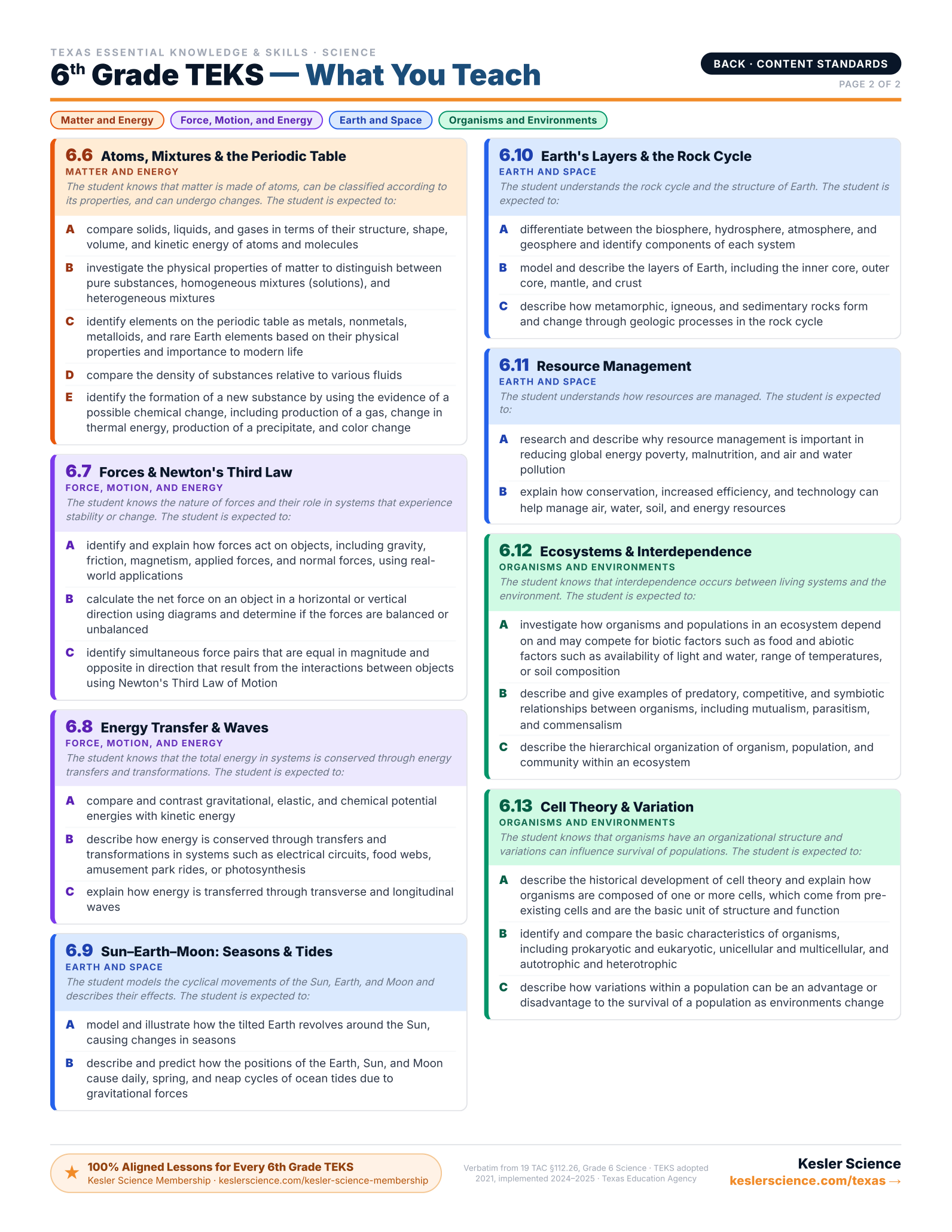
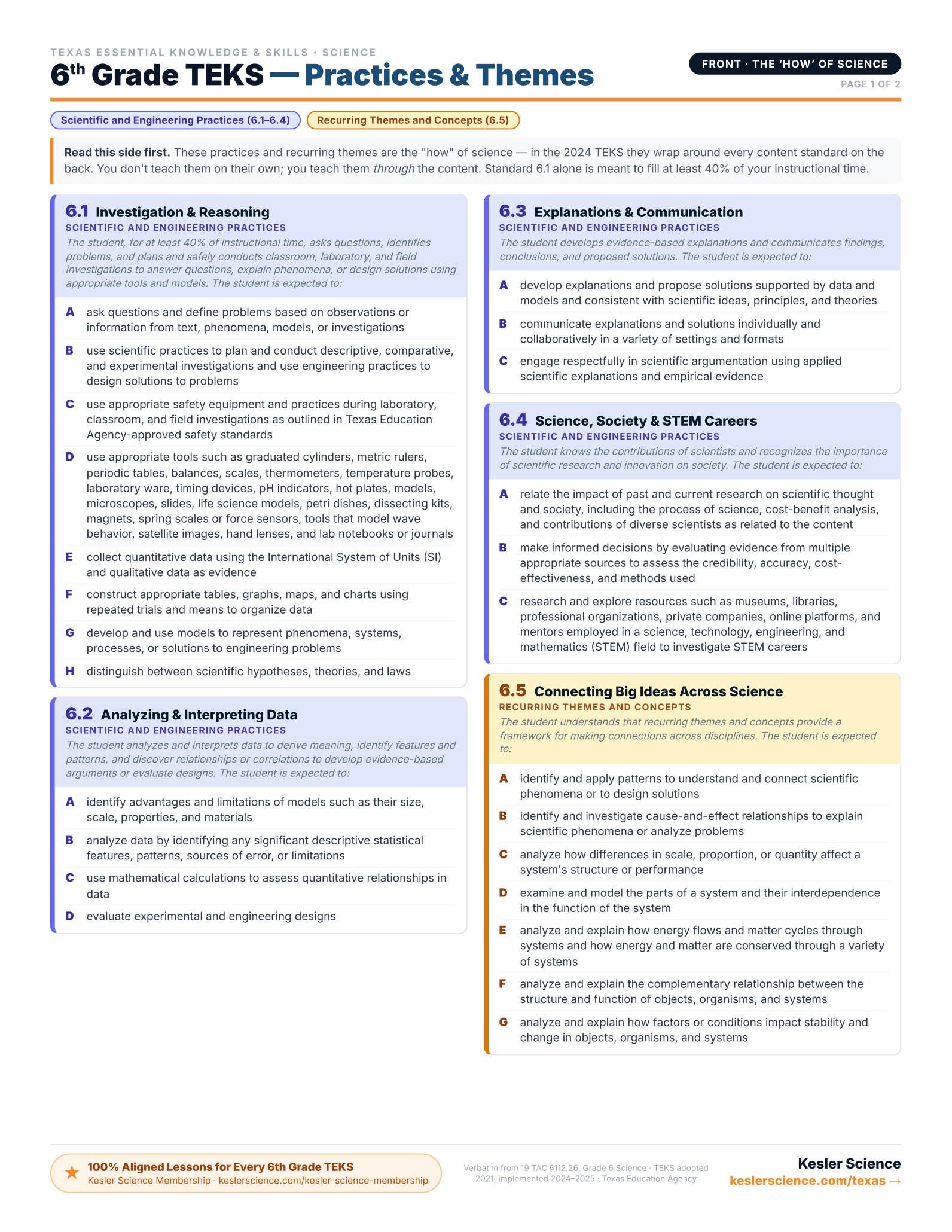
Every 6th-Grade Science TEKS on One Page
The color-coded, front-and-back cheat sheet I wish I'd had — every standard, organized by reporting category. Print it and reference it all year long. This will be your new favorite document!
Trusted Across Texas
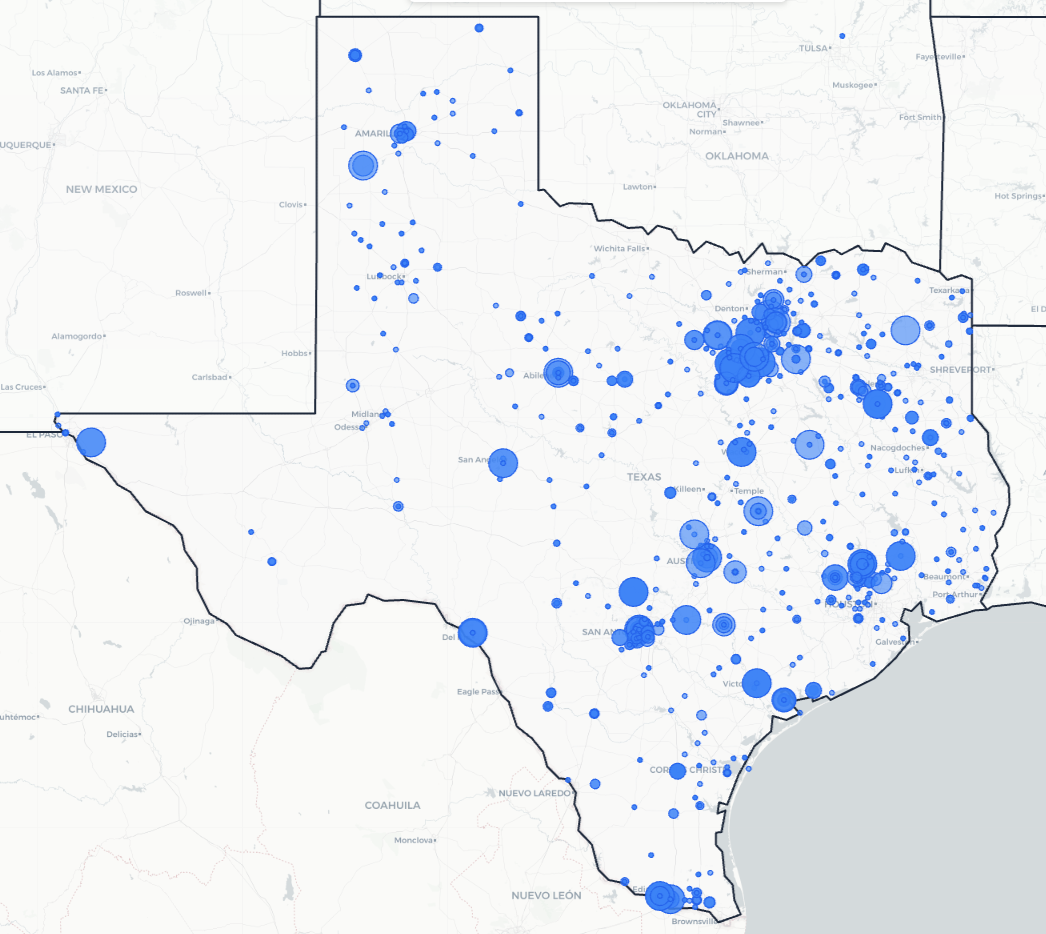
From the Rio Grande Valley to the Panhandle, Texas science teachers are using Kesler Science to save time and engage students.
Texas Schools and Districts
Love Kesler Science
What Teachers Are Saying
Give Your Science Teachers Everything They Need
School and district licenses give your teachers access to every resource they need, including station labs, inquiry labs, anchoring phenomena, presentations, escape rooms, and much more. One purchase covers the grade levels you need.
- PO-friendly. We accept purchase orders
- Volume discounts for 11+ teachers
- Complimentary Kesler Science Plus orientation for 4+ teachers
- Three free implementation PD sessions for departments of 11+
- Aligned to the 2024 TEKS standards
See It in Action
Book a walkthrough and we'll show you how Kesler Science fits your campus.
Book Demo CallNo pressure, no hard sell