.png?width=375&height=100&name=WebPage%20logo%20with%20curves%202026%20(8).png)
Modeling Layers of Earth
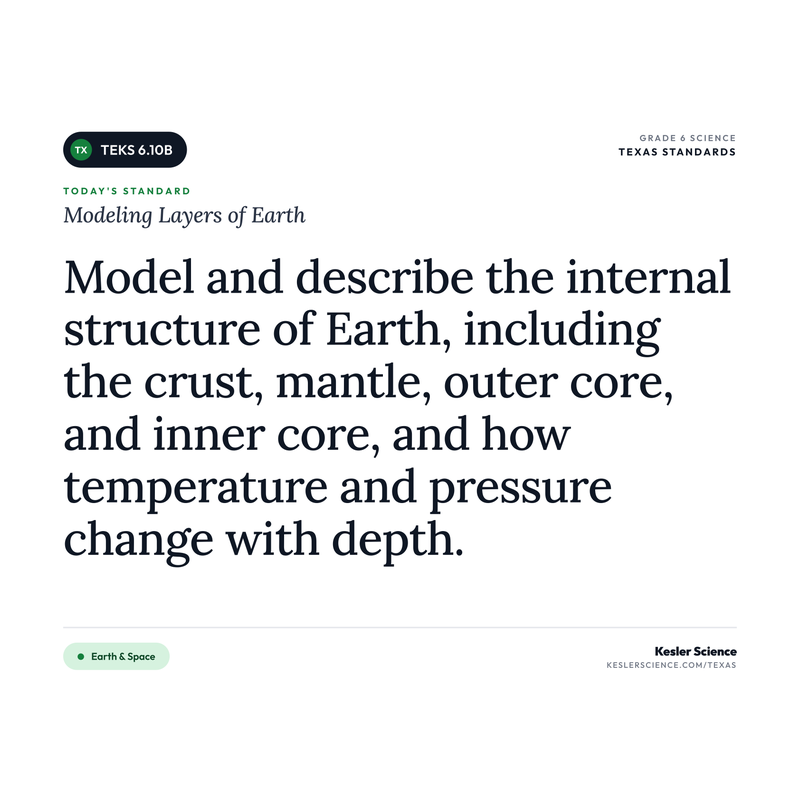
"Model and describe the layers of Earth, including the inner core, outer core, mantle, and crust."
💡 What This Standard Actually Means
"Model and describe". Students are creating models of Earth's interior and describing the four named layers in order: inner core, outer core, mantle, and crust. The shift in the new wording is that the temperature-and-pressure-with-depth piece isn't required by this standard anymore. The focus is on identifying and modeling the layers themselves. Instruction can take many forms, such as cross-section drawings, hard-boiled egg analogies, layered playdough or clay models, and labeled cut-away diagrams.
The crust is the thin, solid, rocky outer shell of Earth. This is where we live, where mountains and oceans sit, and where the shallowest volcanoes and earthquakes happen. Below it is the mantle, which makes up most of Earth's volume. The mantle is solid rock, but it's so hot that it can flow very slowly over long periods of time, the way thick taffy stretches. That slow flow drives plate tectonics.
Deeper still is the outer core, a layer of molten iron and nickel. It behaves like a liquid. The motion of this liquid metal generates Earth's magnetic field. At the very center is the inner core, made of iron and nickel that is even hotter than the outer core but stays solid because the pressure pressing down on it is so intense.
Two trends tie it together. Temperature increases with depth. Pressure increases with depth. As you go deeper, both go up. That combination explains why the outer core can be liquid while the even-hotter inner core is still solid. It's not that one is hotter and the other colder. It's that pressure wins at the center.
My students used to say "the core of the Earth is lava" the same way they'd say "the sky is blue." I'd draw the four layers, we'd label them, we'd do the worksheet, and that one sentence still showed up on quizzes. What finally broke it was starting with the pressure idea. I'd hand a student a squishy gel-filled stress ball and have them squeeze it as hard as they could. "It wants to squish through your fingers, right? Now imagine the entire weight of Earth pushing in on iron at the center. That's why the inner core stays solid, even though it's hotter than the lava you see in videos." Once they could picture pressure as a force, the inner-core-is-solid idea stopped feeling like a trick.
⚠️ Misconceptions Your Students May Have
These are some of the most common misconceptions. Knowing what to look for can help you get ahead of them.
"The mantle is liquid because there's magma in it"
The mantle is mostly solid rock. It's extremely hot and it can flow very slowly, over millions of years, which is what allows the tectonic plates to move. Small amounts of magma form in specific places in the upper mantle and crust, but the mantle as a whole is not a sea of liquid. Think slow-flowing solid, not lake of liquid.
"The inner core is liquid hot lava"
The inner core is actually solid, not liquid. Even though it is incredibly hot (around 5,400 degrees Celsius, about as hot as the surface of the Sun), the pressure from all the rock and metal above it is so enormous that the iron and nickel cannot move into a liquid state. The outer core is the part that is liquid. This is one of those rare cases where pressure wins out over temperature.
"Each layer is about the same thickness"
The layers vary enormously in thickness. The crust is the thinnest, as little as about 5 kilometers under the oceans and up to roughly 70 kilometers under tall mountains. The mantle is by far the thickest, extending about 2,900 kilometers down. The outer core and inner core together make up the rest. A proper-scale drawing looks very different from the evenly-striped cross-sections in many textbooks.
"Temperature increases with depth but pressure stays the same"
Both temperature AND pressure increase as you go deeper into Earth. Pressure increases because every additional kilometer of rock above adds to the weight pressing down. This is the key to explaining why the inner core is solid while the outer core is liquid. Without the pressure half of the story, the layers stop making sense.
📓 Teaching Resources for 6.10B
These resources are aligned to this standard.


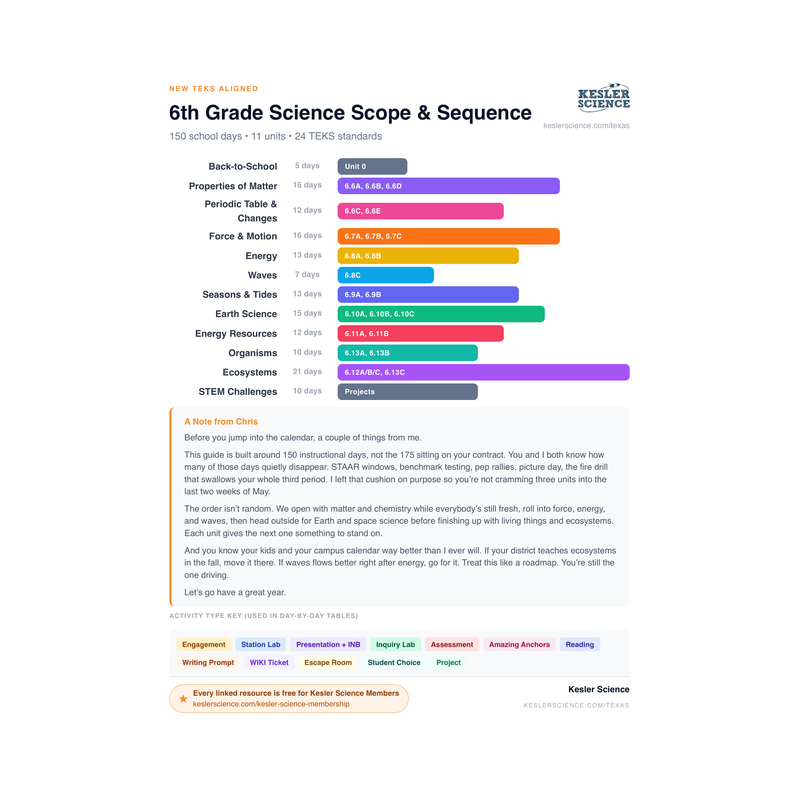
100% Aligned Lessons for Every TEKS You Teach
Kesler Science Plus puts thousands of ready-to-teach lessons and activities in your hands, so you can boost engagement and get your planning time back. Trusted by schools and districts all over the great state of Texas.
🌎 Phenomenon Ideas for 6.10B
Use these real-world phenomena to anchor your lesson. Show students the phenomenon first, let them wonder, then build toward Modeling Layers of Earth as the explanation.
The Deepest Hole Ever Drilled
In the 1970s and 1980s, Soviet scientists drilled a hole straight down into the Kola Peninsula in Russia. They kept going for nearly two decades and reached about 12 kilometers before they had to stop. The temperature at the bottom was so high it was melting their equipment, and the rock flowed back into the hole like plastic. After all that work, they barely scratched the crust.
"Earth's radius is about 6,371 kilometers. The deepest hole ever drilled reached 12 kilometers. Why do we think we still know anything about what's at the center if we've never been there? How do scientists study layers they can't see?"
A Compass That Always Knows North
Pull out any cheap compass. Spin it, shake it, drop it, walk to any room in the school, and the needle still points north. That's not a coincidence. Earth has a global magnetic field that a compass needle can feel from anywhere on the planet's surface. And scientists believe it is produced deep inside our planet, in a layer we will never see with our eyes.
"Earth has a planet-wide magnetic field. What property would a layer inside Earth need to have to create a magnetic field? Does that tell us anything about what the outer core is made of?"
Earthquake Waves That Change Speed Underground
When a big earthquake happens in Japan, sensors in Europe, South America, and Antarctica pick up the vibrations within minutes. Scientists have studied thousands of earthquakes and noticed that the waves speed up, slow down, and even bend when they pass through different depths of Earth. Some waves skip around certain areas entirely. This pattern is the main reason we know Earth has layers at all.
"If seismic waves travel at different speeds through different parts of Earth, what does that tell us about how the inside of Earth is put together? How could we use that information to figure out what each layer is made of without ever seeing it?"
💡 Free Engagement Ideas for 6.10B
Ready-to-run activities you can drop straight into a lesson. Where one of these looks like a phenomenon from the section above, that is on purpose: show it first as the hook, then let students run it themselves.
Hard-Boiled Egg Cross-Section
Slice a hard-boiled egg in half and show the class. The thin outer shell is the crust. The white is the mantle. The yolk is the core. It's not a perfect analogy, but the scale of the layers matches up surprisingly well, especially how thin the crust is compared to everything below it. Pass pieces around and have students label each part.
Play-Doh Scale Model
Give each group four colors of Play-Doh. Have them roll out a small solid inner core, wrap it in outer core, wrap that in a much bigger mantle, and finish with a very thin crust. They slice it in half with plastic knives and label each layer. The challenge of making the crust thin enough sticks with students for the rest of the unit.
Temperature and Pressure Graph
Give students a simple blank graph with depth on the X axis and values on the Y axis. Provide rough temperature and pressure values at several depths (surface, bottom of crust, middle of mantle, core-mantle boundary, center of Earth). Students plot both trends. They see the two parallel upward curves, which lock in "both go up with depth" visually.
The Silly Putty Mantle Demo
Hand each group a ball of Silly Putty. Have them smack it hard against the desk (it cracks like a solid) and then set it on a flat surface and watch it slowly flatten over a minute or two (it flows like a liquid). Same material, two behaviors, depending on the time scale. That's a tangible model for why the mantle can be solid and still flow slowly enough to move continents.
🎯 What Approaches, Meets, and Masters Thinking Look Like
Here is what student thinking at each level looks like on this one task, so you know what to look for and how to move a student up.
Draw a cut-away model of the inside of Earth. Show all four layers in the right order from the center out, and label each one: inner core, outer core, mantle, and crust. Next to your model, write a short description of each layer. Tell whether the layer is solid or liquid, and one thing that makes it different from the others.
- A cut-away model that shows all four layers, not just two or three.
- The layers in the correct order from the center out: inner core, then outer core, then mantle, then crust.
- Each layer clearly labeled with its real name (not just "the middle" or "the top").
- The crust shown as the thin outer layer and the mantle shown as the thick layer that takes up most of the space.
- A short description for each layer that tells if it is solid or liquid.
- The outer core correctly described as liquid metal and the inner core correctly described as solid.
- The mantle described as mostly solid rock that can flow very slowly (not a layer of liquid). That is the trickiest one to get right.
The crust is the thin top part where we live. The inner core and outer core are in the middle and they are super hot. The mantle is liquid because there is magma in it, so it is like a layer of melted rock under the ground.
The crust is the thin solid rock layer on the outside where we live. The mantle is the thickest layer. It is mostly solid rock, but it is so hot that it can flow really slowly over a long time. The outer core is liquid metal, mostly iron. The inner core is in the very center and it is solid metal even though it is the hottest part.
From the center out the layers are the inner core, outer core, mantle, and crust. The inner core is the hottest layer, but it is still solid. That is because there is so much rock and metal pressing down on it that the metal cannot turn into a liquid. The outer core has less pressing on it, so the same kind of hot metal is liquid there.
An egg is a good way to picture this. The thin shell is like the crust, the thick white is like the mantle, and the yolk in the middle is like the core. The thin shell shows how the crust is really thin compared to the layers underneath, which is the part a lot of drawings get wrong.
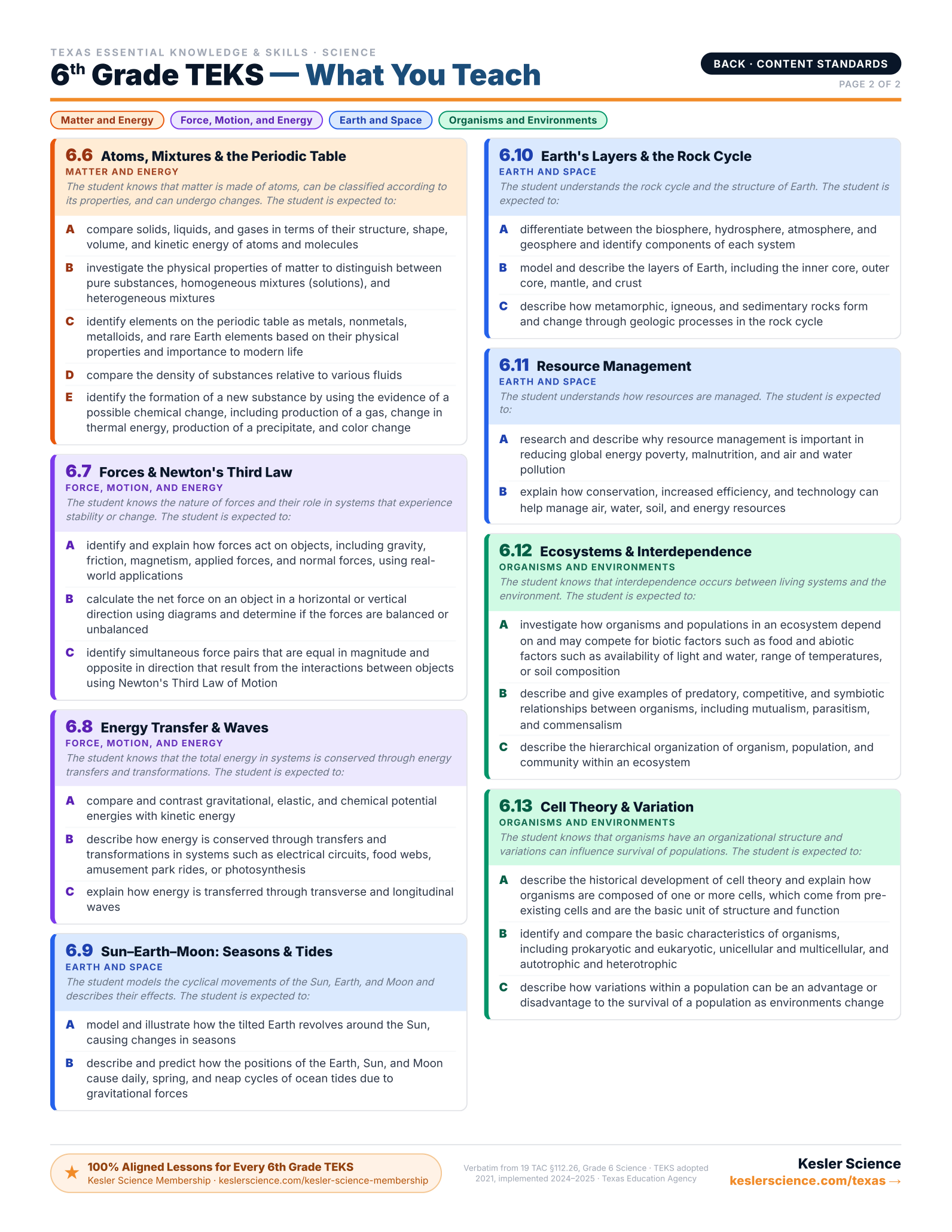
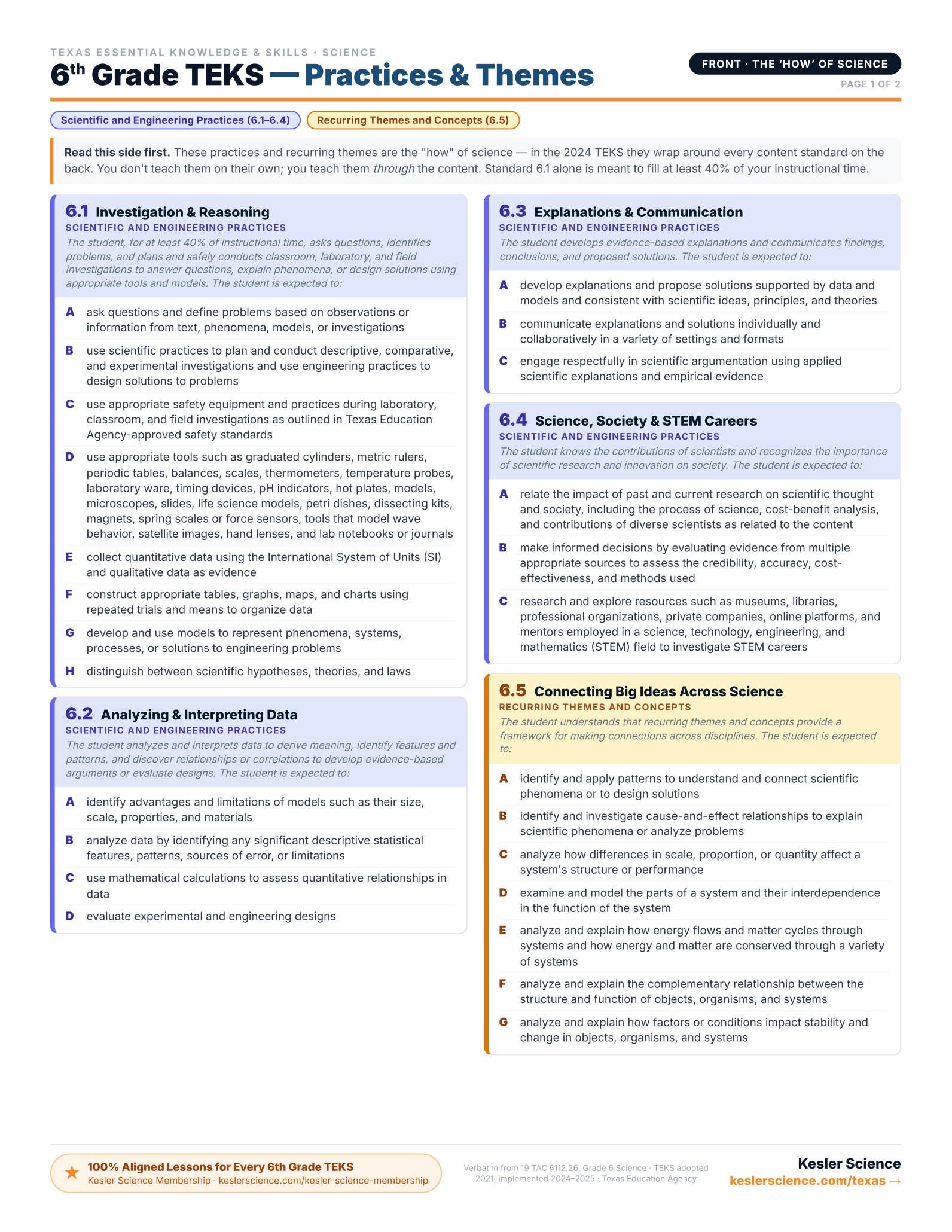
Every 6th-Grade Science TEKS on One Page
The color-coded, front-and-back cheat sheet I wish I'd had — every standard, organized by reporting category. Print it and reference it all year long. This will be your new favorite document!
Trusted Across Texas
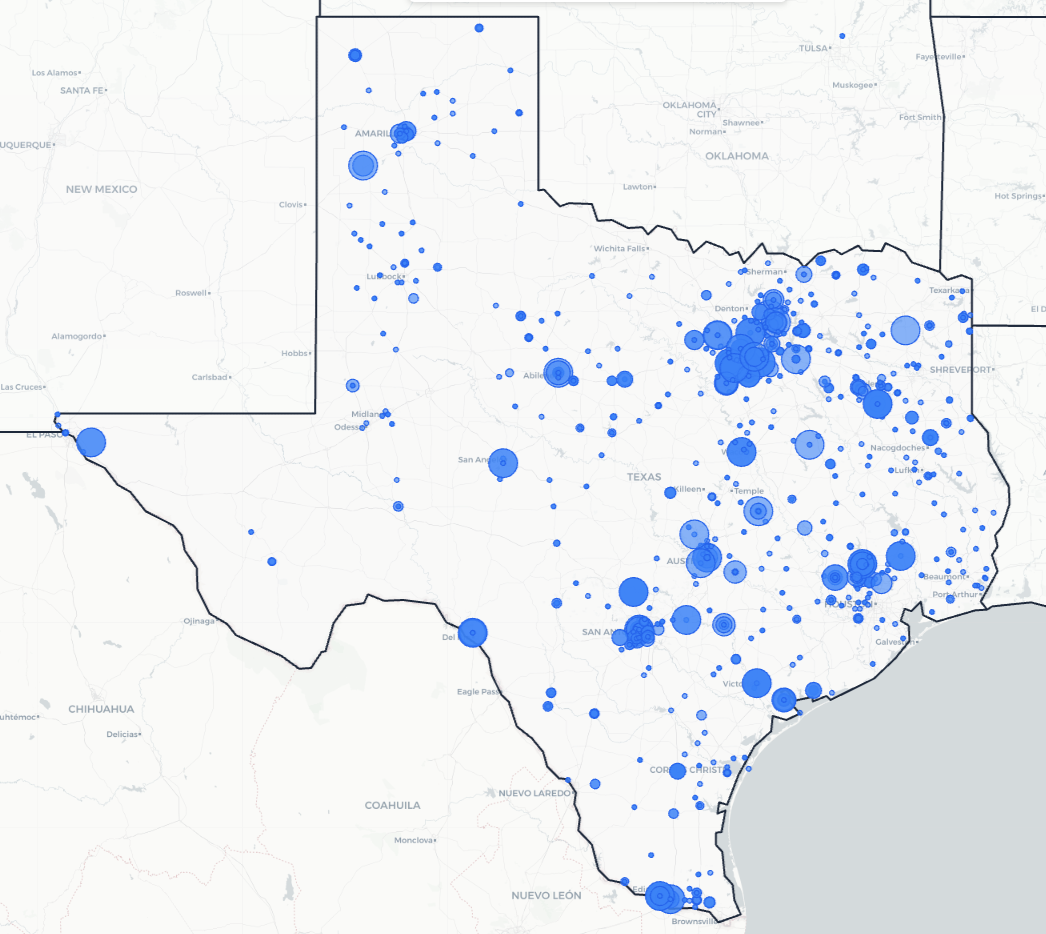
From the Rio Grande Valley to the Panhandle, Texas science teachers are using Kesler Science to save time and engage students.
Texas Schools and Districts
Love Kesler Science
What Teachers Are Saying
Give Your Science Teachers Everything They Need
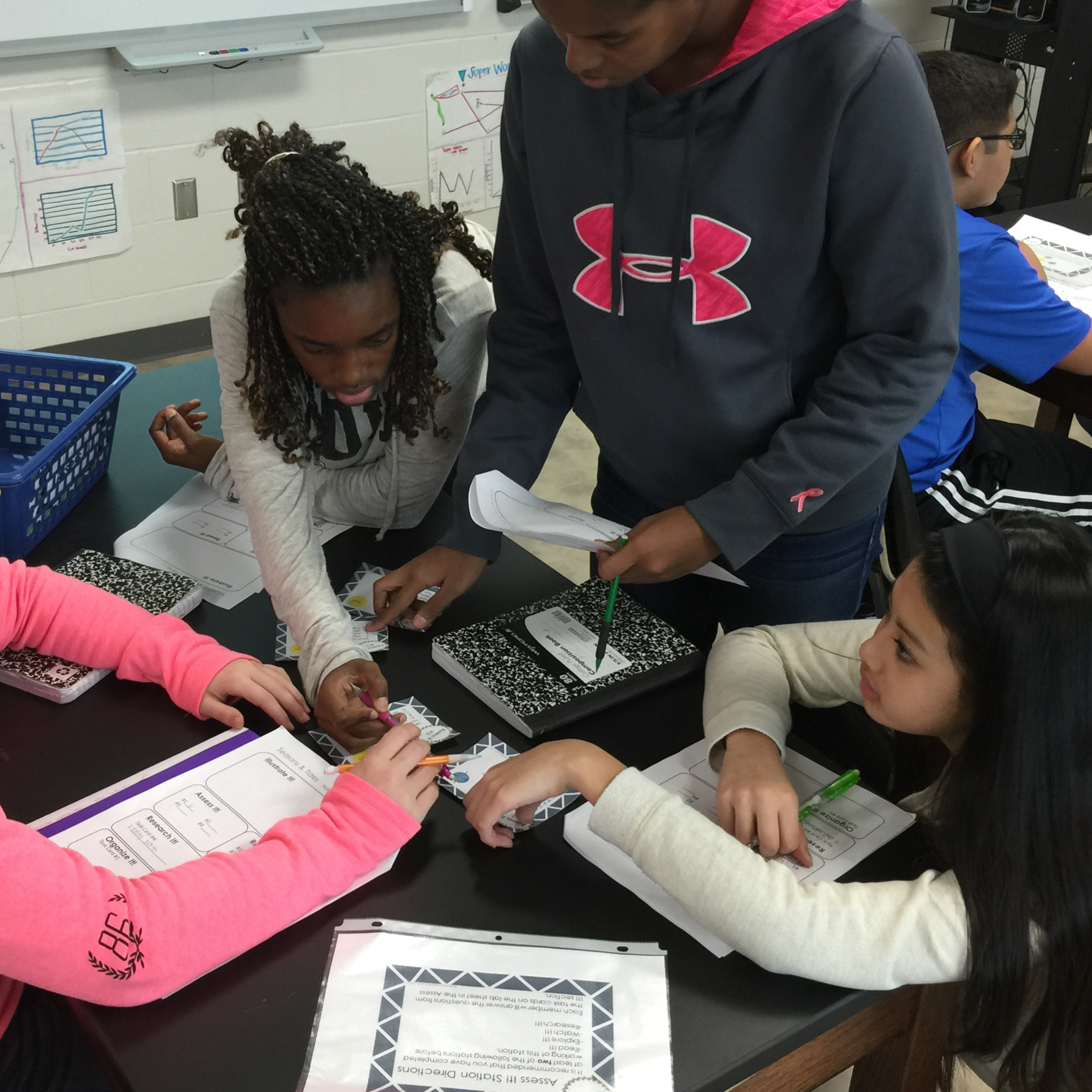
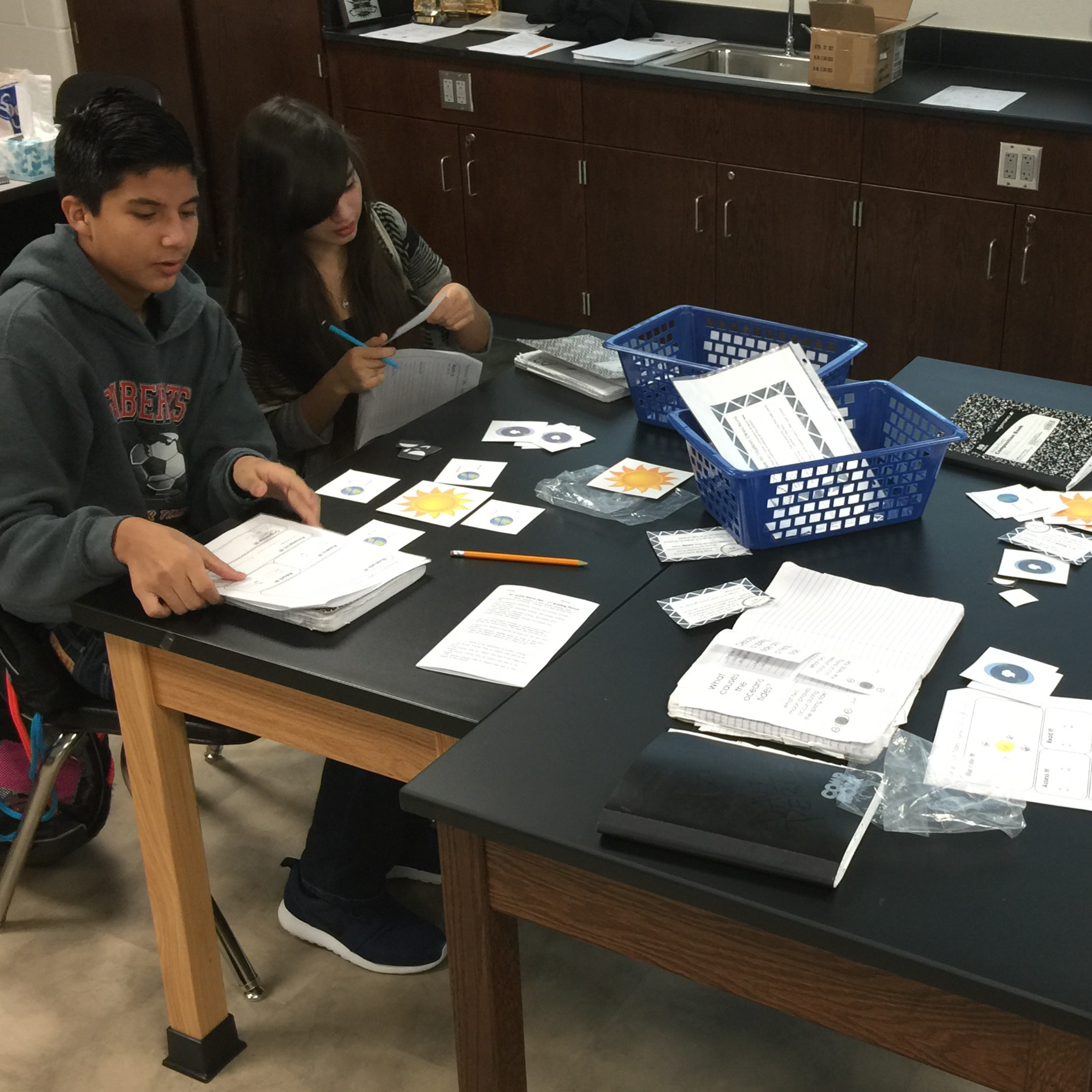
School and district licenses give your teachers access to every resource they need, including station labs, inquiry labs, anchoring phenomena, presentations, escape rooms, and much more. One purchase covers the grade levels you need.
- PO-friendly. We accept purchase orders
- Volume discounts for 11+ teachers
- Complimentary Kesler Science Plus orientation for 4+ teachers
- Three free implementation PD sessions for departments of 11+
- Aligned to the 2024 TEKS standards

See It in Action
Book a walkthrough and we'll show you how Kesler Science fits your campus.
Book Demo CallNo pressure, no hard sell