.png?width=375&height=100&name=WebPage%20logo%20with%20curves%202026%20(8).png)
Differentiate Between Earth's Spheres
"Differentiate between the biosphere, hydrosphere, atmosphere, and geosphere and identify components of each system."
💡 What This Standard Actually Means
"Differentiate". Students are telling the four spheres of Earth apart (biosphere, hydrosphere, atmosphere, and geosphere) and identifying the components that make up each one. The shift in this standard is huge. The old version was about modeling how the spheres interact. The new version is about distinguishing the spheres from each other and naming what's in each. Instruction can take many forms, such as labeled-photo sorting, four-corner classroom activities, sphere-component card sorts, and walks outside where kids identify which sphere each thing they see belongs to.
Earth is often described as four overlapping systems, called spheres. Each sphere has a specific job and a list of components, and the focus of this standard is being able to tell them apart and identify what belongs in each one.
The geosphere is the solid Earth. Components include rocks, minerals, soil, sand, sediment, the layers of Earth (crust, mantle, outer core, inner core), and landforms like mountains, valleys, plains, and volcanoes. If you can stand on it or dig into it, it's part of the geosphere. The hydrosphere is all the water on Earth, in every form and location. Components include oceans, lakes, rivers, streams, groundwater, glaciers, polar ice caps, and water vapor moving through the cycle. (Some textbooks pull frozen water out into a separate cryosphere, but for 6th grade TEKS, frozen water lives inside the hydrosphere.)
The atmosphere is the layer of gases that surrounds Earth. Components include nitrogen (the biggest piece, about 78 percent), oxygen (about 21 percent), and small amounts of carbon dioxide, water vapor, and other gases. The atmosphere is also where weather happens and where the layers like the troposphere and stratosphere live. The biosphere is all the living things on Earth. Components include plants, animals, fungi, bacteria, and every other living organism, plus the spaces where they live. Students should be able to look at a photo, an example, or a real object and identify which sphere it belongs to. That's the heart of this standard.
The first time I taught spheres I just defined them and moved on. Students could label them on a diagram but they had no idea why any of it mattered. What worked better was flipping the lesson. I'd open with a short video of a volcano erupting or a hurricane making landfall and ask one question: "How many parts of Earth did that one event touch?" We'd build a web on the board. Ash goes up (atmosphere). Ash falls in the ocean (hydrosphere). Lava covers a forest (biosphere, geosphere). Kids who couldn't even spell "hydrosphere" ten minutes earlier were suddenly explaining system interactions. Lead with the event. Vocabulary comes after.
⚠️ Misconceptions Your Students May Have
These are some of the most common misconceptions. Knowing what to look for can help you get ahead of them.
"The spheres are separate layers, like a cake"
Students often picture the spheres stacked: rock on bottom, water above it, air above that, plants on top. In reality, the spheres overlap everywhere. A lake has water (hydrosphere) sitting on a rock bottom (geosphere), fish swimming in it (biosphere), and air on top of it (atmosphere). One small pond touches all four. A Venn diagram works better than a layered cross-section for this concept.
"Humans are part of the environment, not the biosphere"
Humans are part of the biosphere. Any activity people do (farming, driving, building a city) is a biosphere interaction that affects the other spheres. This matters because a lot of sphere-interaction examples involve human activity. Students should be comfortable including people when they talk about the biosphere.
"The atmosphere is only oxygen"
Earth's atmosphere is actually about 78% nitrogen, 21% oxygen, and about 1% other gases like argon, water vapor, and carbon dioxide. Oxygen gets most of the attention because we breathe it, but nitrogen is the majority of every breath you take. Students should know the atmosphere is a mixture of gases, not just one gas.
"The biosphere is just plants and animals"
The biosphere is every living thing on Earth, not just the obvious stuff. It includes bacteria in your gut, fungi in the soil, mold growing on bread, plankton drifting in the ocean, and yes, you and your students. Anything alive, anywhere on the planet, counts as part of the biosphere. Push students to name the not-obvious living things, because that's where the components piece really clicks.
📓 Teaching Resources for 6.10A
These resources are aligned to this standard.


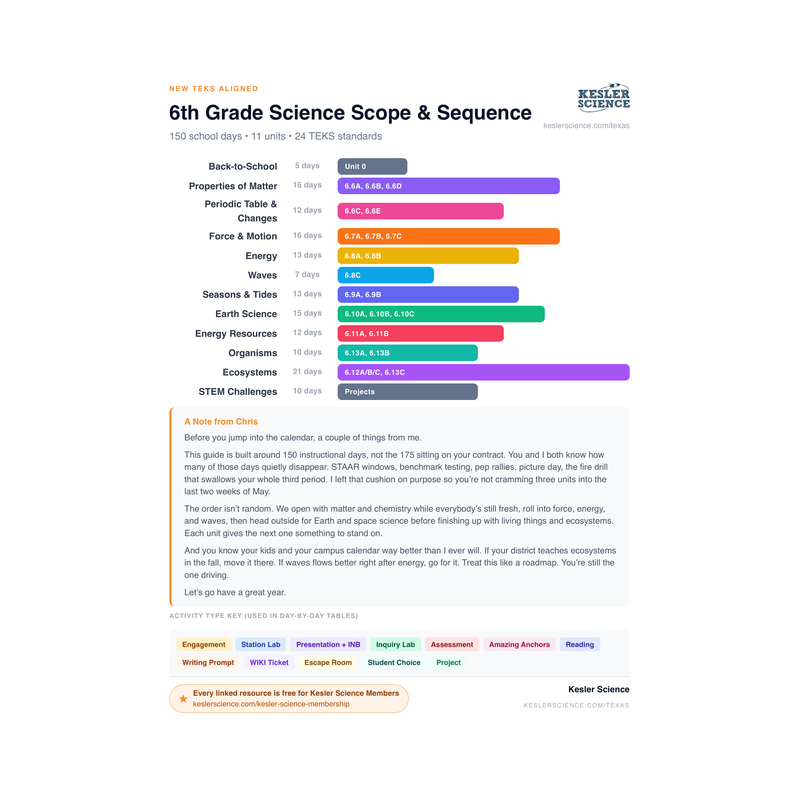
100% Aligned Lessons for Every TEKS You Teach
Kesler Science Plus puts thousands of ready-to-teach lessons and activities in your hands, so you can boost engagement and get your planning time back. Trusted by schools and districts all over the great state of Texas.
🌎 Phenomenon Ideas for 6.10A
Use these real-world phenomena to anchor your lesson. Show students the phenomenon first, let them wonder, then build toward Differentiate Between Earth's Spheres as the explanation.
One Photo, Four Spheres
Pull up a photo of a Texas state park (Big Bend, Enchanted Rock, Garner, take your pick). At first glance it just looks like a pretty picture: cliffs, a creek, some trees, sky. But every single thing in that frame belongs to one of Earth's four major spheres. The rocks and soil are the geosphere. The water is the hydrosphere. The trees, birds, even the moss on a rock are the biosphere. The air, clouds, and humidity are the atmosphere. Every photo of Earth is really a photo of all four systems happening at once.
"Look at this photo. List as many components as you can see and decide which sphere each belongs to. Are there any components you can't see in the image but you know have to be there?"
Where Does Your Lunch Belong?
Hold up a school lunch tray. The bread, the apple, the slice of cheese, the carton of milk, the water in the bottle, even the air gap above the food. Every single piece of that lunch came from one of the four spheres. The wheat in the bread and the apple are biosphere. The water you drink is hydrosphere. The salt sprinkled on the fries came out of the geosphere. The oxygen letting you smell the food is atmosphere. A lunch tray is a four-sphere snapshot of Earth.
"Pick five things on your lunch tray. Which sphere did each one originally come from? Are there any items that are tricky to place because they came from more than one sphere?"
The Air You're Breathing Right Now
Most kids will say the atmosphere is "oxygen". Take a breath and ask them what's actually in there. Earth's atmosphere is about 78% nitrogen, 21% oxygen, and roughly 1% other stuff: argon, water vapor, carbon dioxide, tiny bits of dust, and pollen. Oxygen gets all the credit, but it's not even close to the majority. The atmosphere has more components than most students assume, and only one of them is the gas they breathe to stay alive.
"If the atmosphere is mostly nitrogen, why do we keep talking about oxygen? List as many components of the atmosphere as you can. Which one would you miss the most if it were gone?"
💡 Free Engagement Ideas for 6.10A
Ready-to-run activities you can drop straight into a lesson. Where one of these looks like a phenomenon from the section above, that is on purpose: show it first as the hook, then let students run it themselves.
Sphere Sort With Magazine Pictures
Give each group a stack of old nature magazines or printed nature photos. Students cut out 20 to 30 images, then sort them into four columns labeled geosphere, hydrosphere, atmosphere, and biosphere. The hook is the arguments about images that belong in more than one column (a frog in a pond, a bird in the sky). Use those as the entry point to the idea that the spheres overlap.
Build the Four-Sphere Word Wall
Tape four big sheets of butcher paper on the wall, one for each sphere. Hand groups a stack of sticky notes. Set a timer for five minutes. Students race to write components of each sphere, one per sticky, and stick them on the right poster. Examples will pile up fast: "river," "soil," "humidity," "yeast," "granite," "bird," "lightning." Once the timer ends, walk through the posters as a class. Argue about the tricky ones (is groundwater hydrosphere or geosphere?) and use those debates to nail down what each sphere actually contains.
Mini Terrarium Sphere Hunt
Build a mini terrarium together (clear jar, pebbles, soil, small plant, a little water). Have students draw and label exactly where each sphere is in the jar. The rocks and soil are the geosphere. The water is the hydrosphere. The plant is the biosphere. The air above the soil is the atmosphere. A jar on a windowsill becomes a four-sphere system students can see and point to every day.
Sphere Bingo
Make a 4x4 bingo card with components mixed across all four spheres (bedrock, river, lightning, mushroom, salt, glacier, oxygen, ant, lava, pollen, sand, snake, the ocean, etc.). Print one per student. Call out a sphere instead of a number. Students mark off any item on their card that belongs to that sphere. First to four in a row yells "Sphere Bingo!" and has to defend each item by naming which sphere it goes in. Quick, fun, and a great formative check on whether kids can place components correctly.
🎯 What Approaches, Meets, and Masters Thinking Look Like
Here is what student thinking at each level looks like on this one task, so you know what to look for and how to move a student up.
Look at this photo of a pond. There is water in the pond, fish swimming in it, rocks on the bottom, and air above it. List which of Earth's four spheres (geosphere, hydrosphere, atmosphere, biosphere) you can find at this one pond, and name what in the photo belongs to each sphere you list.
- Each sphere they name is matched to a real thing in the photo, not just listed by itself.
- Water in the pond placed in the hydrosphere.
- The rocks on the bottom placed in the geosphere.
- The air above the pond placed in the atmosphere.
- The fish (and any other living thing, like plants) placed in the biosphere.
- The student finds more than one sphere at the same spot, instead of saying the pond is only one sphere.
- All four spheres found at this one pond, with the idea that they overlap in the same place. That is the part students miss most.
This pond is the hydrosphere because it is full of water. The spheres are stacked like layers, so the pond is the water layer. The rocks and the air and the fish are in their own layers somewhere else, not here in the pond.
Can you touch more than one sphere without leaving this pond?and have them point to the rocks, the air, and the fish one at a time.
I can find all four spheres at this one pond. The water is the hydrosphere. The rocks on the bottom are the geosphere. The air above the pond is the atmosphere. The fish are the biosphere because they are alive. So the pond is not just one sphere. Four spheres are all in the same place here.
All four spheres meet at this pond. The water is the hydrosphere, the rocks on the bottom are the geosphere, the air above it is the atmosphere, and the fish are the biosphere. The spheres are not stacked layers. They overlap, so one small spot can have more than one sphere at the same time.
It works the same way in places that are not a pond. Right now where I am standing there is air around me (atmosphere), the floor and ground under me (geosphere), me and the plants by the window (biosphere), and even a little water in the air and in my water bottle (hydrosphere). Almost any spot on Earth touches more than one sphere at once.
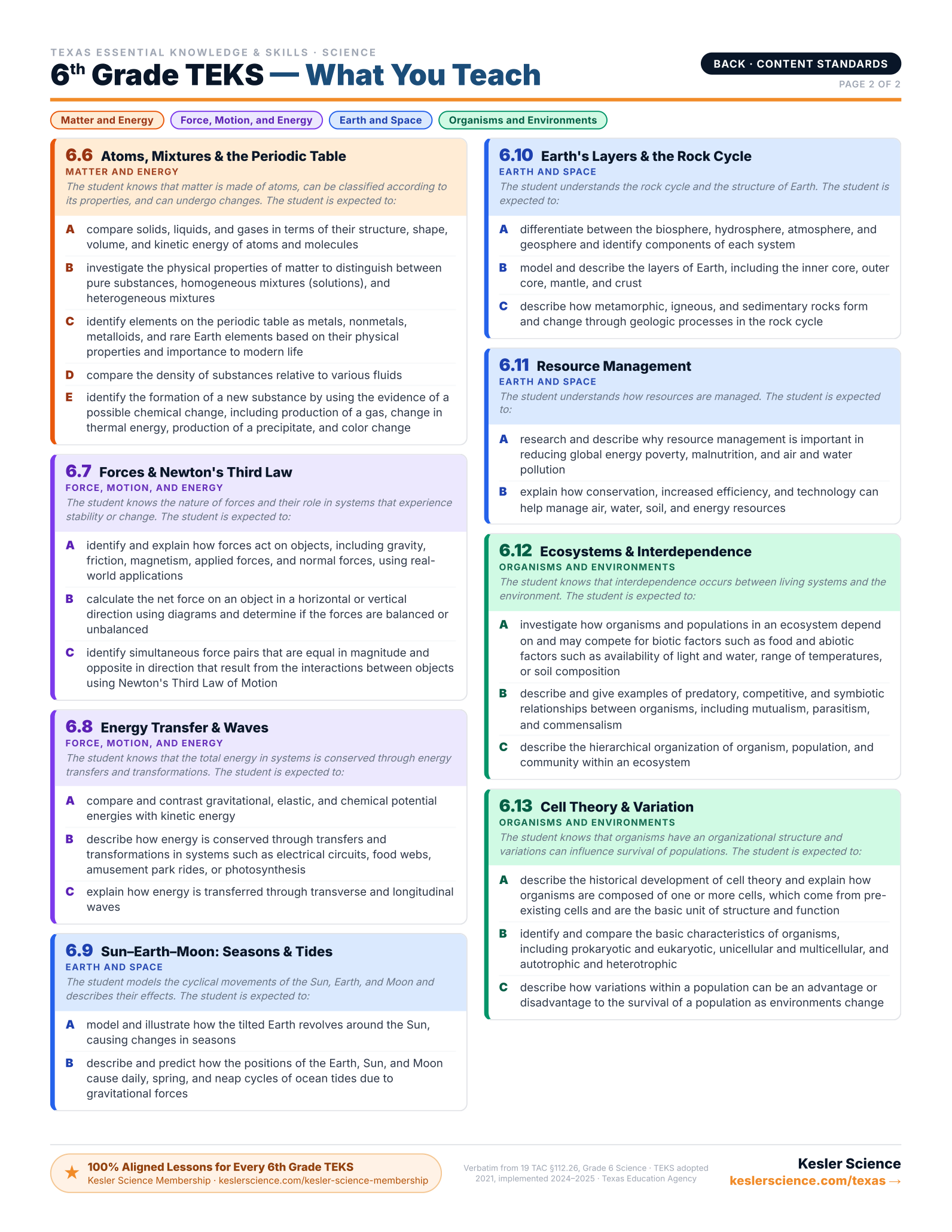
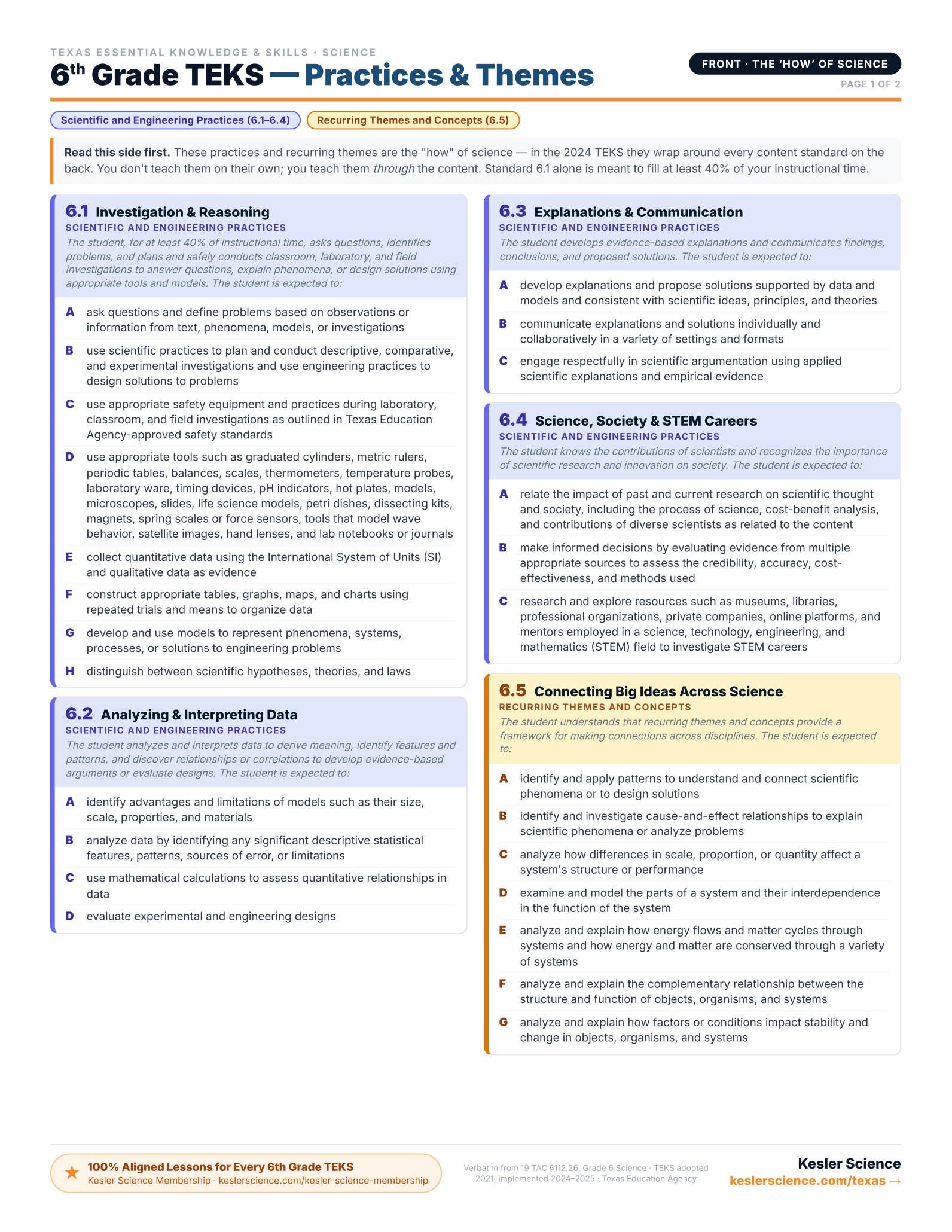
Every 6th-Grade Science TEKS on One Page
The color-coded, front-and-back cheat sheet I wish I'd had — every standard, organized by reporting category. Print it and reference it all year long. This will be your new favorite document!
Trusted Across Texas
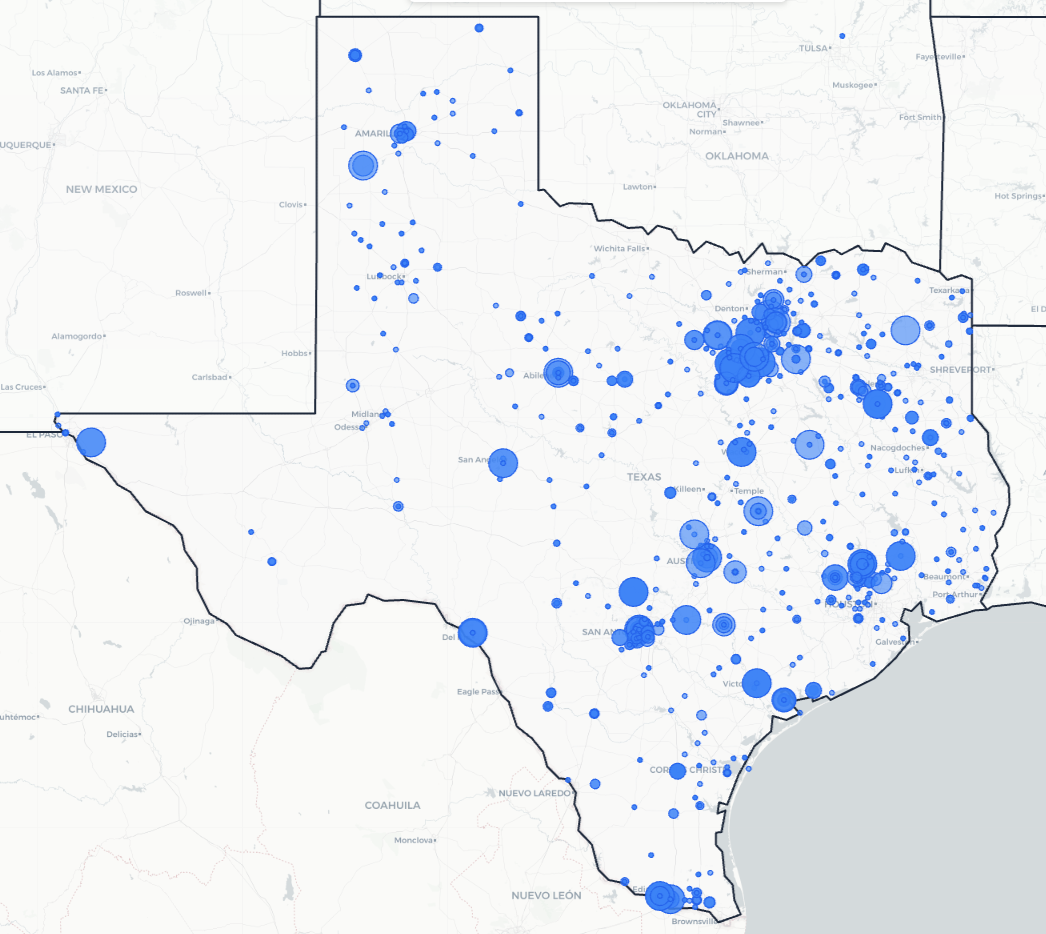
From the Rio Grande Valley to the Panhandle, Texas science teachers are using Kesler Science to save time and engage students.
Texas Schools and Districts
Love Kesler Science
What Teachers Are Saying
Give Your Science Teachers Everything They Need
School and district licenses give your teachers access to every resource they need, including station labs, inquiry labs, anchoring phenomena, presentations, escape rooms, and much more. One purchase covers the grade levels you need.
- PO-friendly. We accept purchase orders
- Volume discounts for 11+ teachers
- Complimentary Kesler Science Plus orientation for 4+ teachers
- Three free implementation PD sessions for departments of 11+
- Aligned to the 2024 TEKS standards
See It in Action
Book a walkthrough and we'll show you how Kesler Science fits your campus.
Book Demo CallNo pressure, no hard sell