.png?width=375&height=100&name=WebPage%20logo%20with%20curves%202026%20(8).png)
Forces in the Real-World
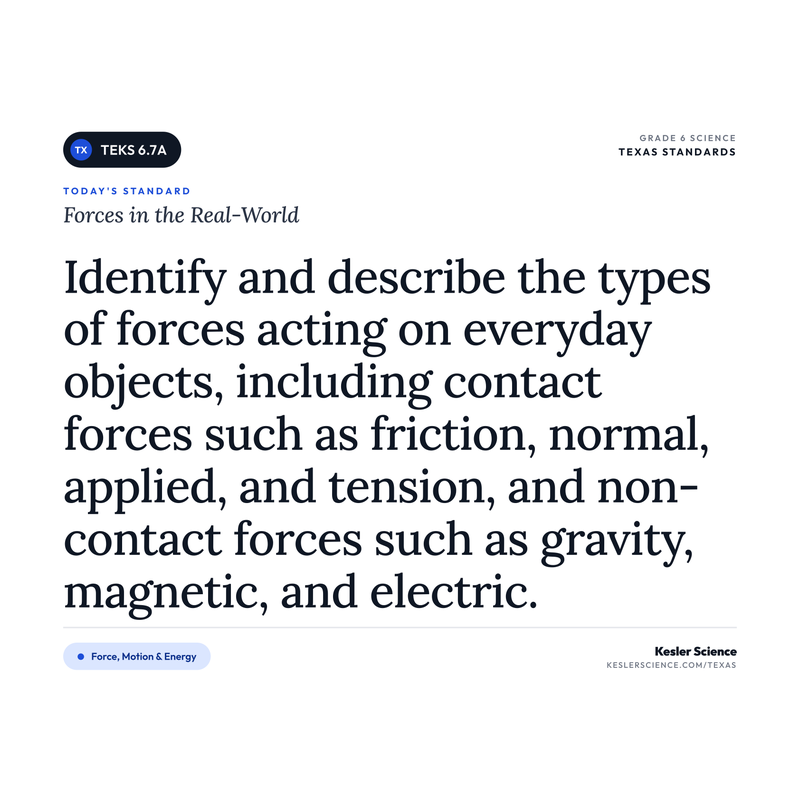
"Identify and explain how forces act on objects, including gravity, friction, magnetism, applied forces, and normal forces, using real-world applications."
💡 What This Standard Actually Means
"Identify and explain". Students are naming the force acting on an object and explaining how it works using real-world applications. The standard limits the list to gravity, friction, magnetism, applied forces, and normal forces. Notice the contact vs. non-contact framing isn't required anymore. The new wording focuses on connecting each force to something kids can see, feel, or do in their own world. Instruction can take many forms, such as everyday-object force labels, sticky-note classroom hunts, friction race-track investigations, and magnet stations.
A force is a push or a pull. Every force has something doing the pushing or pulling and something receiving it. The 2024 TEKS calls out five specific forces students need to know inside and out, and the focus is on connecting each one to a real-world example.
Gravity is the pull between any two objects with mass. On Earth, it's the force that pulls a dropped phone toward the ground and keeps every kid in their seat instead of floating to the ceiling. Friction is the force that resists sliding between two surfaces. It's why a soccer ball rolling across grass slows down, why brakes can stop a bike, and why slick floors are slippery. Magnetism pulls or pushes certain materials (like iron, nickel, and cobalt) without the objects needing to touch. Refrigerator magnets, MRI machines, speakers, and the magnets inside electric motors all use magnetism. Applied forces are simple pushes or pulls from a person or object. A student opening a door, a player kicking a ball, or a backpack strap pulling down on a shoulder are all applied forces. Normal force is the push a surface gives back on an object resting on it. A desk pushes up on a textbook with the same force the textbook presses down. Without normal force, the book would fall through the desk.
The core understanding students should walk away with is that forces are everywhere in their daily lives, not just in physics class. Every object they touch, push, drop, or watch move involves at least one of these five forces. The standard wants kids to identify the force, explain what it's doing, and connect it back to something real.
The thing that locked this one in for my kids was turning the classroom into a scavenger hunt. I'd put seven sticky notes on my desk, each with a force written on it, and say, "Find an example of each one in this room." They'd wander. They'd argue. Someone would touch the wall and say, "Is this friction or normal force?" That argument is the gold. Pair it with a two-column chart on the board, one column for the force they're naming and one for how they know, and let them place their examples. By the end of the period, they stop seeing "a book on a shelf" and start seeing "a book with gravity pulling it down and normal force pushing it up." That shift is the whole standard.
⚠️ Misconceptions Your Students May Have
These are some of the most common misconceptions. Knowing what to look for can help you get ahead of them.
"If an object isn't moving, no forces are acting on it"
This is probably the most common one. A book resting on a table has gravity pulling it down and the table pushing up on it with normal force. The forces are balanced, so the book doesn't move, but forces are still acting. Stillness does not mean "no forces." It means the forces cancel out.
"Gravity only works on Earth, or only on heavy things"
Gravity acts between any two objects with mass, anywhere. A feather is pulled down by gravity just like a bowling ball. The feather just falls slower because of air resistance, not because gravity is weaker on it. Gravity also acts on astronauts in orbit. They float because they're falling around the Earth, not because gravity shut off.
"Friction is bad and we should get rid of it"
Friction can slow things down, but we depend on it constantly. Friction between shoes and the floor is what lets students walk. Friction between tires and the road is what lets cars turn and stop. Without friction, they couldn't pick up a pencil. The goal is to know when friction helps and when it doesn't, not to label it as the enemy.
"Magnets pull on everything metal"
Students assume "metal equals magnetic." Most everyday magnets only strongly attract materials containing iron, nickel, or cobalt. Aluminum soda cans, copper pennies, and gold rings are metals but don't stick to a standard refrigerator magnet. A quick sort with a magnet and a pile of metal items clears this up fast.
"Normal force means normal or regular"
In physics, "normal" means perpendicular. Normal force is the force a surface pushes outward on an object resting on it, at a 90-degree angle to the surface. The table pushes straight up on the book because the table's surface is flat. On a ramp, the normal force points out perpendicular to the ramp, not straight up. Naming the vocabulary honestly with students helps this stick.
📓 Teaching Resources for 6.7A
These resources are aligned to this standard.


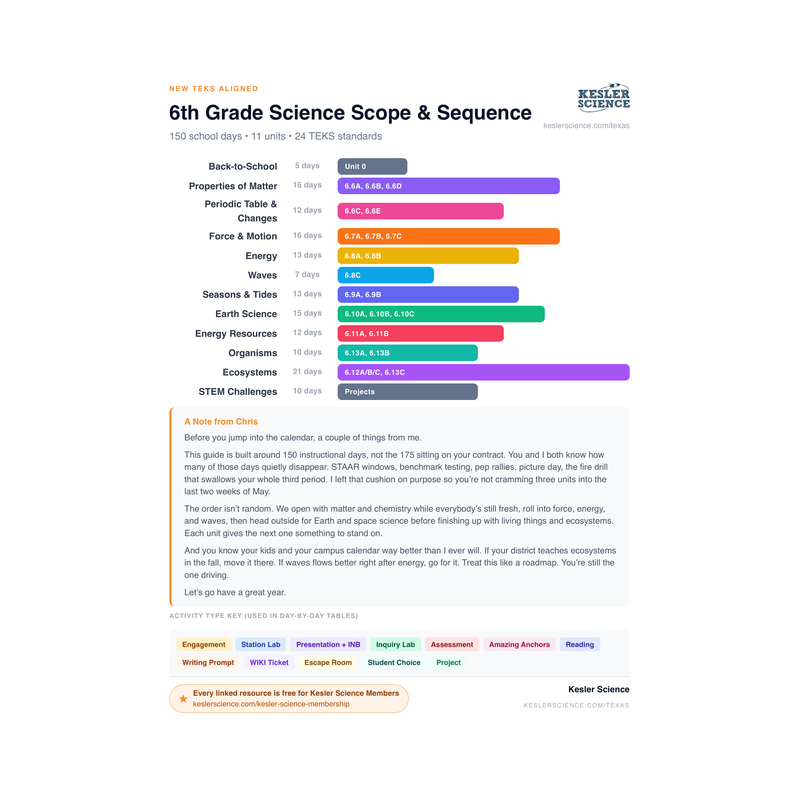
100% Aligned Lessons for Every TEKS You Teach
Kesler Science Plus puts thousands of ready-to-teach lessons and activities in your hands, so you can boost engagement and get your planning time back. Trusted by schools and districts all over the great state of Texas.
🌎 Phenomenon Ideas for 6.7A
Use these real-world phenomena to anchor your lesson. Show students the phenomenon first, let them wonder, then build toward Forces in the Real-World as the explanation.
A Floating Magnet Train
Maglev trains in countries like Japan and China can travel at very high speeds while hovering above the track. They are held up and pushed forward by powerful magnets, not by wheels on rails. The train and the track never touch during normal operation, yet the forces between them are strong enough to lift a multi-ton vehicle and speed it along.
"If the train and the track aren't touching, what's holding the train up? What's pushing it forward? Which of the five forces we've named could reach across a gap like that?"
Rock Climbers on a Rope
A rock climber dangles from a rope halfway up a cliff. The rope is pulled tight. The climber isn't moving, but the rope is under enormous strain. If the rope snapped, the climber would fall. Something has to be pulling up on the climber with the same strength that gravity is pulling them down.
"Name every force acting on the climber. Which one is pulling up and which is pulling down? Why doesn't the climber fall, and why don't they shoot up into the air?"
A Static-Charged Balloon and Your Hair
Rub a balloon on your head for a few seconds, then hold it just above your hair without touching. Individual hairs often rise up and reach toward the balloon. The balloon and the hair are clearly not in contact, but something is pulling the hair upward against gravity. The same balloon can stick to a wall without any tape.
"The balloon isn't touching the hair, but the hair still moves. What type of force is this? How is it similar to, and different from, how a magnet pulls on a paperclip?"
💡 Free Engagement Ideas for 6.7A
Ready-to-run activities you can drop straight into a lesson. Where one of these looks like a phenomenon from the section above, that is on purpose: show it first as the hook, then let students run it themselves.
Force Scavenger Hunt
Give each group a printed list of the five TEKS forces (friction, normal, applied, gravity, magnetic). For bonus credit, students can also look for tension and electric forces. They have 15 minutes to find and photograph or sketch a real example of each one in the classroom, hallway, or school grounds. Come back together and share. Disagreements about which force is which are where the real learning happens.
The Paperclip and Magnet Sort
Set out a bin of small items: paperclips, aluminum foil, pennies, rubber bands, paper, a plastic spoon, a steel washer, a nickel. Give each group a refrigerator magnet and have them predict first, then test, which items the magnet attracts. Chart the results and ask: what do the "attracted" items have in common?
Same Puck, Four Surfaces
Give each group one small object (an eraser, or a bottle cap with a penny taped inside) and a rubber band. Hook the rubber band on the object and pull it slowly across four surfaces: a bare desk, a sheet of sandpaper, a carpet square, and wax paper. Have them watch how far the rubber band stretches before the object budges, and rank the surfaces from least to most friction. Same object, same pull, different surface. That's the whole point.
Tug-of-War Force Diagram
Two students grab opposite ends of a rope. Before the tug begins, have the rest of the class label every force acting on each student: gravity pulling down, normal force up from the floor, friction between shoes and floor, applied force pulling through the rope (tension), and the applied force from the opponent. Then let them tug gently and re-label to show which forces got stronger. A great way to see tension, friction, and applied force all in one picture.
🎯 What Approaches, Meets, and Masters Thinking Look Like
Here is what student thinking at each level looks like on this one task, so you know what to look for and how to move a student up.
A textbook is sitting still on a flat desk. It is not moving at all. Identify the forces acting on the book right now, and explain what each force is doing. (Remember: a force is a push or a pull.)
- Names gravity as a force acting on the book, even though the book is sitting still.
- Explains that gravity is a pull, and that it pulls the book down toward the ground.
- Names the normal force from the desk (some students may just call it "the desk pushing up").
- Explains that the desk pushes up on the book, in the opposite direction from gravity.
- Says the two forces are balanced (they cancel out), which is why the book stays still.
- Connects the answer to the real object on the desk, not just a textbook definition.
- Understands that "not moving" does not mean "no forces." That is the hardest part to get right.
The book is just sitting there, so no forces are acting on it. Forces are pushes and pulls, and nothing is pushing or pulling the book because it is not moving. If I pushed it across the desk, then there would be a force. But right now it is still, so there are no forces.
Two forces are acting on the book. Gravity is pulling the book down toward the ground. The desk is pushing up on the book, and that push is called the normal force. Gravity pulls down and the normal force pushes up, so they are balanced and cancel out. That is why the book stays still and does not fall through the desk or float up.
The book has two forces on it. Gravity pulls it straight down toward the ground, and the desk pushes back up on it with the normal force. They are equal and point in opposite directions, so they are balanced and the book stays still. The book is not still because there are no forces. It is still because the forces cancel each other out.
Now imagine someone starts pushing the book sideways across the desk. Gravity and the normal force are still there and still balanced up and down, so the book stays on the desk instead of falling through it. But now there is an applied force pushing it sideways and friction between the book and the desk pushing back the other way. If the push is stronger than the friction, the book slides. Nothing about the first two forces changed. I just added a force that nothing cancelled out, and that is what made it move.
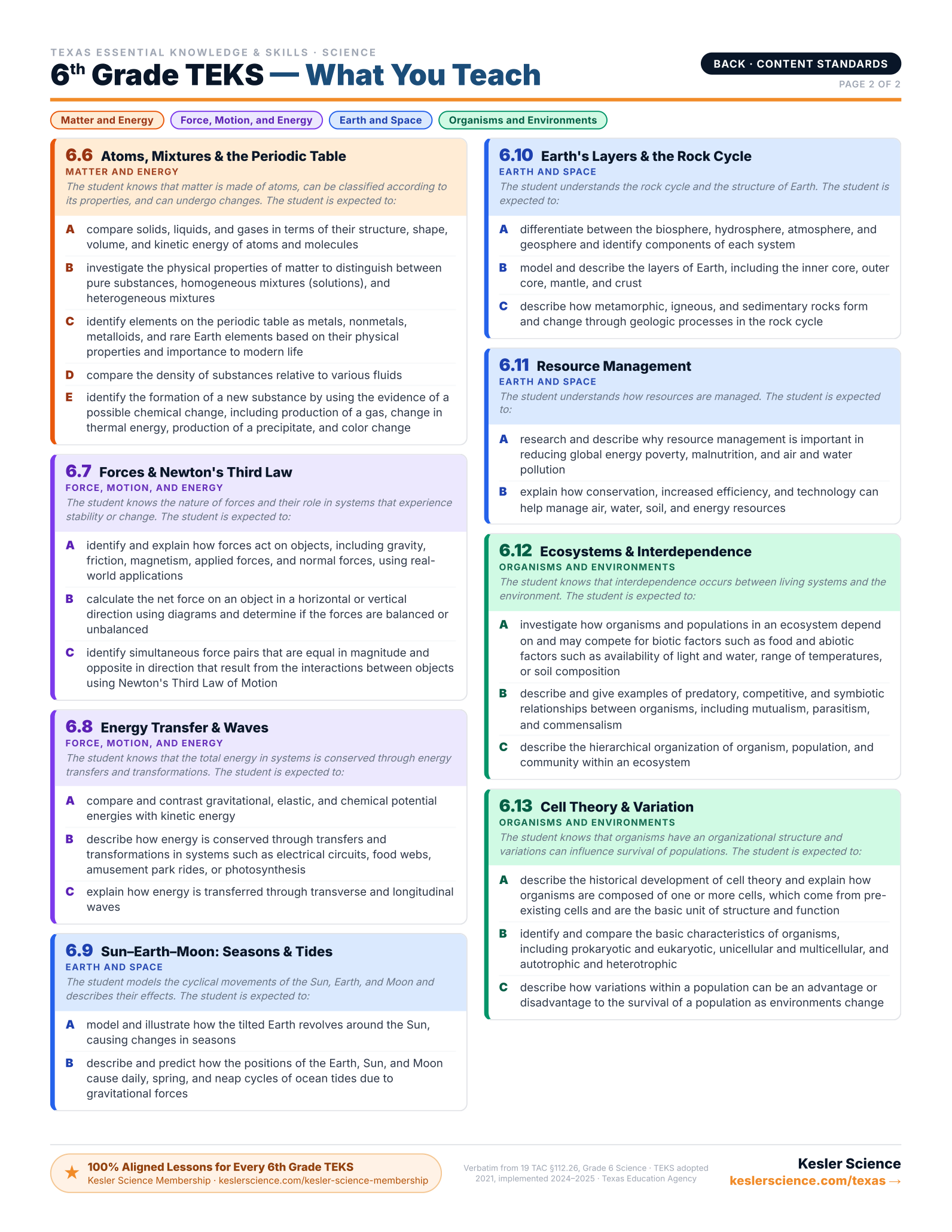
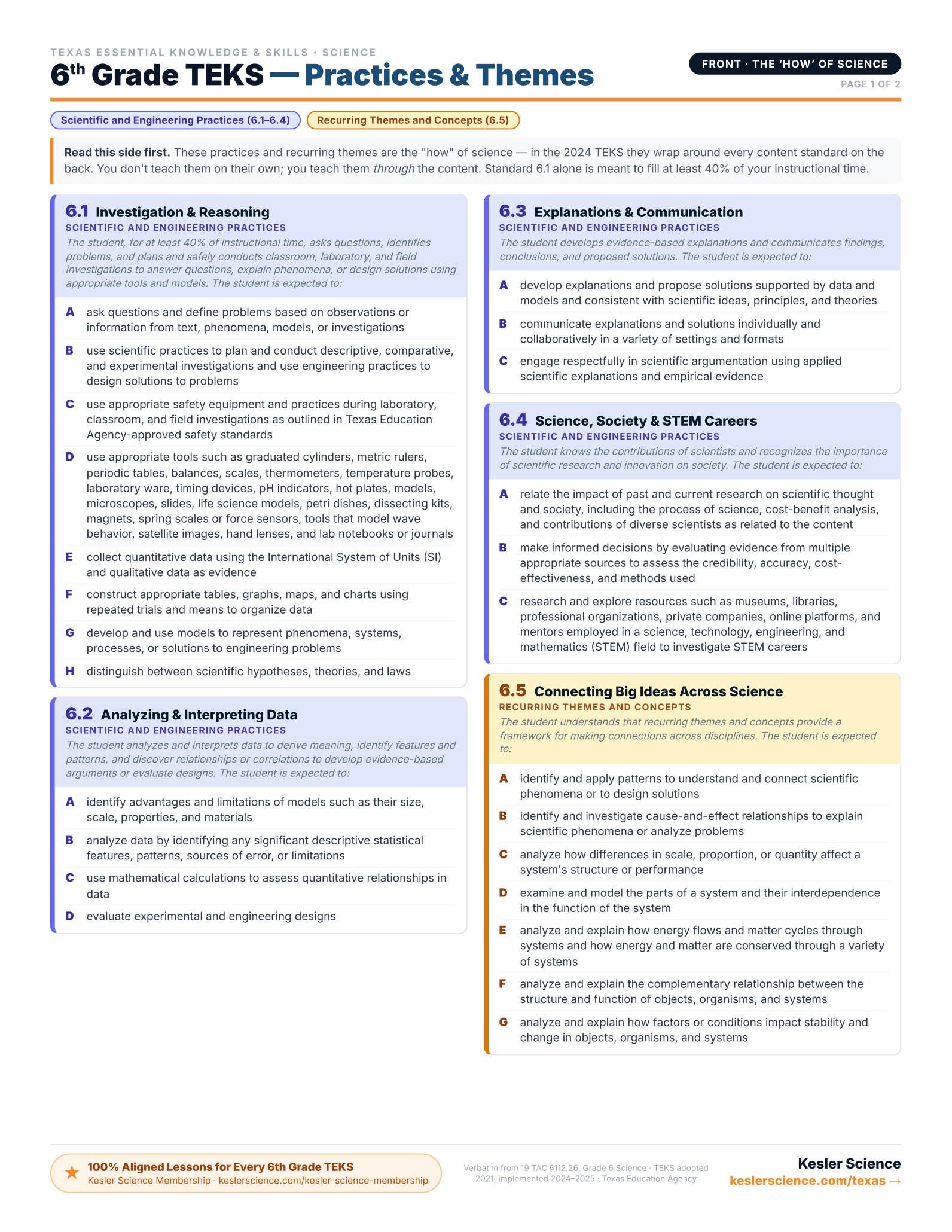
Every 6th-Grade Science TEKS on One Page
The color-coded, front-and-back cheat sheet I wish I'd had — every standard, organized by reporting category. Print it and reference it all year long. This will be your new favorite document!
Trusted Across Texas
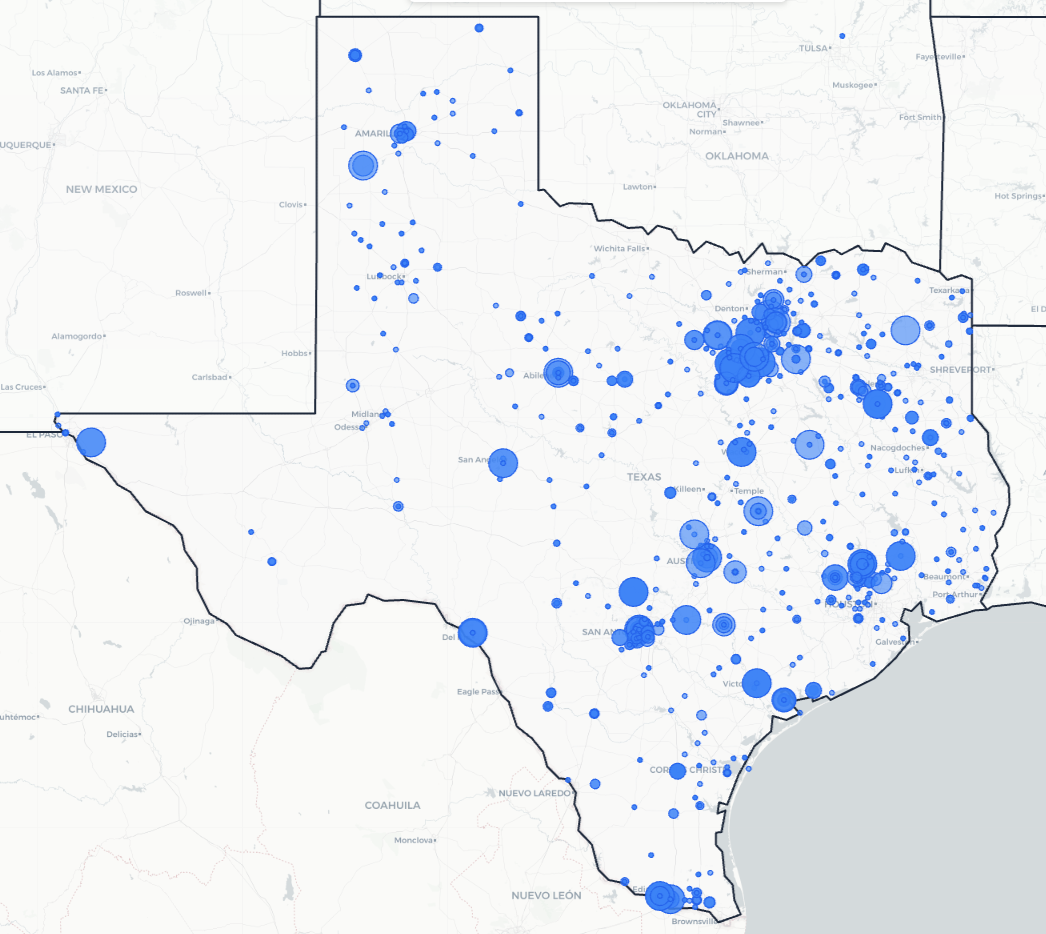
From the Rio Grande Valley to the Panhandle, Texas science teachers are using Kesler Science to save time and engage students.
Texas Schools and Districts
Love Kesler Science
What Teachers Are Saying
Give Your Science Teachers Everything They Need
School and district licenses give your teachers access to every resource they need, including station labs, inquiry labs, anchoring phenomena, presentations, escape rooms, and much more. One purchase covers the grade levels you need.
- PO-friendly. We accept purchase orders
- Volume discounts for 11+ teachers
- Complimentary Kesler Science Plus orientation for 4+ teachers
- Three free implementation PD sessions for departments of 11+
- Aligned to the 2024 TEKS standards
See It in Action
Book a walkthrough and we'll show you how Kesler Science fits your campus.
Book Demo CallNo pressure, no hard sell