.png?width=375&height=100&name=WebPage%20logo%20with%20curves%202026%20(8).png)
Calculating Net Force
"Calculate the net force on an object in a horizontal or vertical direction using diagrams and determine if the forces are balanced or unbalanced."
💡 What This Standard Actually Means
"Calculate". Students are using diagrams of forces acting in horizontal or vertical directions to figure out the net force on an object, then deciding whether the forces are balanced or unbalanced. Same direction forces add. Opposite direction forces subtract. Once students have the net force, they can predict whether anything will change about the object's motion. Instruction can take many forms, such as arrow-and-vector worksheets, free-body diagram practice, tug-of-war investigations, and force-meter labs.
The net force is the total force acting on an object after all of the individual forces are combined. If two forces push in the same direction, they add together. If they push in opposite directions, they subtract. The result tells you whether anything will change about the object's motion.
When the net force on an object is zero, the forces are balanced. The object's motion does not change. A book sitting on a desk has gravity pulling it down and the desk pushing up with equal strength, so the net force is zero and the book stays still. A car cruising at a steady speed down a straight road also has balanced forces, even though it's moving. The forces pushing it forward equal the forces pushing it back, so the speed stays the same.
When the net force is not zero, the forces are unbalanced. An unbalanced net force causes a change in motion. That change could be speeding up, slowing down, or changing direction. The important phrasing to share with students is that unbalanced forces cause changes in motion, not that they "cause motion." An object already in motion keeps moving unless something unbalanced acts on it. That subtle distinction trips up a lot of 6th graders.
I used to lose kids on this one because I'd jump straight to the arrow diagrams in the textbook. What finally worked was staging a rope pull with two kids of roughly equal strength, then having a third kid join one side. The class had to predict what would happen each round and then explain why. Before the third kid, the rope didn't move, balanced. After, it moved, unbalanced. We'd then diagram exactly what we just saw with arrows and numbers. Living it before drawing it made the numbers make sense. After that, I could hand them a worksheet and they'd fly through it.
⚠️ Misconceptions Your Students May Have
These are some of the most common misconceptions. Knowing what to look for can help you get ahead of them.
"If something is moving, the forces must be unbalanced"
This is the biggest trap. A car going a steady 60 mph down a straight highway has balanced forces. The engine pushes forward, friction and air resistance push back, and those forces are equal. Because the net force is zero, the speed doesn't change. Balanced forces mean motion doesn't change, not that there is no motion.
"Unbalanced forces make something move"
Unbalanced forces cause a CHANGE in motion. That change can be starting to move from rest, speeding up, slowing down, or changing direction. An object already moving will keep moving even when forces are balanced. The correct phrasing is "unbalanced forces change motion," not "unbalanced forces cause motion."
"Net force always points in the direction the object is moving"
Net force points in the direction of acceleration, not in the direction of motion. A car slowing down to stop is still moving forward, but the net force on it points backward (from brakes plus friction). That is why the car decelerates. Motion and net force are connected through acceleration, not directly to each other.
"The stronger force wins, and the weaker force disappears"
Both forces are still acting. When one is bigger, the net force points in the direction of the bigger force, but the smaller force is still pushing back. It just gets partly cancelled out. Understanding that both forces remain is what lets students predict what happens when either force changes.
"Net force is the same as total force"
Net force is what's left over after forces in opposite directions cancel each other out. Two 20 N forces pushing in opposite directions have a total force of 40 N, but a net force of 0 N. "Total" and "net" sound alike but mean different things. When students mix them up, their diagrams tend to show balanced objects that should be moving.
📓 Teaching Resources for 6.7B
These resources are aligned to this standard.


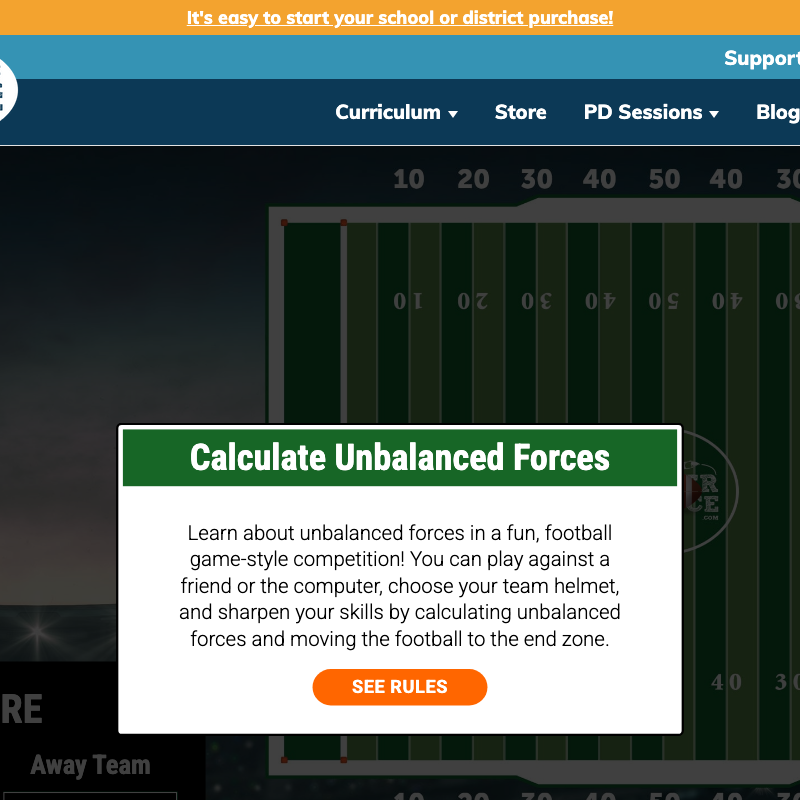
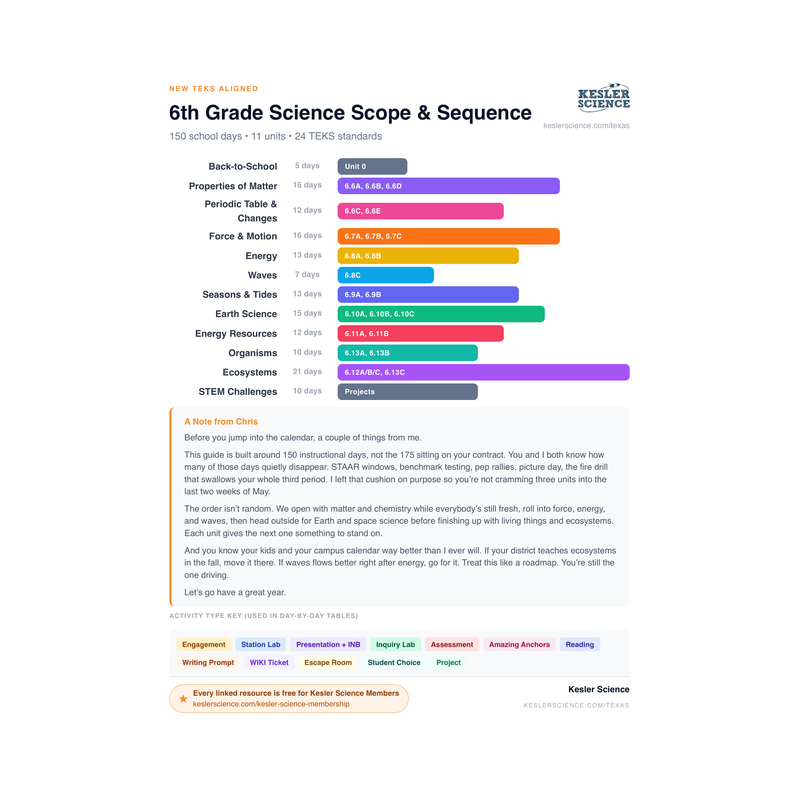
100% Aligned Lessons for Every TEKS You Teach
Kesler Science Plus puts thousands of ready-to-teach lessons and activities in your hands, so you can boost engagement and get your planning time back. Trusted by schools and districts all over the great state of Texas.
🌎 Phenomenon Ideas for 6.7B
Use these real-world phenomena to anchor your lesson. Show students the phenomenon first, let them wonder, then build toward Calculating Net Force as the explanation.
A Tug-of-War That Won't Budge
Two teams are pulling hard on a rope during a tug-of-war. Muscles strain, the rope is taut, and the center knot is dead still over the line. Both sides are clearly exerting force, but for a full 20 seconds, nothing moves. Then one team adds a new player, and the knot starts sliding toward them.
"If both teams are pulling, why isn't the rope moving? What changed when the extra player joined? Use the words balanced, unbalanced, and net force in your answer."
A Skydiver at Terminal Velocity
A skydiver jumps out of a plane. At first, they keep falling faster and faster. But after around 10 to 12 seconds of free fall, their speed stops increasing and stays steady at around 120 mph. Gravity is still pulling them down the whole time. So why does the falling speed stop changing?
"Gravity pulls the skydiver down the entire time. What other force acts on them as they fall? When the speed stops changing, what must be true about the net force?"
A Car Stuck in a Traffic Jam
A driver is stopped in traffic. They press the gas pedal, the engine revs, but the car in front of them hasn't moved. The engine is producing a forward force. Brakes are producing a backward force. The car doesn't move at all until the brake is released. Somehow, a running engine is not enough to change the car's motion.
"Why doesn't the car move forward even though the engine is pushing it? Draw the forces on the car. What is the net force? Is it balanced or unbalanced?"
💡 Free Engagement Ideas for 6.7B
Ready-to-run activities you can drop straight into a lesson. Where one of these looks like a phenomenon from the section above, that is on purpose: show it first as the hook, then let students run it themselves.
Desk Push War
Pair students up on opposite sides of a small rolling desk or cart. Round 1: both push with equal strength, the desk doesn't move. Round 2: one student is told to push twice as hard, the desk slides. Round 3: one student stops pushing entirely. After each round, students draw a force diagram with arrows sized to match the push, label it balanced or unbalanced, and predict before the next round.
Spring Scale Rope Pull
Attach a small object (like a stuffed animal) to two spring scales with string, one on each side. Students pull on both scales at the same time with different amounts of force (for example, 5 N on the left, 3 N on the right). They record the readings, calculate the net force, and predict which way the object will move. Then release one scale to see if their prediction was right.
Balloon Rocket Net Force Race
Tape a straw to a balloon, thread a long string through the straw, and pull it tight across the room. Release the balloon. The air pushes back out of the balloon (one force), and the balloon flies forward (the reaction). Students tape a paperclip or penny to the balloon, repeat the race, and discuss how adding resistance changes the net force and the motion.
Book Stack Balance Check
Place a book on a desk. Ask: is the net force on this book zero? How do you know? Stack a second book on top. Ask again. Then have students draw the force diagram for each setup, showing gravity pulling down and normal force pushing up. A great closing activity for labeling balanced systems and separating "still" from "no forces."
🎯 What Approaches, Meets, and Masters Thinking Look Like
Here is what student thinking at each level looks like on this one task, so you know what to look for and how to move a student up.
A sled is being pulled across flat, snowy ground. An arrow shows a 30 N force pulling the sled to the right. Another arrow shows a 30 N force of friction pushing to the left. The sled is sliding to the right at a steady speed. Find the net force on the sled. Then tell whether the forces are balanced or unbalanced, and explain what is happening to the sled's motion.
- The two forces read correctly off the diagram: 30 N to the right, 30 N to the left.
- The forces combined the right way: opposite directions, so they subtract (30 N minus 30 N).
- A net force of 0 N.
- The forces named as balanced because the net force is zero.
- The motion described correctly: the sled keeps sliding at the same steady speed, its motion does not change.
- An explanation that connects net force to the motion: balanced forces mean the motion stays the same, not that the sled must stop.
- No claim that the sled must be slowing down or stopping just because the forces are balanced. That is the easiest place to slip.
The net force is 0 N because 30 minus 30 is 0. The sled is moving, so the forces have to be unbalanced. I think the sled is going to keep speeding up because it is sliding to the right.
The two forces are pushing in opposite directions, so I subtract them. 30 N minus 30 N is 0 N, so the net force is 0 N. That means the forces are balanced. Because the forces are balanced, the sled's motion does not change. It keeps sliding to the right at the same steady speed. It does not speed up or slow down.
The pull is 30 N to the right and friction is 30 N to the left. They point opposite ways, so they cancel out. 30 N minus 30 N is 0 N, so the net force is 0 N and the forces are balanced. When the net force is zero, there is nothing left to change the motion, so the sled keeps sliding to the right at the same steady speed.
The real rule is that balanced forces keep motion the same, they do not have to make something stop. That is how I know a car driving at a steady 60 on the highway also has balanced forces. The engine pushes forward and friction and air push back the same amount, so the net force is 0 N and the speed stays the same, even though the car is moving fast.
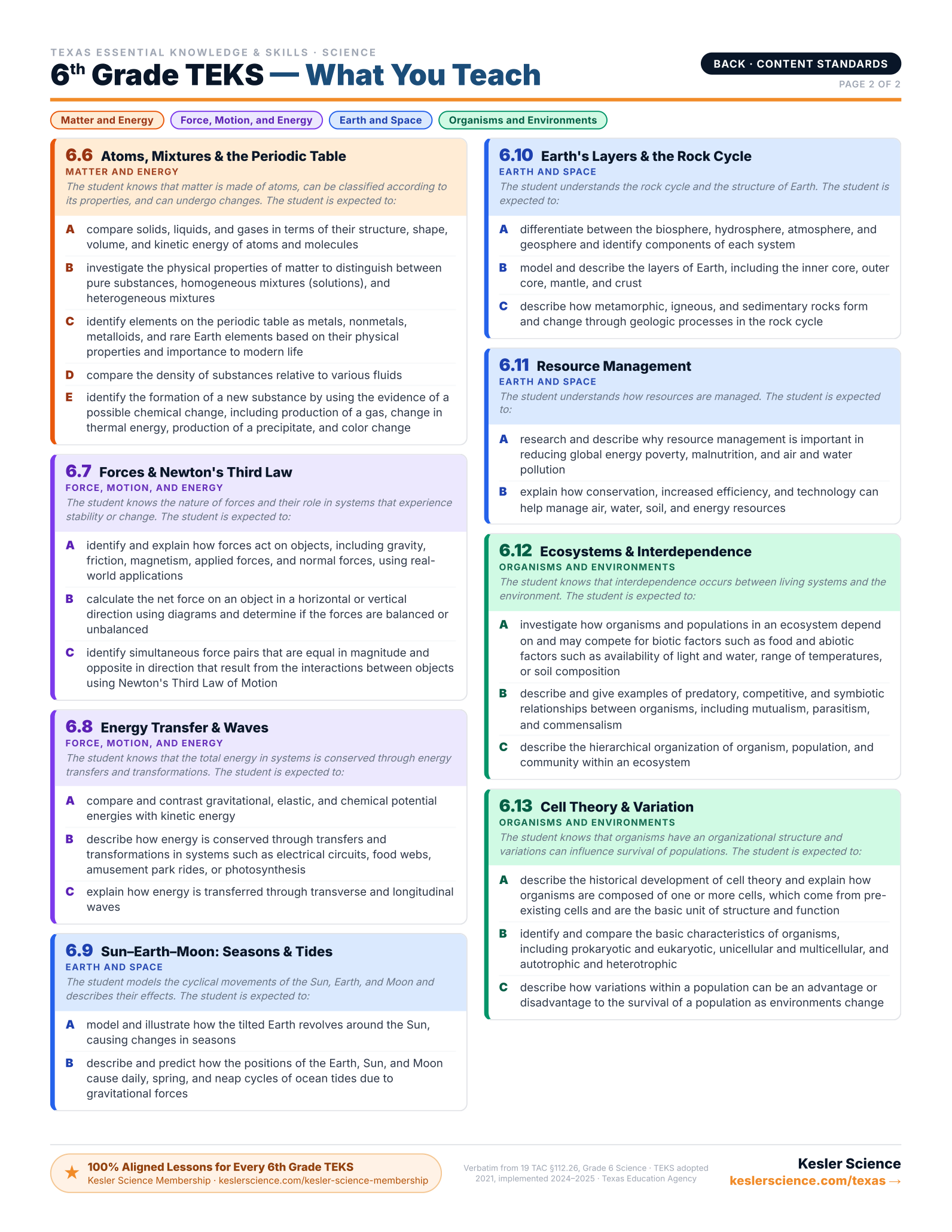
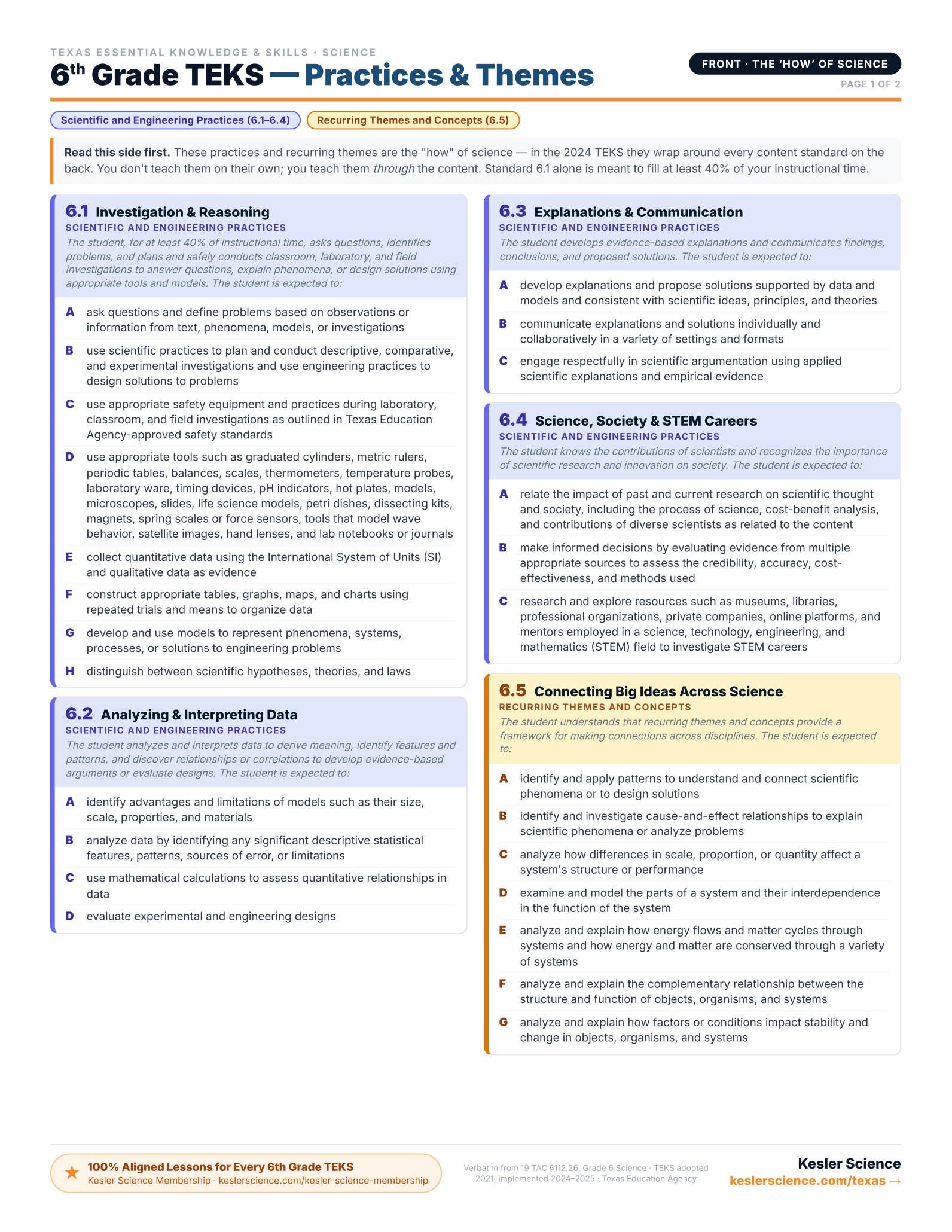
Every 6th-Grade Science TEKS on One Page
The color-coded, front-and-back cheat sheet I wish I'd had — every standard, organized by reporting category. Print it and reference it all year long. This will be your new favorite document!
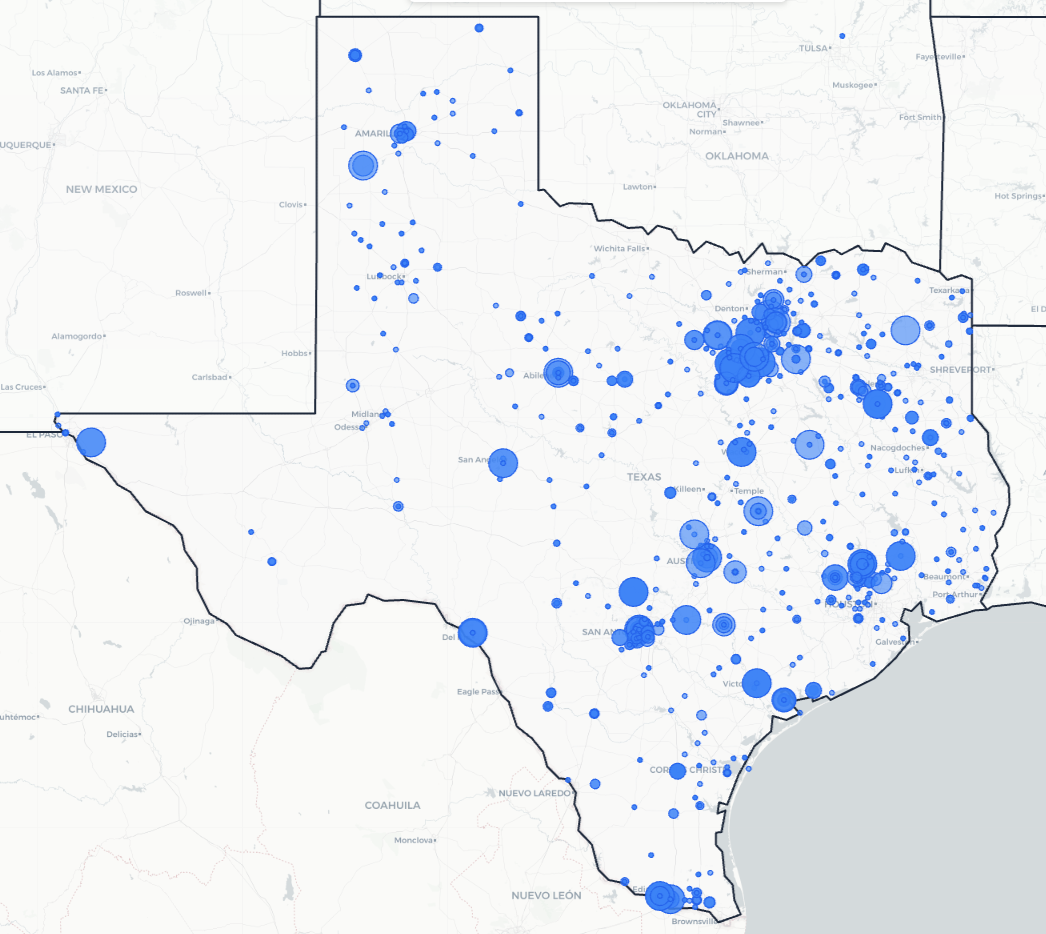
Trusted Across Texas
From the Rio Grande Valley to the Panhandle, Texas science teachers are using Kesler Science to save time and engage students.
Texas Schools and Districts
Love Kesler Science
What Teachers Are Saying
Give Your Science Teachers Everything They Need
School and district licenses give your teachers access to every resource they need, including station labs, inquiry labs, anchoring phenomena, presentations, escape rooms, and much more. One purchase covers the grade levels you need.
- PO-friendly. We accept purchase orders
- Volume discounts for 11+ teachers
- Complimentary Kesler Science Plus orientation for 4+ teachers
- Three free implementation PD sessions for departments of 11+
- Aligned to the 2024 TEKS standards



See It in Action
Book a walkthrough and we'll show you how Kesler Science fits your campus.
Book Demo CallNo pressure, no hard sell