
8 hands-on stations for teaching energy transformations
A station lab is a student-led activity where small groups rotate through 8 stations (plus a 9th challenge station for early finishers) at their own pace during one to two class periods. You become a facilitator instead of a lecturer. You walk around, spot-check, and break misconceptions while kids work through the rotation.
The Energy Transformations in Systems Station Lab has four input stations (where students take in new info on systems, energy forms, and the law of conservation of energy) and four output stations (where they show what they learned). Here's what's at each one.
4 input stations: how students learn energy transformations
A short YouTube video shows a classic bowling-ball pendulum demonstration: a guy lets a heavy bowling ball swing toward his face from the top of a ladder, and the ball stops just short. Three questions tie it back to where the ball has maximum potential vs. maximum kinetic energy, how the demo proves the law of conservation of energy, and why a dinosaur figure placed in the path got smacked while the man's face didn't. Visual learners come alive at this station because they SEE conservation of energy in real time.
A one-page passage called "The Energy Journey of a Roller Coaster" walks students through every energy transformation on a coaster ride: the motor (electrical → mechanical) pulls the car up, gravity drops it (potential → kinetic), friction makes heat (kinetic → thermal). The vocabulary is bolded throughout (system, transform, law of conservation of energy, conserved, transfer). Three multiple-choice questions follow, plus the vocab notes section. Comes in two reading levels (Dependent and Modified) plus a Spanish version.
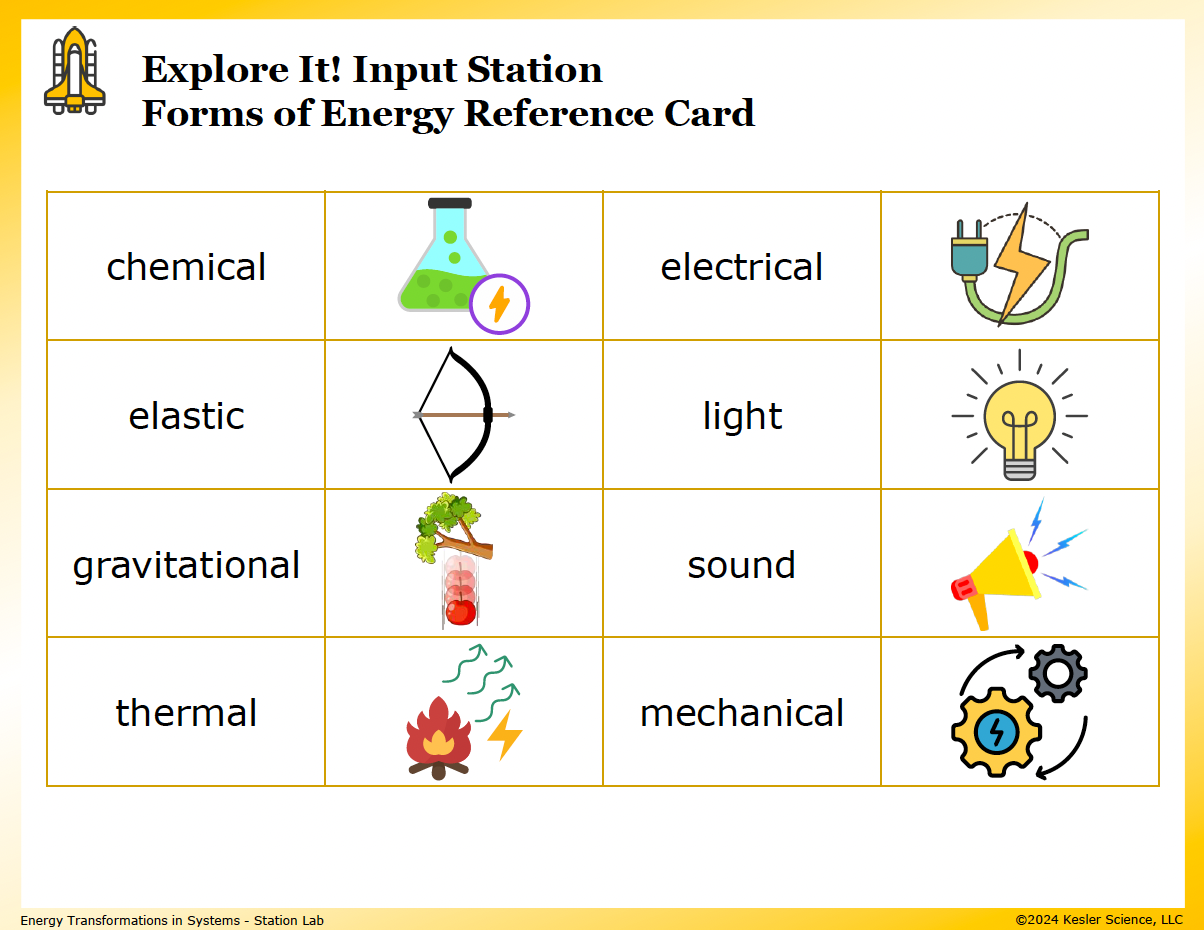
This is the heart of the lab. Three hands-on activities. Activity 1: Observe a lava lamp that's already running and identify the energy transformations (electrical → thermal → kinetic motion of the blob). Activity 2: Build a simple circuit with a battery, wires, and a small electrical device, watch it operate, and trace the energy chain. Activity 3: Wind up a toy and track elastic → kinetic → thermal as friction slows it down. Six questions tie all three back to the law of conservation of energy. Plus a Forms of Energy reference card on the table for kids who blank on the names.
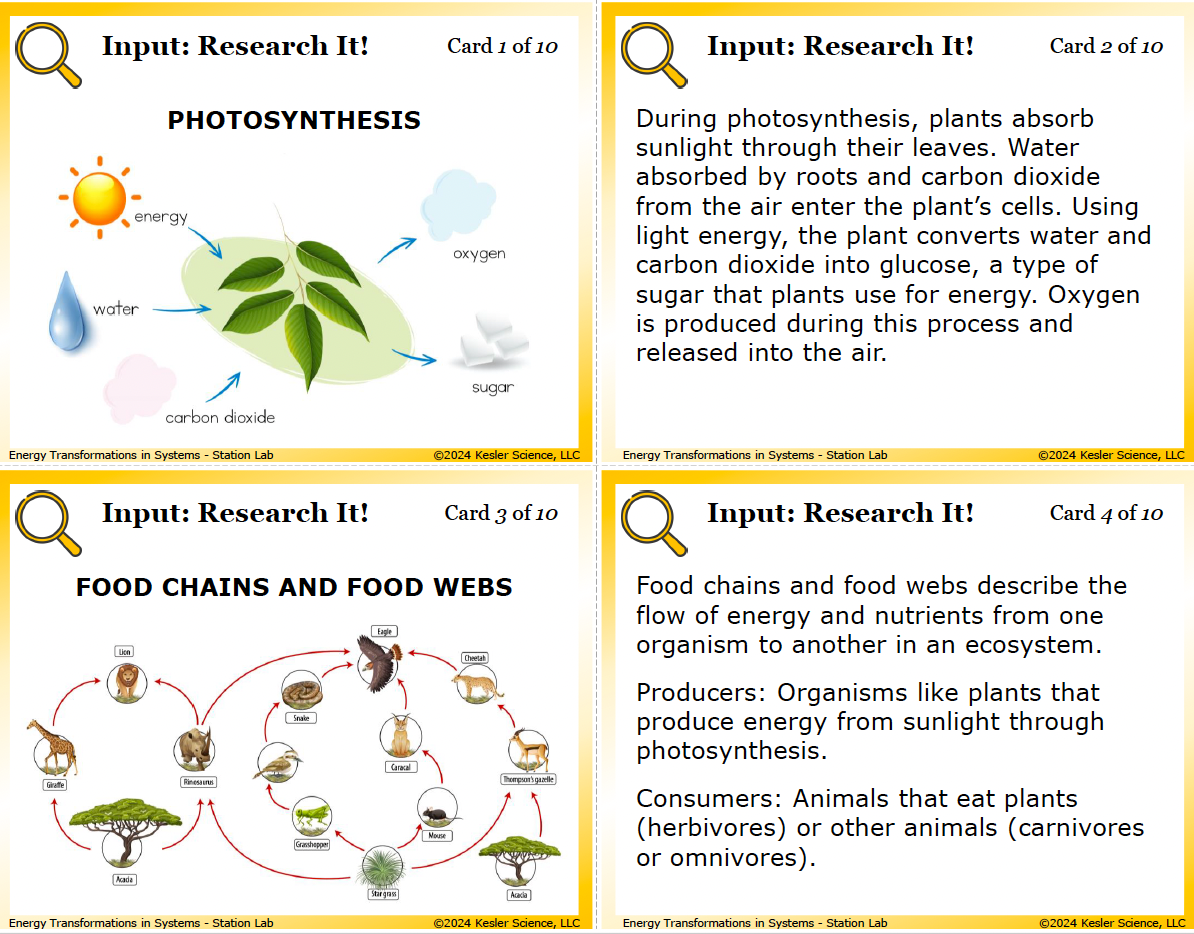
Students examine 10 reference cards covering biological energy systems: photosynthesis (sun → chemical energy in glucose), food chains and food webs, the energy pyramid showing the 10% rule (with bananas → fruit flies → toucans → jaguars and the percentages decreasing at each level), and the role of decomposers. Four questions check whether they can identify the primary source of energy for the food web, the energy transformation in photosynthesis, how energy moves up trophic levels, and how the whole system demonstrates conservation of energy.
4 output stations: how students show what they learned
A two-column card sort. Kids match seven everyday scenarios with their energy transformation chains. Examples: turning on a flashlight → chemical → electrical → light → thermal. Riding a bike after eating lunch → chemical → mechanical. Photosynthesis → light → chemical. Skydiving → gravitational → kinetic. Rubbing hands together → kinetic → thermal. Cooking on a gas stove vs. an electric stove (chemical → thermal vs. electric → thermal) makes for a great compare-and-contrast moment. Easy to spot-check at a glance.
Students pick one system (a food chain, an electrical circuit, or a roller coaster) and sketch it with arrows showing energy flow at each step. They label each form of energy along the way. Even kids who say "I can't draw" surprise themselves here. The arrows are what reveal whether they understand conservation: every arrow has to lead somewhere, energy can't just stop.
Three open-ended questions: how a roller coaster demonstrates conservation of energy, how energy flows in a food web from the Sun to a top predator, and what energy transformation happens in a battery-and-bulb circuit. This is the writing practice middle schoolers need and rarely get in science class.
Eight multiple-choice and fill-in-the-paragraph questions tied to TEKS 6.8B vocabulary (system, transform, law of conservation of energy, conserved, transfer). Includes which option correctly defines conservation of energy, the correct order of energy flow in a Sun → plant → rabbit → fox food web, and the energy chain in a wind turbine that powers a radio (kinetic → mechanical → electrical → sound). The fill-in paragraph weaves all five vocabulary words together. If you're grading the lab, this is the easiest station to grade.
Bonus Challenge It! station for early finishers
Four optional extensions: build a 10-word vocabulary crossword puzzle, design and document a model experiment that shows conservation of energy (marble run, pendulum, etc.), create a comic strip illustrating an energy transformation step by step, or write an acrostic poem using "CONSERVATION." Requires teacher approval before they start.
How this fits into a complete energy transformations unit
This Station Lab is the Explore day of our full Energy Transformations in Systems Complete 5E Lesson for TEKS 6.8B. The complete two-week unit follows the 5E method of instruction and includes an Engage hook, the Energy Transformations in Systems Station Lab for Explore, PowerPoint slides and interactive notebook pages for Explain, student choice projects to Elaborate, and an Evaluate assessment.
Most teachers grab the full 5E because the Station Lab lands hardest with the days around it. But if you just need a strong hands-on day on energy transformations and conservation, the Station Lab on its own does the job.

Get this energy transformations activity

Or if you want the full two-week experience with the Engage hook, Explain day, Elaborate extension, and Evaluate assessment all included:
(Station Lab is included)
Frequently asked questions
What does TEKS 6.8B cover?
Texas TEKS 6.8B asks 6th grade students to provide evidence supporting that the law of conservation of energy applies in transformations of energy in systems. Students should be able to look at any system (a circuit, a roller coaster, a food web, an amusement park ride) and trace how energy flows from one form to another, showing that the total energy stays the same even as it transforms.
Is this kids' first time meeting conservation of energy?
Yes for most 6th graders. They've seen examples of energy in earlier grades (light, heat, motion), but "the law of conservation of energy" as a formal idea is brand new. The Read It! roller coaster passage introduces it in bold, the Watch It! bowling-ball pendulum video is the visual anchor, and the Organize It! card sort tests whether they can apply it to seven different real-life scenarios.
How long does this energy transformations activity take?
One to two class periods (45 to 110 minutes total). The Explore It! station's three hands-on activities are the longest piece, so plan for two periods the first time you run a station lab. Once your class has the rotation routine down, most groups can finish all 8 stations in one period.
Do I need a lot of supplies for this?
A small lava lamp, a few simple circuit kits (battery + wires + LED or motor), and a wind-up toy. Total cost for a class of 30: under $25 if you're starting from nothing. The Watch It! station also needs a device with internet.
Can I use this in a 1:1 digital classroom?
Yes. The full digital version (PowerPoint or Google Slides) works in 1:1 classrooms and Google Classroom. Students drag the digital reference cards instead of physically modeling. The Explore It! hands-on activities are harder to digitize. You can substitute simulation videos or PhET energy simulations if you don't have the supplies.