.png?width=375&height=100&name=WebPage%20logo%20with%20curves%202026%20(8).png)
Compare & Contrast Energies
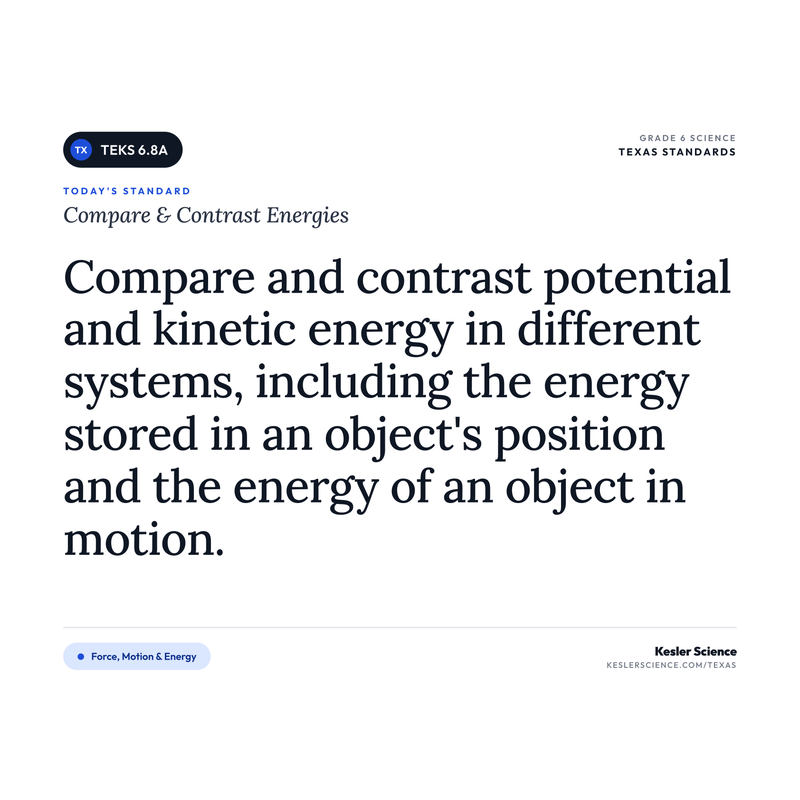
"Compare and contrast gravitational, elastic, and chemical potential energies with kinetic energy."
💡 What This Standard Actually Means
"Compare and contrast". Students are looking at three specific kinds of potential energy (gravitational, elastic, and chemical) alongside kinetic energy and explaining how they're alike and how they're different. The standard pulls in three types of stored energy that all behave a little differently and contrasts them with the energy of motion. Instruction can take many forms, such as roller-coaster diagram analysis, stretching-rubber-band labs, food-energy reading activities, and side-by-side energy comparison T-charts.
Kinetic energy is the energy of an object that's moving. A rolling ball, a falling book, or a kid running across the gym all have kinetic energy. The amount depends on how much mass the object has and how fast it's going.
The standard now asks students to compare kinetic energy to three specific types of potential energy, which is energy stored because of position or condition. Gravitational potential energy is energy stored because of how high something is off the ground. A book held up on a high shelf has more gravitational PE than the same book on a low shelf. The higher up it is, the more energy waiting to be released if it falls. Elastic potential energy is energy stored when an object is stretched, squeezed, or twisted out of its normal shape. A pulled-back rubber band, a compressed spring, and a drawn bow all hold elastic PE. Let go and the object snaps back, releasing the energy. Chemical potential energy is energy stored in the bonds between atoms. The food in a kid's lunchbox, the gasoline in a car's tank, and the battery inside a phone are all examples. Break the bonds (digesting, burning, reacting) and the stored energy gets released.
The big idea students should walk away with is that potential energy is stored and quiet, while kinetic energy is active and moving. The two types can swap. A roller-coaster car pulled to the top of a hill has gravitational PE. As it drops, that PE turns into kinetic energy. A stretched slingshot has elastic PE that becomes kinetic energy when released. Food has chemical PE that becomes kinetic energy in a runner's muscles. Same energy, different forms.
The move that worked for me on this one was leading with a visual before anything else. I'd hold a basketball over a student's desk and ask, "Is this doing anything right now?" They'd say no. Then I'd ask, "What would happen if I let go?" They'd answer for me. That's your opening to the idea that position is part of energy, not just motion. From there, I'd layer in the vocabulary (potential, kinetic, stored, in motion) and have them label the basketball at different points. Position first, then motion, then the comparison. That order maps directly to how the TEKS asks them to compare and contrast the two.
⚠️ Misconceptions Your Students May Have
These are some of the most common misconceptions. Knowing what to look for can help you get ahead of them.
"If something isn't moving, it doesn't have any energy"
This one runs deep. Students see a book sitting on a shelf and assume it's "doing nothing." But that book has potential energy because of its height. If the shelf breaks, you'd see that energy pretty quickly. Energy can be stored without being visible.
"Kinetic energy only counts when things move fast"
Students hear "kinetic" and picture race cars or roller coasters. But a slowly rolling marble, a person walking across the room, or a leaf drifting down all have kinetic energy. Motion is motion. Speed changes the AMOUNT, but any movement at all means kinetic energy is present.
"Potential energy only means something up high"
Students often lock in on gravitational potential energy (the high-shelf, top-of-the-hill kind) and forget that stretched rubber bands, compressed springs, bent diving boards, and pulled-back bowstrings also store potential energy. Height is one way to store energy by position. Shape and configuration are others. Show examples of both so students don't assume "up high" is the only way.
"An object can only have potential OR kinetic energy, never both"
Watch any object fall off a table. Halfway down, it has some height left (potential) AND it's moving (kinetic). Most real-world examples have both at the same time. The ratio just shifts as the object moves. Don't let students draw a hard line between the two.
📓 Teaching Resources for 6.8A
These resources are aligned to this standard.


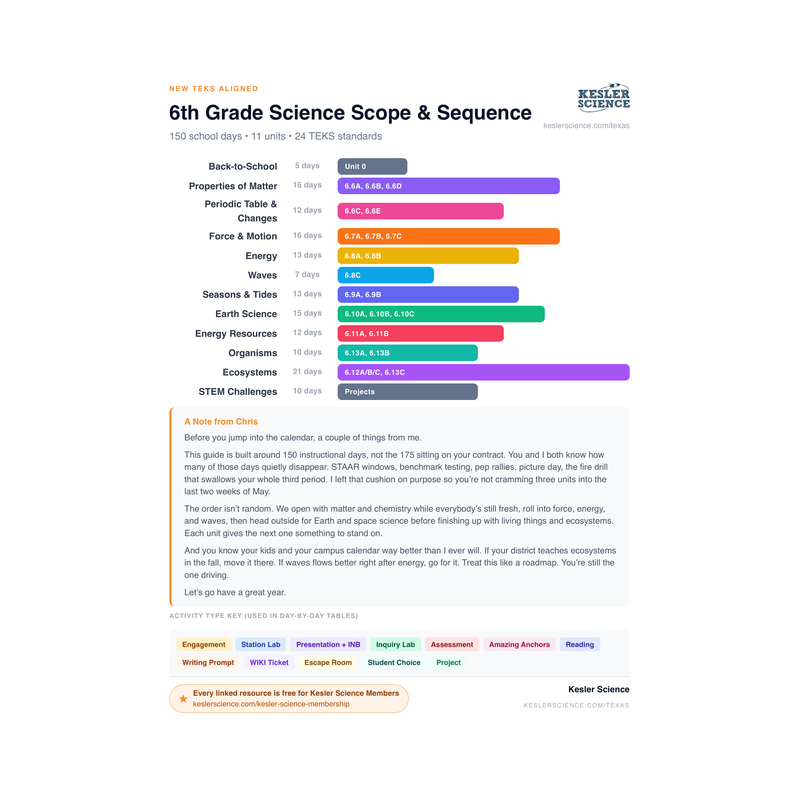
100% Aligned Lessons for Every TEKS You Teach
Kesler Science Plus puts thousands of ready-to-teach lessons and activities in your hands, so you can boost engagement and get your planning time back. Trusted by schools and districts all over the great state of Texas.
🌎 Phenomenon Ideas for 6.8A
Use these real-world phenomena to anchor your lesson. Show students the phenomenon first, let them wonder, then build toward Compare & Contrast Energies as the explanation.
The First Hill of a Classic Roller Coaster
On a classic chain-lift roller coaster, a motor pulls the cars slowly up the first big hill. After the cars crest the top, many of these coasters glide through most of the rest of the ride using the energy they gained from being lifted up. On a traditional design, that first lift is where most of the ride's energy comes from. When the car is at the top, it's barely moving. When it's at the bottom of the first drop, it's screaming along. What changed?
"On a traditional chain-lift coaster, why is the first hill usually taller than the hills that follow? What happens to the energy of the car as it climbs and as it drops?"
A Pulled-Back Archery Bow
An archer pulls back the bowstring and holds it. Nothing is moving. The arrow is just sitting there. But the second they let go, the arrow can fly over 200 feet per second. Where did all that motion come from, if nothing was moving a moment earlier?
"If the archer only pulls the string back a little bit, the arrow doesn't go far. If they pull it back a lot, the arrow goes far. What's the relationship between how far back the string is pulled and how much energy the arrow has?"
Water Behind a Dam
The water behind the Hoover Dam sits there, flat and calm, for years. But that still water powers homes for millions of people. When engineers open a gate at the bottom, the water shoots out so fast and with so much force that it can spin giant turbines. How does water that wasn't even moving end up producing that much electricity?
"Why do dams hold the water up so high? Why don't we just use water at ground level to make electricity?"
💡 Free Engagement Ideas for 6.8A
Ready-to-run activities you can drop straight into a lesson. Where one of these looks like a phenomenon from the section above, that is on purpose: show it first as the hook, then let students run it themselves.
Pull-Back Toy Car Challenge
Give each group a pull-back toy car and masking tape. Have them pull it back different distances (1 inch, 2 inches, 3 inches), release, and mark where it stops. Graph the data. Kids see the connection between stored energy and motion immediately.
The Ball Drop Crater Test
Fill a cup with flour. Drop a small ball into it from 3 different heights and measure the crater each time. The higher the drop, the deeper the crater. Students can literally see potential energy converting to kinetic energy converting to "dent the flour" energy.
Ramp and Roll
Prop up one end of a book or board to make a ramp. Roll a marble from different heights on the ramp and measure how far it travels across the floor. Have students label where the energy is potential, where it's kinetic, and where it's both.
Pendulum Swap Stations
Tie a washer to a string and hang it from a pencil taped to a desk edge. Pull the washer back and release. Have students draw or annotate the pendulum at 5 positions (top, moving down, bottom, moving up, top again) and label where PE is high, where KE is high, and where they're equal.
🎯 What Approaches, Meets, and Masters Thinking Look Like
Here is what student thinking at each level looks like on this one task, so you know what to look for and how to move a student up.
A roller-coaster car is parked at the very top of the first hill. A few seconds later, it has zoomed down and is racing along the flat track at the bottom. Compare the energy the car has at the top of the hill to the energy it has at the bottom. Name the kind of energy in each spot and explain how they are alike and how they are different.
- The car at the top is named as having gravitational potential energy (stored energy because of how high it is).
- The car at the bottom is named as having kinetic energy (the energy of motion).
- A clear contrast: potential energy is stored and waiting, kinetic energy is active and moving.
- A likeness: both are forms of energy, and the energy did not disappear, it changed form as the car went down.
- An understanding that the parked car at the top still has energy, even though it is not moving.
- The idea that the stored energy at the top turned into the motion energy at the bottom.
- The car at the top correctly called potential (not "no energy") AND the bottom correctly called kinetic. Mixing those two up is the easiest place to slip.
At the bottom the car has kinetic energy because it is moving fast. At the top the car is just sitting there, so it does not have any energy yet. It gets its energy once it starts to move down the hill.
At the top of the hill the car has gravitational potential energy. That is stored energy because of how high up it is. At the bottom the car has kinetic energy because it is moving fast. They are alike because they are both energy. They are different because potential energy is stored and waiting, and kinetic energy is the energy of something that is actually moving.
At the top the car has gravitational potential energy, which is stored energy because of how high it is. At the bottom it has kinetic energy, the energy of motion. They are alike because they are both energy, and the energy did not disappear. They are different because one is stored and one is moving. As the car rolls down, the stored potential energy keeps changing into kinetic energy, so the higher the car started, the faster it ends up going.
It works the same way with a stretched slingshot. The pulled-back band is not moving, but it has elastic potential energy stored in its stretched shape, just like the parked car had stored energy from its height. When you let go, that stored energy turns into kinetic energy and the rock flies. The energy is stored a different way (shape instead of height), but the stored-to-moving change is the same idea.
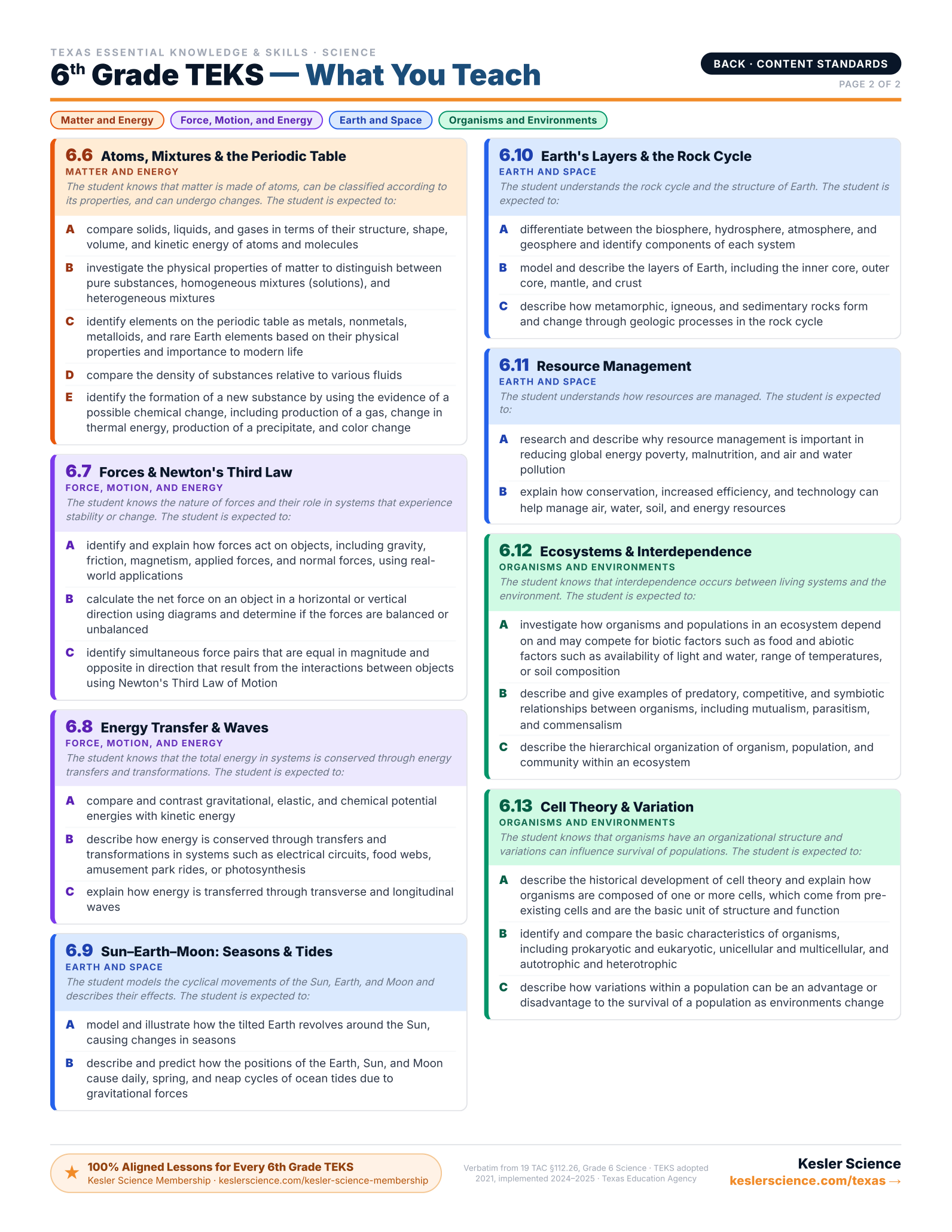
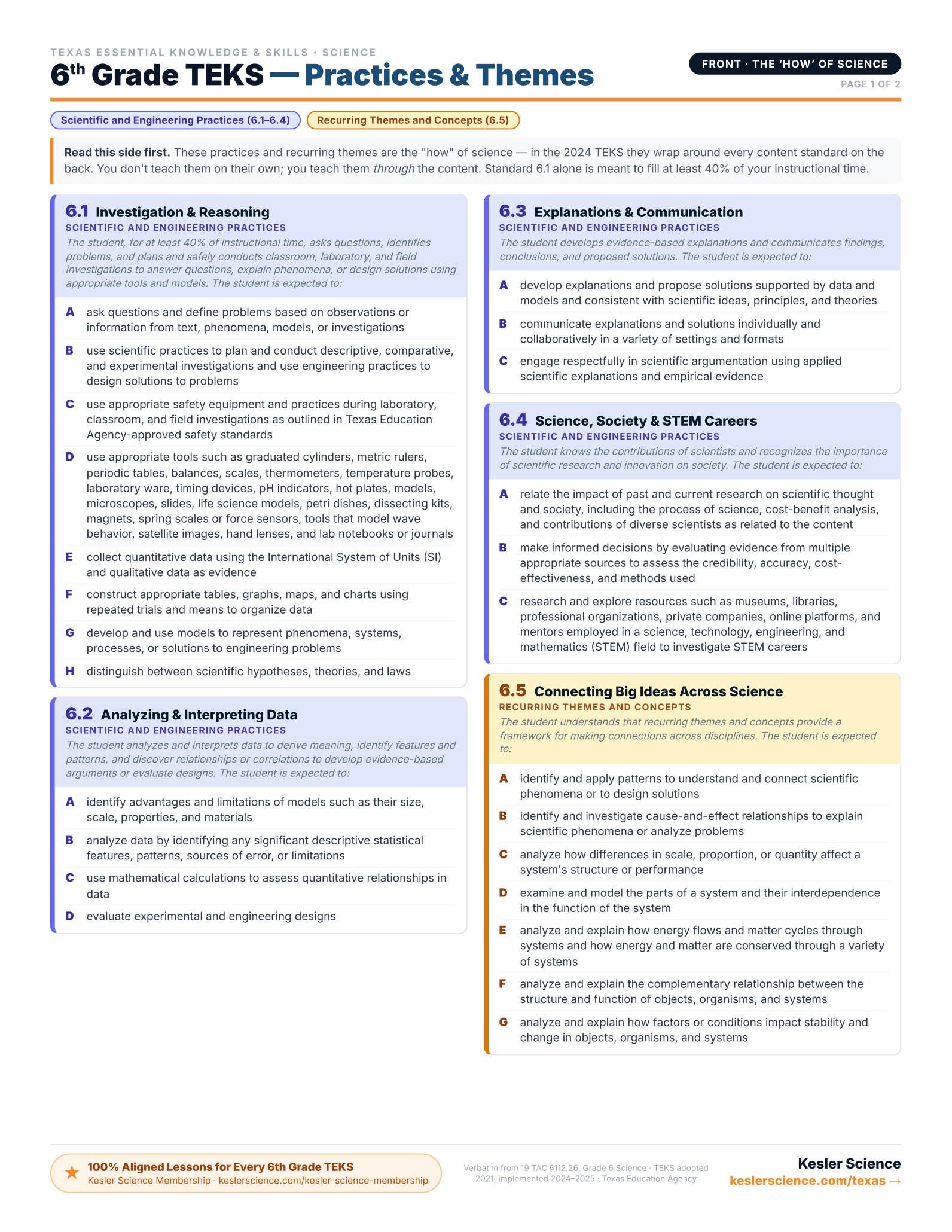
Every 6th-Grade Science TEKS on One Page
The color-coded, front-and-back cheat sheet I wish I'd had — every standard, organized by reporting category. Print it and reference it all year long. This will be your new favorite document!
Trusted Across Texas
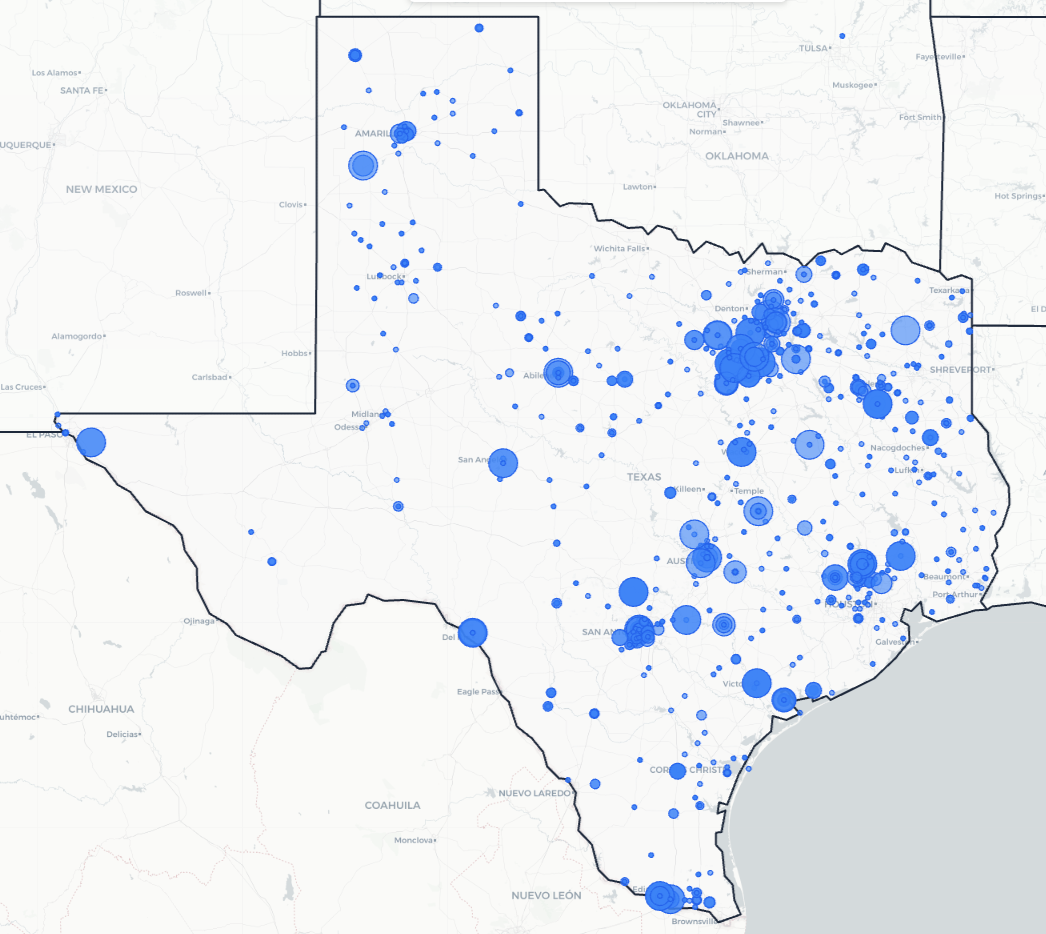
From the Rio Grande Valley to the Panhandle, Texas science teachers are using Kesler Science to save time and engage students.
Texas Schools and Districts
Love Kesler Science
What Teachers Are Saying
Give Your Science Teachers Everything They Need
School and district licenses give your teachers access to every resource they need, including station labs, inquiry labs, anchoring phenomena, presentations, escape rooms, and much more. One purchase covers the grade levels you need.
- PO-friendly. We accept purchase orders
- Volume discounts for 11+ teachers
- Complimentary Kesler Science Plus orientation for 4+ teachers
- Three free implementation PD sessions for departments of 11+
- Aligned to the 2024 TEKS standards
See It in Action
Book a walkthrough and we'll show you how Kesler Science fits your campus.
Book Demo CallNo pressure, no hard sell