.png?width=375&height=100&name=WebPage%20logo%20with%20curves%202026%20(8).png)
Energy of Waves
"Explain how energy is transferred through transverse and longitudinal waves."
💡 What This Standard Actually Means
"Explain". Students are explaining how energy moves through both transverse waves and longitudinal waves. The big idea kids need to land on is that waves carry energy from one place to another, but the matter the wave moves through mostly stays in place. Instruction can take many forms, such as slinky demos, water-ripple observations, wave generator videos, and labeled-diagram drawing activities.
A wave is a disturbance that carries energy from one place to another. The most important idea in this standard is that waves move energy, not matter. When a wave travels across a lake, the water itself mostly moves up and down in place while the wave's energy travels forward. A piece of floating cork bobs up and down but does not ride the wave to the other side of the lake.
Transverse waves move the material at right angles (perpendicular) to the direction the wave is traveling. If the wave is moving left to right, the material goes up and down. Light waves are the cleanest example. The visible ripples on the surface of water behave like transverse waves for the up-and-down part of their motion (the full picture for water is a bit more complex). Transverse waves have crests (the high points) and troughs (the low points).
Longitudinal waves move the material in the same direction the wave is traveling, through a back-and-forth squeezing motion. Sound waves traveling through air are the classic example. Longitudinal waves have compressions (where the material is squeezed together) and rarefactions (where the material is spread out). Both wave types transfer energy from one place to another, and in both cases, the material itself moves mostly in place while the energy moves forward. That "energy travels, matter stays" idea is the core understanding students should walk away with.
Nothing teaches waves like a slinky on the floor. I'd have two students stretch one out across the carpet, then shake one end side to side to make a transverse wave. Then I'd have them push and pull the end forward and back to make a longitudinal wave. Same slinky, totally different-looking waves. The magic moment was asking a third student to put a piece of tape on one coil, and watching the tape stay roughly in place while the wave zipped down the slinky. Kids who had been memorizing definitions suddenly got it. "The tape didn't go anywhere, but the wave did." That one sentence is the whole standard.
⚠️ Misconceptions Your Students May Have
These are some of the most common misconceptions. Knowing what to look for can help you get ahead of them.
"A wave carries the water (or air) along with it"
This is the biggest one. Students see a wave crashing on a beach and assume the water is being pushed from the middle of the ocean all the way to shore. Out in open water, a floating bottle mostly bobs up and down as waves pass under it. The wave carries energy forward, but each bit of water mostly stays in place. The same is true of sound in air. Molecules vibrate in place while the energy moves outward.
"Sound travels like a wave on the ocean"
The visible ripples on the surface of water behave like transverse waves for the up-and-down part. Sound in air is longitudinal. They look different because they move the material in different directions. Drawing a curvy line for sound can confuse students. A better picture for sound in air is a repeating pattern of squished and spread-out areas, like a slinky being pushed and pulled along its length.
"Sound and light are basically the same kind of wave"
Light is a transverse electromagnetic wave and can travel through empty space. Sound is a longitudinal mechanical wave and needs a material, like air, water, or a solid, to travel through. That's why astronauts in space can see the sun but cannot hear it. Different types of waves, different rules.
"Bigger waves are always faster waves"
The height of a wave (its amplitude) tells you how much energy it's carrying, not how fast it's moving. A loud sound and a quiet sound at the same pitch travel through the same air at about the same speed. The loud one just has more energy. Speed depends mostly on the material the wave is traveling through.
"If you can't see or feel a wave, it must not be there"
We're surrounded by waves that our senses miss. Radio waves, microwaves, and ultraviolet light pass through the classroom right now. Dog whistles create sound waves that humans can't hear but dogs can. Just because a wave isn't visible doesn't mean it's gone. Helping students expand their mental list of waves past "ocean" and "music" opens the standard up.
📓 Teaching Resources for 6.8C
These resources are aligned to this standard.


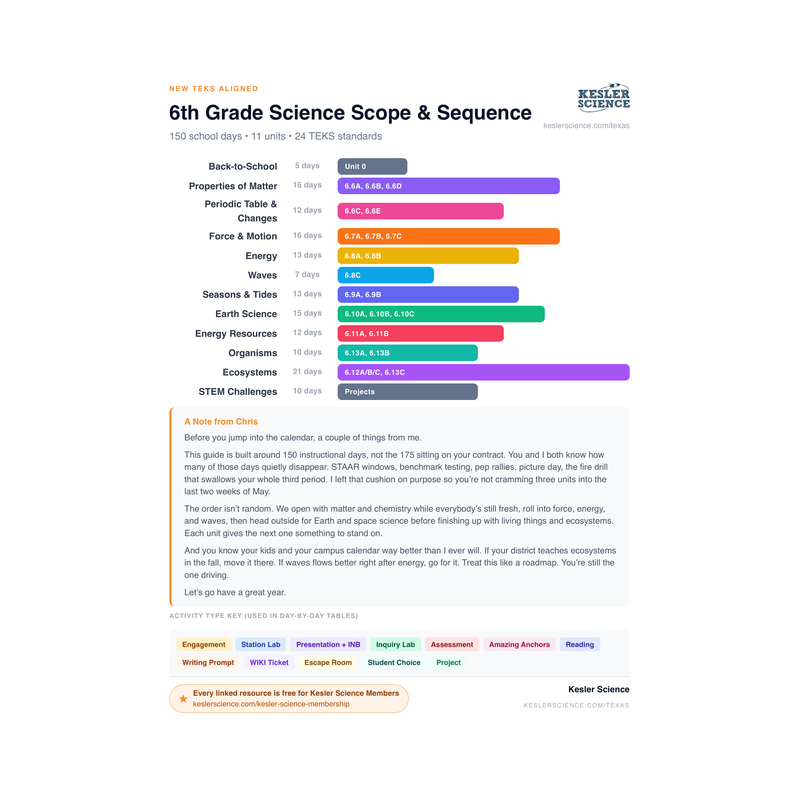
100% Aligned Lessons for Every TEKS You Teach
Kesler Science Plus puts thousands of ready-to-teach lessons and activities in your hands, so you can boost engagement and get your planning time back. Trusted by schools and districts all over the great state of Texas.
🌎 Phenomenon Ideas for 6.8C
Use these real-world phenomena to anchor your lesson. Show students the phenomenon first, let them wonder, then build toward Energy of Waves as the explanation.
A Rubber Duck in a Pond
Drop a pebble into a calm pond with a rubber duck floating a few feet away. Ripples spread out from the splash and reach the duck. The duck bobs up and down several times, but mostly stays in roughly the same spot. The ripples clearly kept traveling outward, but the duck didn't travel with them.
"If the waves traveled all the way to the duck, why didn't the duck get pushed to the edge of the pond? What did the wave actually carry across the pond?"
Feeling a Bass Speaker Through Your Chest
Stand in front of a loud speaker at a school dance, a movie theater, or a football stadium. When the bass drops, you don't just hear the sound. You feel it pushing against your chest. Something traveling through the air is strong enough to move your shirt and vibrate your body, but you can't see it at all.
"If you can feel the sound, something must be hitting you. What's doing the hitting? Is it air moving toward you from the speaker, or something else?"
Sunlight After an 8-Minute Trip
Sunlight from the sun takes roughly 8 minutes to reach Earth. Most of the path between the sun and Earth is empty space with almost no material in it. Somehow, enough energy comes across that gap to warm your skin on a summer afternoon in Texas. Whatever is doing the traveling didn't need air or water to carry it.
"How can energy from the sun reach Earth if space is mostly empty? What type of wave might be able to travel without a material to move through?"
💡 Free Engagement Ideas for 6.8C
Ready-to-run activities you can drop straight into a lesson. Where one of these looks like a phenomenon from the section above, that is on purpose: show it first as the hook, then let students run it themselves.
Slinky Wave Lab
Pair students up with a long slinky on the floor or across two desks. First, one student shakes the end side to side to model a transverse wave. Next, one student pushes and pulls the end in and out to model a longitudinal wave. Place a small piece of tape on one coil so students see the coil return to its starting position while the wave travels forward. Have them sketch both waves and label the parts.
Water Wave and Floating Cork
Fill a long, clear baking pan with about an inch of water. Float a small piece of cork or bubble wrap near one end. At the other end, dip a finger in and out repeatedly to create waves. Students watch the waves travel toward the cork, and observe that the cork mostly bobs up and down in place. A cheap, vivid demo of "energy travels, matter stays."
Rice on a Drum
Sprinkle uncooked rice or salt onto the top of a stretched balloon or a drum-like surface (a plastic storage bin covered tight with plastic wrap works). Hold a phone speaker close to the surface and play different notes. The rice jumps and dances as sound waves vibrate the drum head. Students see a direct visual of the invisible longitudinal sound waves hitting a surface and transferring energy.
Jump Rope Transverse Wave
Take a jump rope outside or into the hall. One student holds each end. Flick one end up and down to send a wave along the rope. Have the holder try sending faster flicks (shorter wavelength) and slower flicks (longer wavelength). Students sketch what they see, labeling crest, trough, wavelength, and amplitude. Add color-coded arrows to show that the rope moves up and down while the wave moves sideways.
🎯 What Approaches, Meets, and Masters Thinking Look Like
Here is what student thinking at each level looks like on this one task, so you know what to look for and how to move a student up.
A student stretches a long slinky across the floor and tapes a small red ribbon to one coil in the middle. Then they shake one end up and down to send a wave across the slinky. Explain what happens to the ribbon as the wave passes through it, and use that to explain how the wave moves energy across the slinky.
- A clear statement that a wave travels across the slinky from one end toward the other.
- The idea that a wave carries energy, not the slinky itself, from one place to another.
- An accurate description of the ribbon: it moves up and down (or back and forth) but stays in about the same spot.
- The connection that the energy keeps moving forward even though the ribbon (the material) stays in place.
- Correct everyday words to describe the motion, such as up and down, in place, or back and forth.
- An explanation that ties the ribbon's motion directly to the big idea: the wave passes through the slinky and moves on, but each part of the slinky mostly stays put.
- The "energy moves, matter stays" idea kept straight, instead of saying the wave pushes the ribbon all the way to the other end. That is the easiest place to slip.
When you shake the slinky, a wave goes across it. The wave is strong, so it pushes the red ribbon down to the other end of the slinky with it. The wave carries the ribbon all the way to where the wave stops.
When you shake the slinky, a wave travels across it to the other end. The red ribbon does not travel with the wave. It moves up and down as the wave passes through it, but it stays in about the same spot. So the slinky stays put, but the energy from my hand moves all the way across. The wave carries the energy, not the slinky.
When you shake the slinky, a wave travels across it. The red ribbon moves up and down but stays in about the same place. That shows the wave is moving energy, not the slinky itself. The energy from my hand passes from coil to coil all the way across, but each coil mostly stays put.
The same thing happens out on a lake. A floating duck bobs up and down as a wave passes under it, but the wave does not carry the duck across the lake. The water stays in about the same place while the wave's energy keeps moving forward. So whether it is a slinky or water, the wave moves the energy and the material mostly stays where it is.
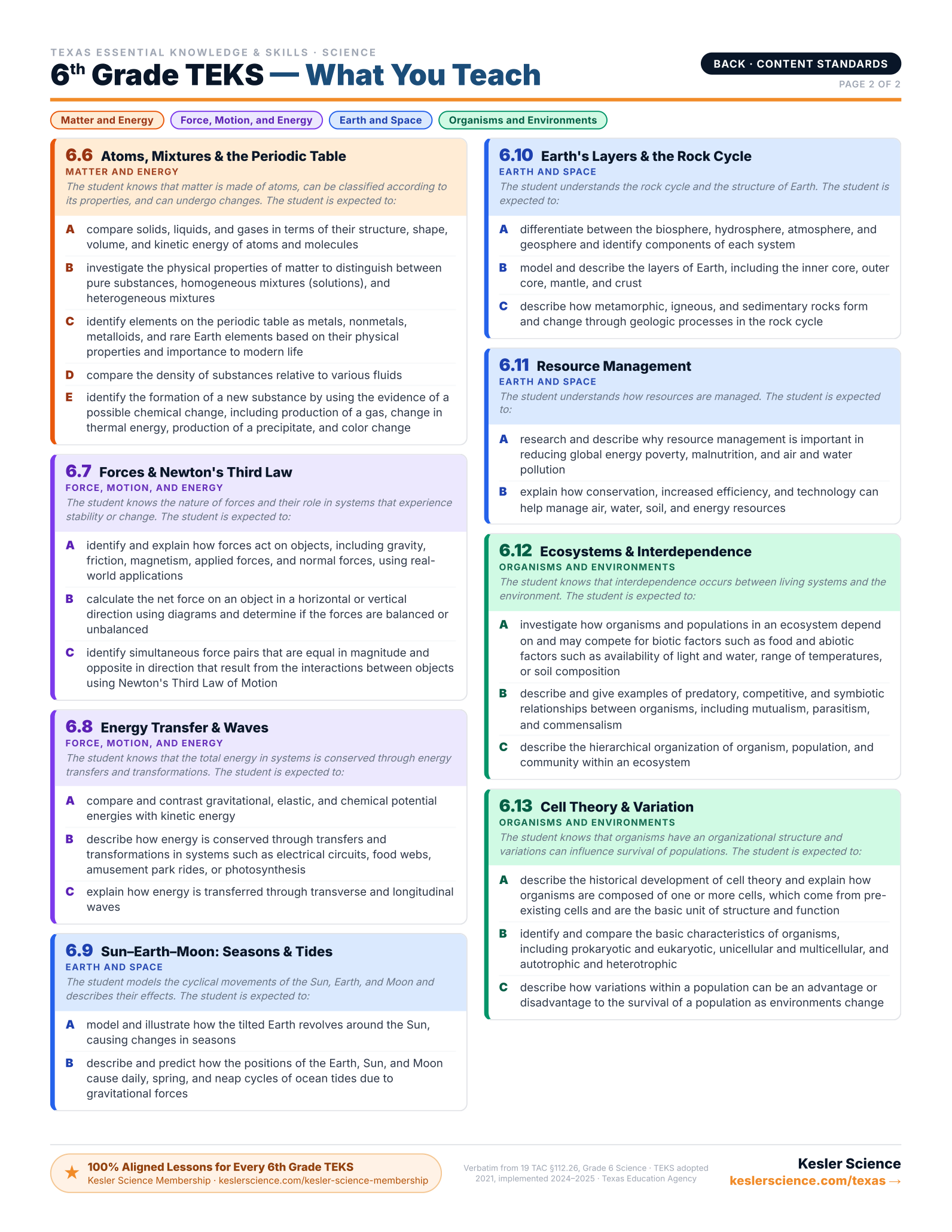
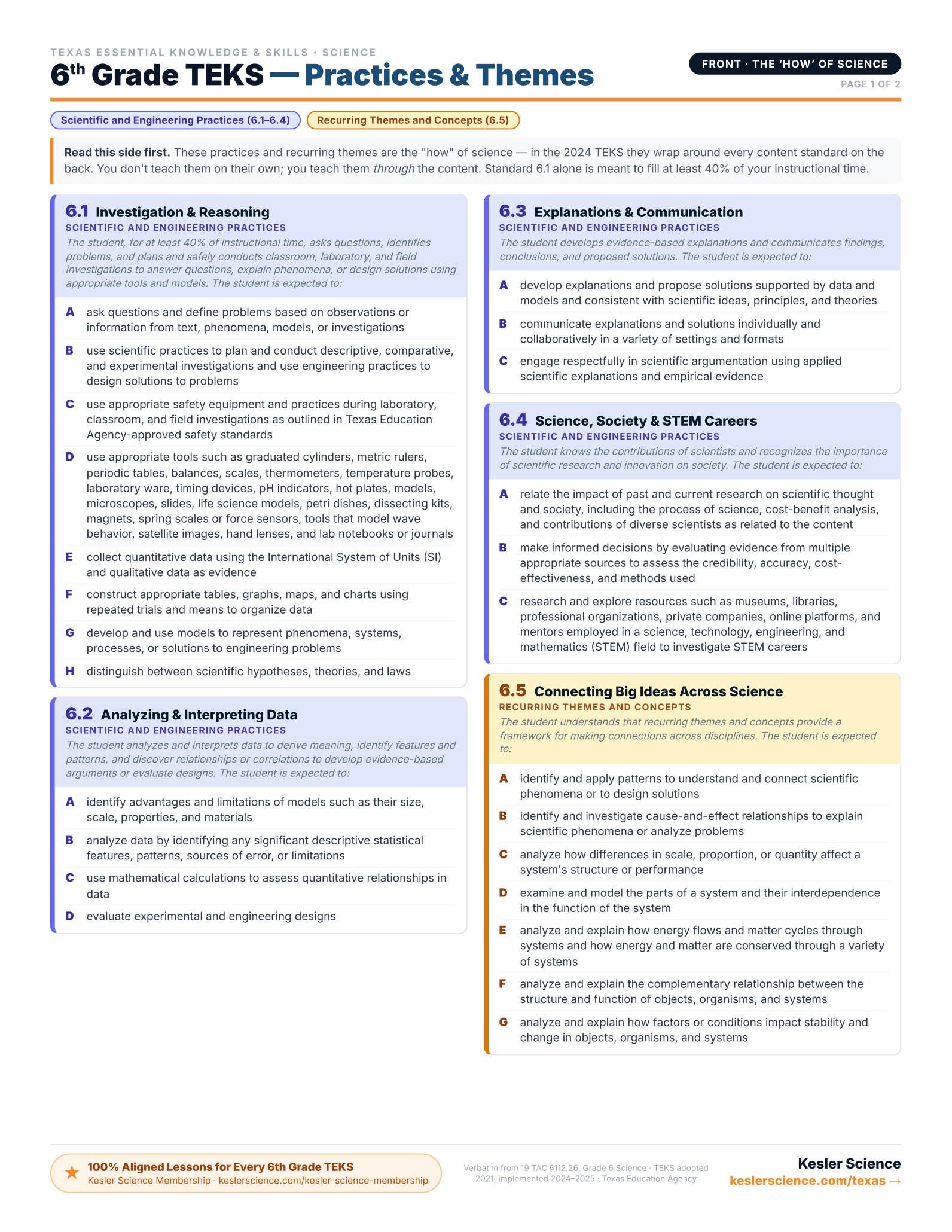
Every 6th-Grade Science TEKS on One Page
The color-coded, front-and-back cheat sheet I wish I'd had — every standard, organized by reporting category. Print it and reference it all year long. This will be your new favorite document!
Trusted Across Texas
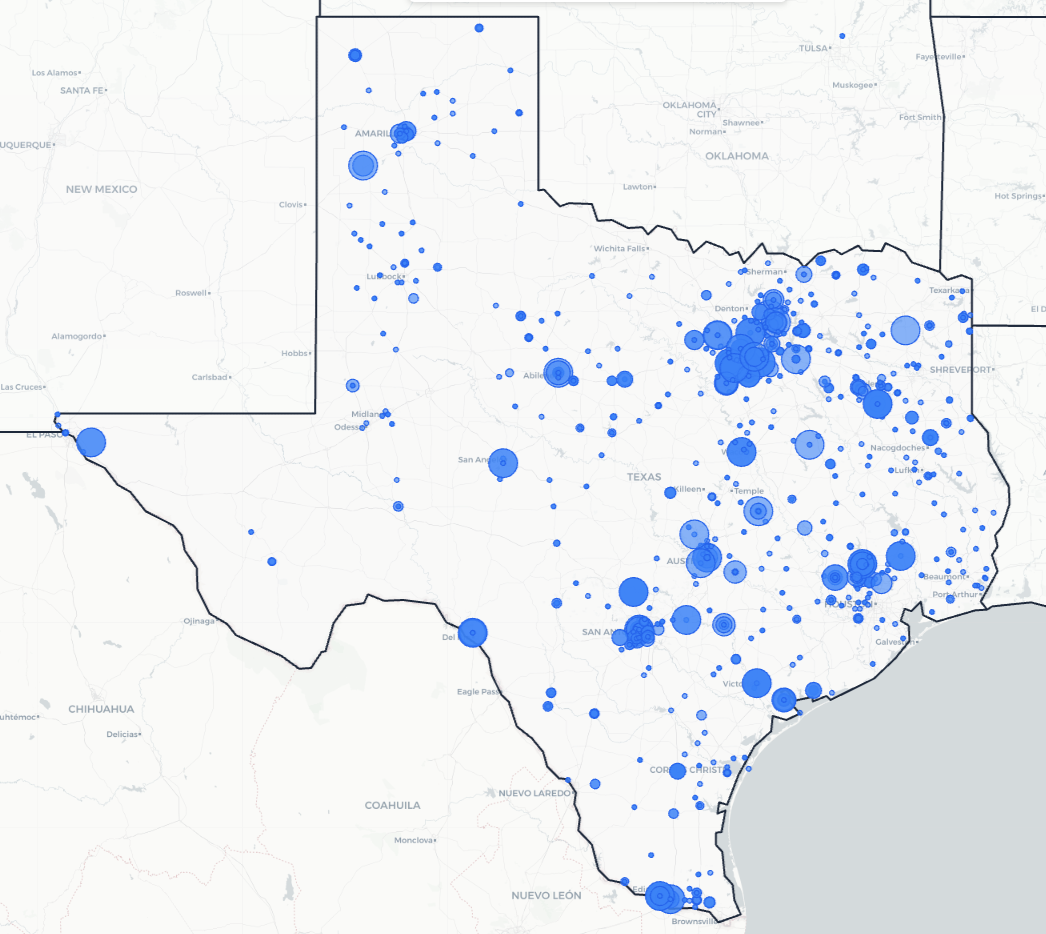
From the Rio Grande Valley to the Panhandle, Texas science teachers are using Kesler Science to save time and engage students.
Texas Schools and Districts
Love Kesler Science
What Teachers Are Saying
Give Your Science Teachers Everything They Need
School and district licenses give your teachers access to every resource they need, including station labs, inquiry labs, anchoring phenomena, presentations, escape rooms, and much more. One purchase covers the grade levels you need.
- PO-friendly. We accept purchase orders
- Volume discounts for 11+ teachers
- Complimentary Kesler Science Plus orientation for 4+ teachers
- Three free implementation PD sessions for departments of 11+
- Aligned to the 2024 TEKS standards
See It in Action
Book a walkthrough and we'll show you how Kesler Science fits your campus.
Book Demo CallNo pressure, no hard sell