
8 hands-on stations for teaching how to calculate net force
A station lab is a student-led activity where small groups rotate through 8 stations (plus a 9th challenge station for early finishers) at their own pace during one to two class periods. You become a facilitator instead of a lecturer. You walk around, spot-check, and break misconceptions while kids work through the rotation.
The Calculating Net Force Station Lab has four input stations (where students take in new info on balanced forces, unbalanced forces, net force, free-body diagrams, and vectors) and four output stations (where they show what they learned). Here's what's at each one.
4 input stations: how students learn to calculate net force
A short YouTube video introduces vectors, resultant forces (the same idea as net forces), and how to add and subtract forces in two perpendicular directions. Kids answer three questions: what two things vectors include (magnitude and direction), what net forces are, and a worked example with an airplane (vertical net force, horizontal net force, overall net force). Visual learners hook in fast at this station because the video shows the arrows being added on screen, which makes the math click before kids see it on a worksheet.
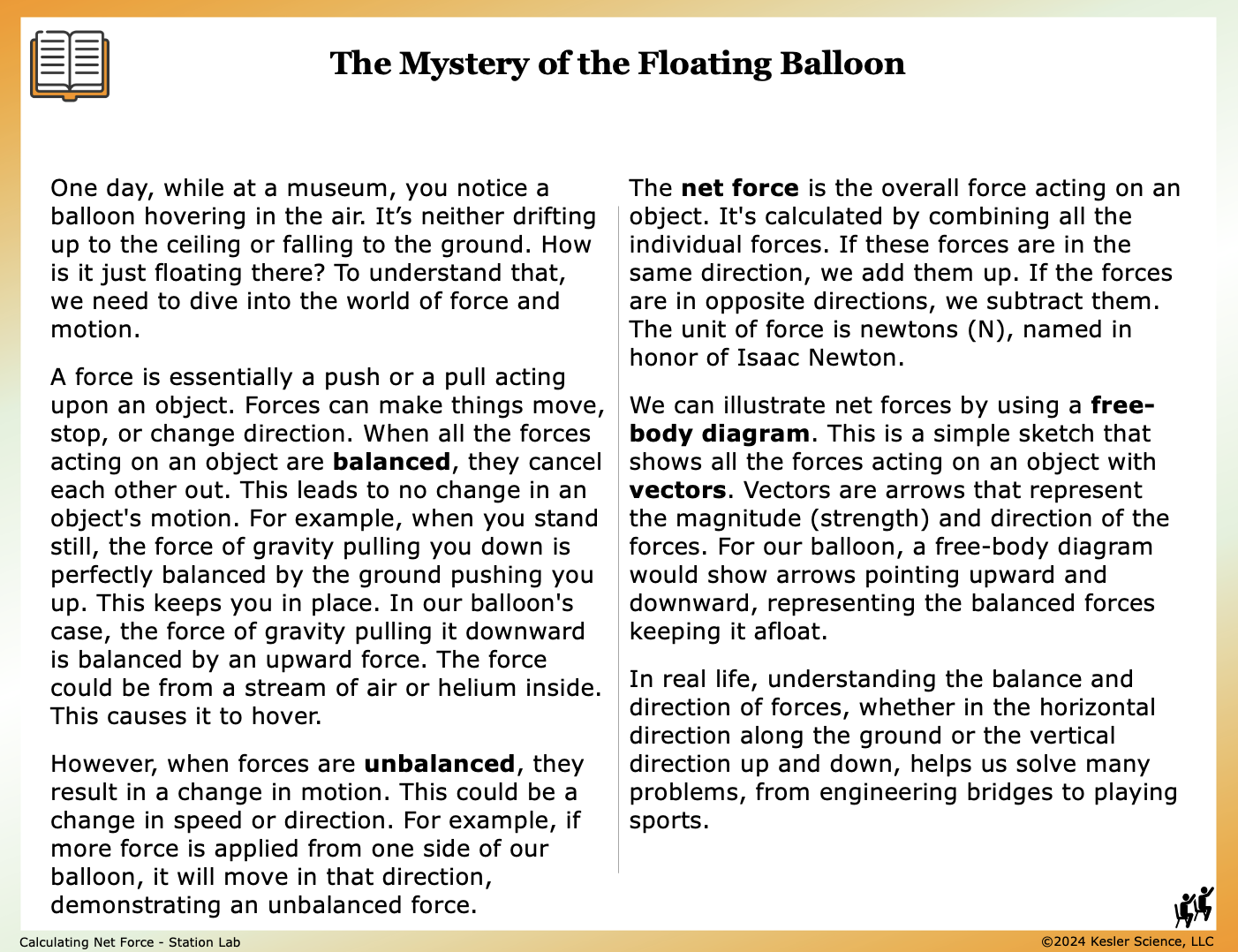
A one-page passage called "The Mystery of the Floating Balloon" frames the lesson around a balloon that hovers in midair, neither rising nor falling. The passage walks through balanced forces (equal in opposite directions, no change in motion), unbalanced forces (one side stronger, change in motion), net force (sum or difference of all forces, measured in newtons), free-body diagrams, and vectors (arrows showing magnitude and direction). Vocabulary is bolded throughout. Three multiple-choice questions follow, plus the vocab notes section. Comes in two reading levels (Dependent and Modified) plus a Spanish version.
This is the heart of the lab. Three-part spring-scale investigation. Part 1: Kids attach spring scales to opposite sides of a small object on the table. One person pulls at 50 N, the other at 75 N from the opposite side. They observe direction of motion and calculate net force (25 N toward the 75 N side). Part 2: Both pull at exactly 50 N from opposite sides. The object doesn't move. Net force is zero. Balanced. Part 3: Two people pull from the SAME side, each with 50 N. The object accelerates fast. Net force is 100 N (forces add). Each part asks: was this balanced or unbalanced, and what was the net force?
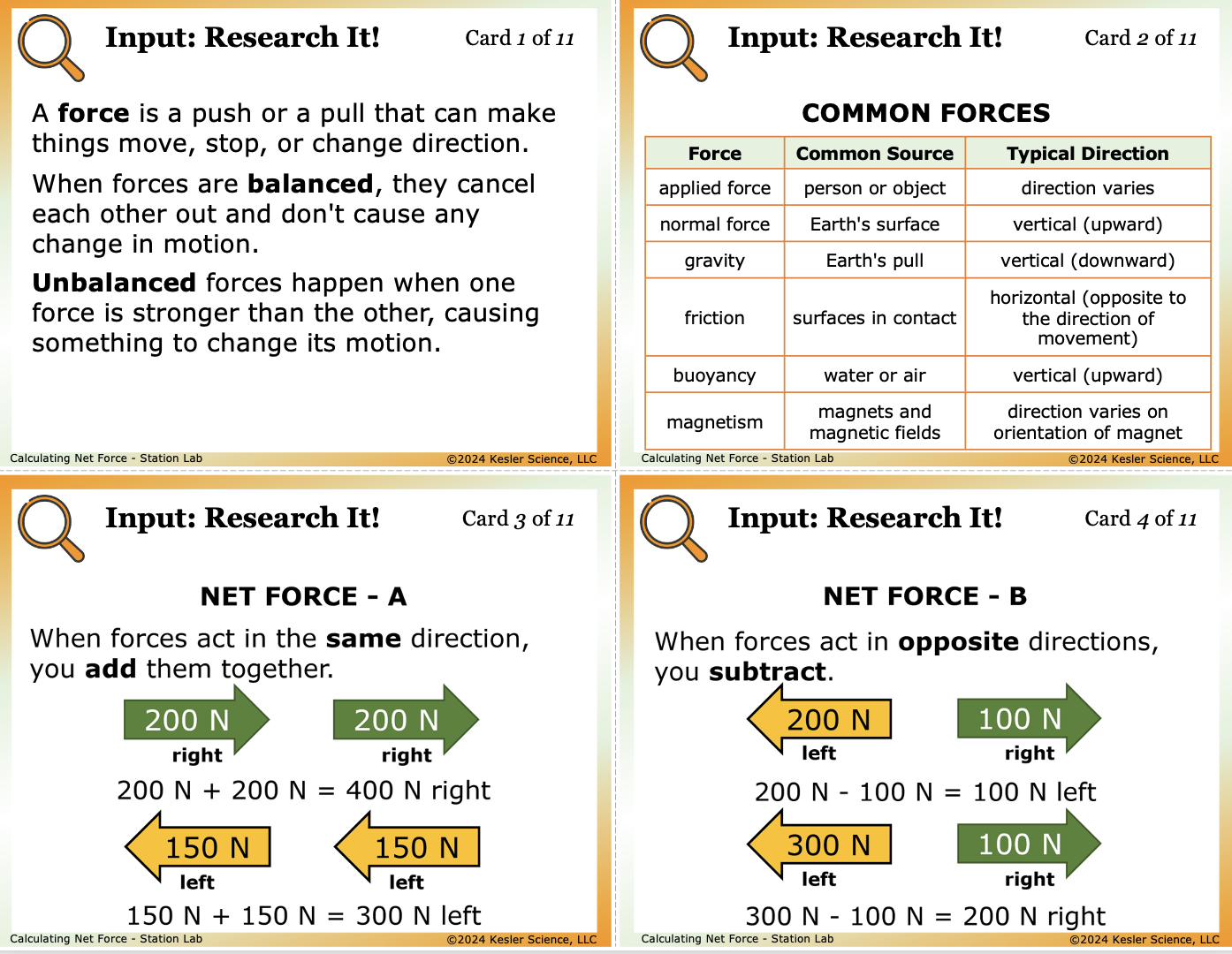
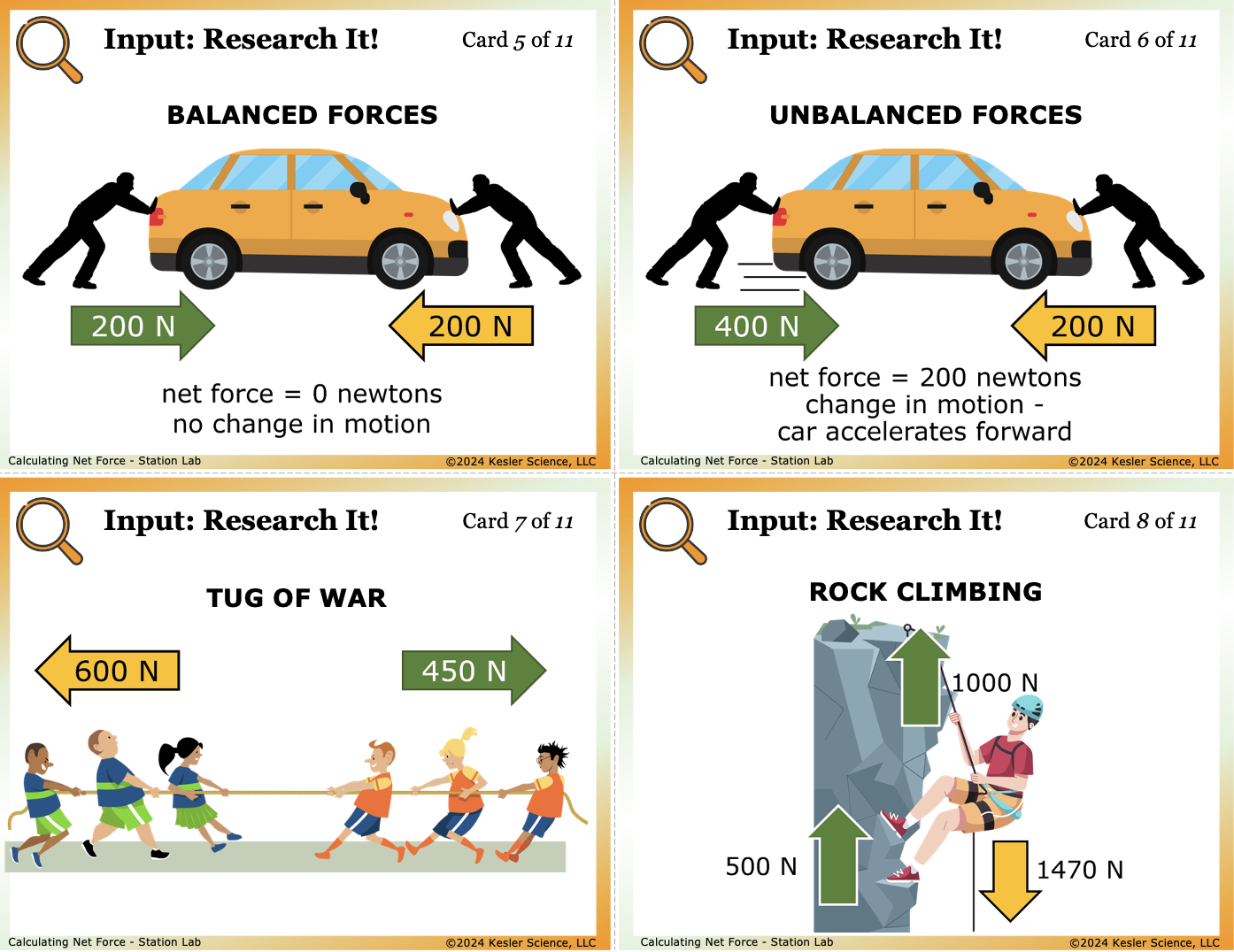
Students examine 8 reference cards: definitions of force, balanced forces, and unbalanced forces, a Common Forces table (applied force, normal force, gravity, friction, buoyancy, magnetism, with typical directions for each), and four real-life photo scenarios (a tug-of-war pull, a rock climber, a volleyball match, and a balanced-vs.-unbalanced car-pulling diagram). Five questions follow, asking kids to interpret balanced/unbalanced forces in each photo, calculate net force on the climber, and describe how forces act differently in horizontal vs. vertical directions.
4 output stations: how students show what they learned
A matching card sort. Kids match six force diagrams with their correct net-force values. The values include 130 N right, 25 N left, 5 N left, 70 N right, 0 N (balanced), and 350 N down. Each diagram has multiple force vectors that students have to add (same direction) or subtract (opposite directions) to find the answer. The 0 N (balanced) card is the key catch: kids see two equal arrows pointing opposite ways and have to recognize that as zero, not as the size of one of the arrows. Easy to spot-check at a glance.
Students draw two free-body diagrams: one of an object with balanced forces and one with unbalanced forces. They use vectors (arrows of different lengths) to represent each force, label each force by name (gravity, applied force, normal force, etc.), and show the net-force calculation underneath. The diagrams force kids to commit to the convention that arrow length equals force size, which makes adding and subtracting forces visual instead of just numeric. Even kids who say "I can't draw" surprise themselves here.
Three open-ended questions: how net force affects an object's motion, how to calculate net force when two people push a sled in the same direction with different strengths, and how to use a free-body diagram to show the forces on a bicycle going uphill (gravity down, normal force up, applied force from the rider, friction opposing motion). Forces kids to apply the indicators to brand-new scenarios. This is the writing practice middle schoolers need and rarely get in science class.
Eight multiple-choice and fill-in-the-paragraph questions tied to TEKS 6.7B vocabulary (balanced forces, unbalanced forces, net force, free-body diagram, vector). Includes what type of force is created when two unequal opposite forces act on an object (unbalanced), what a net force of zero means for motion (object is at rest or constant speed), and a rocket diagram where students calculate the net force from given thrust and gravity values. The fill-in paragraph weaves all five vocabulary words together using a hurricane scenario. If you're grading the lab, this is the easiest station to grade.
Bonus Challenge It! station for early finishers
Four optional extensions: write a 10-question quiz with answer key for classmates, run the PhET Forces and Motion Basics simulation manipulating mass and force values, create vector art (a large-scale paper-and-markers drawing with accurately scaled force arrows on a chosen object like a rocket or sailing boat), or work through a Math Connection set of real-world net-force calculations (sled with weights, parachute descent, etc.). Requires teacher approval before they start.
How this fits into a complete calculating net force unit
This Station Lab is the Explore day of our full Calculating Net Force Complete 5E Lesson for TEKS 6.7B. The complete two-week unit follows the 5E method of instruction and includes an Engage hook, the Calculating Net Force Station Lab for Explore, PowerPoint slides and interactive notebook pages for Explain, student choice projects to Elaborate, and an Evaluate assessment.
Most teachers grab the full 5E because the Station Lab lands hardest with the days around it. But if you just need a strong hands-on day on net force, balanced/unbalanced forces, and free-body diagrams, the Station Lab on its own does the job.

Get this calculating net force activity

Or if you want the full two-week experience with the Engage hook, Explain day, Elaborate extension, and Evaluate assessment all included:
(Station Lab is included)
Frequently asked questions
What does TEKS 6.7B cover?
Texas TEKS 6.7B asks 6th grade students to calculate the net force on an object in a horizontal or vertical direction using diagrams and to determine whether forces are balanced or unbalanced. Students should be able to read a free-body diagram, add forces in the same direction, subtract forces in opposite directions, write the net-force value with a direction, and predict the object's motion. The standard pairs naturally with 6.7A (forces in the real world) and 6.7C (Newton's third law).
Is this kids' first time with vectors and free-body diagrams?
Yes for most 6th graders. They've heard "force" since elementary school, but representing forces with arrows of specific length and direction is brand new. The Watch It! video introduces vectors, the Read It! passage defines them, the Research It! reference cards model them in real photos, and the Illustrate It! station forces kids to draw their own. By the end, they can read a diagram and tell you the net force just by looking at the arrows.
How long does this calculating net force activity take?
One to two class periods (45 to 110 minutes total). The Explore It! station's three-part spring-scale investigation is the longest piece, so plan for two periods the first time you run a station lab. Once your class has the rotation routine down, most groups can finish all 8 stations in one period.
Do I need a lot of supplies for this?
Pretty light. Two spring scales per station rotation and one movable object per station. If your school has a physics kit, all the supplies are probably already in it. If not, spring scales run about $5-8 each from a science-supply vendor. Total cost for a class of 30 (5 station rotations): about $50-80, and the equipment is reusable for years.
Can I use this in a 1:1 digital classroom?
Yes. The full digital version (PowerPoint or Google Slides) works in 1:1 classrooms and Google Classroom. Students drag digital cards for the Organize It! sort and complete free-body diagrams on a digital canvas. The Explore It! spring-scale activity is harder to digitize, but the PhET Forces and Motion Basics simulation (free) is a great substitute and is also called out in the Challenge It! station.