
8 hands-on stations for teaching forces in the real world
A station lab is a student-led activity where small groups rotate through 8 stations (plus a 9th challenge station for early finishers) at their own pace during one to two class periods. You become a facilitator instead of a lecturer. You walk around, spot-check, and break misconceptions while kids work through the rotation.
The Forces in the Real-World Station Lab has four input stations (where students take in new info on gravity, friction, normal, applied, and magnetic forces) and four output stations (where they show what they learned). Here's what's at each one.
4 input stations: how students learn the five forces
A short YouTube video introduces forces as vector quantities and walks through the difference between contact forces (where two objects touch) and noncontact forces (which act through a field of influence). Three questions: why forces are vectors, an example of a contact force from the video and why it qualifies, and what "field of influence" means for noncontact forces. Visual learners come alive at this station because it gives them the contact-vs-noncontact framework before they hit the rest of the lab.
A one-page passage called "Basketball Forces" walks students through every force at play when you shoot, dribble, or bounce a basketball. The vocabulary is bolded throughout (gravity, friction, magnetism, applied force, normal force). Three multiple-choice questions follow, plus the vocab notes section. Comes in two reading levels (Dependent and Modified) plus a Spanish version.
This is the heart of the lab. Four hands-on parts. Part 1: Drop a tennis ball from 2 meters and observe gravity pulling it down and normal force stopping it at the floor. Part 2: Roll a marble across smooth tile, then across carpet, and time the difference. Part 3: Use a magnet to move a paperclip without touching it. Part 4: Two students hold opposite ends of a jump rope and try to keep it stationary with equal force, then try unequal force. Eight questions walk them through the observations. By the end, kids have physically felt all five forces.
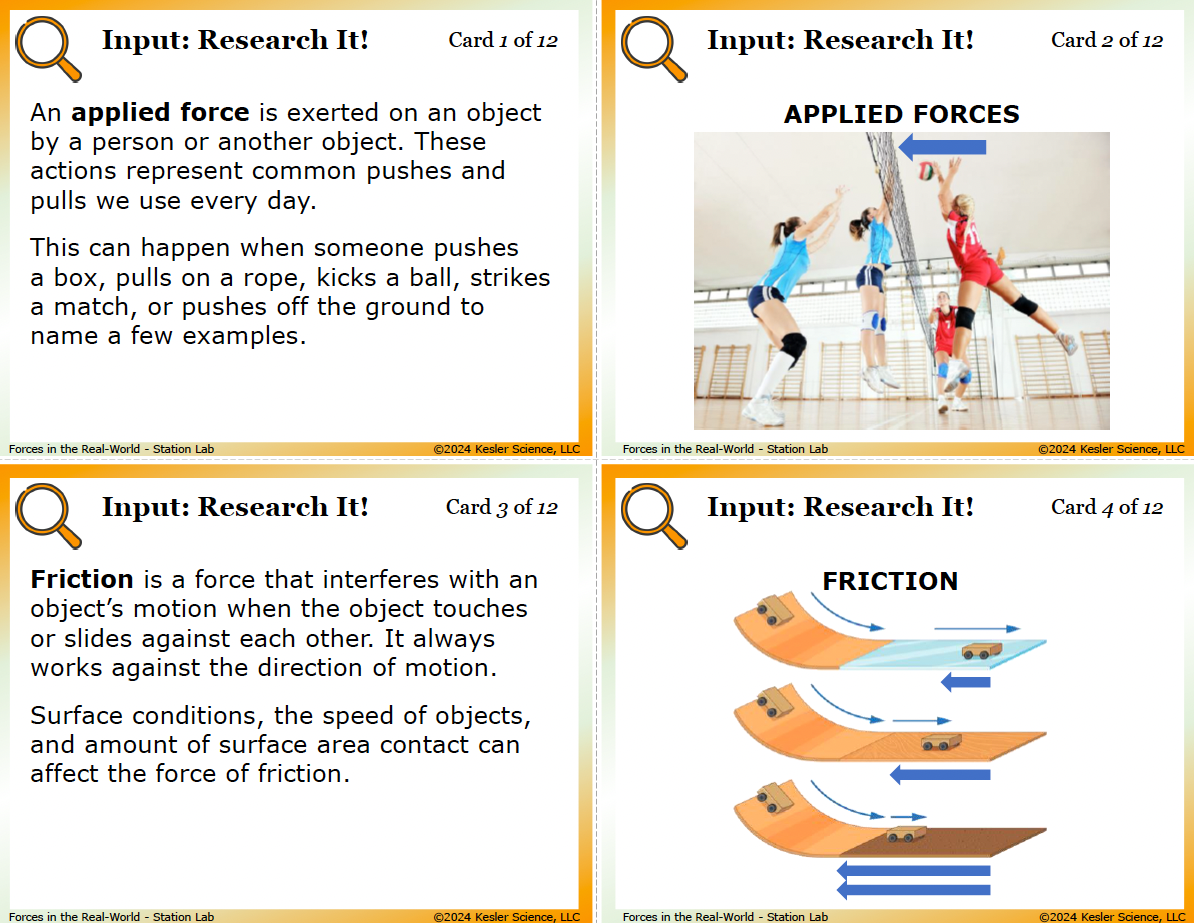
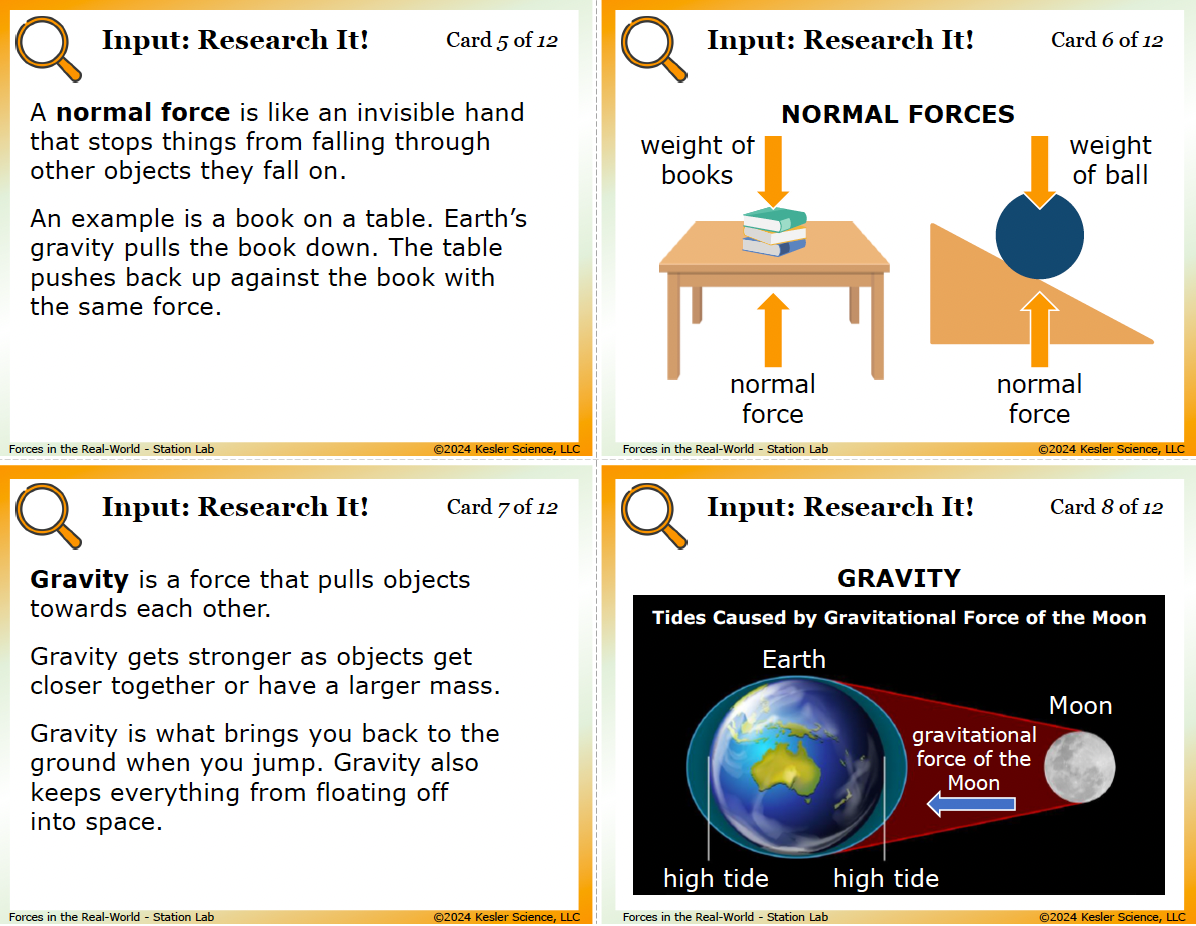
Students examine 12 reference cards covering each force in detail: applied forces (with a volleyball-spike photo), friction (with ramp diagrams showing how surface texture changes the slowdown), normal force (with the book-on-table and ball-on-slope diagrams), gravity (with the Earth-Moon-tides illustration), and magnetism (with the magnetic-field diagram showing unlike-poles-attract and like-poles-repel). Five application questions tie it all back to sports, transportation, and the gravitational force of the Moon on Earth's tides.
4 output stations: how students show what they learned
A four-column card sort. Kids match each of the five forces (gravity, friction, magnetism, normal force, applied force) with its definition, an image, and a real-world application. Examples: gravity → "keeping our feet on the ground," friction → "braking a car," magnetism → "fridge magnets holding notes," normal force → "sitting in a chair," applied force → "kicking a soccer ball." Easy to spot-check at a glance.
Students sketch a real-world scene from sports, transportation, or technology that shows at least three of the five forces. They label each force, then draw arrows showing the direction AND relative strength (big arrow for big force, small arrow for small force). Even kids who say "I can't draw" surprise themselves here. The arrows force them to think about which forces are bigger than others, which sets them up perfectly for the net force lab in TEKS 6.7B.
Three open-ended questions: how friction can be both helpful and unhelpful in everyday life (with two examples), how normal forces make furniture sturdy enough to sit on, and how applied forces matter in a sport of their choice. This is the writing practice middle schoolers need and rarely get in science class. The friction question is the one that fixes the "friction is only bad" misconception.
Eight multiple-choice and fill-in-the-paragraph questions tied to TEKS 6.7A vocabulary (gravity, friction, magnetism, applied force, normal force). Includes what happens to gravitational force as distance increases, an example of reducing friction, and identifying applied force from four scenarios. The fill-in paragraph weaves all five vocabulary words together. If you're grading the lab, this is the easiest station to grade.
Bonus Challenge It! station for early finishers
Four optional extensions: build a forces crossword puzzle, design board-game questions, run a mini physics experiment (build an electromagnet, test friction with different surfaces, or model gravity), or do a forces scavenger hunt around the classroom and document examples of all five forces. Requires teacher approval before they start.
How this fits into a complete forces in the real-world unit
This Station Lab is the Explore day of our full Forces in the Real-World Complete 5E Lesson for TEKS 6.7A. The complete two-week unit follows the 5E method of instruction and includes an Engage hook, the Forces in the Real-World Station Lab for Explore, PowerPoint slides and interactive notebook pages for Explain, student choice projects to Elaborate, and an Evaluate assessment.
Most teachers grab the full 5E because the Station Lab lands hardest with the days around it. But if you just need a strong hands-on day on the five forces and how they show up in real life, the Station Lab on its own does the job.

Get this forces in the real-world activity

Or if you want the full two-week experience with the Engage hook, Explain day, Elaborate extension, and Evaluate assessment all included:
(Station Lab is included)
Frequently asked questions
What does TEKS 6.7A cover?
Texas TEKS 6.7A asks 6th grade students to identify and describe the changes in position, direction, and speed of an object when acted upon by unbalanced forces, including gravity, friction, magnetism, and applied force. Students should be able to look at any real-world scene (a basketball game, a car driving, a refrigerator magnet, a chair holding someone up) and name the forces at work.
Is this kids' first time meeting all five forces?
Mostly yes. Sixth graders have heard "gravity" before and most have used a magnet, but "normal force," "applied force," and "friction" as labels are new for the majority of them. The Read It! basketball passage introduces all five at once with bolded vocabulary, the Research It! reference cards reinforce them, and the Organize It! card sort tests whether kids can match each force with a real-world example.
How long does this forces in the real-world activity take?
One to two class periods (45 to 110 minutes total). The Explore It! station's four hands-on parts are the longest piece, so plan for two periods the first time you run a station lab. Once your class has the rotation routine down, most groups can finish all 8 stations in one period.
Do I need a lot of supplies for this?
A tennis ball, a marble, a magnet, a paperclip, and a jump rope. Total cost for a class of 30: under $15 if you're starting from nothing. Most middle school science teachers already have all of these. The Watch It! station also needs a device with internet.
Can I use this in a 1:1 digital classroom?
Yes. The full digital version (PowerPoint or Google Slides) works in 1:1 classrooms and Google Classroom. Students drag the digital reference cards instead of physically modeling. The Explore It! hands-on parts are harder to digitize. You can substitute simulation videos or PhET force simulations if you don't have the supplies.