.png?width=375&height=100&name=WebPage%20logo%20with%20curves%202026%20(8).png)
Comparing Density
"Compare the density of substances relative to various fluids."
💡 What This Standard Actually Means
"Compare". Students are looking at the density of a substance and comparing it to the density of various fluids (water, oil, salt water, syrup) to predict and explain what will sink and what will float. The shift in this standard is that students aren't just calculating density to identify an unknown anymore. They're using density relationships across different fluids. Instruction can take many forms, such as density column labs, sink-or-float prediction stations, side-by-side beaker observations, and quick demos with water, oil, and salt water.
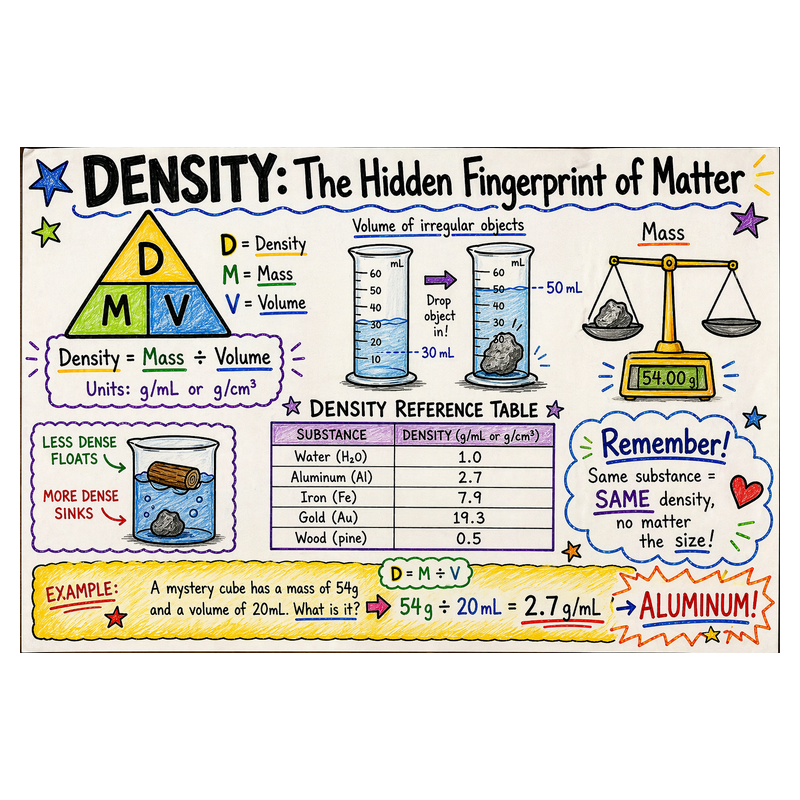
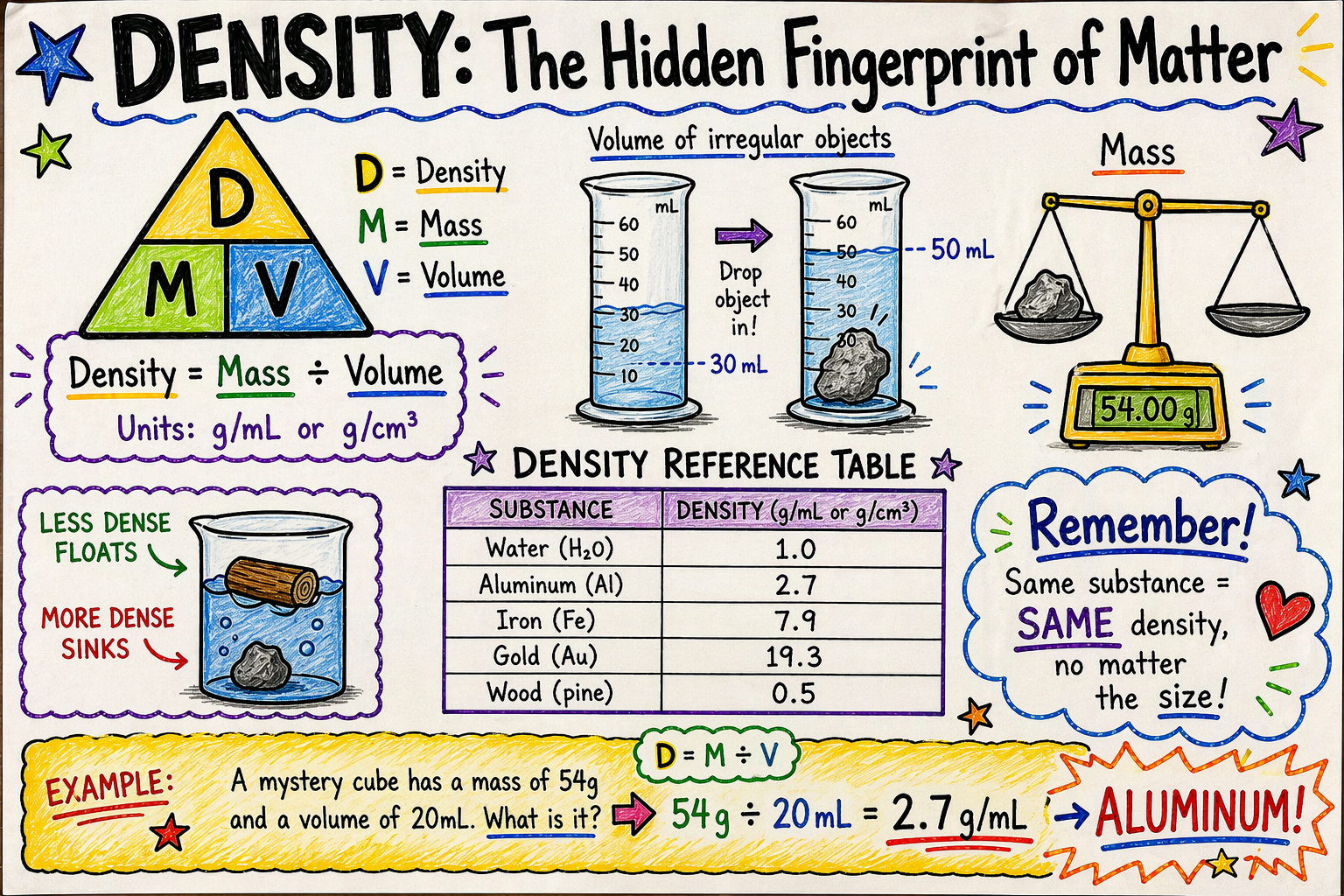
Density is how much mass is packed into a given volume. The formula is density equals mass divided by volume (D = m/V), and the most common units are grams per milliliter (g/mL) or grams per cubic centimeter (g/cm3). Two objects can take up the same amount of space and still have very different densities. A bowling ball and a beach ball are about the same size, but the bowling ball packs way more mass into that space.
What this standard is really pushing students toward is comparing densities across different fluids, not just using water as the reference. Water has a density of about 1 g/mL. Vegetable oil is around 0.92 g/mL, so it floats on top of water. Honey is about 1.42 g/mL, so it sinks below water. Salt water is denser than fresh water, which is why it's easier to float in the ocean than in a pool. A density column with several layered liquids and small objects is the picture students should have in their head.
The big idea is relative. An object floats in a fluid when it's less dense than the fluid, and it sinks when it's more dense. The same object can float in one liquid and sink in another. A grape sinks in fresh water but floats in salt water, and an egg does the same thing. Students should walk away able to compare any object to any fluid and predict the outcome.
Every year, the moment that sold kids on density was the can test. I'd bring a can of regular Coke and a can of Diet Coke and drop them both into a clear tub of water at the same time. The regular Coke sinks. The Diet Coke floats. Same can, same amount of liquid, different result. The only difference is that regular Coke has sugar packed into the liquid while Diet Coke uses a tiny amount of artificial sweetener. That demo gave me a whole class period of discussion. Then we'd measure, calculate, and predict with other items for the rest of the week.
⚠️ Misconceptions Your Students May Have
These are some of the most common misconceptions. Knowing what to look for can help you get ahead of them.
"Heavy things sink and light things float"
This is the most common student explanation. It misses the size piece entirely. A giant cargo ship weighs tens of thousands of tons and floats, while a small steel bolt weighs less than an ounce and sinks. What matters is the ratio of mass to volume, not mass alone. Density is the idea that ties both together.
"Bigger things are denser than smaller things"
Students often mix up density with size or mass. A 1-gallon jug of water and a 1-liter water bottle have the same density even though the jug is bigger and heavier. Density tells you how tightly the matter is packed. Cut a chunk of iron in half and each piece still has the same density as the whole original piece.
"Objects with holes always float because they're empty"
Students see a boat or a hollow rubber duck and say "it has air inside, that's why it floats." The real explanation is that the object plus the air inside it has an overall density less than water. A metal boat shaped like a solid brick would sink. Shape matters because it changes how much volume the object takes up.
"Whether something sinks depends on the water, not the object"
Students sometimes think that changing the amount of water will change whether an object sinks or floats. A penny sinks in a tiny cup of water and also sinks in a swimming pool. The amount of water doesn't matter. What matters is comparing the density of the object to the density of the liquid.
📓 Teaching Resources for 6.6D
These resources are aligned to this standard.


100% Aligned Lessons for Every TEKS You Teach
Kesler Science Plus puts thousands of ready-to-teach lessons and activities in your hands, so you can boost engagement and get your planning time back. Trusted by schools and districts all over the great state of Texas.
🌎 Phenomenon Ideas for 6.6D
Use these real-world phenomena to anchor your lesson. Show students the phenomenon first, let them wonder, then build toward Comparing Density as the explanation.
Regular vs. Diet Soda in Water
Drop an unopened can of regular Coke into a tub of water. It sinks. Drop an unopened can of Diet Coke into the same tub. It floats. The cans are the same size and shape, sealed the same way, containing roughly the same amount of liquid. Something tiny inside is different, and that tiny difference changes what the can does in water.
"Both cans look identical from the outside. Regular Coke has a lot of dissolved sugar in it. Diet Coke has almost no sugar. How could that change whether the can sinks or floats?"
Why Huge Steel Ships Float
A solid block of steel sinks straight to the bottom of a pool of water. But a massive cargo ship, built from thousands of tons of steel, floats across the ocean carrying stacks of containers. How does the same metal sink as a block and float as a ship?
"The steel in the block and the steel in the ship are the same material. What's different about how the ship is built that changes its overall density? Where does all the empty space inside the ship come in?"
Floating in the Dead Sea
Swimmers in a regular pool have to tread water to keep their heads up. But in the Dead Sea in the Middle East, people lie on their backs and float without trying. The water there has a huge amount of dissolved salt, much more than ocean water. Same human body, different liquid, different result.
"Why do people float more easily in the Dead Sea than in a pool? What does the dissolved salt do to the density of the water, and how does that change whether your body floats or sinks?"
💡 Free Engagement Ideas for 6.6D
Ready-to-run activities you can drop straight into a lesson. Where one of these looks like a phenomenon from the section above, that is on purpose: show it first as the hook, then let students run it themselves.
Density Column Build
In a tall clear glass, students layer honey, dish soap, water with food coloring, vegetable oil, and rubbing alcohol (with food coloring) by pouring slowly down the side. Each liquid settles into its own layer based on density. Students rank the liquids from most dense to least and connect it to why each layer sits where it does.
Sink, Float, or Hover
Set up four clear cups, each with a different fluid: water, vegetable oil, salt water, and rubbing alcohol. Give each group four small objects (a grape, a paperclip, a piece of candle wax, a chunk of modeling clay). Before testing, students predict whether each object will sink, float, or hover in each fluid based on how dense they think the object is compared to that fluid. Then they test and record. The big aha is that the same object can sink in one fluid and float in another. Density only matters relative to what's around it.
Salt Water Egg Test
Fill two clear cups with water. In one, dissolve several tablespoons of salt. Drop an uncooked egg into the plain water and observe. Move the same egg to the salt water and observe. Students explain why the same egg sinks in one and floats in the other, using density as the reason.
Same Size, Different Feel
Give each group 3 same-sized cubes or blocks: one wood, one plastic, one metal. Students predict which has the highest density just by holding them. Then they measure mass and volume and calculate density to check their hunch. This helps them feel the difference between mass and density before they do the math.
🎯 What Approaches, Meets, and Masters Thinking Look Like
Here is what student thinking at each level looks like on this one task, so you know what to look for and how to move a student up.
A grape sinks to the bottom of a glass of fresh water. Then you stir a lot of salt into the same water, and the grape floats up to the top. The grape did not change. Explain why the grape sinks in fresh water but floats in salt water. Use the idea of density in your answer.
- A clear statement that the grape itself did not change between the two glasses.
- The word density used to mean how much mass is packed into a space, not just how heavy something is.
- A comparison: the grape sinks because it is more dense than the fresh water.
- A comparison: the grape floats because the salt water is more dense than the grape.
- The key reason the water changed: adding salt makes the water denser (more mass packed into the same space).
- The big idea stated in their own words: an object floats when it is less dense than the fluid and sinks when it is more dense.
- No drift back to "the grape got lighter" or "salt water is just heavier." That is the easiest place to slip.
The grape sinks in the fresh water because it is too heavy for that water. When you add salt, the salt water gets stronger and pushes the grape up so it can float. Heavy things sink and light things float, so the salt makes the grape lighter.
The grape did not lose any weight, so what about the water is different now?That nudges them off "heavy versus light" and toward comparing the grape to the fluid.
The grape did not change. Density is how much mass is packed into a space. The grape sinks in fresh water because the grape is more dense than the fresh water. When you add salt, the water becomes more dense than the grape, so now the grape floats. An object floats when it is less dense than the liquid and sinks when it is more dense than the liquid.
The grape did not change, so its density stayed the same the whole time. What changed is the water. When you stir salt into the water, you pack more mass into the same amount of space, so the salt water becomes more dense than fresh water. In fresh water the grape is more dense than the water, so it sinks. Once the salt water is more dense than the grape, the grape floats. Floating and sinking are always about comparing the object to the fluid it is in.
This is also why it is easier to float in the ocean than in a pool. The ocean is salt water, so it is more dense than the fresh water in a pool. The denser the fluid, the more things will float in it, which is the same reason oil floats on top of water: the oil is less dense than the water under it.
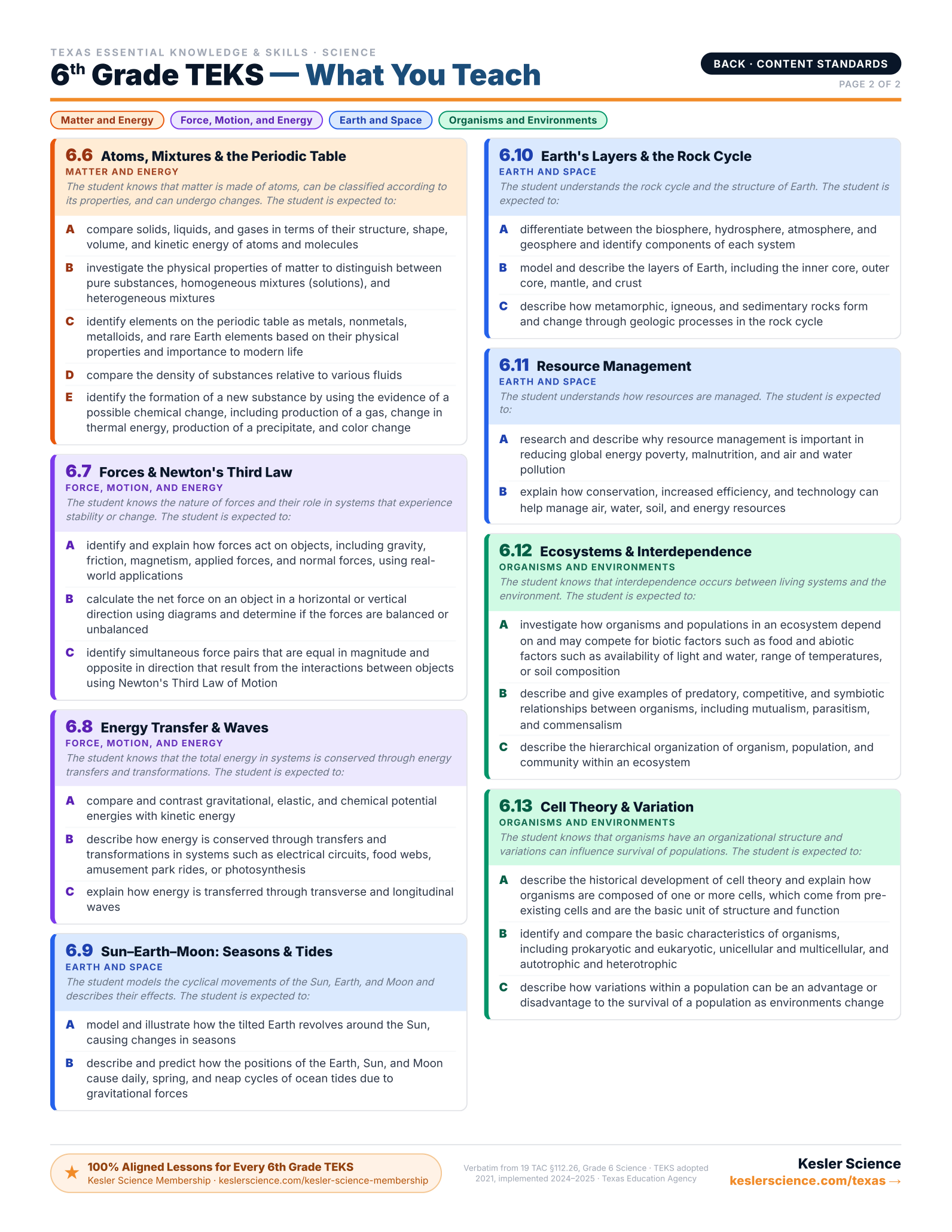
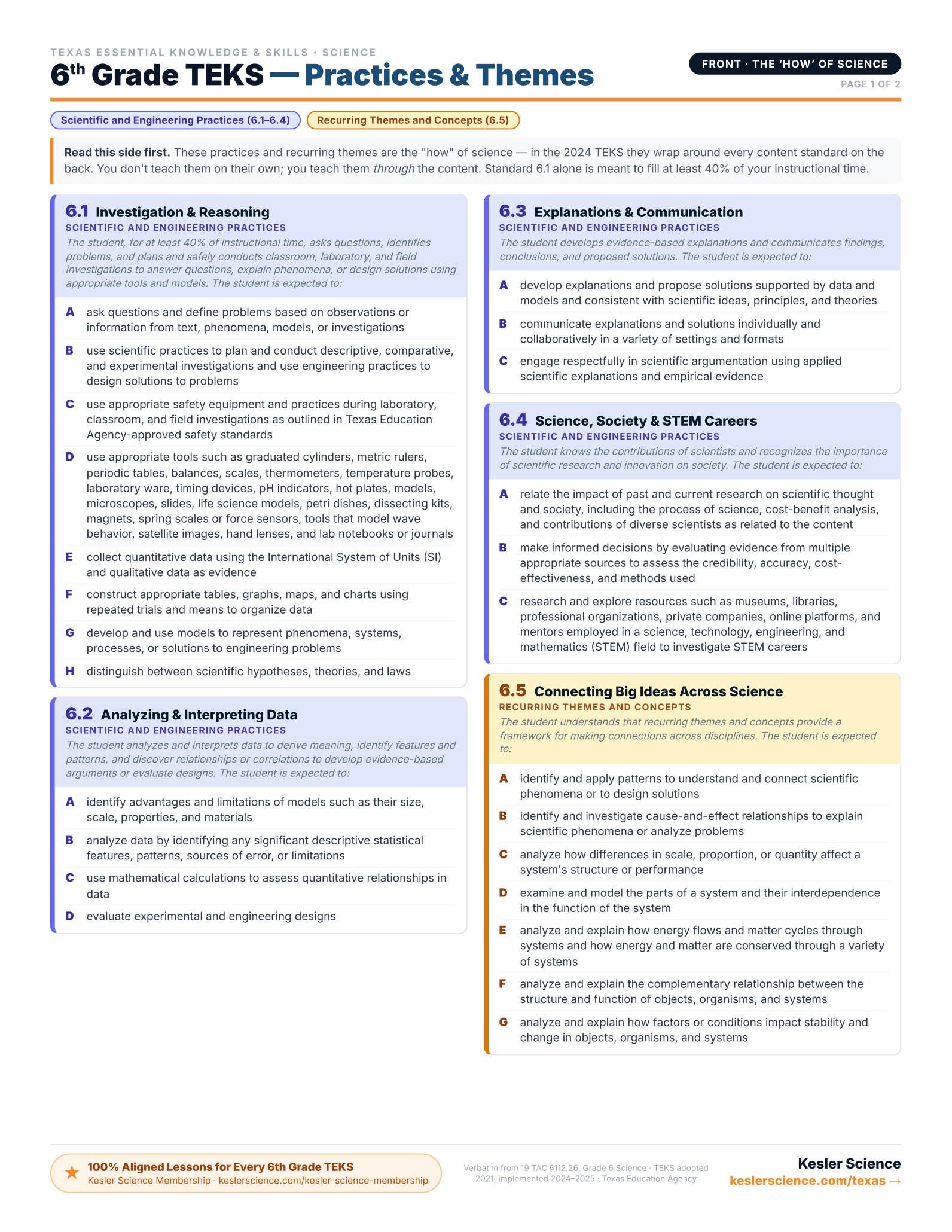
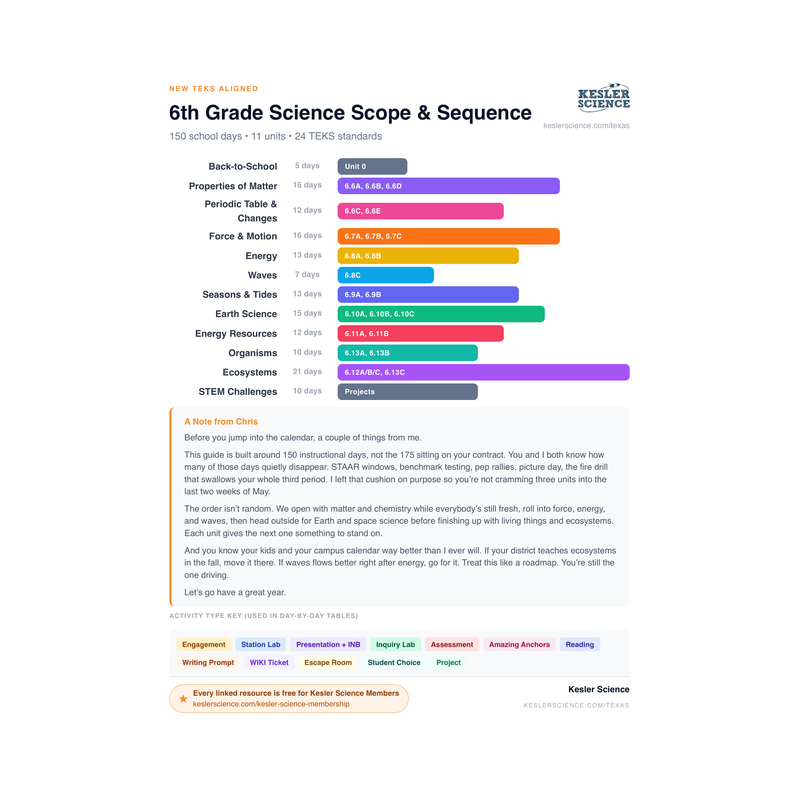
Every 6th-Grade Science TEKS on One Page
The color-coded, front-and-back cheat sheet I wish I'd had — every standard, organized by reporting category. Print it and reference it all year long. This will be your new favorite document!
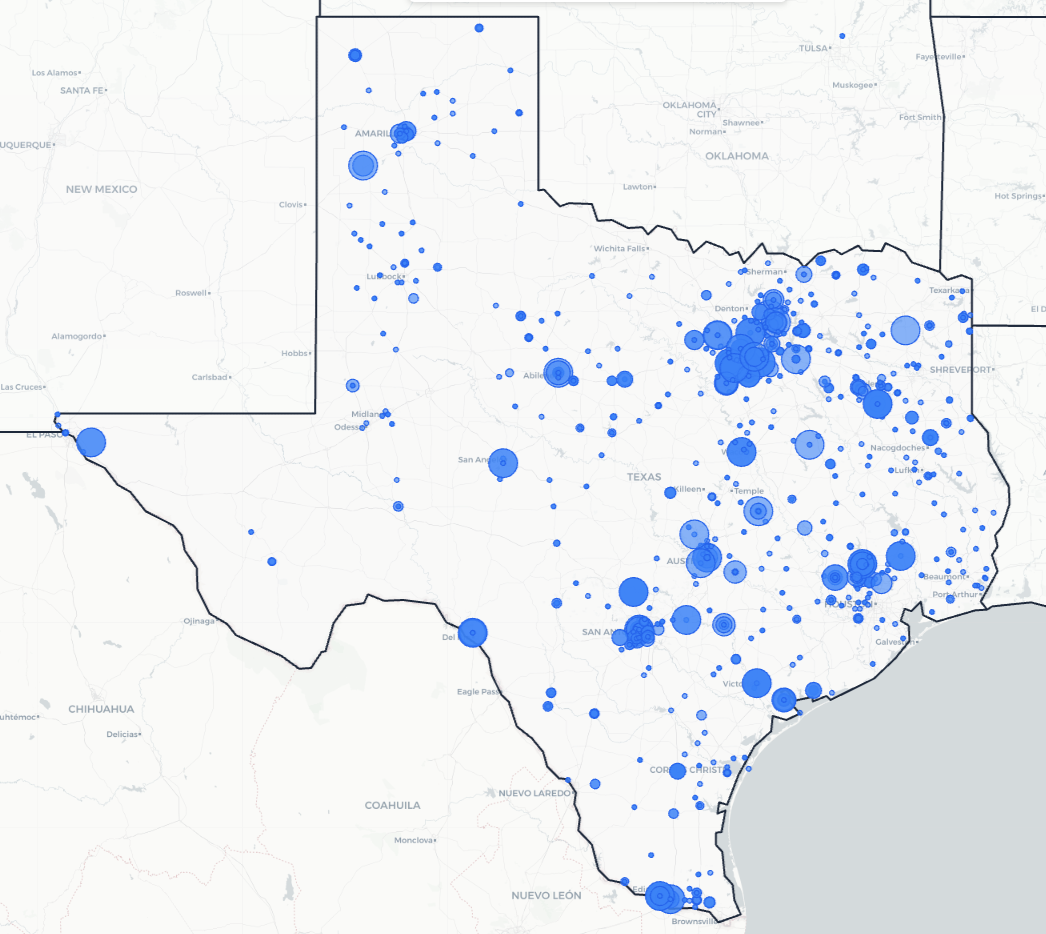
Trusted Across Texas
From the Rio Grande Valley to the Panhandle, Texas science teachers are using Kesler Science to save time and engage students.
Texas Schools and Districts
Love Kesler Science
What Teachers Are Saying
Give Your Science Teachers Everything They Need
School and district licenses give your teachers access to every resource they need, including station labs, inquiry labs, anchoring phenomena, presentations, escape rooms, and much more. One purchase covers the grade levels you need.
- PO-friendly. We accept purchase orders
- Volume discounts for 11+ teachers
- Complimentary Kesler Science Plus orientation for 4+ teachers
- Three free implementation PD sessions for departments of 11+
- Aligned to the 2024 TEKS standards

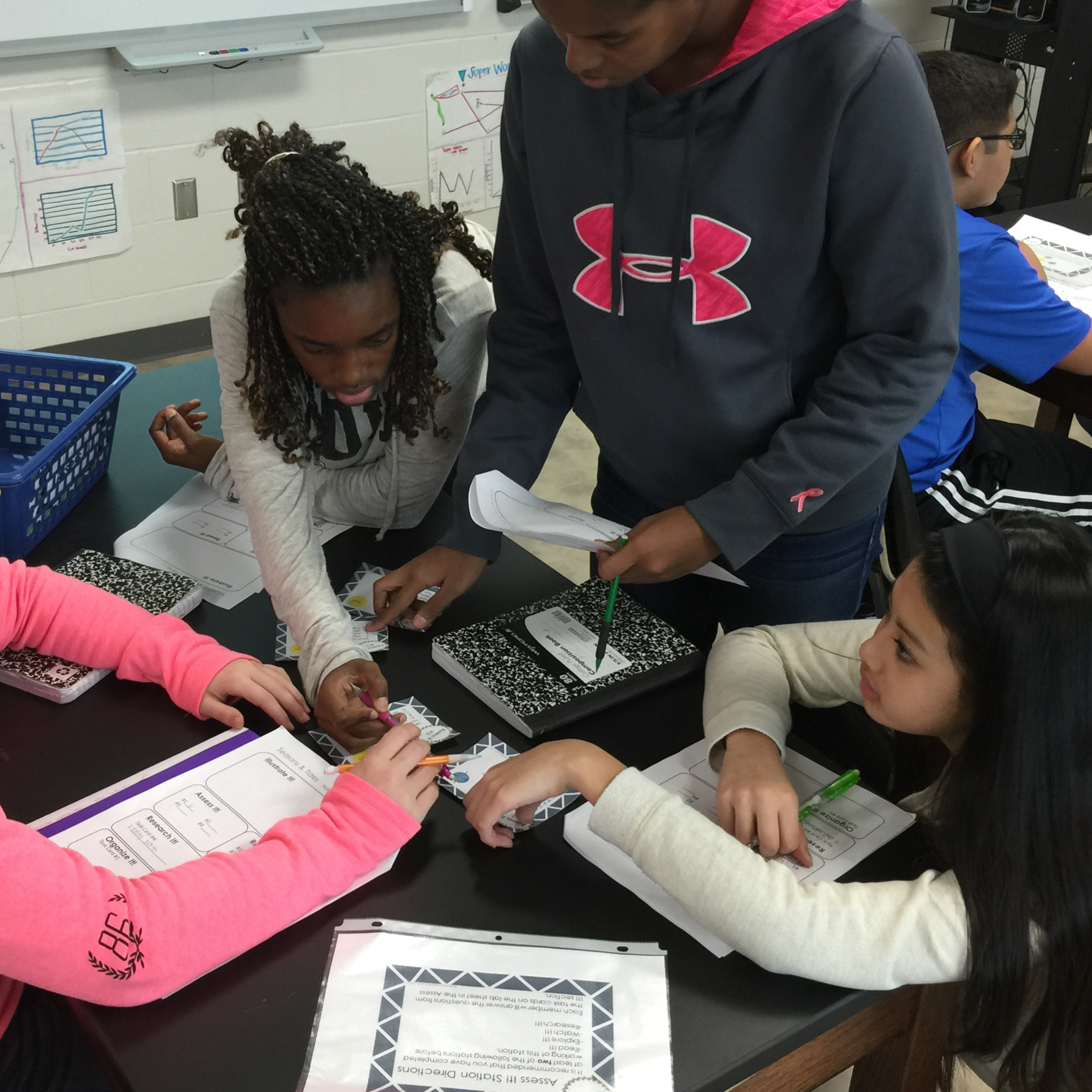
See It in Action
Book a walkthrough and we'll show you how Kesler Science fits your campus.
Book Demo CallNo pressure, no hard sell