.png?width=375&height=100&name=WebPage%20logo%20with%20curves%202026%20(8).png)
Classify Elements
"Identify elements on the periodic table as metals, nonmetals, metalloids, and rare Earth elements based on their physical properties and importance to modern life."
💡 What This Standard Actually Means
"Identify". Students are using physical properties to put elements into the right group on the periodic table: metals, nonmetals, metalloids, and rare Earth elements. The newer addition for this standard is rare Earth elements and their importance to modern life, so kids need to know more than just where the element sits, they need to connect it to real uses (phones, batteries, magnets, screens). Instruction can take many forms, such as periodic table coloring activities, real-object sorting, technology-teardown research, and short videos on how rare Earth metals are mined.
The periodic table groups elements with similar properties together. Metals sit on the left side and middle. They tend to be shiny, conduct heat and electricity well, and can be bent or hammered without shattering. Iron, copper, aluminum, and gold are classic metals. Nonmetals sit on the upper right. They tend to be dull, don't conduct electricity well, and are brittle when solid. Many are gases at room temperature. Oxygen, nitrogen, carbon, and sulfur all live here. Metalloids run along the stair-step line that separates metals from nonmetals and show a mix of properties. Silicon is the famous one because it's used in computer chips.
Rare Earth elements are a newer focus for this TEKS. They're a set of 17 elements (the 15 lanthanides plus scandium and yttrium) that aren't actually that rare in Earth's crust, but they're hard to find in concentrated deposits and difficult to separate from each other. The reason students need to know them is because they're hidden inside the technology kids use every day. Smartphones, laptops, electric car batteries, wind turbines, MRI machines, and LED screens all rely on rare Earth elements like neodymium, europium, and dysprosium.
The big idea students should walk away with is that the position of an element on the periodic table tells you a lot about how it behaves and where you'll find it in the modern world. Metals do the heavy lifting in construction and electricity. Nonmetals make up most of the air, water, and living things. Metalloids quietly run our electronics. Rare Earth elements power the devices in our pockets.
The thing that clicked for my kids was treating the periodic table like a neighborhood map. I'd project a big version on the board and literally draw fences around the metals, the nonmetals, and the stair-step border. Then we'd play a game called "Who lives here?" I'd call out an element and a student had to walk up, find it, and tell me the neighborhood. After a few rounds, they stopped memorizing random elements and started seeing the pattern. The table went from scary to a tool they could actually use.
⚠️ Misconceptions Your Students May Have
These are some of the most common misconceptions. Knowing what to look for can help you get ahead of them.
"The periodic table is just a random list of elements to memorize"
Students often see it as a wall of squares they have to memorize. The organization itself is the lesson. Elements in the same column have similar properties. Reading position left to right and top to bottom gives information about what an element is likely to do. It's a map, not a list.
"All metals are hard and solid"
Students picture iron or steel and assume every metal is rock-hard. Mercury is a metal that's liquid at room temperature. Sodium is soft enough to cut with a butter knife. Gallium melts in your hand. The common properties (shiny, conductive, malleable) hold for many metals, but hardness and state of matter can vary a lot.
"Nonmetals are all gases"
Because the obvious nonmetals (oxygen, nitrogen, hydrogen) are gases, students assume all nonmetals are. Carbon is a nonmetal and it's solid (think of the graphite in pencils). Sulfur is a yellow solid. Bromine is a reddish-brown liquid. Nonmetals can be solids, liquids, or gases at room temperature.
"Metalloids are just a weird in-between category nobody really uses"
Metalloids show up everywhere in modern life. Silicon is the backbone of computer chips and solar panels because it sits between "good conductor" and "insulator." Boron is in borax and Pyrex glass. The split personality of metalloids, part metal and part nonmetal, is exactly what makes them so useful.
📓 Teaching Resources for 6.6C
These resources are aligned to this standard.


100% Aligned Lessons for Every TEKS You Teach
Kesler Science Plus puts thousands of ready-to-teach lessons and activities in your hands, so you can boost engagement and get your planning time back. Trusted by schools and districts all over the great state of Texas.
🌎 Phenomenon Ideas for 6.6C
Use these real-world phenomena to anchor your lesson. Show students the phenomenon first, let them wonder, then build toward Classify Elements as the explanation.
Why Silicon Runs Your Phone
The chip inside every smartphone is made largely of silicon, which is extracted from plain sand. Silicon isn't a great conductor like copper, and it's not a strong insulator like rubber. It sits in the middle, and that's exactly the point. Engineers can tune how well it conducts electricity, which makes it the backbone of modern computing.
"Why would engineers want a material that's kind of a conductor but kind of not? What does silicon's in-between behavior have to do with where it sits on the periodic table?"
A Penny That's Not Really Copper
Most pennies made after 1982 are mostly zinc with a thin copper coating. Both zinc and copper are metals. Both are shiny, both conduct electricity, both can be shaped without breaking. But if you scratch deep into a modern penny, the inside looks different from the outside. Different metals can look and feel similar and still be distinct elements.
"Zinc and copper are both metals, but they're different elements. What properties do they share because they're both metals? Where do you find them on the periodic table, and what does that tell you?"
Why Skyscrapers Aren't Made of Sulfur
Skyscrapers, bridges, and cars are built from metals like iron and aluminum. They're strong, can be shaped, and hold up under pressure. Sulfur, a nonmetal, is a yellow solid that crumbles when you hit it. Both are pure elements, but nobody builds a bridge out of sulfur. Where an element sits on the periodic table predicts what jobs it can do.
"Why are buildings built from metals and not from nonmetals like sulfur? What properties of metals make them good for construction, and which properties of nonmetals get in the way?"
💡 Free Engagement Ideas for 6.6C
Ready-to-run activities you can drop straight into a lesson. Where one of these looks like a phenomenon from the section above, that is on purpose: show it first as the hook, then let students run it themselves.
Shine, Bend, Conduct Test
Set up three test stations. Give groups samples of safe elements and common materials: aluminum foil, a copper wire, a pencil (graphite core), a chunk of charcoal, and a piece of tin. At each station they test for shininess, ability to bend without breaking, and conductivity with a simple battery-bulb circuit. They fill out a property chart and classify each as metal, nonmetal, or metalloid.
Color the Periodic Table
Hand out blank periodic tables. Using three highlighters or colored pencils, students color metals one color, nonmetals another, and metalloids a third. Draw the stair-step line in a bold color. The physical act of coloring the boundaries locks in where each group lives. Hang finished tables on the wall as a reference.
Mystery Element Bag
Put 6 to 8 samples (paper clip, pencil lead, aluminum can tab, copper penny, sulfur sample from a science kit, small zinc washer) into numbered bags. Students pass the bags around, note properties, and try to classify each before you reveal what the element is and where it lives on the periodic table.
Build-a-City Element Match
Show a slide of a city street. Students identify parts of the scene (car body, window glass, copper wiring, concrete, rubber tires) and work backward to ask which elements are in each and why. They classify each element as metal, nonmetal, or metalloid and explain why that category fits the job.
🎯 What Approaches, Meets, and Masters Thinking Look Like
Here is what student thinking at each level looks like on this one task, so you know what to look for and how to move a student up.
A student has a property card for four elements. Gold is shiny, bends without breaking, and carries electricity well. Sulfur is a dull yellow solid that snaps when you hit it and does not carry electricity. Silicon is shiny but brittle and carries a little electricity. Neodymium is a metal used to make the tiny strong magnets inside phone speakers and earbuds. Sort each element as a metal, a nonmetal, a metalloid, or a rare Earth element, and explain how you decided using the clues.
- All four elements sorted into a category (metal, nonmetal, metalloid, rare Earth element).
- Gold called a metal, using the clues shiny, bendable, and carries electricity well.
- Sulfur called a nonmetal, using the clues dull, brittle (snaps), and does not carry electricity.
- Silicon called a metalloid because it has a mix of properties (shiny like a metal but brittle, carries only a little electricity).
- Neodymium connected to a real use in everyday technology (the magnets inside phones and earbuds), not just labeled.
- An explanation that ties each choice back to the property clues, not just a guess or a memorized spot on the table.
- The silicon case handled correctly as a metalloid (a mix), not forced into metal or nonmetal. That is the easiest place to slip.
Gold is a metal. Sulfur is a nonmetal because it is dull and brittle. Neodymium is a rare Earth element. Silicon is a metal because metals are shiny and carry electricity, so silicon is a metal too.
Gold is a metal because it is shiny, it bends without breaking, and it carries electricity well. Sulfur is a nonmetal because it is dull, it snaps instead of bending, and it does not carry electricity. Silicon is a metalloid because it is in between. It is shiny like a metal but brittle like a nonmetal, and it only carries a little electricity. Neodymium is a rare Earth element, and it is used to make the strong magnets inside phone speakers.
Gold is a metal (shiny, bends, carries electricity well). Sulfur is a nonmetal (dull, brittle, does not carry electricity). Silicon is a metalloid because it has a mix: shiny like a metal but brittle like a nonmetal, and it carries only a little electricity. Neodymium is a rare Earth element. It is a metal, but it sits in its own section of the table with elements that act a lot alike and are spread thin through the rock they come from. That is what makes them rare Earth elements. What puts it on my card is why it matters today: it makes the strongest magnets we use, the little ones in phone speakers and earbuds.
The real way to sort an element is by its properties, not by how it looks at first. Shiny by itself does not prove it is a metal. You have to check if it also bends and carries electricity well. That is how I would figure out boron, which was not on my card. Boron is shiny but brittle and only carries a little electricity, just like silicon, so boron is a metalloid too.
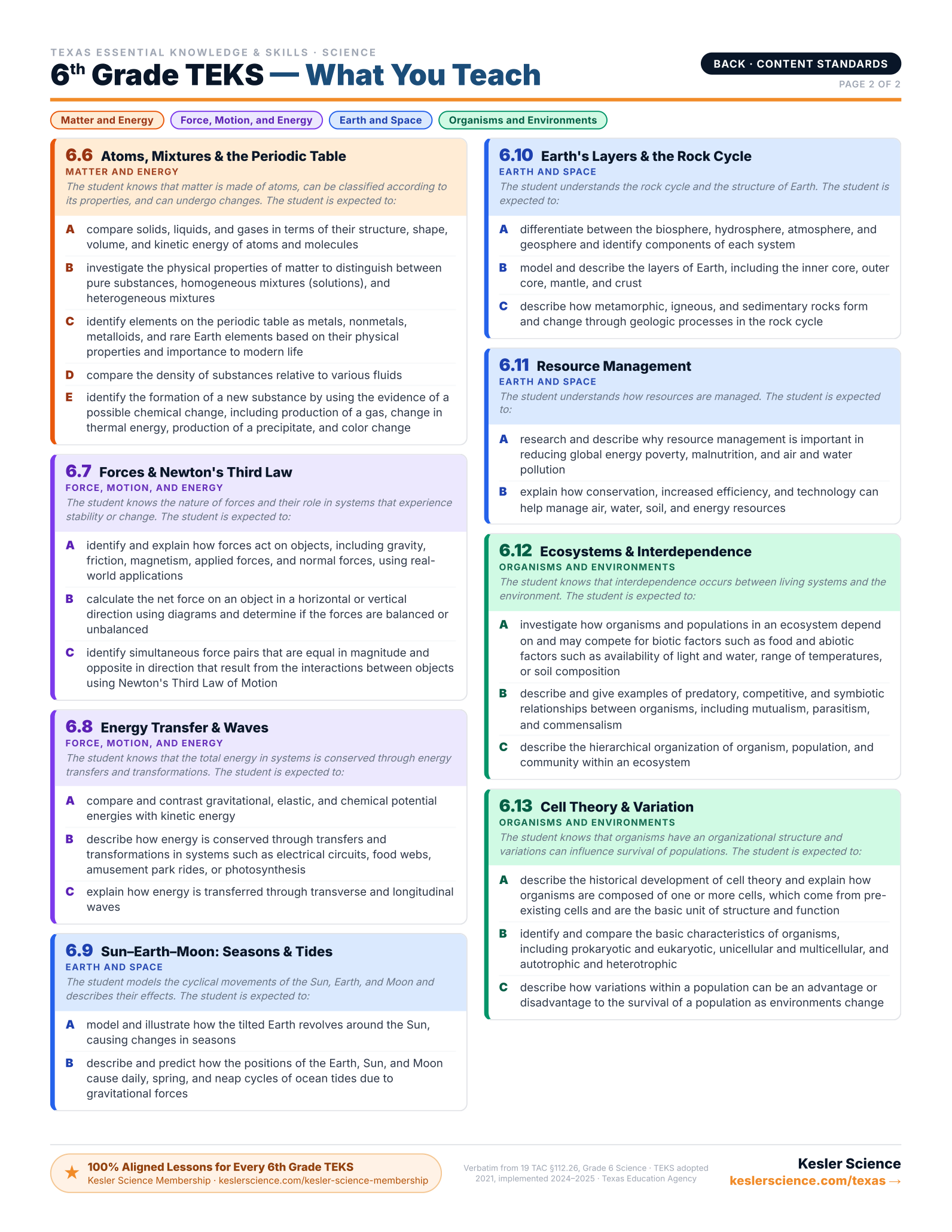
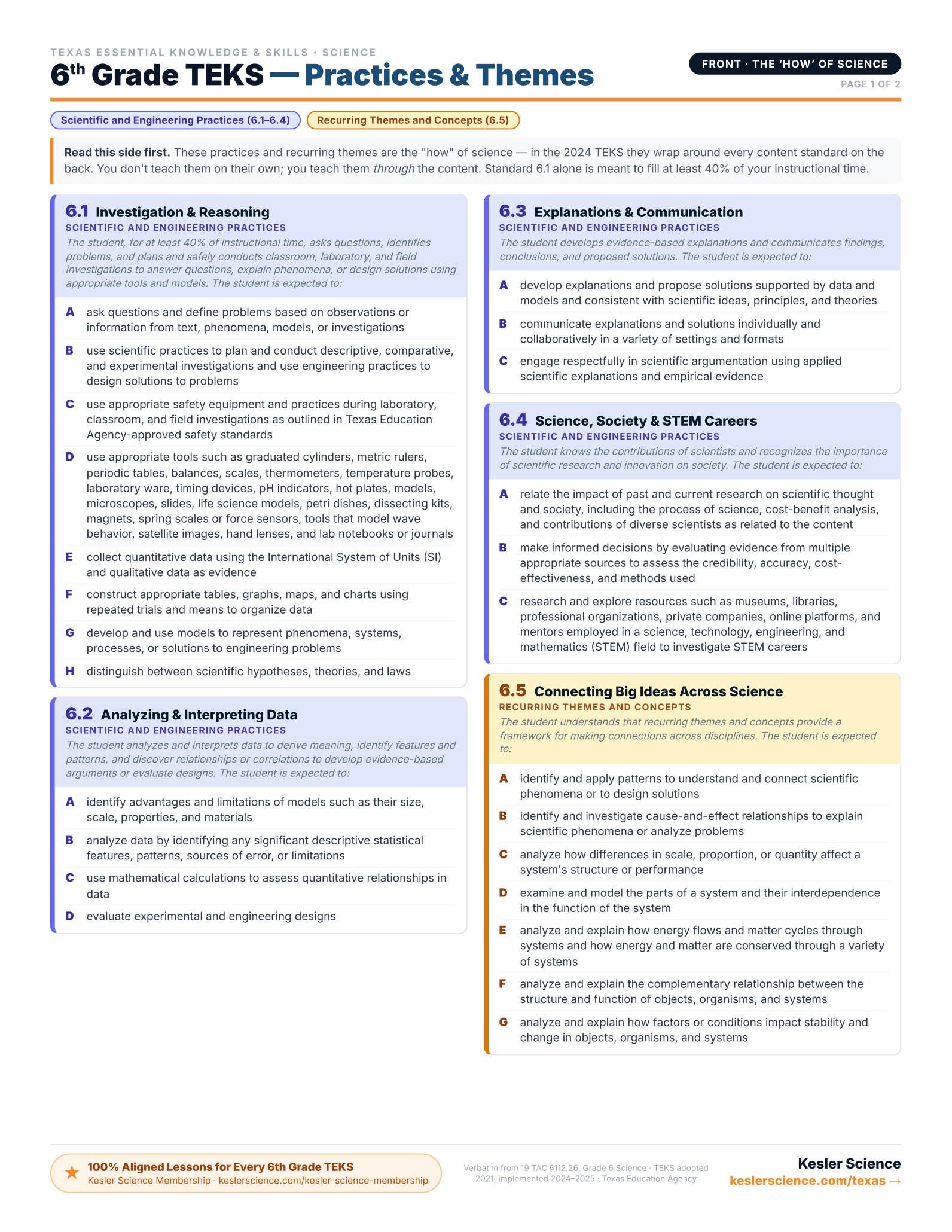
Every 6th-Grade Science TEKS on One Page
The color-coded, front-and-back cheat sheet I wish I'd had — every standard, organized by reporting category. Print it and reference it all year long. This will be your new favorite document!
Trusted Across Texas
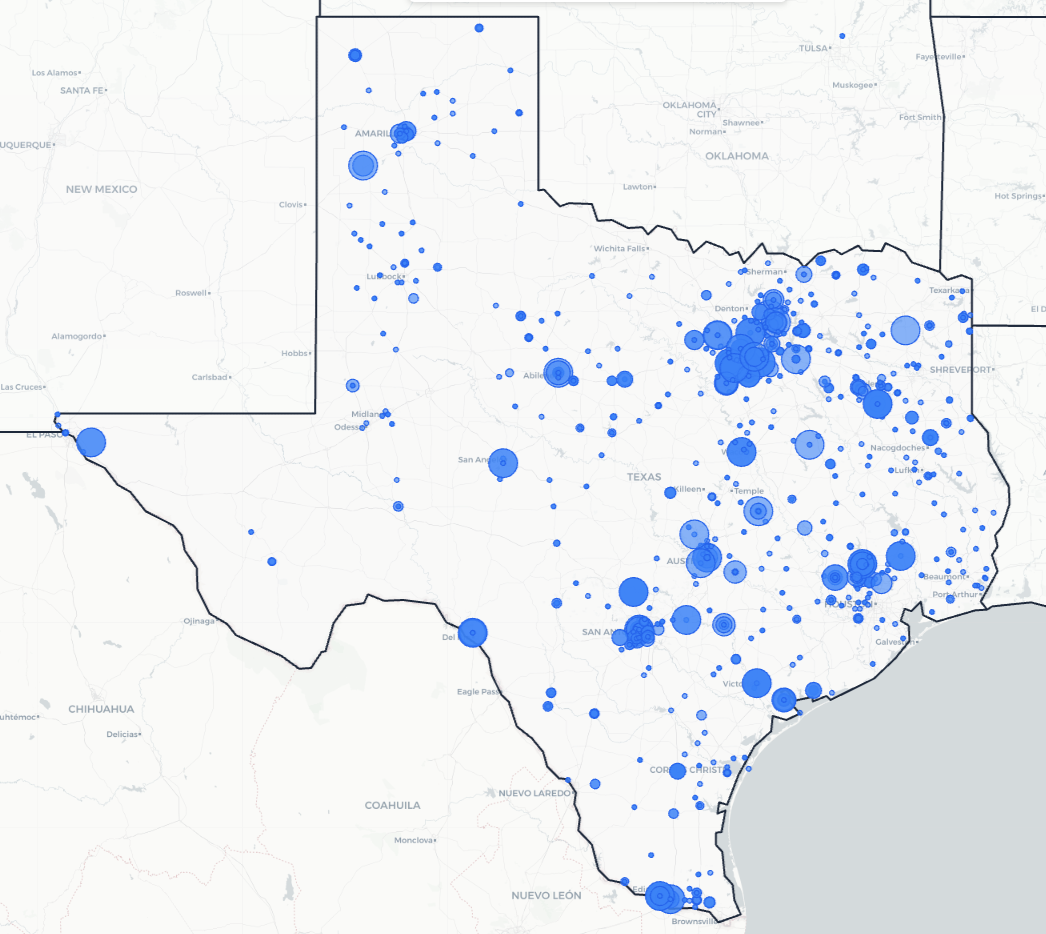
From the Rio Grande Valley to the Panhandle, Texas science teachers are using Kesler Science to save time and engage students.
Texas Schools and Districts
Love Kesler Science
What Teachers Are Saying
Give Your Science Teachers Everything They Need
School and district licenses give your teachers access to every resource they need, including station labs, inquiry labs, anchoring phenomena, presentations, escape rooms, and much more. One purchase covers the grade levels you need.
- PO-friendly. We accept purchase orders
- Volume discounts for 11+ teachers
- Complimentary Kesler Science Plus orientation for 4+ teachers
- Three free implementation PD sessions for departments of 11+
- Aligned to the 2024 TEKS standards
See It in Action
Book a walkthrough and we'll show you how Kesler Science fits your campus.
Book Demo CallNo pressure, no hard sell