
8 hands-on stations for teaching how to classify elements
A station lab is a student-led activity where small groups rotate through 8 stations (plus a 9th challenge station for early finishers) at their own pace during one to two class periods. You become a facilitator instead of a lecturer. You walk around, spot-check, and break misconceptions while kids work through the rotation.
The Classify Elements Station Lab has four input stations (where students take in new info on metals, nonmetals, metalloids, and the periodic table) and four output stations (where they show what they learned). Here's what's at each one.
4 input stations: how students learn to classify elements
A short YouTube video introduces how scientists classify elements based on their physical and chemical properties. Kids answer three questions: how elements are classified, examples of metal properties from the video, and what makes metalloids different from metals and nonmetals. Visual learners hook in fast at this station because the video shows actual samples and where they land on the periodic table, which is hard to picture from words alone.
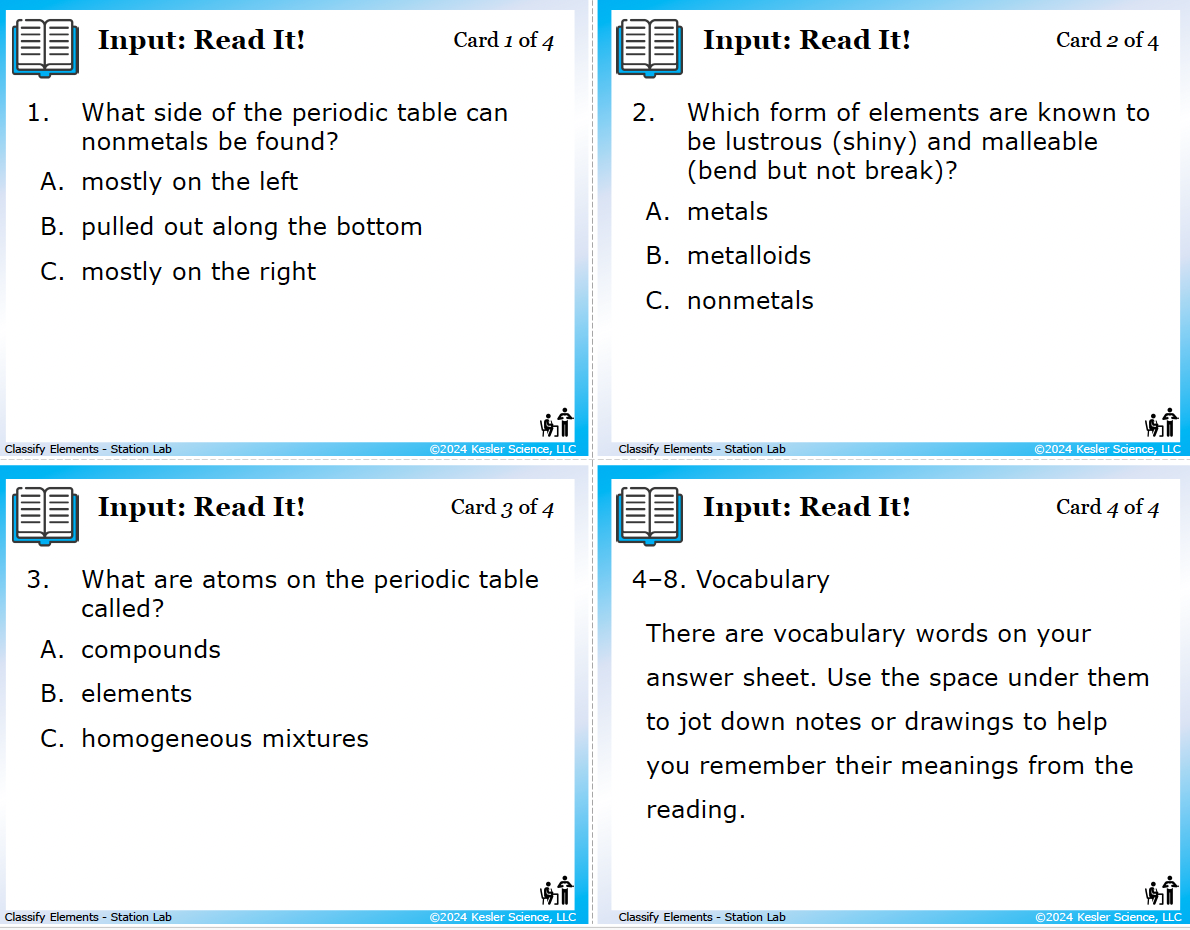
A one-page passage called "The Building Blocks of Everything!" frames the periodic table as a mosaic. Each tile is an atom, and elements are grouped into families based on shared properties. The passage walks through metals (luster, strength, conductivity, found mostly on the left), nonmetals (dull, poor conductors, on the right), metalloids (silicon, arsenic, used in semiconductors for phones and computers), and rare earth elements (scarce metals used in magnets and electronics). Vocabulary is bolded throughout. Three multiple-choice questions follow, plus the vocab notes section. Comes in two reading levels (Dependent and Modified) plus a Spanish version.
This is the heart of the lab. Three-test physical-properties investigation. Test 1 (Appearance): kids place small samples on a paper towel and record color, luster, and form (sheet, powder, crystal, gas). Test 2 (Conductivity): they touch a battery-powered conductivity tester to each sample. If the bulb lights, it's a conductor. If not, an insulator. They predict what a semi-conductor would do. Test 3 (Malleable vs. Brittle): kids try to bend each sample with their fingers, then tap gently with a small hammer. Malleable flattens. Brittle shatters. After all three tests, they classify each sample as metal, nonmetal, or metalloid and justify their answer with the test data.
Students examine 8 reference cards: real-life examples of metals (Fe, Cu, Au, Pt, Ti, Sn, Co, Ni, Pb, Ag, Zn), examples of nonmetals (gas tanks of nitrogen, oxygen, helium, argon), examples of metalloids (a chunk of silicon), and a full periodic table. The next four cards define each property (heat resistance, conductivity, malleability, luster, density, state of matter) and end with a comparison chart showing how metals, nonmetals, and metalloids stack up on every property. Six questions follow, including a mystery-element challenge: kids get a list of properties (gray, solid at room temperature, semiconducting, density 2.33 g/cm³) and have to classify it as metal, nonmetal, or metalloid using reasoning.
4 output stations: how students show what they learned
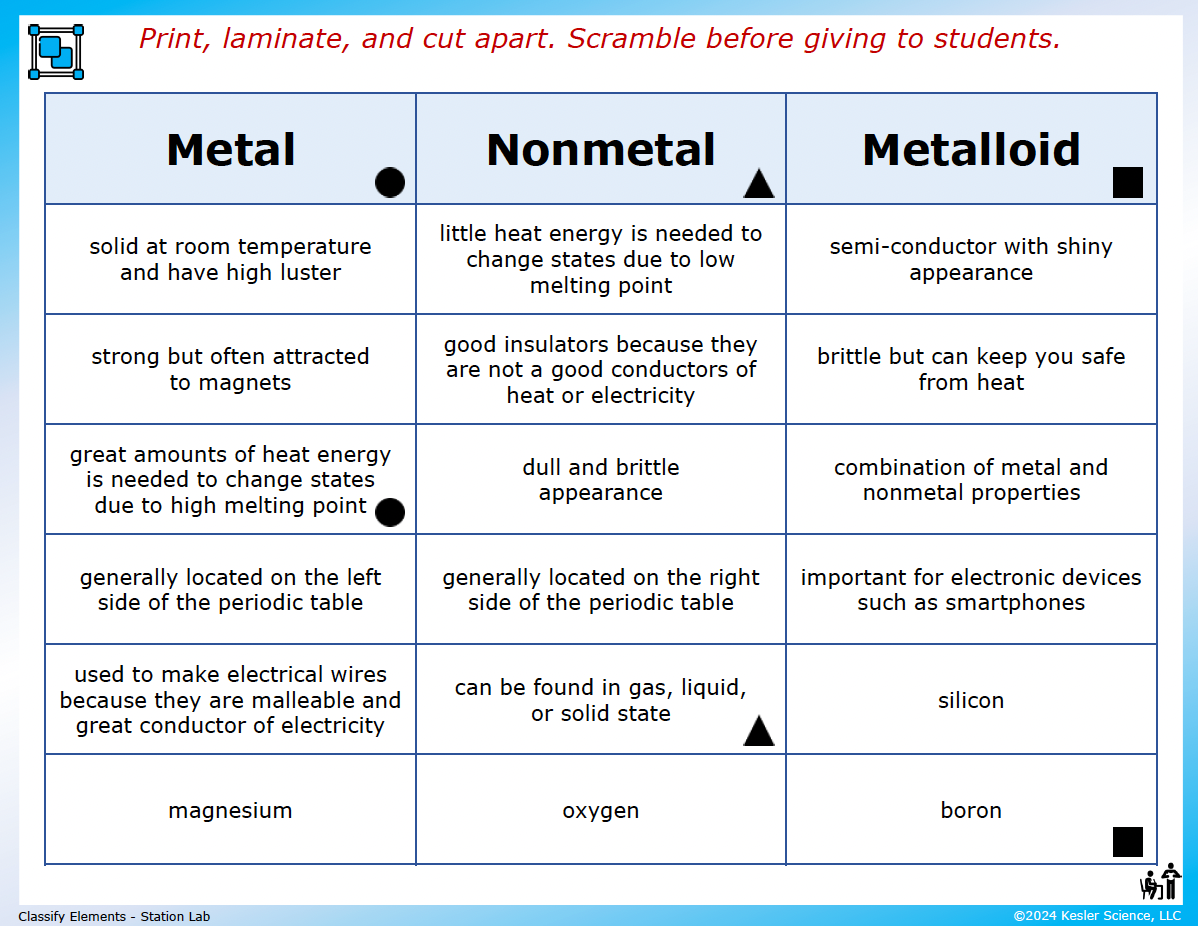
A three-column card sort. Kids sort 18 description cards into METAL, NONMETAL, and METALLOID columns. Cards include "solid at room temperature and have high luster," "good insulators because they are not good conductors of heat or electricity," "semi-conductor with shiny appearance," "used to make electrical wires because they are malleable," "can be found in gas, liquid, or solid state," plus a representative element for each column (magnesium for metal, oxygen for nonmetal, boron for metalloid, plus silicon). Easy to spot-check at a glance.
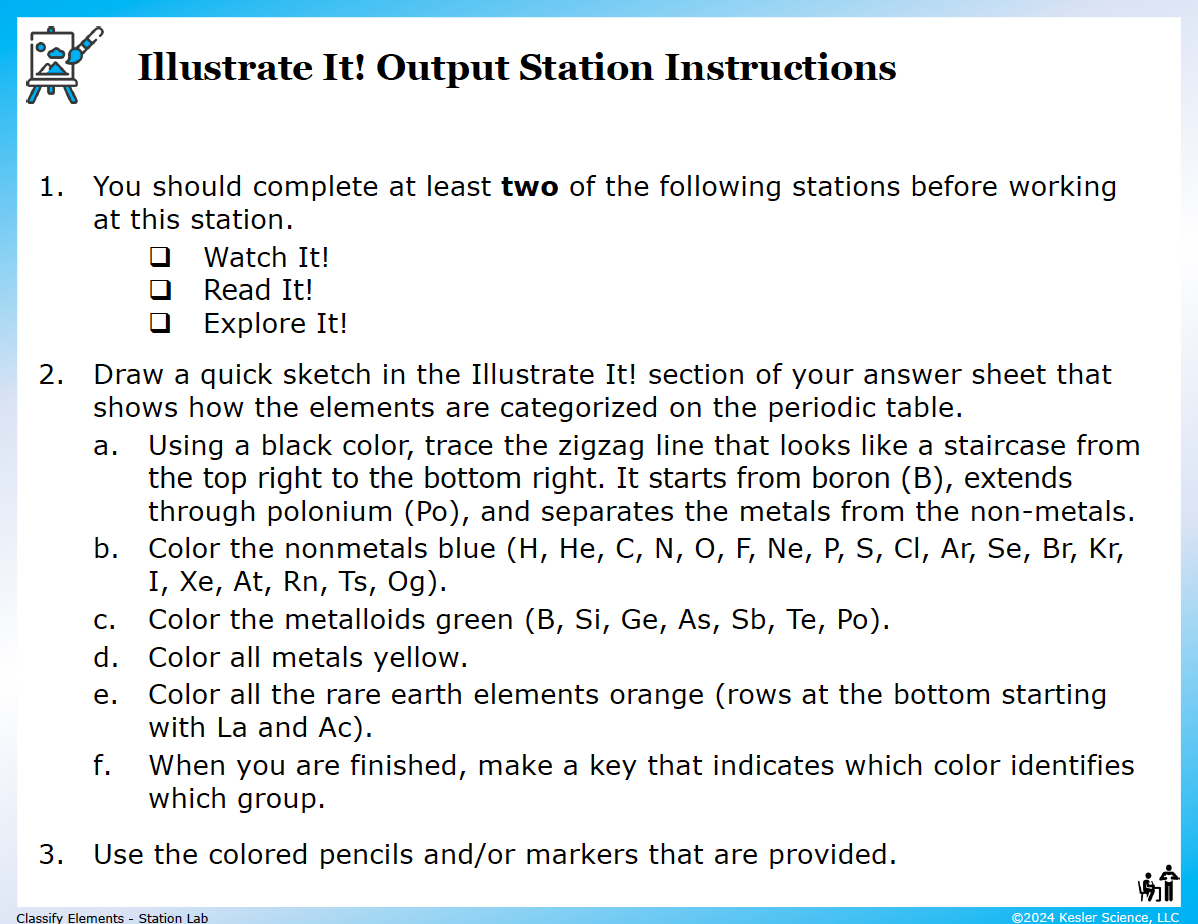
Students color a printed periodic table to show how the elements are categorized. They trace the zigzag staircase line in black from boron through polonium that separates metals from nonmetals. Then they color nonmetals blue (H, He, C, N, O, F, P, S, Cl, Ar, Br, Kr, etc.), metalloids green (B, Si, Ge, As, Sb, Te, Po), all metals yellow, and rare earth elements orange (the two rows starting with La and Ac). Even kids who say "I can't draw" surprise themselves here because the geography of the table is itself the diagram.
Three open-ended questions: why scientists need a way to group elements together, the differences between metals and nonmetals, and what rare earth metals are and how we use them in daily life (magnets, catalysts, electronic devices). Forces kids to commit definitions to paper and connect classification to real-world technology. This is the writing practice middle schoolers need and rarely get in science class.
Eight multiple-choice and fill-in-the-paragraph questions tied to TEKS 6.6C vocabulary (metal, nonmetal, metalloid, periodic table, rare earth element). Includes which is the largest group on the periodic table, why rare earth elements matter for modern tech, and how metalloids combine traits of both metals and nonmetals. The fill-in paragraph weaves all five vocabulary words together into a single explanation. If you're grading the lab, this is the easiest station to grade.
Bonus Challenge It! station for early finishers
Four optional extensions: write a Rental Space ad for a family of the periodic table (list desired characteristics for becoming a resident), research the differences between 10K, 14K, 18K, and 24K gold, design a custom periodic table for a non-science theme (superpowers, foods, sports) with 20 items organized by shared properties, or create Mystery Pixel Art where players color element boxes based on clues to reveal a hidden picture. Requires teacher approval before they start.
How this fits into a complete classify elements unit
This Station Lab is the Explore day of our full Classify Elements Complete 5E Lesson for TEKS 6.6C. The complete two-week unit follows the 5E method of instruction and includes an Engage hook, the Classify Elements Station Lab for Explore, PowerPoint slides and interactive notebook pages for Explain, student choice projects to Elaborate, and an Evaluate assessment.
Most teachers grab the full 5E because the Station Lab lands hardest with the days around it. But if you just need a strong hands-on day on metals, nonmetals, and metalloids, the Station Lab on its own does the job.

Get this classify elements activity

Or if you want the full two-week experience with the Engage hook, Explain day, Elaborate extension, and Evaluate assessment all included:
(Station Lab is included)
Frequently asked questions
What does TEKS 6.6C cover?
Texas TEKS 6.6C asks 6th grade students to classify substances by their physical properties using the periodic table. Students should be able to identify an unknown element as a metal, nonmetal, or metalloid based on properties like luster, conductivity, malleability, and density, and explain how the periodic table organizes elements into families with shared behavior. The standard pairs naturally with 6.6A (particles and kinetic energy) and 6.6B (pure substances and mixtures).
Is this kids' first time with the periodic table?
Most 6th graders have seen a periodic table before, but this is often the first time they're asked to use it as a tool. The Read It! passage introduces the table as a map of element families, the Research It! card stack drives home that location predicts properties, and the Illustrate It! coloring activity locks in where metals, nonmetals, metalloids, and rare earth elements actually live. By the end, the table stops being a wall of names and becomes a usable reference.
How long does this classify elements activity take?
One to two class periods (45 to 110 minutes total). The Explore It! station's three property tests (appearance, conductivity, malleable vs. brittle) are the longest piece, so plan for two periods the first time you run a station lab. Once your class has the rotation routine down, most groups can finish all 8 stations in one period.
Do I need element samples for this?
Helps a lot but isn't required. A typical chemistry classroom kit (a strip of magnesium, copper wire, sulfur, carbon, aluminum foil) works perfectly. If you don't have samples, kids can run the Explore It! tests on common classroom objects (a paperclip for iron, pencil lead for carbon, foil for aluminum) and get most of the same results. Total cost for a full element kit: under $30 from a science-supply vendor, or you can borrow one from a high school chemistry teacher.
Can I use this in a 1:1 digital classroom?
Yes. The full digital version (PowerPoint or Google Slides) works in 1:1 classrooms and Google Classroom. Students drag digital cards for the Organize It! sort and color a digital periodic table for Illustrate It!. The Explore It! hands-on tests are harder to digitize, but you can substitute conductivity simulation videos or PhET particle simulations if you don't have the supplies.